

Where Do Scientist-Entrepreneurs Go After Leaving the Lab?
Where Did Scientist-Entrepreneurs Go After Leaving the Lab?
In the “Top 100 Innovators” interview series curated by VBInsight, I always make it a point to ask scientists who have already founded companies how they determined their company’s location.
Site selection is a critical undertaking for any company. “First, gather candidate locations from various local authorities; then, list the operational requirements to preliminarily screen and identify several key sites; finally, conduct on-site visits.” This was the most memorable response received by Orange Bureau.
For every scientist-entrepreneur, selecting a company location is a process that must be undergone. Based on the above, we can essentially summarize it as follows:Collection—Screening—Evaluation—Confirmation. However, different patterns can be summarized based on the diverse profiles of entrepreneurs. For scientists, who represent original innovation, their choice of location after leaving the laboratory has drawn significant attention from investors, partners, and local governments. By reviewing past interview materials, VCBeat has found that,From the laboratory to the market, it is ultimately a process of seeking out and returning to an innovation ecosystem.。
Nine times out of ten, prioritize locations near universities and research institutes.
We have observed an interesting phenomenon:Eight or nine out of ten scientists establish their companies in industrial parks or economic development zones located in the same city as their affiliated universities.. For instance, Shenji Changhua is based in the Zhongguancun Life Science Park in Changping District, Beijing; Tiangang Yinuo is located in the Intelligent Technology Park within the Hefei Economic and Technological Development Zone in Anhui Province; and Aiweide has chosen to establish its presence in the Suzhou New District of Jiangsu Province......
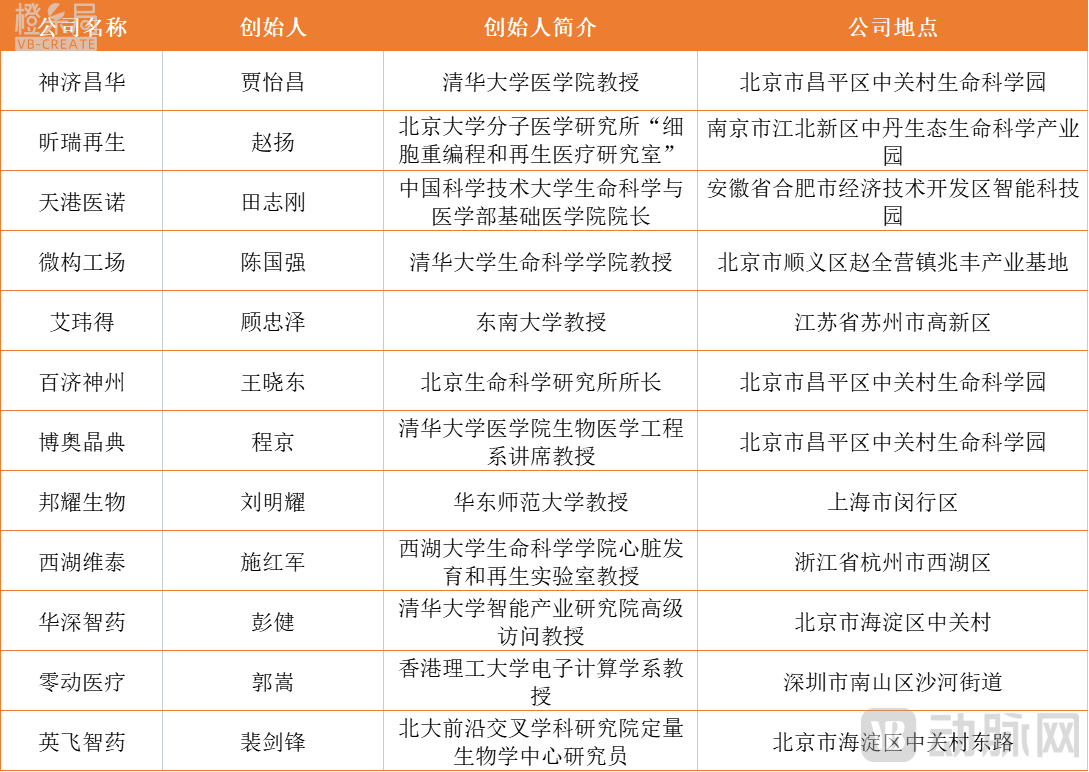
Locations of Companies Founded by Select Professors/Scientists; Data Sourced from Public Records
Proximity is a significant factor. “I can teach students in the morning and then drive to the company in the afternoon to handle some matters,” many scientist-entrepreneurs stated.
Scientists typically work and teach on campus; therefore, establishing their companies in close proximity to the campus allows them to conveniently shuttle between teaching and business operations. This arrangement enables scientists to effectively manage their dual roles.Balancing Teaching and Corporate Management to Minimize Waste of Time and Energy。
In addition to the convenience offered by proximity,Enhancing resource interaction and cooperation between enterprises and universities is also a key reason.. Scientists often serve as mentors to students and possess an in-depth understanding of their research and projects. If a scientist’s company is located in close proximity to a university, it facilitates face-to-face discussions and collaboration with students, enabling the translation of academic laboratory achievements into corporate projects. Infinitus Pharma and Peking University jointly developed “PharmGPT,” a ChatGPT-like tool for drug design. Through further investigation, Orange Bureau learned that the platform’s latest update originated directly from a student project supervised by founder Pei Jianfeng.
Not only collaborating with outstanding students on campus, but also forTalent IntroductionStartups located around universities often have more options, including PhD candidates and graduate students. These talents can bring professional knowledge and innovative thinking to the company, driving its research projects and product development.
Furthermore, from the perspective of universities themselves,Universities typically possess robust software and hardware infrastructure.First, there are hardware facilities and equipment, such as laboratory infrastructure and library resources. These resources can significantly reduce the costs of basic research for startups. Second, there are software resources; universities often host various institutions and organizations that support entrepreneurship, such as technology transfer offices and business incubators. They provide professional consulting, financial support, and entrepreneurial networks. By leveraging these resources and networks, startups can further secure patent protection and commercialization support.
Therefore, considering factors such as convenience, interactivity, talent acquisition, and resource sharing, scientists prefer to establish their companies near universities. This approach not only balances teaching responsibilities with corporate management but also fosters mutual exchange and integration between universities and enterprises.
Follow the Incubator
Of course, in our survey, approximately one-tenth of scientists sacrificed convenience to align with incubators. Xinrui Regeneration is one such example.
Benefiting from the university-local government collaborative project for the commercialization of scientific and technological achievements undertaken by the Nanjing Institute of Translational Molecular Medicine, Peking University (hereinafter referred to as the “Nanjing Translational Institute”), the institute’s incubation platform provides robust support to laboratory Principal Investigators (PIs) in leveraging their professional expertise to translate their scientific research outcomes into practical applications.
“The hardware facilities of the incubation platform were customized to meet our needs, allowing our team to move in and start operations immediately,” said Zhao Yang, founder of Xinrui Regeneration, in an interview. With streamlined processes and support from the university, Zhao encountered no difficulties in areas such as site selection for registration, equipment procurement, and office renovation.
To encourage faculty and students to enhance their capabilities in transforming scientific research achievements into innovations and startups, universities and research institutes have begun establishing relevant incubators either on campus or in external parks. These initiatives facilitate the transfer of internal projects to on-campus innovation and entrepreneurship centers, university science parks, as well as numerous off-site university technology transfer centers or translational medicine research institutes.
Meanwhile, startups that choose this method for household registration can, on the one hand,Maximize Time and Effort Efficiency, the team may skip the preliminary collection and screening process, as negotiations with the school alone may suffice to finalize the decision; on the other hand,Incubators operated by universities and research institutes generally possess robust scientific research resources and innovation capabilities., in addition to co-working spaces, it also provides professional consulting services and angel funds, enabling a certain degree of commercialization of laboratory-based technological achievements.
Facilitating the commercialization of research outcomes within the university ecosystem. Academic support, collaborative opportunities, intellectual property protection, and educational resources essential for the development of startups are maximally safeguarded.
In addition to incubators operated by universities and research institutes, there are also enterprise-operated incubators. The JLABS incubator is a prominent example.
“No strings attached”: JLABS does not require equity stakes in incubated companies, nor does it demand rights of first refusal for investment. ButIncubated companies can access shared spaces, including offices and laboratories, as well as various experimental equipment by paying a monthly fee. Specifically, laboratory bench rentals are available at a monthly rate of $3,000., and receive operational management services from the JLABS team in areas such as human resources and finance.
The advantage of startups that follow this type of incubator lies in,Higher Business Model and Market Fit. As a globally renowned medical enterprise, Johnson & Johnson has been continuously validated by the market since its establishment. Over time, this has endowed JLABS with greater market acumen compared to incubators operated by universities and research institutes, and the companies it incubates exhibit similar characteristics. However, a limitation is that, for most scientists,They are more willing to invest funds in research and development.. Therefore, few scientists are willing to pay for the privilege of establishing residency.
Return to the innovation ecosystem.
Whether establishing a company near universities or following incubators, the entrepreneurship and innovation ecosystem is an indispensable factor for entrepreneurs to consider, andUniversities, research institutes, and incubators possess precisely these characteristics.
To use a simple analogy, founders have two options when choosing a location for their headquarters: Location A, which has lower costs and may even offer free office space, and Location B, which is not free but boasts a robust innovation ecosystem.
“Many times, they are more inclined to choose to go to Place B,” an industry insider told Chengguo Bureau.
The so-called innovation ecosystem can be understood as a unique closed-loop innovation system anchored by universities and research institutions, integrating government bodies, research units, venture capital firms, and enterprises. These entities are closely linked through benefit-sharing mechanisms, ultimately formingA Collaborative and Symbiotic Innovation Ecosystem。
The government provides long-term policy support to foster an innovation-friendly atmosphere and urban space; universities supply innovation resources and cultivate talent; venture capital firms provide critical capital support for innovation; and enterprises offer opportunities and platforms for the commercialization of innovative outcomes.
As the source of innovation, universities and research institutes often attract significant attention from the government and society. On social media platforms, topics such as “VCs hunting for professors at universities” are ubiquitous, and this attention has also stimulated the innovation ecosystem within the academic and research community. Incubators follow the same logic; whether operated by universities and research institutes or by enterprises, they have already formed stable internal ecosystems.
In a virtuous cycle of an innovation ecosystem, we typically observe the following:
First,Convenient Transportation. For scientists who are either part-time or full-time entrepreneurs, no one wishes to spend excessive time commuting. Even though modern technology has transformed the way meetings are conducted, in-person discussions often prove more effective for research and development work. Moreover, convenient transportation provides significant support for companies in recruiting and selecting more suitable employees.
Second,Abundant Industry ResourcesThis encompasses services such as resource coordination across various stages, including industrial design of project products, process research and development, product regulatory approval, pilot-scale manufacturing, market packaging, and sales channel development, as well as upstream and downstream resources required for industry chain development and related third-party services. Scientist entrepreneurs can select CROs, CDMOs, raw material manufacturers, and other partners based on their specific business development needs. Taking biopharmaceuticals as an example, the new drug development process involves numerous steps, including drug target screening and validation, hit compound screening and confirmation, lead compound discovery, animal studies, and clinical trials, making it a complex and lengthy endeavor for startups. CRO services primarily cover all aspects of new drug development and testing; depending on the stages covered, they are categorized into preclinical CROs and clinical CROs, helping startups improve efficiency.
Third, ample capital reserves. For startups, fundraising is crucial, and financial support is a key factor to consider in entrepreneurship. Within the innovation ecosystem, highly concentrated scientific research resources and professional investors enable venture capital to extend into the incubation stage. Numerous high-quality commercialization projects from universities and research institutes attract specialized and capable venture capital firms, allowing startups to seek financing opportunities within this environment. Furthermore, this serves as a powerful tool for government industrial policy guidance; as a significant limited partner (LP), the government provides financial support to startups engaged in the commercialization of scientific and technological achievements.
Fourth,Aggregation of Top Talent. Universities, research institutes, and enterprises are the key elements that keep the ecosystem fluid. In the innovation ecosystem, universities are not merely a potential talent pool for enterprises; they serve as sources of innovation that influence the life sciences industry by cultivating and exporting global talent in biotechnology through education. Meanwhile, enterprises continuously absorb talent from universities and research institutes across functions ranging from product development and market operations to public relations, thereby acting as a conduit for both scientific researchers and commercialization professionals.
Not necessarily a difficult choice, but never to be taken lightly
In an interview, Xiao Weihua, co-founder of Tiangang Medino, recalled that Academician Tian Zhigang had casually mentioned during a conversation with Director Qin of the Hefei Economic and Technological Development Zone Administrative Committee that his team was seeking a location to establish their base. Upon hearing this, Director Qin immediately extended an invitation to Academician Tian and pledged to make every effort to provide the necessary conditions for Tiangang Medino’s establishment in the zone.
Thus, with remarkable speed, Tiangang Yinuo officially settled in the Intelligent Science and Technology Park of Hefei Economic and Technological Development Zone in the spring of 2020. During the same period, it established a specialized R&D base spanning nearly 8,000 square meters, which includes an SPF-grade animal laboratory, a GMP-compliant recombinant protein preparation laboratory, a BSL-2 biosafety laboratory, and an NK cell detection and analysis platform. Meanwhile, the Hefei Economic and Technological Development Zone provided Tiangang Yinuo with settlement funding to facilitate the commercialization of its technological achievements.
Not just Tiangang Yinuo, but for enterprises engaged in the commercialization of scientific research achievements,Founders with the “halo” of scientists and professors often come with abundant academic and social resources., which gives them more initiative in choosing where to establish their businesses. It may not necessarily be a difficult decision, but it should not be underestimated. Generally speaking, premises are an essential element for startups.Being in a robust innovation ecosystem, investing in startups at the seed and angel stages, or adding leverage for future business development.