

Shanghai Yingdong Medical Secures NMPA Approvals for AI-Powered Imaging Reconstruction Portfolio Ahead of IPO
Healthcare is one of the earliest fields where AI has been implemented. Among the various application scenarios in healthcare, medical imaging has seen the most widespread adoption. Since 2015, China has introduced a series of supportive policies to vigorously promote the development of domestically produced medical imaging equipment. In recent years, driven by policies that leverage AI to enhance medical imaging, this sector has experienced rapid growth, with device approvals reaching record highs. According to data from the National Medical Products Administration (NMPA), as of July 5, 2023, the NMPA had approved a total of 70 Class III medical device registrations, covering 13 types of auxiliary diagnostic products, including those for coronary arteries and pulmonary nodules.
Distinct from downstream AI-assisted diagnosis, image reconstruction and enhancement—an upstream stage in the clinical workflow—is also gradually evolving, driven by the latest AI technologies. Related technological products can significantly shorten scan times while ensuring image quality, thereby improving diagnostic accuracy for physicians and providing patients with faster and safer diagnostic and therapeutic services.
Recently, Rodio Dynomio (hereinafter referred to as “Rodio Dynomio”) has achieved breakthrough progress in the field of AI medical imaging.Company’s Two Self-Developed Reconstruction Enhancement Products, RaDynCT and RaDynSPECT, Obtain NMPA Class II Registration CertificatesWith the addition of two reconstruction and enhancement products, RaDynMR and RaDynPET, which received regulatory approval in 2022, Rodio Dynomio has officially become the manufacturer with the largest number of approved registration certificates and the broadest coverage of sub-sectors in this field. Currently, the majority of the 70 products with NMPA registration certificates are concentrated in the auxiliary diagnosis sector. In contrast, Rodio Dynomio’s R&D focuses on image reconstruction and enhancement. Its related technologies can accelerate MRI scans and reduce radiation doses in CT and nuclear medicine imaging examinations.
In the fiercely competitive field of AI in medicine, why were all four products from Rodio Dynomio approved within three years? What are the advantages of these products, and how has the company achieved differentiated development? VCBeat conducted an exclusive interview with Dr. Gong Nanjie, founder of Rodio Dynomio, to provide insights into these questions.
Under traditional medical imaging technologies, patients often face long waiting times, and the equipment typically involves high radiation doses, posing significant threats to patient health and safety. Furthermore, older-generation devices produce images of inferior quality, which hinders physicians’ ability to make accurate diagnoses. Clearly, there are substantial clinical pain points and strong market demand in the field of image reconstruction and enhancement.
Furthermore, overseas medical imaging manufacturers typically do not license their newly developed technologies to third-party enterprises; instead, these technologies are exclusively integrated into their own branded equipment. Moreover, such innovations are generally limited to new device models, thereby imposing certain constraints on their application scenarios. Meanwhile, some overseas AI-driven medical imaging big data companies face significant risks of data leakage, a concern Dr. Gong Nanjie has deeply experienced through his previous entrepreneurial ventures.
If asked to evaluate Rodio Dynomio in a single sentence, Dr. Gong Nanjie stated: “Rodio Dynomio is an AI medical imaging company with Chinese R&D, Chinese data, and a Chinese team.。”
In the field of medical imaging, China started relatively late. Due to high technological R&D barriers and long development cycles, the market has long been dominated by imports. It is only in recent years that some domestic enterprises have gradually mastered core technologies. In basic clinical applications, domestically produced imaging equipment is achieving import substitution; however, there remains a certain gap between Chinese companies and their international counterparts in high-end equipment and software.
As a Chinese enterprise, Rodio Dynomio has consistently upheld the philosophy of “Intelligent Manufacturing in China” across its technical team, data resources, software, and algorithms. The company strictly adheres to national AI regulatory and data security protection requirements, ensuring absolute data security.
In addition, the company’s products feature strong compatibility and comprehensive model coverage. They are compatible with all mainstream imaging equipment from GE, Siemens, Philips, and United Imaging, as well as hospital PACS systems. These solutions can seamlessly integrate into existing radiology department workflows and be deployed on any model of existing equipment, effectively helping hospitals and health examination centers extend the service life of legacy devices or achieve cost-effective upgrades for lower-end systems.
Currently, Rodio Dynomio is primarily focused on the track of medical image reconstruction and enhancement, with its RaDynPET, RaDynMR, RaDynSPECT, and RaDynCT product lines developing most rapidly and reaching maturity.
On positron emission tomography (PET),RaDynPET: A Rapid, Low-Dose PET Image Enhancement Platform. RaDynPET improves image quality while increasing imaging speed by 4-fold and reducing radiation dose by up to 75%, thereby enhancing the patient experience.
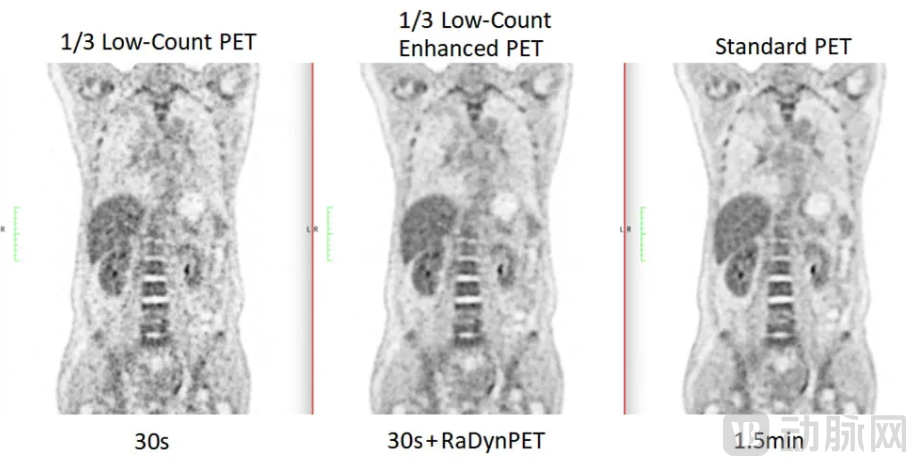
RaDynPET Efficacy
On magnetic resonance imaging (MRI), RaDynMR is an AI-powered, deep learning-based image enhancement system that improves MRI image quality and enhances the patient experience.RaDynMR leverages AI to perform real-time reconstruction of MRI images, enabling 2–4x, or even up to 10x, faster scanning and reducing examination costs. It employs deep learning algorithms to optimize machine-generated MRI images, thereby reducing artifacts, suppressing noise, and enhancing resolution.。
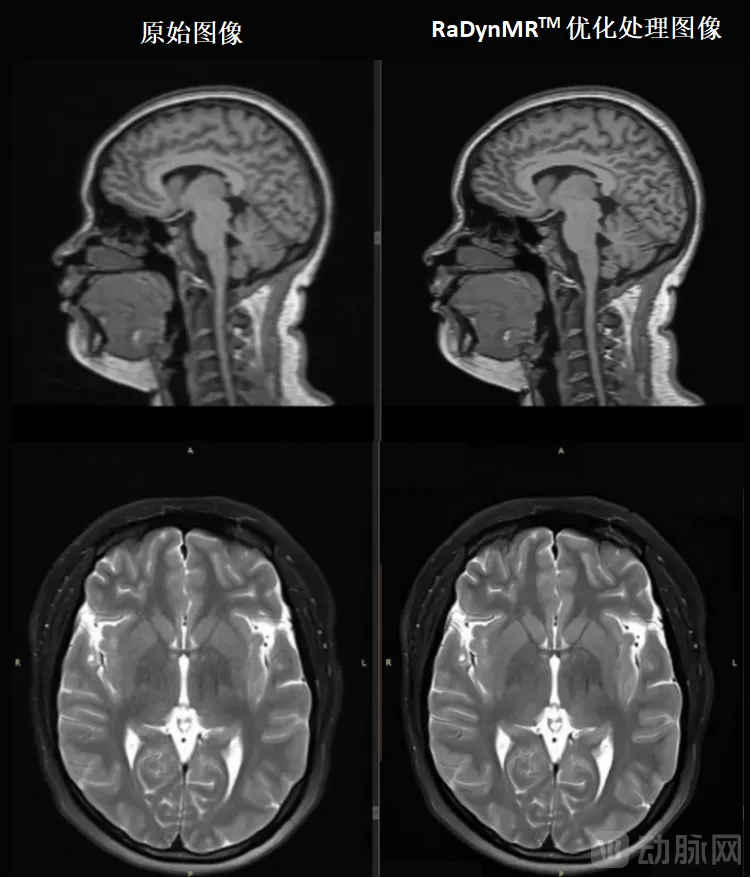
Efficacy of RaDynMR
On single-photon emission computed tomography (SPECT), RaDynSPECT is a deep learning-based software for accelerating and enhancing SPECT imaging.RaDynSPECT supports the fusion of SPECT and CT images, accelerating SPECT scan speeds by up to 7 times. It enables simultaneous structural and functional imaging, allowing for precise localization of lesions in terms of location, nature, and severity. The system delivers diagnostic-quality imaging while reducing contrast agent usage by up to 86%.。
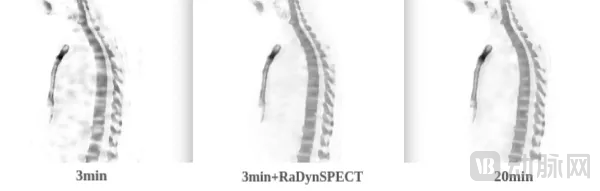
Mechanism of Action of RaDynSPECT
On computed tomography (CT),RaDynCT can increase image resolution by up to 4 times, facilitating better observation of small lesions by physicians. On the other hand, RaDynCT can reduce radiation dose by approximately 70%, significantly decreasing the radiation hazards of X-rays. Meanwhile, it effectively reduces X-ray tube wear and tear, lowers the frequency of tube replacements for medical institutions, further saving medical costs, and even extends the lifespan of low-configuration equipment that has experienced significant performance degradation after prolonged use.。

Efficacy of RaDynCT
Notably, the current products launched into production have improved imaging speed and image quality, which can greatly enhance physicians' examination efficiency, reduce patient waiting times, thereby improving patient experience, as well as increasing patient throughput and boosting hospital efficiency and profitability.
Rodio Dynomio has a relatively short history, yet its professional team enabled the company to independently develop and register four reconstruction-enhancement products within just three years.
Dr. Gong Nanjie, the company’s founder, boasts extensive experience in both scientific research and business. After earning his bachelor’s degree from Tsinghua University, he pursued advanced studies in medical imaging at the University of Hong Kong, Stanford University, Duke University, and the University of California, Berkeley. Upon returning to China, he joined United Imaging Healthcare, where he served as Head of Global Scientific Collaborations. He also held the position of Executive Team Leader for the New Neuroimaging Technology Platform at the Shanghai Center for Brain Science and Brain-Inspired Intelligence, and served as Project Director for the “Molecular and Functional Atlas of the Chinese Human Brain,” a major special project in Zhangjiang. It is reported that during his tenure at United Imaging Healthcare, Dr. Gong spearheaded the development of the company’s earliest AI-based image reconstruction and enhancement technology, which can be integrated into United Imaging’s PET and MR systems. This innovation resulted in related patents that were granted domestic and international authorization five years ago.

Gong Nanjie, Founder of Rodio Dynomio
Armed with extensive theoretical knowledge and clinical experience accumulated during his academic training, as well as additional academic and industry resources and medical enterprise marketing expertise gained through his professional career, Dr. Gong Nanjie successfully founded Rodio Dynomio in 2020 under the incubation of Tsinghua Strait Research Institute, focusing on developing AI-powered medical imaging solutions that reduce costs and enhance efficiency.Dr. Gong Nanjie currently serves as the Director of the Intelligent Medical Imaging Laboratory at the Tsinghua Strait Research Institute, and maintains close collaborations with R&D teams at Tsinghua University’s main campus and renowned overseas universities.
The team at Rodio Dynomio is a typical R&D-focused group, primarily dedicated to the development of algorithms and software. Most team members hail from prestigious domestic and international institutions such as Tsinghua University, Peking University, Stanford University, and the University of California, Berkeley. The team is predominantly young, driven by the fearlessness and vigor characteristic of newcomers. Within three years, they have developed four products that have been deployed in major hospitals and health examination centers for clinical use and business collaboration. The company has secured over 20 domestic patents (with additional applications pending), multiple PCT international patents, and numerous software copyright registrations. During its development, Rodio Dynomio has attracted attention from local government authorities and received funding under several entrepreneurial talent support programs.
Meanwhile, the company’s team has established cutting-edge collaborations with dozens of top-tier hospitals and third-party imaging centers worldwide, successfully achieving commercial implementation. Relevant international academic papers have been published in journals such as *Medical Physics* and *Physics in Medicine & Biology*. Domestic partners include Peking Union Medical College Hospital, Peking University Third Hospital, Shanghai Changzheng Hospital, Shanghai Changhai Hospital, and Shanghai East Hospital. In addition, the company has engaged in technical collaborations with enterprises such as Yiyi Medical, Kaiying Medical, and Regato Medical, aiming to leverage domestic capabilities to drive high-quality development in China’s medical imaging sector.
When discussing the company’s future plans, Dr. Gong Nanjie divided Rodio Dynomio’s development strategy into three phases,Covering all imaging products, expanding from technical departments to clinical departments, and venturing into application areas beyond healthcare。
AI medical imaging can be categorized into MRI, CT, ultrasound, X-ray, and DSA (Digital Subtraction Angiography). Currently, Rodio Dynomio boasts the most comprehensive product line for reconstruction and enhancement spanning PET, MR, SPECT, and CT, covering approximately 70%–80% of mainstream medical imaging technologies. The company is actively developing other imaging technologies such as ultrasound and DSA, with the aim of achieving full-spectrum coverage of its imaging product portfolio in the near term.
In the medium to long term, Rodio Dynomio will continue to expand its capabilities in quantitative analysis and computer-aided diagnosis. Furthermore, the company is not limited to algorithm research; it aims to integrate software with hardware, extending its products from radiology and other medical technology departments to other clinical specialties. Meanwhile, Rodio Dynomio will diversify its business models by catering to both B2B and B2C markets, thereby establishing a new revenue model.
In the long run, Dr. Gong Nanjie hopes that Rodio Dynomio can extend its reach beyond hospitals and leverage AI medical imaging technology to make a greater contribution to the health and well-being of the general public.
Rodio Dynomio has completed its seed and angel financing rounds and is launching a new fundraising initiative to expand its core R&D and sales teams. The company is also building a nationwide sales network in China, aiming to reach prospective users at all levels across the country more quickly and comprehensively, thereby expanding its product footprint.