

Milestone in TCM Digitalization: Qihuang WenDao Large Model Officially Launched by Dajing TCM
2023July 28, YearIn the afternoon, “Qihuang Wendao,” developed by DAJING TCM, a leading enterprise in China’s digital and intelligent traditional Chinese medicine industry·The “Large Model” was officially launched at the Nanjing Jiangbei New Area Industrial Technology Research and Innovation Park. FromApproximately 100 guests from the medical, technology, and investment sectors, as well as the traditional Chinese medicine and big health industries, and the news media—including Xinhua News Agency and People’s Daily—attended the press conference.
The press conference commenced with the screening of DAJING TCM’s corporate promotional video, “The Path.” The video highlighted the company’s arduous journey and relentless pursuit over the past seven years in the field of digital and intelligent transformation of Traditional Chinese Medicine (TCM), as well as its series of achievements in innovating TCM heritage models, talent development frameworks, and diagnosis and treatment paradigms.
Jiang Huarong, Secretary of the Party Working Committee and Director of the Administrative Committee Office of the Nanjing Jiangbei New Area Industrial Technology Research and Innovation Park, and Shang Zhenbai, Deputy Director of the Nanjing Jiangbei New Area Science and Technology Innovation and Big Data Administration Bureau, delivered welcome addresses respectively. They introduced the measures taken by Jiangbei New Area to encourage and support the development of artificial intelligence technology and gave full affirmation to the innovative practices of DAJING TCM.
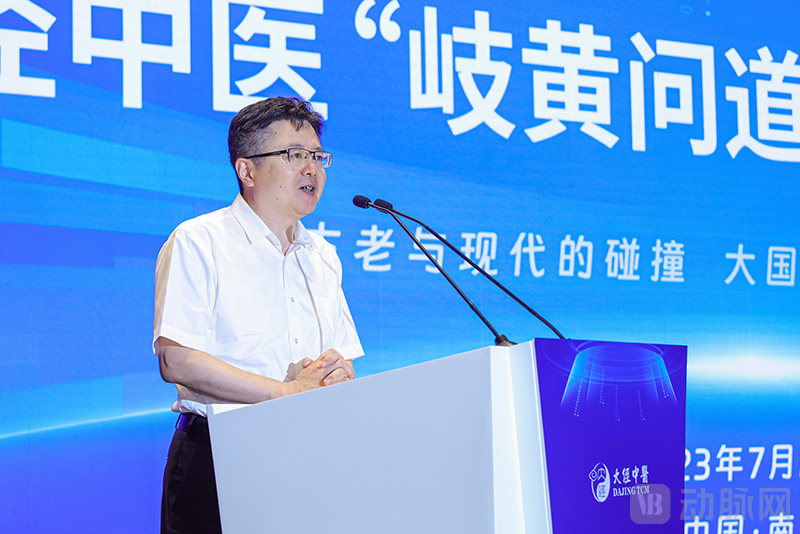
Jiang Huarong, Secretary of the Party Working Committee and Director of the Administrative Committee of the Industrial Technology Research and Innovation Park in Nanjing Jiangbei New Area
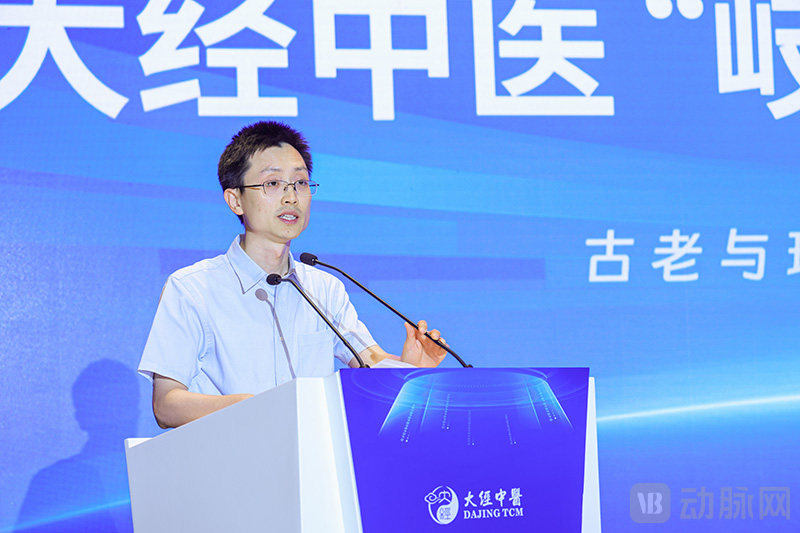 Shang Zhenbai, Deputy Director of the Nanjing Jiangbei New Area Science and Technology Innovation and Big Data Administration
As the official launch of the large language model commenced, Li Wenyou, Founder and Chairman of DAJING TCM, delivered a keynote speech titled “Why Large Language Models? Why Traditional Chinese Medicine? Why DAJING TCM?” In his address, he outlined the background and objectives behind the development of the “Qihuang Wenda Large Language Model” and shared his insights on large language models for Traditional Chinese Medicine. The main points of his speech are as follows:
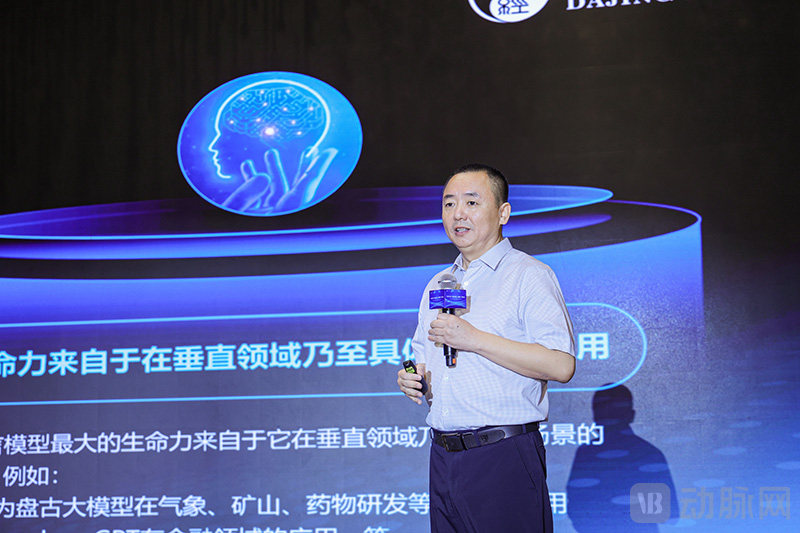
Li Wenyou, Founder and Chairman of DAJING TCM
1. Large language models have transformed human-computer interaction, shifting from user interfaces (UI), operating systems (OS), and electronic medical records (EMR) to natural language. This shift in interaction paradigms will usher in a revolution in “traffic entry points” and “knowledge acquisition pathways.”
2. The greatest vitality of large language models stems from their applications in vertical domains and even specific scenarios, such as:
1) Applications of Huawei’s Pangu large model in meteorology, mining, and drug R&D.
2) Applications of BloombergGPT in the financial sector, etc.
3. The application of large language models in vertical domains and even specific scenarios depends on:
1) Acquisition of high-quality industry data;
2) Adjustments to and feedback on pre-trained models by high-level experts in the industry;
3) In-depth business development in specific scenarios and a thorough understanding of the business within those scenarios (to achieve effective integration of large language models with industry applications).
As early as seven years ago, DAJING TCM proposed that “digital intelligence is the inevitable path for the development of Traditional Chinese Medicine (TCM).” Practice since the establishment of DAJING TCM has proven this judgment to be highly accurate.
1. Clinical diagnosis and treatment data in Traditional Chinese Medicine (TCM), as well as TCM literature data, are predominantly in textual form. Large language models, which excel in natural language recognition and processing, hold significant importance for the inheritance and development of TCM.
2. Clinical diagnosis and treatment in Traditional Chinese Medicine (TCM) possesses both a comprehensive theoretical framework and strong empirical characteristics. These experiences are deeply embedded within the vast corpus of TCM literature and classics, as well as in the extensive medical case records, discourses, and treatises left by generations of physicians. Hence, the adage “study the classics and learn from renowned masters” has long guided TCM education. However, comprehending, memorizing, and applying these experiential insights constitute a formidable challenge. The emergence of large language models specifically designed for TCM will significantly transform the paradigms of TCM learning and talent development.
3. Traditional Chinese Medicine (TCM) is not merely a medical discipline but also an integral part of the Chinese lifestyle. Consequently, TCM practices extend beyond hospitals into households and various health-related spaces. In non-hospital settings, natural language interaction aligns more closely with the communication habits of the general public. Therefore, TCM-specific large language models will facilitate the deployment of AI-driven TCM solutions across a broader range of scenarios.
A. Data Advantages
1. DAJING TCM has established a standardized dictionary of Traditional Chinese Medicine (TCM) symptoms and signs, containing over 25,000 entries. As the only large-scale, comprehensive terminology standardization dictionary in the industry covering all disease categories, it significantly reduces the impact of wording discrepancies on the model's responses.
2. Traditional Chinese Medicine (TCM) knowledge is highly personalized and extensive. Meanwhile, TCM has long adhered to the tradition of “not transmitting the Dao to the unworthy, nor teaching methods to third parties,” making high-quality data highly private, while publicly available data is generally of low quality. DAJING TCM has constructed a TCM diagnosis and treatment knowledge graph based on the clinical experiences of numerous renowned veteran TCM practitioners and diagnostic knowledge from TCM literature. Covering all disciplines including internal medicine, surgery, gynecology, and pediatrics, as well as all schools such as Jingfang, Shifang, Menghe, and Lingnan, it represents the highest-quality industry data in the vertical field of TCM.
3. DAJING TCM serves over 400 tiered hospitals and more than 8,000 primary healthcare institutions, whose data provides robust support for DAJING TCM’s AI training in traditional Chinese medicine.
B. Talent Advantage
1. DAJING TCM boasts the largest cross-disciplinary R&D team in Traditional Chinese Medicine (TCM) and AI across the industry, as well as the largest consortium of renowned veteran TCM practitioners collaborating on TCM-AI research through formal agreements. This enables the company to conduct high-quality work such as Reinforcement Learning from Human Feedback (RLHF).
2. DAJING TCM has partnered with top-tier domestic experts, including the large language model R&D team from the Department of Computer Science and Engineering at Shanghai Jiao Tong University. By leveraging their respective technological strengths to achieve a synergistic effect where 1+1>2, they have established a powerful R&D team dedicated to developing large models for Traditional Chinese Medicine.
C. Application Advantages
The application by a large number of customers across multiple scenarios helps to:
1. Train a large language model specialized in Traditional Chinese Medicine (TCM) with advanced capabilities in understanding industry scenarios and business operations;
2. Continuously iterate on this large language model specialized in the field of Traditional Chinese Medicine.
DAJING TCM’s extensive AI application scenarios in traditional Chinese medicine (TCM), which boast a large user base, facilitate the training and continuous iteration of large language models. These scenarios include:
1) Applications in tiered medical institutions such as Longhua Hospital Affiliated to Shanghai University of Traditional Chinese Medicine and Guangdong Provincial Hospital of Chinese Medicine;
2)Similar to the application of regional TCM medical consortia in Jiangning District, Nanjing City, and Gaoqing County, Zibo City;
3) Similar to its application in grassroots village clinics in regions such as Shandong and Jilin;
4) Applications in large health institutions similar to the “Senior Service Center” in Changning District, Shanghai;
5) Similar to the application for C-end users on the “Xuexi Qiangguo” app.
1. From Clinical Diagnosis and Treatment Data of Renowned Senior TCM Practitioners and TCM Literature Data to a TCM Diagnosis and Treatment Knowledge Graph: Using knowledge graphs to represent and store the diagnostic and therapeutic experiences of renowned senior TCM practitioners and the diagnostic and therapeutic knowledge derived from literature.
2. From TCM Diagnostic and Therapeutic Knowledge Graphs to Domain-Specific Pre-trained Models: Leveraging tens of millions of data points from TCM knowledge graphs and clinical diagnostic and treatment records to fine-tune general-purpose pre-trained models, thereby enhancing their understanding of TCM reasoning and knowledge.
3. From Pre-trained Models in Traditional Chinese Medicine to the Qihuang Wendao Large Model: Built upon pre-trained models in the field of Traditional Chinese Medicine, with participation from TCM experts, and leveraging a reward model–reinforcement learning mechanism, the “Qihuang Wendao Large Model” was ultimately developed.
Leveraging the advantages of large language models and adapting to DAJING TCM’s diverse application scenarios, the DAJING TCM “Qihuang Wendao Large Model” comprises sub-models in three directions (the first model will officially open internal testing applications to medical institutions after the launch event):
1. Clinical Diagnosis and Treatment Large Model Based on Confirmed Diseases:Based on the disease, symptoms, and signs provided by the user, provide a pattern differentiation (diagnosis) result and a treatment plan (traditional Chinese medicine prescription).
2. Clinical Diagnostic and Therapeutic Large Language Model Based Solely on Symptoms and Signs:Based on the patient's chief complaints, associated symptoms, and physical signs, provide a TCM pattern differentiation (diagnosis) and treatment plan (herbal prescription).
3. Large Model for Traditional Chinese Medicine Health Preservation and Conditioning:Based on the symptoms and signs provided by the user, deliver a personalized TCM health status assessment, along with multi-dimensional wellness recommendations including dietary therapy, herbal teas, tuina massage, and moxibustion.
Additionally, it can be disclosed that large language models for ancient Traditional Chinese Medicine (TCM) texts, based on diverse technical approaches, are also under active training. These models will be capable of reading and comprehending ancient texts, extracting “useful” knowledge, aligning with clinical needs, and constructing a knowledge chain encompassing “disease–symptom–pathogenesis–treatment principle–prescription–herb.”
1. Over the past seven years, DAJING TCM’s flagship product, the Intelligent Clinical Decision Support System (CDSS) for Traditional Chinese Medicine, has established an application ecosystem across healthcare institutions at all levels, ranging from benchmark tertiary Grade-A TCM hospitals to community health service centers and township health centers, and further extending to clinics, outpatient departments, and village health rooms.
2. Since the beginning of this year, the Dajing Digital Intelligence TCM Integrated Diagnosis and Treatment System, which integrates the TCM Clinical Intelligent Auxiliary Diagnosis and Treatment System (“TCM Brain”), the TCM Intelligent Pulse Diagnostic Instrument (“TCM Finger”), and the TCM Intelligent Tongue and Facial Diagnostic Instrument (“TCM Eye”), has expanded beyond the “serious healthcare” ecosystem into the “TCM general health and wellness” ecosystem.
3. With the release of DAJING TCM’s “Qihuang Wendao · Large Model,” the “TCM Big Health” ecosystem will be further expanded and strengthened. We welcome partners from relevant fields to seize this urgent opportunity and join this promising ecosystem, working together with us to pioneer a bright future for AI in Traditional Chinese Medicine—
1) We embrace all medical institutions and internet-based healthcare providers that offer Traditional Chinese Medicine (TCM) diagnosis and treatment services, as well as preventive care services for disease prevention;
2) We welcome all elderly care institutions and wellness centers that provide Traditional Chinese Medicine (TCM)-based chronic disease management and TCM health preservation services;
3) We welcome all enterprises offering Traditional Chinese Medicine (TCM) wellness and healthcare services, including health stations, community health centers, wellness centers, and beauty salons;
4) We embrace all traditional Chinese medicine (TCM) colleges and universities;
5) We embrace all TCM cultural centers and museums;
6) We embrace all families and individuals who integrate Traditional Chinese Medicine into their daily lives!
During the “Qihuang Wendao · Large Model” demonstration session, demonstrations were conducted in two formats and three scenarios:
1. On-site Testing: Young physicians input simulated "disease-symptom-sign" data of real patients on-site, and the large language model outputs TCM syndrome differentiation results, treatment principles and methods, and herbal prescriptions;
2. Screen Recording Demonstration: Without a clear diagnosis of a specific disease, only inputting symptom and sign information, the large model outputs TCM syndrome differentiation results, treatment principles and methods, and Chinese herbal formulas;
3. Screen Recording Demonstration: Input symptoms and signs, and the large language model outputs TCM health status identification results along with a series of wellness and conditioning plans, including Chinese herbal medicine, meridian acupoints, dietary therapy, and herbal teas.
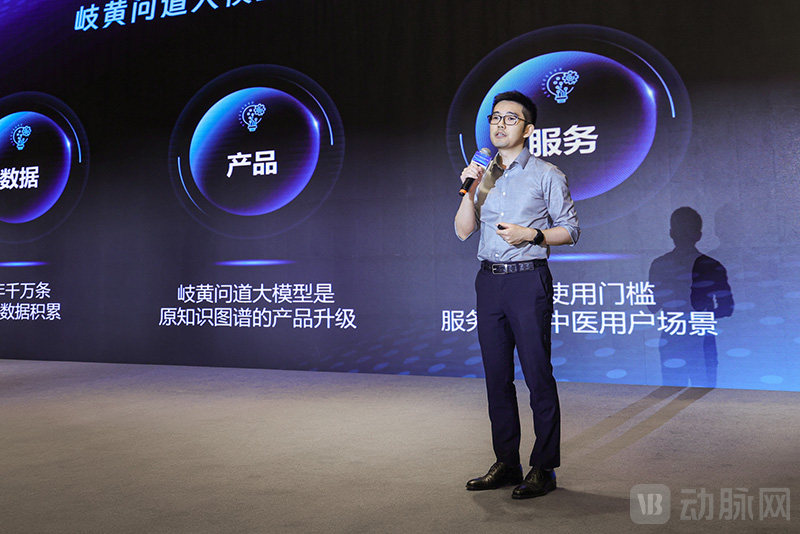
Wang Qi, Technical Director of the “Qihuang Wendao · Large Model” at DAJING TCM
Subsequently, Wang Qi, Technical Director of DAJING TCM’s “Qihuang Wendao Large Model,” delivered a presentation titled “Qihuang Wendao Large Model: From Data to Products and Services,” detailing the model’s “past and present.” The main points are as follows:
Over the past six months, the AI sector has witnessed a “hundred-models war,” with large language models emerging in rapid succession. What differentiated and unique value does DAJING TCM’s “Qihuang Wendao Large Model” offer? We have distilled three core points:
1. Data: The foundation of large language models is data; without the day-to-day accumulation of high-quality data by Dajing TCM over the past seven years, the “Qihuang Wendao Large Language Model” would not exist;
2. Product: The original product system based on knowledge graphs serves as the foundation for the “Qihuang Wendao Large Language Model”; this initiative represents a product upgrade;
3. Service: “Qihuang Wendao · Large Model” lowers the barrier to entry for AI products in the traditional Chinese medicine (TCM) industry, enabling a wider range of clients to utilize TCM AI solutions across diverse scenarios.
Data: Seven years of accumulating tens of millions of TCM data records have forged the “Qihuang Wendao Large Language Model”:
1. First, we divide the capabilities of large language models into three stages:
Phase I Capabilities:Currently, the large language models (LLMs) available on the market are predominantly general-purpose models, such as ChatGPT, Baidu’s Wenxin Yiyan, and Alibaba’s Tongyi Qianwen. While these models offer comprehensive multimodal capabilities—including text, image, and audio generation—and cover a broad range of functions, they perform poorly in addressing highly specialized industry-specific questions. Their responses often contain substantial amounts of fabricated information, leading to the characterization of “confidently speaking nonsense.” Consequently, general-purpose LLMs are virtually incapable of achieving practical implementation in the specialized field of Traditional Chinese Medicine (TCM).
Phase II Capabilities:By training on extensive high-quality data in the field of Traditional Chinese Medicine (TCM), and through substantial adjustment and feedback efforts involving TCM experts, the large language model has enhanced its understanding of TCM knowledge and TCM-based thinking.
Phase III Capabilities:When “foundational capabilities” are combined with “industry-specific capabilities,” large language models acquire AI competencies such as distillation, classification, imitation, inference, and recognition within the specialized domain of Traditional Chinese Medicine (TCM). By integrating these capabilities with diverse TCM business scenarios, they become practical and deployable TCM-specific large language models.
Returning to Phase II, in the field of TCM data, DAJING TCM has accumulated extensive proprietary data unique to the TCM industry over the past seven years. For the training of the “Qihuang Wendao Large Model,” our current dataset includes:
● 11 million entries of Traditional Chinese Medicine (TCM) knowledge graph data;
● Data from 1,500 ancient Chinese medicine texts and literature;
● 100,000 real-world medical case records from TCM experts;
● 100,000 data entries on pulse conditions, tongue manifestations, meridians, and acupoints;
● 2 million real-world clinical diagnosis and treatment records in Traditional Chinese Medicine.
With a scale of tens of millions of data points, this dataset may seem modest compared to the hundreds of millions of entries commonly used by contemporary large language models. However, professionals experienced in AI training understand that one high-quality, curated data record holds far greater value than 100 records of unstructured, general-purpose internet content. The tens of millions of data points currently employed by DAJING TCM for AI training are all high-quality and meticulously curated. Over the past few years, DAJING TCM has invested tens of millions of yuan to acquire and prepare these data assets.
After training on large-scale traditional Chinese medicine (TCM) data, the “Qihuang Wendao Large Language Model” has acquired AI reasoning capabilities specific to the TCM industry. These capabilities are applied in two core scenarios:
● Serious medical scenarios, primarily targeting TCM-assisted diagnosis and treatment;
● The big health and wellness scenario primarily targets Traditional Chinese Medicine (TCM) health and wellness services.
Product: “Qihuang Wendao · Large Model” is an upgrade of the original knowledge graph product:
1. Over the past seven years, DAJING TCM has established a comprehensive Traditional Chinese Medicine (TCM) knowledge graph system and integrated it into its TCM Clinical Decision Support System (CDSS). Based on the disease, symptom, and sign information input by physicians, the system can accurately infer TCM syndrome patterns, treatment principles, and herbal prescriptions. Currently, we have transformed this knowledge graph system into 11 million natural language data entries in TCM, which serve as the “nourishment” for training the “Qihuang Wendao Large Language Model.” This dataset constitutes the foundational substrate that enables the “Qihuang Wendao Large Language Model” to take root and flourish.
2. Leveraging knowledge graph-based applications, DAJING TCM has established a complete end-to-end business workflow. The integration of natural language processing capabilities in the “Qihuang Wendao Large Language Model” further enhances the efficiency and convenience of this workflow.
For example:
1) During the consultation phase, physicians previously relied on standardized selection of symptoms and signs to input patient information. Now, powered by large language models (LLMs), patient information can be directly entered through natural language descriptions. This approach allows LLMs to capture all communication details that were previously lost during consultations.
2) In the AI-based syndrome differentiation phase, the “intelligence” of large language models is no longer confined to knowledge graphs but has expanded to encompass knowledge embedded in broader and more voluminous datasets, such as medical case records and clinical diagnosis and treatment data. This advancement has significantly extended both the depth and breadth of AI-driven syndrome differentiation and treatment.
3. As for how to train the “Qihuang Wendao Large Language Model,” this topic has become easier to understand given that the underlying training methodologies for large language models are already publicly available. We adopt a four-stage progressive training approach: pre-training → supervised fine-tuning → reward modeling → reinforcement learning. Currently, the first two stages have been completed, with our primary focus now on the third and fourth stages—reward modeling and reinforcement learning. Through continuous iteration and expert evaluation, we aim to enhance the accuracy of AI-generated responses.
4. This is a screenshot of the reward model and reinforcement learning system currently in use on our backend. It is evident that substantial work remains to be completed through collaboration between experts in Traditional Chinese Medicine (TCM) and AI. Please pay attention to the IDs evaluated by TCM experts; the counter has currently reached 17,046.05 million, representing an extremely large data scale. Our TCM experts have been working exceedingly hard.
Service: Lowering the barrier to entry to serve more TCM user scenarios:
1. We have just analyzed the workflow of the “Qihuang Wendao Large Language Model” from a product perspective. As a result of these process changes, DAJING TCM will now possess broader service capabilities.
We conducted a cross-sectional comparison of key parameters. Previously, clinical workflows with high professional requirements were difficult to popularize among junior physicians. With the introduction of the “Qihuang Wendao Large Language Model,” junior physicians can now leverage AI to handle clinical workflows requiring moderate levels of expertise, while also reducing overall time consumption.
Meanwhile, the application of large language models has reduced information loss during consultations. All data from “doctor-patient communication” is retained, and the more generalized datasets accumulated throughout the diagnostic and treatment process will increase by a factor of ten to one hundred.
Regarding the accuracy of large language models (LLMs) in answering questions, although there is still a gap compared to the exceptionally high accuracy of traditional Clinical Decision Support Systems (CDSS), the accuracy of LLMs has increased from 30% to 60% over the past few months. This represents significant and notable progress. With continued training on datasets accumulated by LLMs, coupled with ongoing expert evaluation and feedback, their accuracy is expected to improve further.
2. Current TCM CDSS systems are primarily applied to users in TCM medical institutions.
We have long hoped to promote the flourishing of Traditional Chinese Medicine (TCM), extend its application to broader scenarios, and popularize TCM knowledge on a larger scale. However, due to technical complexity, it has been difficult for non-professionals to effectively utilize TCM Clinical Decision Support Systems (CDSS) for assisted diagnosis and treatment. The “Qihuang Wendao” large language model, which features natural language interaction, has resolved this issue. As previously mentioned, it lowers the barrier to entry, allowing us to deploy it across a wider range of TCM user scenarios. With the expansion of these applications, our “Qihuang Wendao” large language model will continue to become increasingly intelligent.
At the conclusion of the press conference, congratulatory videos were screened featuring TCM practitioners, TCM university students, TCM enthusiasts, volunteers from elderly care institutions, and professionals in the TCM health and wellness sector from across China, demonstrating the widespread anticipation from all sectors of society for the launch of the “Qihuang Wendao Large Model.”