

Huixin Medical Valley Submits IPO Prospectus Following Global First-in-Class Autologous iNSC-DAP Stem Cell Therapy for Parkinson’s Disease

Wiseheart Medval
Developer of Cell Therapy for Nervous System Diseases
Recently, Wiseheart Medval, an innovative biopharmaceutical company focused on cell therapy for neurological disorders, announced that its first pipeline product—an autologous iNSC-DAP (dopaminergic precursor cells derived from induced neural stem cells) formulation—has completed autologous stem cell transplantation for the treatment of Parkinson’s disease at Xuanwu Hospital of Capital Medical University.*。
*This clinical trial is an Investigator-Initiated Trial (IIT).
This trial represents the world’s first clinical study using induced neural stem cells (iNSCs) as seed cells for the treatment of Parkinson’s disease, marking China’s entry into the global forefront of exploring stem cell therapies for neurological disorders. This clinical trial constitutes a major milestone in the history of research and development and clinical treatment for both stem cell therapy for Parkinson’s disease and the broader management of neurological diseases.
In the innovative research on this therapy,Wiseheart Medval’s scientists are the first team in China to initiate validation work using primate animal models., and efficacy data have currently been obtained. Notably,This clinical trial received strong support from the Cell Therapy Center of Xuanwu Hospital and its associated clinical resources.. As the National Center for Neurological Disorders, the China International Neuroscience Institute, and the National Clinical Research Center for Geriatric Diseases, Xuanwu Hospital possessesChina's Largest Parkinson's Disease Diagnosis and Treatment Center, boasting significant advantages in scientific research, medical and educational resources, clinical experience, and patient base within this disease area. The Cell Therapy Center will transfer over a decade of accumulated research outcomes to Wiseheart Medval in the form of intellectual property. Meanwhile, Wiseheart Medval has refined and established a comprehensive technical system, achieving seamless integration across medical, technical, and engineering disciplines, thereby culminating in today’s major innovation.
Parkinson’s disease is the second most prevalent neurological disorder after Alzheimer’s disease. The Chinese Guidelines for the Treatment of Parkinson’s Disease (4th Edition) indicate that the global number of patients with Parkinson’s disease is projected to increase from 4.1 million in 2005 to 8.7 million by 2030. With the advent of an aging society, the number of Parkinson’s disease patients in China is expected to reach 5 million by 2030, accounting for nearly half of the global patient population.
Meanwhile, certain antipsychotic, antidepressant, antihypertensive, sedative-hypnotic, and antispasmodic medications list an increased risk of Parkinson’s disease as a potential side effect. With rising societal stress levels, the number of young and middle-aged adults undergoing treatment with antipsychotics, antidepressants, antihypertensives, and insomnia medications is also increasing. Therefore, in addition to the impact of an aging society, the population of patients with potential drug-induced parkinsonism is continuously growing.
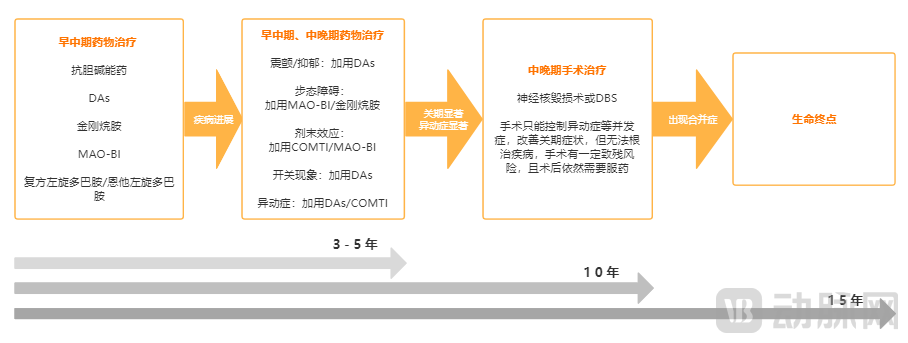
Basic Steps in the Management of Parkinson's Disease Progression
However, at present, treatment for Parkinson’s disease is limited to managing patients’ quality of life. For patients in the early to middle stages, physicians typically prescribe anticholinergic agents, dopamine agonists (DAs), amantadine, MAO-B inhibitors (MAO-BIs), and compound levodopa/benserazide or levodopa/entacapone. As the disease progresses, the efficacy of these medications gradually diminishes, and long-term use often leads to significant drug resistance and other adverse effects.
Approximately 50% of patients will develop significant "off" periods and severe dyskinesia within 3–5 years after disease onset. A small subset of these patients may undergo ablative neurosurgery or Deep Brain Stimulation (DBS). Generally, DBS surgery is indicated when "off" periods and dyskinesia are severe. The cost for a single procedure ranges from approximately RMB 100,000 to over RMB 300,000.
On April 11, 2023, the 27th World Parkinson’s Day, Professor Chen Biao from Xuanwu Hospital of Capital Medical University shared in an interview with Neuro News: “The clinical management of Parkinson’s disease (PD) remains predominantly symptomatic. Many patients are hoping for a miracle and a complete cure, which I believe is still difficult to achieve at present.” However, he noted that early diagnosis, halting disease progression, functional improvement, stem cell therapy, and gene therapy will be the key focal points for future PD research.
Although the road ahead remains long, the advancements of stem cell and gene therapies in disease repair and regeneration are gradually gaining industry recognition, potentially evolving into the long-term, etiology-targeted treatments that patients eagerly anticipate.
From the perspective of etiology, most scholars currently believe that Parkinson's disease is a neurological disorder caused by pathological changes in the dopaminergic neurons of the substantia nigra in the midbrain. These changes lead to a significant reduction in dopamine secretion, thereby impairing the brain's ability to control muscle movement.
Dopamine supplementation has become a common approach to disease management. Levodopa is the standard therapy for early-stage Parkinson’s disease and the most effective symptomatic treatment, with up to 75% of patients worldwide using it. However, as the disease progresses and with long-term levodopa use, most patients develop motor complications, including symptom fluctuations and dyskinesia. Motor fluctuations induced by prolonged levodopa therapy have become the most challenging issue in Parkinson’s disease treatment.
If dopamine supplementation fails to yield the desired effects, can we restore the body’s ability to produce dopamine endogenously?
Stem cell therapy has emerged as a novel approach to breaking the current impasse.
In 2006, Shinya Yamanaka first reprogrammed mouse somatic cells into a stem cell state by introducing four transcription factors, for which he was awarded the Nobel Prize in Physiology or Medicine in 2012. In 2007, human skin cells were successfully induced into induced pluripotent stem cells (iPSCs), and since then, iPSC-based therapies have gradually entered clinical trials. Driven by this progress, there has been a surge in Investigational New Drug (IND) applications for various stem cell therapies.
In the field of stem cell therapy research for Parkinson’s disease, companies including Bayer, Sana Biotechnology, Aspen Neuroscience, Wiseheart Medval, Ruijian Medicine, Shize Bio, Huode Bio, and Yuesai Bio have embarked on innovative R&D efforts. Among them, the corresponding pipelines of Bayer and Wiseheart Medval have entered clinical trial stages.
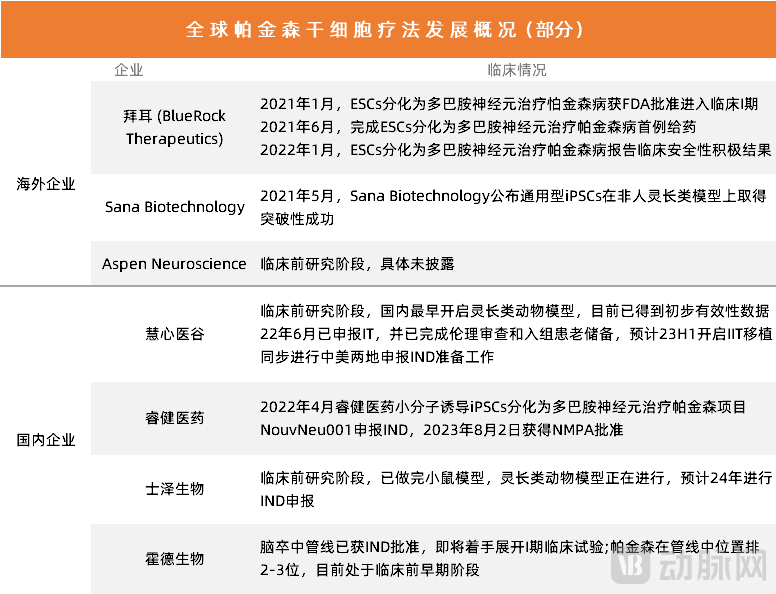 Overview of the Global Development of Stem Cell Therapy for Parkinson’s Disease (Partial)
Directed differentiation of iPSCs is currently a more common technical approach, with Wiseheart Medval being the only company that has chosen the iNSC-based R&D path. Overall, whether for iPSC or iNSC therapies, the development strategy involves directing reprogrammed stem cells to differentiate into neural progenitor cells.
Wiseheart Medval stated in an interview that the company is optimistic about the application of iNSC technology in cellular therapy for Parkinson’s disease for two main reasons. First, iNSCs have a relatively short differentiation cycle, making them more suitable for industrial-scale development and serving as an ideal seed stem cell for commercialization. Second, these cells exhibit relatively weak stemness and differentiate exclusively into neural lineages, resulting in a lower tumorigenic risk and a higher safety profile. Furthermore, other types of neural precursor cells developed based on this technological principle could provide novel therapeutic approaches and strategies for degenerative neurological diseases beyond Parkinson’s disease.
Based on this analysis, the prospects for iNSC transplantation therapy in treating neurological disorders are promising, and it is expected to become a key breakthrough for Chinese scientists in mastering the fundamental technologies underlying stem cell therapy.
Founded in 2021, Wiseheart Medval has conducted preclinical studies in animals such as mice and monkeys using iNSC precursors generated through directed induction and differentiation. These studies have confirmed that its directedly differentiated iNSC-DAPs exclusively differentiate into A9-type dopaminergic neurons, which are therapeutically effective, and have yielded positive results in terms of both safety and efficacy.
Wiseheart Medval's technology enables directionally induced iNSC-DAPs to highly specifically differentiate into dopaminergic neurons in vivo.First, the scientific team confirmed the efficacy of this technique in a mouse model of Parkinson’s disease. Subsequently, in a primate model of Parkinson’s disease, it was demonstrated that induced neural stem cells (iNSCs) could naturally differentiate into mature neurons in vivo, with no evidence of tumorigenic risk observed over the subsequent three months.
Further studies have revealed that iNSC-DAPs transplanted into the striatum and substantia nigra of non-human primates can mature in vivo and differentiate into A9-type dopaminergic neurons expressing tyrosine hydroxylase (TH). These cells tested negative for other neuronal types, including cholinergic neurons (marked by CHAT) and glutamatergic neurons (marked by VGlut1). This indicates that iNSC-DAPs transplanted into the primate brain can selectively differentiate and mature into dopaminergic neurons with minimal risk of developing into other neuronal lineages. Such findings represent a highly positive signal for the establishment of subsequent technical standards and safety assessments.
During the subsequent one-year observation period, a large number of neuronal cells at the tissue level were observed to remain viable. In terms of individual behavioral changes, the animal showed significant improvement in motor function after transplantation, with sustained efficacy over time and a marked increase in overall activity levels.
Based on the aforementioned animal model studies, Wiseheart Medval has actively advanced this pipeline into the clinical research phase.The world’s first investigator-initiated trial (IIT) of autologous human iNSC-DAP therapy for Parkinson’s disease has passed the ethical review by Xuanwu Hospital and completed registration with the National Health Commission and the National Medical Products Administration. Through close collaboration among the Departments of Neurology, Neurosurgery, Radiology and Nuclear Medicine, the Cell Therapy Center, and the Nursing Department at Xuanwu Hospital, the surgical transplantation was successfully performed.
This investigator-initiated trial (IIT) plans to enroll 10 patients, and a 2-year baseline follow-up has been completed. Currently, therapeutic cell samples for two patients have been prepared and are undergoing comprehensive testing and validation, with intracerebral transplantation for these two patients scheduled in the near term. Meanwhile, cell sample preparation for the third patient is concurrently underway.
Based on current progress, the company plans to initiate bilateral Investigational New Drug (IND) applications in China and the United States in 2024. Moving forward, it also intends to leverage the achievements of its current autologous stem cell therapy to extend into process development for allogeneic iNSC-DAP therapy, aiming to develop this technology into a scalable cell therapy product for Parkinson’s disease.
According to publicly reported data, there were approximately 3 million Parkinson’s disease patients in China in 2022. As a key therapeutic option for improving symptoms in patients with moderate-to-advanced Parkinson’s disease, deep brain stimulation (DBS) has been performed on only 30,000 patients cumulatively in China to date, representing a market penetration rate of 1%. Globally, the cumulative number of patients who have undergone DBS surgery has reached 180,000, with related annual medical revenue amounting to approximately RMB 54 billion.
As this patient population continues to grow, the market is expected to expand further. By 2030, the number of patients with intermediate-to-advanced stage disease in China is projected to rise to 2.5–3.5 million. Targeting this population, the surgical transplantation market for allogeneic iNSC-DAPs is anticipated to reach a scale of tens of billions of yuan.
Wiseheart Medval prioritizes “clinical value” and “patient benefit” in its drug development strategy. “One transplantation, long-lasting efficacy”—this has been the company’s steadfast vision since its inception.
As the world’s first industrialization project for iNSCs, Wiseheart Medval has been matched with a wealth of Parkinson’s disease clinical cases from Xuanwu Hospital.Based on a clear understanding of the pathogenic mechanisms and innovative research strategies aimed at reducing drug side effects and achieving a complete cure, if the company can fully validate iNSC-DAP surgery and advance allogeneic transplantation technology, it will have the opportunity to break through the traditional treatment dilemmas of Parkinson’s disease and “unlock” this multi-billion-dollar market.