

Chinese Endoscope Maker Reports 650% Profit Surge Amid Domestic Breakthrough and Product Innovation

Aohua
Developer and Manufacturer of Flexible Electronic Endoscopes

SonoScape
R&D and Manufacturer of Medical Devices

OptoMedic
High-end Optical Medical Device R&D Manufacturer
Shenzhen-based SonoScape, a listed domestic endoscopy company, released its half-year earnings forecast. In the first half of 2023, SonoScape’s net profit increased by 50%–65% year-on-year. Another domestic endoscopy manufacturer, AOHUA Endoscopy Partner, also announced its half-year earnings forecast in early August, with net profit surging by 651.46% year-on-year. Domestic endoscopes are experiencing a moment in the spotlight.
Meanwhile, in July, Pentax Medical, a subsidiary of Japan’s Hoya Corporation, announced the establishment of an endoscope production, R&D, and service center in Shanghai, specifically targeting the Chinese market. This manufacturing base will produce Pentax Medical’s endoscopy solutions for the Chinese market. By localizing its operations in China, Pentax Medical aims to accelerate the delivery of its innovative endoscopy solutions, providing unprecedented support for the improvement of healthcare quality in China.
As a Japanese company with over a century of history and one of the world’s leading manufacturers of flexible endoscopes, Pentax Medical is further deepening its localization efforts, following its announcement in March this year to establish its first factory outside Japan in Shanghai.
Coincidentally, Olympus, one of the global leaders in the field of medical endoscopy, also announced this year that it would establish its production and R&D base in Suzhou Industrial Park. This marks the first time Olympus has set up a manufacturing and research-and-development facility for medical devices in China, as well as the first time it has produced its core products outside of Japan.
Perhaps it is precisely the rapid advancement of domestically produced endoscopes that has accelerated the localization strategies of foreign brands. What have domestic brands done right? And where is the endoscopy market headed in the future?
A stable external environment is a crucial guarantee for the growth of domestically produced endoscopes.
As the impact of the pandemic gradually subsides, the focus of procurement in the healthcare system has shifted from emergency pandemic-related supplies to general medical supplies. Departments significantly affected by the pandemic, such as respiratory and gastroenterology departments, have resumed normal procurement of related products, including endoscopes. This has laid a solid foundation for the growth of domestically produced endoscopes. This trend is corroborated by first-quarter performance data; for instance, AOHUA Endoscopy Partner and Haitai New Light both reported year-over-year revenue growth exceeding 50% in Q1 of this year.
Targeting the lower-tier markets and pursuing differentiated competition have become the strategic choice for domestic brands.
With the widespread adoption of early gastrointestinal cancer screening and the introduction of new endoscopic techniques, the flexible endoscope market is growing at a faster rate than the rigid endoscope market. However, the flexible endoscope market requires physician training; once trained, physicians exhibit higher product dependency, fostering strong user stickiness. Foreign brands such as Olympus, Fujifilm, and Pentax have leveraged their first-mover advantage to capture the majority of the domestic market, holding an absolutely dominant position, particularly in tertiary hospitals.
On the other hand, minimally invasive diagnostic and therapeutic technologies are becoming increasingly mature, with their clinical applications continuously expanding. These technologies have begun to penetrate and gain traction in primary healthcare institutions, gradually becoming an indispensable tool in diagnostic and therapeutic practices. Although there is currently a certain shortage of endoscopists, this also indicates that there is still significant room for development in the demand for flexible endoscopes in the primary healthcare market.
Consequently, the market for Tier II and lower-tier hospitals, as well as private hospitals, has become a key focus for many domestic brands. For instance, SonoScape has chosen to concentrate its efforts on the extensive market of county-level and primary care hospitals to establish a competitive advantage. In Q1 2023, SonoScape’s installed base in county-level and primary care hospitals grew by 200% and 300% year-on-year, respectively.
Refining products around clinical pain points to gain recognition from frontline clinicians while demonstrating the product's inherent value.
For a long time, the perception among frontline clinical healthcare professionals has been that domestically produced endoscopes suffer from inferior product quality and poor user experience. To break this stereotype, many domestic brands have begun to implement targeted promotional strategies addressing specific clinical pain points. For instance, AOHUA Endoscopy Partner has established in-depth collaborations with multiple Grade 3A hospitals across China, gathering feedback and suggestions from end-users regarding their products during clinical diagnosis and treatment processes.
AOHUA Endoscopy’s AQ-300, a 4K ultra-high-definition endoscopy system launched late last year, officially embarked on its commercialization journey this year. Through exchanges with hospitals and experts, the company has further refined the AQ-300 based on feedback from frontline clinical practice, laying the groundwork for subsequent large-scale clinical installations. During this process, the AQ-300 has gained recognition from frontline clinicians, generating over RMB 63 million in revenue in Q1 alone. In comparison, AOHUA Endoscopy’s total equipment revenue for the entire year of 2022 was approximately RMB 390 million. The new product has brought incremental growth to AOHUA Endoscopy.
In its earnings forecast, AOHUA Endoscopy Partner reported a 72.74% year-on-year increase in revenue and a 651.46% year-on-year increase in net profit attributable to shareholders for the first half of 2023. This growth was primarily driven by the launch of the new AQ-300 model, continuous refinement and upgrading of products, sustained investment in R&D for new technologies and products, and the provision of satisfactory endoscopic solutions to customers, thereby achieving growth in its core business.
Racing overseas, both to seek a second growth curve and to mitigate risks.
Although large-scale centralized procurement has not yet been implemented for endoscopes, it remains an unavoidable issue that presents both opportunities and challenges for enterprises. On one hand, regional centralized procurement initiatives exert pressure on companies through nationwide price linkage effects. On the other hand, centralized procurement is driving high-quality development by encouraging firms to continuously launch new products. Many companies have taken proactive measures by expanding into overseas markets, seeking a second growth curve to mitigate potential future risks.
SonoScape has newly established multiple subsidiaries in Germany, India, the Netherlands, and the United States, recruiting local personnel to achieve localized operations. Its overseas sales team played a crucial role in ensuring steady growth in international business despite travel restrictions during the pandemic. Since 2022, SonoScape has added several core international distributors, facilitating a qualitative breakthrough in the U.S. market and acquiring more than 30 new hospital clients. AOHUA Endoscopy Partner and Nanwei Medical also stated at investor conferences that they are advancing product market access in overseas markets.
Although foreign brands have initiated localization strategies, domestic brands still have room for development.
From establishment to commercial production, a factory must undergo numerous processes, including site construction, acceptance of production facilities, product registration, and the establishment of a production system, which typically takes around two years. The short-term impact of foreign brands setting up manufacturing plants in China on the domestic market is limited. Ultimately, competition in the medical device industry hinges on product strength. Domestic brands must seize this window of opportunity to continue enhancing their capabilities and prepare for future competition.
As numerous domestic manufacturers enter the market, endoscopy has entered a period of transformation.
With the rapid development of minimally invasive surgery, how endoscopes can better transmit clear images of the patient’s internal anatomy to surgeons—facilitating intraoperative observation, lesion navigation, and diagnostic and therapeutic procedures—has become a key challenge for related enterprises. Taking rigid endoscopes as an example, development efforts are focused on upgrading the endoscopic imaging systems, with an emphasis on image processing capabilities integrating fluorescence, 3D, and 4K technologies.
In late July, Mindray launched the new-generation scalable endoscopic platform, the UX5. Leveraging fully independent R&D across the entire chain—including light sources, optical scopes, cameras, and image algorithms—the UX5 seamlessly integrates software algorithms with hardware performance, delivering a significant leap in imaging capabilities. Breakthroughs in key fluorescence technologies enable true visualization of occult lesions and stained boundaries, thereby facilitating precise surgical navigation. Additionally, the UX5 features new expansion interfaces that allow simultaneous on-screen display of ultrasound and endoscopic images, addressing the pain point in traditional combined endoscopy-ultrasound procedures where physicians must repeatedly switch their gaze between two separate imaging displays.
Not only giants like Mindray, but also some startups are exploring the path of endoscopic innovation.
Founded in 2013, OptoMedic offers a comprehensive product portfolio that includes full-featured endoscopic imaging platforms, fluorescence laparoscopy series, white-light laparoscopy series, electronic flexible endoscope series, single-use endoscope series, and consumables. Since launching its high-definition fluorescence endoscopy system in 2018, the company simultaneously introduced 4K fluorescence endoscopes in domestic and international markets in 2020, and in 2022 unveiled Stellar, China’s first platform-based product featuring 4K resolution with integrated 3D and fluorescence capabilities.
These three major leaps forward have been made possible by OptoMedic’s accumulation of independently developed foundational technologies across its entire value chain, granting it a first-mover technological advantage and establishing robust technical barriers in the field of fluorescence imaging. In the realm of 3D imaging, OptoMedic is one of the few companies worldwide to have mastered 3D optical endoscopy technology. Meanwhile, OptoMedic has extended its technological capabilities outward, launching multiple products in succession since 2022, including electronic nasopharyngolaryngoscopes, electronic cystorenal pelviscopes, and the first domestically produced electronic choledochoscope.
In July, OptoMedic completed a Pre-IPO financing round exceeding RMB 200 million, led by CCB Equity and Huajin Capital, with participation from Guoxin Capital and Binfu Capital. The company has filed for tutoring registration with the Guangdong Securities Regulatory Bureau, officially launching its A-share IPO process. OptoMedic has carved out an innovative path characterized by technological breakthroughs and platform-based product development.
On the other hand, the continuous expansion of clinical application scenarios has driven the integration of endoscopes with new technologies, materials, and manufacturing processes, giving rise to a wider variety of innovative products such as single-use endoscopes, capsule endoscopes, and ultrasound endoscopes, which are gradually becoming new sources of market growth.
Disposable endoscopes address the challenges of thorough cleaning and disinfection associated with traditional endoscopes, which pose a significant risk of cross-infection, thereby emerging as a new growth driver in the flexible endoscope market.
Many foreign brands have already entered this sector. For instance, Boston Scientific has launched single-use bronchoscopes, single-use digital ureteroscopes, and single-use duodenoscopes. Pentax Medical, Olympus, and KARL STORZ have also made strategic moves in this area. In the domestic market, numerous Chinese manufacturers are actively expanding their presence. According to data from VCBeat, 48 domestically produced single-use endoscopes were approved for market launch in 2022 alone. As of February 14 this year, the number of approvals has already reached nearly 30% of the total for all of 2022, suggesting that the market for domestically produced single-use endoscopes is poised for explosive growth this year.
Notably, constrained by reimbursement mechanisms, 70% of currently approved products are utilized in urological applications. The product positioning focused on “infection prevention,” combined with existing medical insurance coding, has facilitated a strong commercial launch for single-use endoscopes. Building on this foundation, the key breakthrough for domestic brands in the next phase will be to demonstrate their value across broader clinical scenarios, resolve reimbursement challenges, and streamline commercialization pathways.
From a product perspective, after Huaxin Medical obtained China’s first certification for disposable electronic bronchoscopes in 2021, companies such as Micro-Tech (Nanjing) Co., Ltd., New Optical Vision, and Yingshu Life also successively received approvals. In the field of gynecology, following Yudu Biology’s acquisition of the certification for disposable electronic hysteroscopic instruments in 2021, Ruipai Medical and Jiyuan Medical, among others, subsequently obtained their certifications. In the future, these two sectors are poised to become the niche segments with the most rapid commercial implementation, following urological applications.
Furthermore, several domestic brands are making strides in the development of composite endoscopes, such as endoscopic ultrasound (EUS), confocal laser endomicroscopy (CLE), capsule endoscopy, and endoscopic optical coherence tomography (EOCT) systems. For instance, Anhan Technology, Jinshan Science & Technology, Zifu Medical, and Huachong Technology are aggressively advancing in the field of capsule endoscopy. Leveraging years of deep expertise in both ultrasound and endoscopy, SonoScape has taken the lead in launching endoscopic ultrasound systems, filling a domestic gap in this sector, with national registration already underway.
Currently, endoscopes are evolving toward multifunctionality, high resolution, miniaturization, and disposability. In the future, endoscopy will integrate cutting-edge technologies such as artificial intelligence to develop auxiliary diagnostic systems that provide more comprehensive information, thereby enabling physicians to achieve precise diagnosis and treatment for optimal therapeutic outcomes and improved efficiency.
Only through continuous product upgrades and iterations can the domestic endoscopy industry embark on a path of high-quality development.
The gradual improvement of the industrial chain is an important guarantee for the high-quality development of domestically produced endoscopes.
The medical endoscopy industry is characterized by high technical barriers and has long been one of the niche segments with a low localization rate. With support from national policies and an influx of capital, an increasing number of domestic enterprises have entered the market, accelerating technological iteration. This has led to a continuous rise in the localization rate of products and the gradual improvement of the industrial chain.
Since 2020, more than 30 companies have entered the disposable endoscope market, with over 50 products approved for launch. In this highly competitive landscape, manufacturers are increasingly competing on production costs. Taking the CMOS optical module—a key component accounting for nearly half of the total cost—as an example, most companies rely on external procurement due to high technical barriers, underscoring the need for robust supply chain support.
Currently, manufacturers of disposable endoscope CMOS optical modules available on the market include OmniVision. Originally founded in the consumer electronics sector, OmniVision developed the world’s first single-chip color CMOS image sensor in 1997 for the mobile phone market and once served as a supplier to Apple. However, it gradually fell behind in competition with Sony and Samsung and was subsequently acquired by Will Semiconductor. Beyond its consumer electronics business, OmniVision has begun extending its CMOS image sensor technology to fields such as healthcare and new energy vehicles.
OmniVision’s CameraCubeChip technology integrates full functionality for image sensing, processing, and single-chip output. By innovatively combining wafer-level optics with CMOS image sensors, it delivers ultra-compact sensors tailored for medical devices while ensuring high low-light sensitivity. This solution excels in medical equipment applications, particularly in endoscopy. Disposable endoscope solutions, characterized by safety, hygiene, cost-effectiveness, and high image quality, have driven significant market demand.
According to Frost & Sullivan, the global medical CMOS image sensor market grew from USD 50 million in 2017 to USD 185 million in 2021, representing a compound annual growth rate (CAGR) of 38.7%, and is projected to reach USD 490 million by 2026, with a CAGR of 21.5%. According to the annual report of Will Semiconductor, the parent company of OmniVision, revenue from its image sensor business for the medical market increased from RMB 390 million in 2021 to RMB 777 million in 2022, a year-on-year increase of 99.02%.
OmniVision’s rapidly rising revenue also indirectly reflects the strong demand for domestically produced endoscopes.
The rapid development of domestic endoscope manufacturers has led to the successive breakthrough of many “chokehold” technologies. Although sourcing of upstream raw materials and processing capabilities for certain core components still require further advancement, the emergence of upstream demand—covering areas such as laser light sources, endoscopic image processing, and articulating sections (snake bones)—has attracted an increasing number of enterprises to engage in original research and development. As the upstream industrial chain continues to improve, it is also driving the overall development of the industry.
In recent years, multiple government departments have issued numerous policies to encourage the development of domestically produced endoscopes in China, creating a favorable environment for domestic brands in terms of development planning, product registration, clinical trials, and procurement. Thanks to these prerequisites, the capital market has also provided strong support for domestically produced endoscopes.
According to data from Artery Orange, the number of endoscopy financing events in the past two years has nearly doubled compared to the period between 2017 and 2020, with the total financing amount increasing by almost threefold. Since the beginning of this year, there have been nearly 20 financing deals, each involving substantial amounts ranging from tens of millions to hundreds of millions. In terms of outcomes, projects with a certain scale and those in the upstream segment of the industry chain have been the key focus areas for securing funding this year.
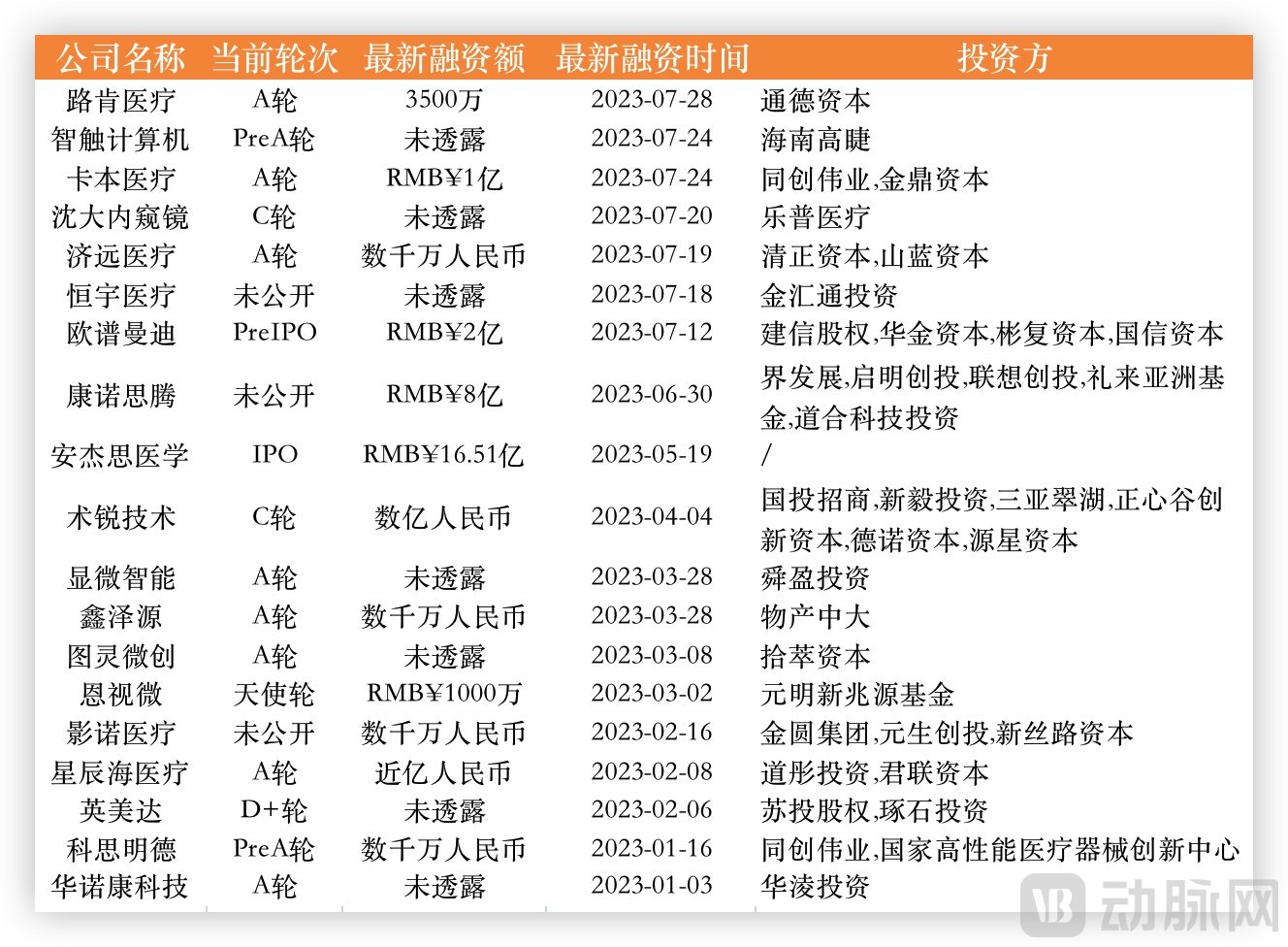
Selected Endoscopy Industry Financing Events This Year, Data Sourced from VCBeat Orange
In addition, companies such as OptoMedic, Innovex Medical, and New Guangwei are also accelerating their initial public offering (IPO) preparations. Together with previously listed enterprises like AOHUA Endoscopy Partner, Nanwei Medical, Haitai Xinguang, and SonoScape, the number of domestic endoscope manufacturers going public is increasing. These companies are leveraging secondary market financing to accelerate product iteration, drive rapid growth, and fast-track their efforts to overtake competitors.
As the pandemic gradually recedes, public health awareness is rising, with greater emphasis placed on proactive disease prevention. Endoscopy plays a pivotal role in the early detection and screening of gastrointestinal lesions and serves as the diagnostic gold standard for many conditions. Currently, the early diagnosis rate for gastrointestinal cancers in China remains below 10%, indicating substantial unmet clinical demand awaiting fulfillment.
On the other hand, according to Frost & Sullivan data, the average annual growth rate of the penetration of minimally invasive surgeries in China was nearly 10% between 2016 and 2021. However, the overall penetration rate remained below 20%, indicating substantial room for growth compared to the over 80% penetration rate in the United States. In the future, as minimally invasive surgeries expand into more clinical departments, endoscopic diagnostic and therapeutic techniques will be applicable to a broader range of clinical scenarios.
Meanwhile, domestic endoscope manufacturers should seize the opportunity to collaborate with frontline physicians, gain insights into actual clinical needs, and promote the development of innovative minimally invasive surgical techniques. They should also develop integrated solutions encompassing medical endoscopes, minimally invasive surgical instruments, and surgical equipment, thereby providing patients with safer and more comfortable treatment experiences.
As the world’s second-largest medical device market, China holds immense potential for future growth. Financial reports from listed companies such as SonoScape and AOHUA Endoscopy Partner reveal that endoscopy, one of the hottest niche segments today, is experiencing a period of rapid expansion. Looking ahead, the endoscopy market size is set to expand further driven by sustained clinical demand. While foreign brands are accelerating their localization strategies, domestic brands must hasten their breakthroughs across multiple technological domains to gain greater international influence. Import substitution is merely the beginning; competing in the global marketplace represents the true future.