

Amid a Wave of Closures and Transfers, Why Are New Players Still Rushing Into Internet Hospitals?
Over the past year, there have been intermittent reports of internet hospital transfers, with some internet hospitals and their operating entities even being deregistered.
Following the peak period two to three years ago, the industry has cooled down, with many internet hospitals grappling with challenges such as operational strategies, regulatory compliance, and revenue generation.
When these issues cannot be resolved in the short term, deregistration or transfer has become a viable exit strategy to cut losses promptly. As a result, the internet hospital sector is undergoing its first round of industry consolidation since 2020...
According to data from Qichacha, among more than 2,300 internet hospital companies in China, over 370 have been deregistered as of now. The highest number of deregistrations occurred in 2022, with 130 companies; since 2023, 65 companies have been deregistered.
Of course, the establishment of an internet hospital company does not imply that it has obtained or will necessarily obtain an internet hospital license; it only reflects, to a certain extent, the company’s plan to develop an internet hospital business.
Among those companies that have already obtained medical institution practice licenses, some have also relinquished this "pass" for online healthcare.
Since 2022, health administrative departments in regions such as Hainan, Hubei, and Ningxia have published cancellation notices for multiple internet hospitals. According to the public disclosures, all cancellations were initiated by the hospitals themselves.
On certain intermediary websites and in industry communication groups, advertisements for the transfer of internet hospital licenses occasionally appear. The transfer prices generally range from over one million yuan to several million yuan, with some transactions including the associated physical medical institutions or teams.
This appears to indicate that the first “knockout round” for internet hospitals has arrived, following their explosive growth during 2020–2021. In the view of Wan Yaohua, Chairman of Guangzhou Yuankangjian Information Technology Co., Ltd., internet hospitals are essentially internet-based projects; benchmarked against the internet industry, they inevitably carry a risk of failure. Deregistration and transfer are normal occurrences, and in practice, such internet hospitals account for a relatively small proportion.
What Lessons Can Be Drawn from Past Precedents for the Industry? In summary, the main reasons for the exit of internet hospitals or companies include the following aspects.
First, the application for an internet hospital license was unsuccessful, leading to the deregistration of the company.
In cases where an enterprise independently establishes an internet hospital relying on a physical medical institution, it is typically necessary to first register a company, and then apply for a practice license from the local health authorities with this company as the main entity.
Currently, most provinces and municipalities, represented by Ningxia, Hainan, Sichuan, Shandong, and Tianjin, have opened channels for enterprises to apply for internet hospital licenses. However, differences in approval levels and enterprise requirements across regions have led to variations in application success rates.
Within the Ningxia Hui Autonomous Region, both the Regional Health Commission and the Yinchuan Municipal Health Commission are authorized to approve internet hospitals; in Hainan Province, approval authority rests solely with the Provincial Health Commission; whereas in Sichuan, Tianjin, Shandong, and other regions, approvals may be granted by municipal- or district-level competent authorities. In areas where approval authority has been decentralized, the application process is, to some extent, less stringent.
Furthermore, certain regions expect license applicants to bring industrial resources and public welfare service capabilities to the local area, or to achieve synergy with local industries. This implies an additional layer of screening criteria for enterprises. In these regions, companies that have not yet commenced actual business operations or exhibit low synergy with local industries face a lower probability of successful application.
Due to various reasons, the company's application for an internet hospital license failed, and the companyCancelIt follows naturally.
Second, internet hospitals that have remained non-operational for an extended period or have demonstrated poor operational performance ultimately cease operations, are deregistered, or are transferred.
During the explosive growth phase of internet hospitals in recent years, the mindset of many enterprises entering the market was, “Everyone else has obtained one, so I need to get one too.”
However, some enterprises have failed to put their internet hospitals into actual operation after obtaining the necessary qualifications. According to officially released operational data, certain internet hospitals have long maintained “zero” online consultation volumes and electronic prescription counts.
Even when an internet hospital is not actually in operation, the operating entity still incurs fixed costs, such as annual fees for affiliation with a physical hospital, server costs, and necessary staff salaries. Rather than incurring these expenses without purpose, it is preferable to deregister the entity.Timely Loss Mitigation, or transfer them to minimize losses.
Currently, among the leading companies in the internet hospital sector, only a minority have achieved profitability after years of exploration, while the majority are still continuously experimenting with business models. For small and medium-sized enterprises that rushed into the market, they may also face unclear operational strategies and profit models, ultimately leading to poor management and resulting in closure or deregistration.
Third, the verification system has been launched, and a preliminary exit mechanism for internet hospitals has been established.
In June 2022, the Detailed Rules for the Supervision of Internet-Based Diagnosis and Treatment (Trial) came into effect, requiring internet hospitals independently established by enterprises to undergo annual verification. Prior to this, Ningxia and Hainan had already formulated relevant regulations for internet-based diagnosis and treatment services and implemented an annual verification mechanism.
During verification, the competent authorities conduct reviews of operational procedures, practitioner qualifications, medical quality and safety assurance measures, cybersecurity, and data integration with regulatory platforms, in accordance with the National Health Commission’s “Basic Standards for Internet Hospitals (Trial)” and other relevant local standards.
If non-compliance is identified during the review, the competent authority will grant a specified period of deferred verification, after which a re-verification will be conducted. If the facility still fails to pass, the Internet hospital may have its license revoked.
Tighter regulatory oversight has also become a major reason for the voluntary or involuntary deregistration of internet hospitals.
Furthermore, some large companies that have previously established internet hospitals in multiple regions may also deregister unnecessary internet hospitals during business adjustments.
On the flip side of internet hospitals ceasing operations, being deregistered, or transferred, there is a steady influx of new entrants.
According to data from Qichacha, although varying numbers of internet hospital companies are deregistered each year, a greater number of new companies are simultaneously registered. In 2022, during the peak period when 130 companies were deregistered, 343 new companies were still registered.
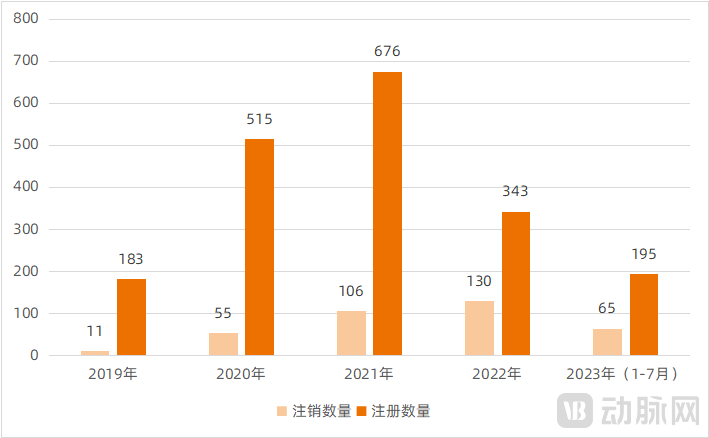
Internet Hospital Company Deregistrations and Registrations in Recent Years, Data Source: Qichacha
According to data from the National Health Commission, there are currently more than 150 internet hospitals independently applied for by enterprises in Sichuan Province, making it the province with the largest number of such licenses; Tianjin has also seen significant growth, increasing from a few previously to 35 now.
Expanding into internet healthcare remains a strategic option for many companies seeking business growth.
At this point, one cannot help but ask: after many pioneers have failed in their initial attempts, why are others still eager to obtain licenses for internet hospitals? What distinguishes these “new entrants”?
VCBeat has previously analyzed in multiple articles that various sub-sectors within the healthcare industry have ventured into internet hospitals, including large internet companies, medical AI and big data firms, pharmaceutical companies and pharmaceutical retailers, medical device manufacturers, insurance and insurtech companies, and health management enterprises.
From the perspective of niche sectors, the types of entities applying to establish internet hospitals are undergoing some changes.
Private Medical Institutions Accelerate Market Entry as Licensing Costs Decline
According to statistics from VCBeat in the "2021 Internet Hospital Report," only 7% of internet hospitals across China were initiated and operated by private medical institutions.
“Over the past two years, private medical institutions have been increasingly proactive in establishing internet hospitals.” A relevant official from Knightley told VCBeat that among these institutions, some are driven by rigid business needs, while others are preparing “bonus points” for hospital accreditation applications and digital transformation.
It is understood that in previous years, the low proportion of private medical institutions establishing internet hospitals was partly due to the high cost of obtaining licenses and significant uncertainty regarding return on investment. Institutions backed by large medical groups had greater financial strength to invest millions in building platforms and operational teams, as well as applying for necessary qualifications. In contrast, small and medium-sized hospitals and clinics were more cautious about such expenditures, primarily conducting online business through online consultations and health education initiatives.
Over the past two years, market demand has spurred the emergence of a wave of active internet hospital technology service providers. Competition among these providers has intensified, and the cost of obtaining an operating license has decreased—from several million yuan in the early stages to generally over 2 million yuan in recent years, with current prices dropping to as low as several hundred thousand yuan.
A representative from Netray stated that the cost for technical service providers to apply for licenses has indeed decreased. Another significant factor is the reduced R&D investment in standardized systems, driven by increased service volume and improved system standardization.
The price decline has made it possible for small and medium-sized hospitals, clinics, and other institutions to extend their service scope through affordable construction costs.
In April 2023, Chengdu Wenjiang Ruolin Doctor Internet Hospital, under the Linjia Haoyi brand, received approval, enabling it to connect with the company’s multiple existing clinics and provide patients with more comprehensive online and offline services.
Clinical Laboratory Institutions Deploy Internet Hospitals to Integrate Medical and Diagnostic Services
Laboratory and imaging tests are an indispensable part of the disease diagnosis and treatment process, primarily conducted offline. For a long time, the integration between internet hospitals and laboratory/imaging test scenarios was not deep, mainly due to the lack of sufficient testing institutions supporting online medical platforms.
Since public internet hospitals became active, some top-tier tertiary hospitals have launched online services such as self-service ordering and appointment scheduling for laboratory and imaging tests, which have become among the most heavily utilized online services. This sufficiently demonstrates patients’ strong demand for “Internet+” laboratory and imaging services.
Since 2021, third-party medical laboratory testing institutions such as KingMed Diagnostics have collaborated with internet healthcare platforms to explore a model comprising online consultations and test appointment scheduling, followed by home sample collection or sampling at offline collection points, and concluding with online report access and interpretation.
Hu Meirong, co-founder of Yinlian Health, stated that an increasing number of clinical laboratories are now directly establishing internet hospitals to build a closed-loop service ecosystem.
Public information indicates that companies such as Dian Diagnostics, BGI Genomics, Kindstar Global, Shuoshi Biotech, and Simcere Diagnostics have already obtained licenses for internet hospitals.
In April 2023, Tianjin BGI Youkang Internet Hospital, a subsidiary of BGI Genomics, received regulatory approval. In addition to offering services such as online consultations, text- and video-based medical visits, remote consultations, e-prescriptions, laboratory test ordering, and chronic disease management, the platform also provides users with genetic testing recommendations and online report interpretation services, particularly in the fields of genetic disorder diagnosis, early cancer screening, and reproductive health.
To establish a channel for directly serving end-users, Dian Diagnostics launched its consumer-facing brand, Xiaofeijian Health. In January 2023, it obtained an internet hospital license in Guangzhou, and subsequently established operations in Yinchuan in March.
Xiaofei Jian Health provides users with services including pre-hospital early screening and diagnosis, health management, post-discharge follow-up, and chronic disease management.
In addition, Kindstar Global launched the “Kindstar Youyi” diagnosis and treatment platform in 2022, integrating specialized testing services. Building on its internet hospital initiated in 2021, Bioswift extended its business operations; in 2023, the first self-operated offline pharmacy of Bioswift Internet Hospital opened, fostering a tighter integration of medical care, testing, and pharmaceuticals.
Upstream, Midstream, and Downstream of Consumer Healthcare: Leveraging Internet Hospitals to Expand C-End Channels
Via internet hospitals, multiple stakeholders across the consumer healthcare industry chain are attempting to establish or expand direct-to-consumer (DTC) channels.
In 2023, Yonghe Medical launched its Hair Health Internet Hospital, providing patients with full-lifecycle hair health and medical services, including online consultations, one-click appointment registration, postoperative follow-up visits, electronic medical records, e-prescriptions, and cloud-based pharmacy services.
In July 2023, Botanee launched the acne-treatment brand “Beifuting.” As part of the operational support for this brand, the company had already acquired Chengdu Wuhou Huifu Internet Hospital in 2022 and established Chengdu Wuhou Beifuting Internet Hospital Co., Ltd. (which has not yet obtained its license). Currently, leveraging its internet hospital platform, Botanee has conducted extensive science popularization initiatives in various formats and introduced services such as AI-powered skin analysis, physician consultations, and customized medical acne treatment plans.
Since 2022, invisible aligner brand Smartee and internet-based consumer healthcare platforms such as Ruli have obtained approvals for their own internet hospitals. Together with the previously established SoYoung Internet Hospital, this trend indicates that upstream manufacturers, midstream platforms, and downstream service providers are all striving to build their own direct-to-consumer (C-end) channels. Their goals include enhancing professional service quality, accumulating private-domain traffic, and reducing marketing costs.
Doctor-Focused MCNs Boom, Leveraging Internet Hospitals to Monetize
The rapid development of internet healthcare has encouraged more physicians to practice online, while also promoting their engagement in online science popularization and live streaming to build personal brands. High-quality medical educational content must be professional, easy to understand, and highly shareable, posing a significant challenge to physicians’ content creation capabilities. Consequently, physician-focused Multi-Channel Network (MCN) agencies have become highly active in recent years.
“MCN agencies control substantial physician resources and possess consumer-facing traffic, seeking to explore monetization avenues through internet hospitals,” said Hu Meirong, Co-founder of Yinlian Health.
In addition, specialized physician learning platforms such as Youan Medicine, Lingling Yi, ENT Information, and Yiben Medical have successively applied for licenses since 2022, leveraging their aggregation of extensive physician resources to provide services to patients.
Xie Wen, founder of Lulutong, stated that based on the companies served over the past two years, applicants for internet hospital licenses have become more rational, with enterprises generally having clear business scenario requirements.
Overall, early internet healthcare began with online consultations and gradually expanded to other service segments or extended to offline settings. Nowadays, an increasing number of enterprises with established physical operations are leveraging internet hospitals as a pathway for digital transformation and upgrading.
“In the past few years, the primary objective for many pharmaceutical retail enterprises in obtaining licenses was to secure prescription rights, thereby enabling the compliant sale of prescription drugs. Currently, a growing number of companies are integrating internet hospitals into their digitalization strategies, taking a holistic approach that encompasses internet hospitals, CRM systems, data interoperability, and intelligent technologies,” said Wan Yaohua, Chairman of Guangzhou Yuankangjian Information Technology Co., Ltd.
Before making decisions on building internet hospitals, enterprises will conduct multi-dimensional assessments. A relevant executive at Knightree stated that the companies currently served by his firm evaluate whether to establish an internet hospital based on practical value, return on investment (ROI), and other factors. “Some have even developed operational plans to weigh their options.”
As enterprises gain a clearer understanding of their objectives for obtaining licenses and their operational planning, they place higher demands on technical services such as system development and maintenance. Previously, some internet hospital systems were built solely to meet the mandatory requirements for licensure; after obtaining the license, these systems were either unused or unusable, necessitating the development of a separate system for actual operations.
Furthermore, as the dynamic regulation of internet hospitals becomes increasingly stringent, the number of entities operating in compliance will continue to grow.
As previously mentioned, the National Health Commission’s “Basic Standards for Internet Hospitals (Trial)” and local regulatory frameworks have been progressively implemented. Internet hospitals are subject to an annual “examination.” Any issues identified during the verification process must be rectified, and only after passing re-verification may they continue their medical practice.
During a verification review, the Hainan Provincial Health Commission identified several issues with an internet hospital, including the establishment of clinical departments beyond its approved scope, inadequate real-name authentication for medical personnel, non-compliant diagnostic and treatment workflows, irregular formats and management processes for electronic medical records and prescriptions, and incomplete data integration with the provincial internet hospital service supervision platform. Public information indicates that the internet hospital implemented corrective measures and passed the verification review two months later.
Participants lacking clear business objectives or operating non-compliantly are exiting, while those with clearer strategic plans are entering and building more effective tools (i.e., information systems)... Currently, the industry is undergoing a process of eliminating the false and retaining the true, where the fittest survive and the less fit are weeded out. There is no need to be pessimistic about the successive exits, nor should one become complacent due to blind optimism. Drawing on the experiences and lessons of predecessors, making more long-term and rational considerations, and steadily progressing step by step are the immediate priorities for the industry.