

Subtle Medical Files IPO Prospectus: Generative AI Healthcare Company Achieves Over $100M Revenue with Pay-Per-Use Model Across Global Markets
Subtle Medical
Medical Imaging Software Developer
The Commercialization of Medical AI Is a Long Road Ahead. Over the past decade, the value of intelligent algorithms has been validated in scenarios such as healthcare informatization, new drug development, clinical surgery, and medical imaging, with related products being deployed at scale. However, constrained by regulatory approvals, market adoption, and pricing and reimbursement policies, the revenue generated through existing systems rarely covers the high costs of research, development, and operations.
Early last year, key opinion leaders (KOLs) in the healthcare industry outlined the trajectory for AI in medical imaging: If companies persist with the pathway targeting tertiary hospitals, they must first obtain regulatory approval, second secure pricing approvals from provincial and municipal authorities, and third rely on out-of-pocket payments by patients, transitioning to reimbursement through basic medical insurance after one to two years of operation. A rough calculation suggests that it would take enterprises approximately four to five years from obtaining certification to achieving profitability.
However, not all AI companies are trapped in this predicament. Beijing Subtle Medical Technology Co., Ltd. (Subtle Medical, Inc., hereinafter referred to as “Subtle Medical”) has carved out a unique path to break through in recent years. Since its establishment in 2017, the company has spearheaded a new wave of AI technologies accelerating image acquisition. After obtaining FDA and CE certifications in 2018 and 2019, respectively, and launching full-scale commercialization in 2020, its global clinical service volume increased more than fivefold year-over-year, with annual revenue growing by nearly 400%. In 2022, the company’s global business scale continued to climb, with annual order value approaching RMB 100 million.
As 2023 just passed its halfway mark, Subtle Medical has secured nearly RMB 100 million in orders within the first seven months. Currently, Subtle Medical’s primary global business model is commercially implemented through hospital-side per-case and recurring payment structures. The company has entered more than 100 top-tier Grade 3A hospitals in China, where its end-user value has been widely recognized, with deployments often carried out through standalone project procurement. If this momentum can be maintained while controlling costs, the company is poised to achieve break-even within this year and is expected to become profitable within two years, thereby breaking the profitability deadlock prevalent in the medical AI sector.
This month, CB Insights released its inaugural Generative AI 50 list. Subtle Medical, a Chinese enterprise and the sole imaging-focused AI company on the list, has demonstrated rapid progress in the commercialization of AI in healthcare. Its inclusion signifies that it represents one of the most valuable generative AI solutions in the global health sector.
Subtle Medical’s breakthroughs and current achievements compel a re-examination of the commercialization of medical AI. Within the complex ecosystem of hospitals, what must medical AI get right to achieve profitability?
Unlike the strategic approaches of other domestic AI companies, Subtle Medical’s product line, while situated within the medical imaging AI sector, does not focus on computer-aided diagnosis. Instead, it specializes in front-end AI-based image enhancement. The purpose of Subtle Medical’s AI products is not to replace physicians, but to empower them by providing a greater volume of higher-quality imaging data.
AI-based image enhancement occupies the upper-to-midstream segment of the industry chain. It leverages intelligent algorithms to assist in image generation without modifying the hardware of imaging equipment, thereby shortening scan time, reducing radiation dose, and improving image quality.
As it does not involve functions such as automated analysis and automated diagnosis that directly serve patients, the evaluation and approval standards for image enhancement have established relatively mature objective quantitative indicators. In this area, Subtle Medical secured exclusive licensing of technology from Stanford University at its inception, including several patents and a vast amount of multimodal medical imaging data with extensive coverage. The value of the data lies not only in its volume; Subtle Medical has purposefully modified clinical acquisition parameters to collect paired data across different devices, anatomical regions, and disease types, varying in scan time, dose, and quality. This has established a difficult-to-replicate data foundation and barrier for the research, development, and validation of AI algorithms for image acceleration.
A precise industry entry point has granted Subtle Medical greater operational flexibility. After securing regulatory approval for its core products in the United States, Subtle Medical subsequently obtained CE marking in Europe and approval from China’s National Medical Products Administration (NMPA), expanding its market presence to Europe, Asia, South America, Canada, Australia, and other regions with successive regulatory clearances. As the demand for enhanced quality and efficiency in clinical imaging is universal, Subtle Medical has leveraged its global product rollout and commercial expansion to gradually become a leading AI service provider worldwide. Currently, its multiple AI products are in clinical use at more than 500 hospitals and imaging centers globally.
Compared with most AI companies, this strategy has, to some extent, shortened the time required to bring AI products from R&D to market. The remaining capital and resources have been invested by Subtle Medical in expanding product functionalities and exploring emerging markets, effectively addressing common challenges in the medical AI sector, such as high market access costs, lengthy approval processes, and limited market size for individual products.
Revisiting More Critical Value Propositions. Subtle Medical’s flagship products at this stage are SubtlePET™ and SubtleMR™ (with their domestically produced, locally deployed counterparts being SupPET™ and SupMR™). The former is designed for PET (Positron Emission Tomography), accelerating PET imaging by 4–10 times while still delivering medical images of equivalent quality; the latter serves MRI, reducing imaging time to less than half of the original duration and decreasing contrast agent usage by tenfold. It is important to note that during the image enhancement process, Subtle Medical’s AI solutions do not alter any existing clinical workflows for physicians.
Improvements in imaging speed and quality hold significant practical promise. On one hand, the vast majority of MRI and PET/CT scanners worldwide are operating at full capacity, with patients often facing wait times of at least one week for an MRI appointment, extending to as long as a month in some large hospitals. Therefore, reducing scan times from the traditional 10–20 minutes to just a few minutes would not only enhance the diagnostic experience for patients but also enable more timely access to examinations for a greater number of patients, facilitating earlier initiation of treatment.
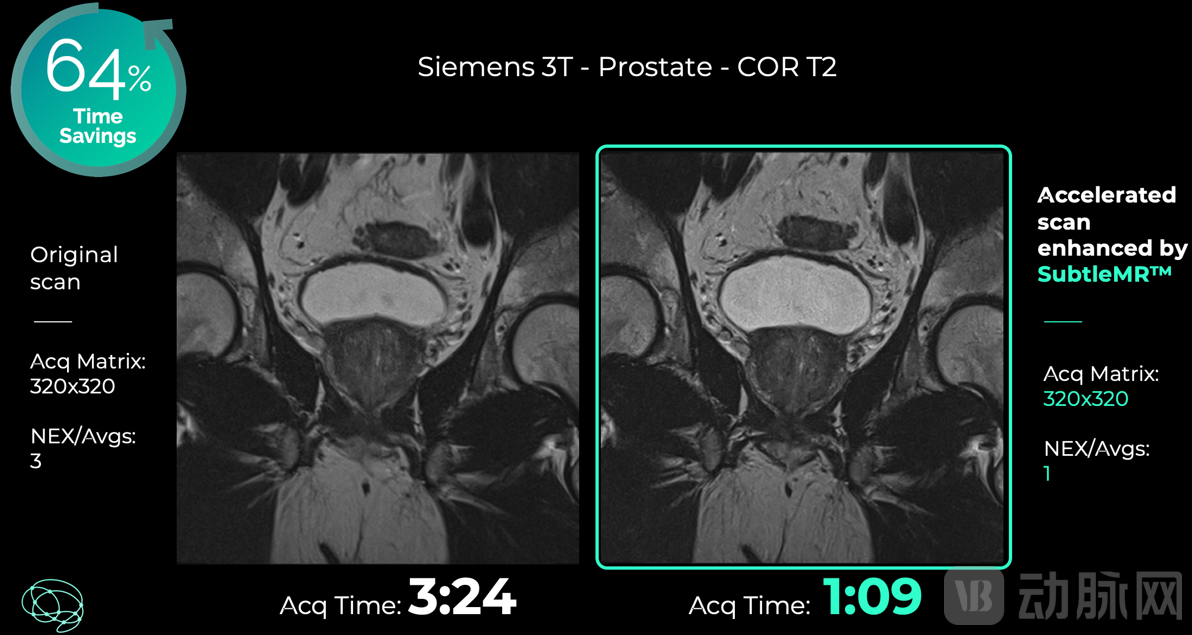
Subtle Medical’s SubtleMR™ Effectively Reduces MRI Scan Time
On the other hand, intensifying competition among imaging equipment manufacturers has driven rapid advancements in imaging-related technologies, leading to iteration cycles for imaging devices that far exceed historical rates. However, for hospitals that have already purchased such equipment, this technological progress erodes their competitive edge in terms of hardware capabilities. Bridging this gap is challenging due to the prohibitive multi-million-dollar costs associated with replacing advanced systems such as MR and PET/CT scanners, stringent site requirements for MR and PET installations, and a shortage of qualified radiologic technologists. The optimal solution is to leverage intelligent software to accelerate image acquisition—this approach reduces scanning time, offers quick and simple deployment, and proves significantly more cost-effective than procuring new equipment.
However, refining AI enhancement is not an overnight process. Acquiring magnetic resonance images of different anatomical regions and disease types requires adjusting to different sequences, and MRI equipment with varying field strengths must be calibrated individually. All of this demands that AI-enhanced imaging companies invest effort to gradually achieve comprehensive coverage.
“When the initial product took shape in 2019, we only supported the six most frequently scanned anatomical regions, but we have now achieved coverage for nearly all anatomical regions,” said Xiang Lei, CTO of Subtle Medical China. “From field strengths ranging from 0.2T to 3.0T, and from multinational GPS (GE Healthcare, Philips, and Siemens Healthineers) to domestic brands such as United Imaging, Neusoft, Lango, and Wandong, Subtle Medical can now accelerate imaging across all field strengths and all equipment brands, thereby empowering the acceleration of domestic brands.”
For Subtle Medical, expanding disease coverage is a time-consuming and labor-intensive process; it took no less than four years to refine just two of its products, SubtlePET™ and SubtleMR™. However, this prolonged period of dedicated development has enabled Subtle Medical to navigate regulatory review and approval processes across global markets, making it the only third-party solution provider in the industry to obtain certifications from the U.S. FDA, the European CE, and China’s NMPA. The company has implemented a comprehensive patent strategy, accumulating nearly 30 international patents along with numerous domestic patents and software copyrights. Its earliest global patent priority dates back to 2016, covering multiple imaging modalities such as MRI, PET, and CT. Since its inception, Subtle Medical’s extensive and broad patent portfolio has provided a significant first-mover advantage, securing its leading position against potential competitors.
Having established formidable technological barriers, Subtle Medical has firmly seized the initiative in global competition.
Although built on cutting-edge technology, the essence of AI-powered medical imaging remains that of a medical device and service. Therefore, product sales are no less important than research and development.
According to Dr. Gong Enhao, Founder and CEO of Subtle Medical, the company has been building a network of potential clients while refining its products. This approach enables Subtle Medical to rapidly achieve sales conversion once its products reach maturity, provided that their performance aligns with hospital requirements.
Furthermore, Subtle Medical’s current Global Head of Sales brings nearly 30 years of experience in hospital-side medical device sales; its Global Head of Product is the former Global Head of MRI Products at GE Healthcare, with over 20 years of industry experience; its Clinical Lead previously served as Director of the Stanford Imaging Center; and its Head of Commercial Operations in China has decades of hands-on sales experience at imaging companies such as Philips and Infervision. This talent advantage is also a significant driver behind the commercialization of its core products.
Regarding its business model, Subtle Medical has not adopted a one-size-fits-all approach but instead tailors its strategy to local conditions.
Per-case payment has long been the preferred reimbursement model for imaging AI vendors. In the vast majority of global markets, including North America, Europe, and South America, Subtle Medical has consistently adopted a SaaS-based per-case pricing structure, implementing quarterly or annual billing based on product usage to help hospitals enhance imaging efficiency, quality, and revenue. In contrast, as Chinese hospitals tend to prefer purchasing medical devices over leasing them, Subtle Medical offers a purely on-premises deployment model in China, primarily relying on license-based sales.
After penetrating the critical hospital market, Subtle Medical has entered the broader health sector, shifting its business model from a focused approach to a full-chain strategy.
By consolidating the medical imaging supply chain, Subtle Medical has established multiple upstream and downstream collaborations with AI imaging service providers such as Aidoc, Bosh Vision, and Dewei, creating end-to-end solutions. Meanwhile, it is exploring OEM-based solutions and engaging in AI partnerships with leading medical imaging equipment manufacturers—including GE Healthcare, Siemens Healthineers, Philips Healthcare, and Neusoft Medical—across various directions and product lines.
Currently, Subtle Medical has repeatedly announced deepened collaborations with Siemens Healthineers. The latter holds nearly one-third of the global MRI market share, and Subtle Medical’s AI will be pre-installed on select MRI systems from this industry giant. At present, Subtle Medical is the sole AI imaging processing partner for Siemens’ image reconstruction pipeline, OpenRecon. In addition, Subtle Medical has established business partnerships with domestic high-end imaging equipment manufacturers such as Nanovision, Regato, and Yiyang, integrating AI enhancement directly into devices targeted at specific markets.
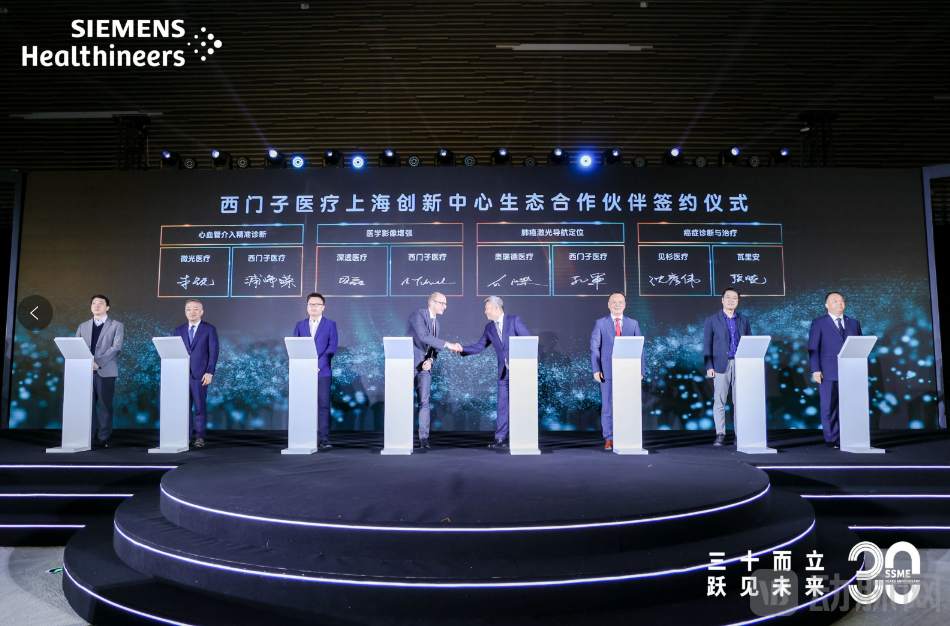
Subtle Medical Partners with Siemens Healthineers Shanghai Innovation Center to Further Strengthen Its Forward-Looking Layout in Local AI-Driven Medical Technology Innovation
Pharmaceutical companies are also among Subtle Medical’s clients. The company has established commercial collaborations worth over $10 million with leading international pharmaceutical firms such as Bayer and Eli Lilly, focusing on contrast agents and radiopharmaceuticals. Subtle Medical’s third product, SubtleGAD™, is designed to enhance MRI scan quality while reducing contrast agent dosage and mitigating the risk of gadolinium deposition during MRI examinations.
In collaborations with pharmaceutical companies, Subtle Medical creates value by leveraging AI to generate higher-quality data, thereby helping manufacturers enhance the safety and imaging efficacy of radiopharmaceuticals. These imaging agents are widely used in the diagnosis and treatment of conditions such as cancer and Alzheimer’s disease. The integration of AI algorithms also adds value by improving trial efficiency and data quality in drug development. This represents a broadly applicable model of AI-enabled pharmaceutical innovation, which can be extended to dose optimization for other nuclear medicine products. By partnering with pharmaceutical companies to bring safer, more advanced products to clinical practice and expanding the eligible patient population (including children, pregnant women, and patients with kidney disease), this approach achieves multi-party mutual benefits and may therefore emerge as a new growth driver for Subtle Medical in the future.
Overall, Subtle Medical’s robust R&D team, diversified product strategy, effective patent barriers, and highly targeted business model have endowed the company with strong resilience against risks and economic cycles. Throughout the multi-year COVID-19 pandemic, Subtle Medical maintained strong growth momentum. As the impact of the pandemic gradually wanes, the company has not only sustained substantial sales growth but also maintained gross profit margins well above the industry average. These advantages are poised to translate into enhanced corporate profitability in the future.
Following the initial commercialization of its products, Subtle Medical has adopted a development strategy similar to that of most artificial intelligence enterprises.
Horizontally expand the imaging modalities empowered by AI, incorporating CT, SPECT, X-ray, and other imaging types into the product portfolio to gradually achieve comprehensive coverage of the AI + medical imaging landscape. Currently, the overall product line covers nearly all clinical imaging examinations. Vertically deepen integration into clinical scenarios by enabling real-time image enhancement during surgeries and reducing imaging steps and radiopharmaceutical dosage in nuclear medicine imaging processes. Taking MRI examinations as an example, Subtle Medical has developed a series of end-to-end solutions comprising multiple products that optimize clinical scanning workflows, efficiency, and quality control, while also enabling completion of missing sequences and enhancing the quality of contrast agent applications.
The difference lies in the technological foundation. While the industry is still discussing the application prospects of generative AI, Subtle Medical has already adeptly applied this cutting-edge large generative AI model technology and achieved commercial implementation. As mentioned at the beginning of the article, Subtle Medical was recently selected as the only medical imaging company and the only Chinese company to be included in CB Insights’ Global Top 50 Generative AI Companies, indicating that its focus on accumulating and deploying frontier technologies has gained global recognition within the industry.
According to Gong Enhao, SubtlePET™ and SubtleMR™ leverage AI to accelerate MRI and PET imaging speeds while enhancing image quality. This process involves using generative AI to process raw data into synthetic data, which is then used to reconstruct MRI and PET images.
In clinical practice, certain sequences in MR scans often suffer from low signal-to-noise ratios and prominent artifacts, compromising the quality of the final images. However, research published in IEEE, titled “One Model to Synthesize Them All: Multi-contrast Multi-scale Transformer for Missing Data Imputation,” demonstrates that with AI support, models such as Transformers can indirectly generate new images (e.g., higher-resolution images, alternative contrasts, or simulated contrast-enhanced images) from existing T1- and T2-weighted images, achieving results that may even surpass those of direct MRI acquisition. Clinical validation of the latest models, including Transformers, has also been published in top-tier clinical imaging journals and conferences such as AJNR and MICCAI.
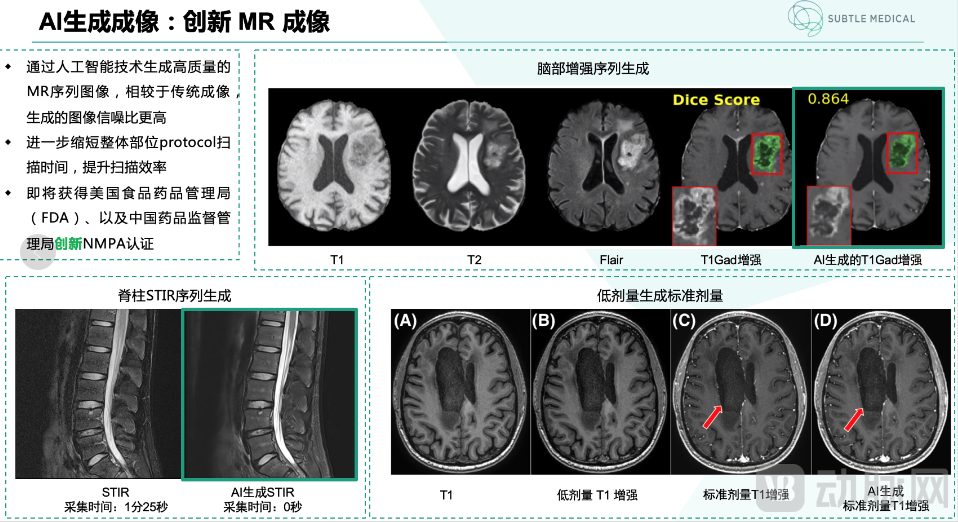
Multiple new products, including SubtleGAD and SubtleSynth, have demonstrated the accuracy and efficiency of their algorithms through multi-center clinical studies.
Currently, while working on image enhancement for CT and other imaging modalities, Subtle Medical is further optimizing its generative AI by incorporating image degradation techniques. Specifically, Subtle Medical leverages extensive real-world clinical data combined with simulation to transform high-quality gold-standard images into ones that more closely resemble low-dose, low-resolution, and low-contrast-agent images obtained from actual scans, thereby training more stable and efficient models. This diffusion model, which integrates multiple data sources, demonstrates significantly superior performance compared to models trained using traditional methods.
Optimizing the technological foundation grants Subtle Medical greater room for innovation. As training datasets become easier to construct, Subtle Medical can expand its AI product lines horizontally at lower costs and faster speeds, accelerating the advent of an era characterized by comprehensive AI-enhanced medical imaging.
A Review of Subtle Medical’s Six-Year Development: Identifying Commonalities Among Successful CasesLooking back on the six-year development of Subtle Medical, we can readily identify commonalities among its successful cases. For instance, Subtle Medical’s product selection strategy has enabled better cost control for its AI products and facilitated faster, more efficient coverage of the global market. Given the shared characteristics in enhancement techniques across different imaging modalities, horizontal expansion of its product portfolio is relatively easy to achieve. By pursuing a global market presence, the company has implemented a widespread per-case payment commercialization model. Furthermore, by precisely targeting top-tier hospitals, hospital alliances, and imaging center alliances as key customers, Subtle Medical has adopted a high-profile market entry strategy while maximizing customer acquisition efficiency and long-term customer value.
Ultimately, Subtle Medical’s success stems from its deep understanding of medicine, AI, and the industry itself.

Subtle Medical Wins NVIDIA Inception AI Award for Its AI-Powered Medical Imaging Enhancement and Acceleration Product
Founder/CEO Gong Enhao (third from left) and Co-founder/Medical Advisor Greg Zaharchuk (second from left) receiving an award from NVIDIA CEO Jensen Huang (first from left)
Gong Enhao stated in an interview that enterprises should adhere to the practicality of clinical technologies and applied research. When your research needs to maintain a high degree of alignment with clinical applications, your objectives become very clear: it is not merely about building models or publishing papers, but rather about whether you can ultimately deliver clinical value and truly bring process optimizations to patients and hospitals. This is a matter of technological value.
Regarding AI technology itself, he believes that enterprises should optimize their technology to minimize costs and ensure stability, while accelerating technological iteration and product deployment. This constitutes a virtuous cycle capable of delivering commercial value, rather than engaging in blind price cuts or unsustainable expansion. Currently, Subtle Medical’s products enjoy high recognition among global customers, demonstrating strong customer stickiness with growing usage and payment rates; indeed, end-user pricing has even seen steady increases.
A prime example lies in the product’s design logic. Subtle Medical operates in the hospital-end market, where clinical workflows are of paramount importance. To innovate within this market, a company must meet hospitals’ demands for high-quality imaging and rapid scan speeds without disrupting physicians’ diagnostic and treatment habits. Therefore, leveraging AI-powered image enhancement to subtly reduce costs and improve efficiency for radiology departments effectively addresses the dual needs of both hospitals and clinicians. Moreover, as end-user hospitals pursue ever-higher standards of quality and efficiency with no endpoint in sight, Subtle Medical continues to refine its technology and pursue bold innovations, steadily enhancing the capabilities of its AI-powered image enhancement solutions.
Guided by this logic, Subtle Medical quickly entered a fast lane of development after turning its focus to the domestic market. On one hand, Subtle Medical’s products closely align with the needs of Chinese hospitals; on the other hand, its major investors include top-tier funds deeply engaged in healthcare and industrial intelligence upgrades in China, such as Zhongding Capital, Bencao Capital, Chunhua Capital, Baidu Ventures, Data Capital, and Legend Star. By maintaining a purely domestically funded entity for its Chinese operations, Subtle Medical has effectively built a team well-versed in local demand patterns, developed fully localized, domestically produced solutions to ensure customer data security, and achieved rapid growth in its domestic revenue scale.
Returning to the initial question: What exactly must AI in healthcare get right? Perhaps there is no fixed answer.
After all, Subtle Medical’s profitability model is not a unique solution exclusive to artificial intelligence (AI), nor is AI-powered image enhancement the only entry point for AI applications. However, Subtle Medical’s development trajectory demonstrates that the introduction of AI is not intended to replace physicians. Instead, AI can be integrated into numerous aspects of healthcare, becoming a key driver in transforming medical development. To achieve this state, entrepreneurs must gain an in-depth understanding of both the healthcare industry and AI technology, seeking practical, utility-driven solutions.