

Sixty Years of 'Asking the Ocean for Medicine': Transitioning from Generic to Innovative Pharmaceuticals

eCyte
Life Science Instrument Developer
The blue whale, the largest animal in the world; seaweed, the longest plant in the world; the blue ocean is a place full of mysterious legends.
Legends of deep-sea treasures have left distinct stories in every civilization. Throughout the development of life sciences, the abundant biological and nutritional resources found in the ocean have long been regarded as key elements for high-quality development in this field, earning it the title of the mysterious “Blue Pharmacy.”
Guan Leijun, a renowned marine pharmacologist in China, proposed the initiative of “seeking medicines from the ocean” at a national science and technology conference in the early stages of the reform and opening-up period. This proposal attracted the attention and emphasis of relevant national ministries and commissions, thereby formally incorporating marine drug research into the National Science and Technology Development Plan.
China has over a millennium of research into harnessing natural resources for drug development, particularly in traditional Chinese medicine, with classic texts such as Compendium of Materia Medica and Shennong’s Classic of Materia Medica. Why, then, is there still a need to seek new drugs from the ocean?
Currently, the therapeutic efficacy of existing terrestrial natural medicines and chemically synthesized drugs against life-threatening conditions such as cancer, AIDS, diabetes, various infectious diseases, and immune-mediated disorders still has considerable room for improvement. There is an urgent need to explore new avenues for drug development, and research and development in the marine biomedical industry have provided scientists with a novel approach.
Oceans cover approximately 71.2% of the Earth's surface, harboring more than 30 phyla and over 500,000 species of marine organisms, which account for 87% of the total global biomass (Source: Ministry of Natural Resources & Science Popularization China). Marine organisms include marine animals, marine plants, and microorganisms. Among these, marine algae; cnidarians, fish, reptiles, and mammals; as well as microorganisms and their secondary metabolites, constitute the primary subjects of research in marine drug development.
The marine ecosystem is uniquely characterized by high salinity, high pressure, hypoxia, and darkness. These conditions endow marine organisms and their secondary metabolites with a high degree of chemical structural diversity and novelty compared to terrestrial organisms. These unique chemical structures confer potent and specific biological activities, such as antibacterial, anti-inflammatory, anticancer, antiviral, and cardiocerebrovascular protective effects.
Moreover, most marine invertebrates lack intrinsic physical defense systems. To survive and evolve in the harsh marine environment, they either synthesize or acquire through dietary intake secondary metabolites with chemical defensive properties, such as marine toxins, thereby deterring most predators.As a highly significant class of secondary metabolites derived from marine organisms, marine toxins not only serve as lead compounds for the development of drugs targeting analgesia, cancer, and cardiovascular diseases, but also provide a broader range of essential reagents for pharmaceutical research and development.
These novel substances unique to the marine environment possess exceptionally high scientific research value. Consequently, the extraction and purification of novel organic compounds from marine flora, fauna, and microorganisms, coupled with the development of active ingredients using biotechnological methods for the production of biochemical drugs, health supplements, and genetically engineered pharmaceuticals, has become a well-established paradigm in modern drug discovery and synthesis.
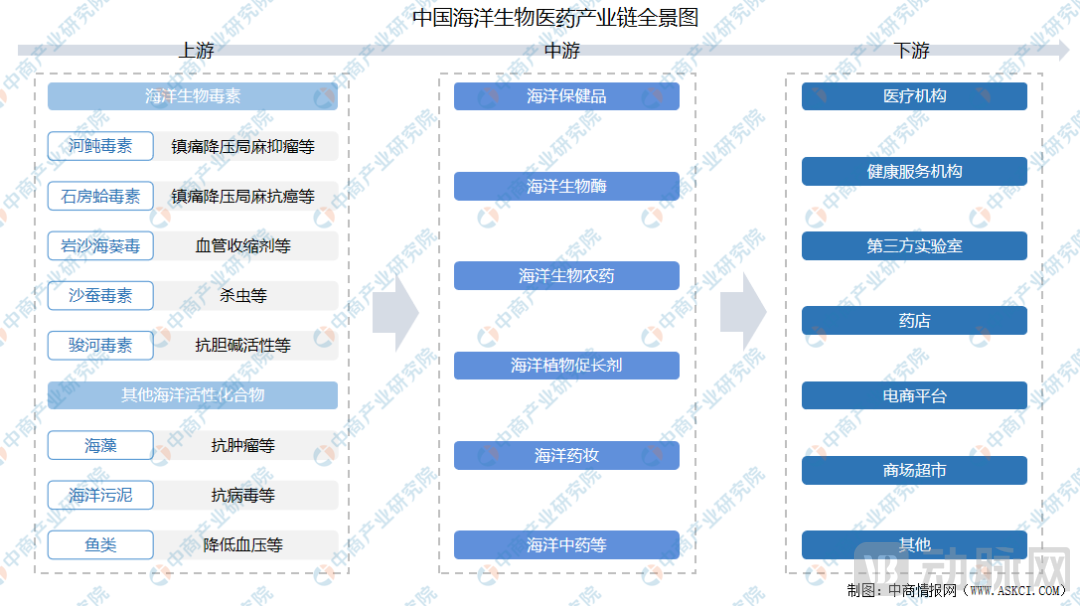 Panorama of China's Marine Biopharmaceutical Industry Chain (Image Source: AskCI)
Currently, China’s marine pharmaceutical industry has established a complete industrial chain encompassing extraction and development, product development, and commercial sales.Upstream activities primarily encompass the development, extraction, and research of marine biological resources, including the characterization of physicochemical properties of novel compounds and the exploration of their metabolic bioactivities. Subsequently, attention shifts to assessing the commercialization potential of these novel compounds, with key development areas spanning chemical drugs, biologics, food products, agrochemicals, health supplements, and cosmetics. Downstream, mature commercialization channels include medical institutions, third-party laboratories, pharmacies, health service providers, e-commerce platforms, and shopping malls and supermarkets.
Prior to 2000, only three marine drugs had been approved for market launch by the U.S. Food and Drug Administration (FDA), all of which were derived from secondary metabolites and their derivatives sourced from sponges. More than a decade into the 21st century, this number had risen to nine, and the global market value of marine drugs exceeded US$8 billion in 2018 (Source: Ministry of Natural Resources & Science Popularization China).
The rapid emergence of this achievement in the current century is primarily attributable to the fact that major developed countries and emerging economies shifted their economic and policy focus to this emerging industry at an earlier stage. The countries with a relatively long history of research in this field globally mainly include the United States, the European Community countries, and Japan.
In 1960, the United States hosted a symposium on the biochemistry and pharmacology of marine natural products., followed by the establishment of the National Institute of Marine Medicine and Pharmacology at the Federal Institutes of Health in 1967 to guide and support national marine drug research. During this period, the United States rapidly established a number of marine biology R&D centers, among which the more prominent ones include the University of Maryland Center for Marine Biotechnology, the UCSD Center for Marine Biotechnology and Environment, and the University of Connecticut Center for Marine Biotechnology.
In terms of policy, the United States explicitly prioritizes the development of biomedicine in its federal and state legislation, offering preferential tax policies to high-tech biotechnology enterprises, including those specializing in marine biomedical technologies. Regarding fund utilization, annual funding for research and development of marine biopharmaceuticals is required to reach at least $100 million, with an annual growth rate of no less than 10%.As of 2021, the United States had 190 patents related to marine biopharmaceuticals. At least 30 marine-derived products targeting HIV/AIDS and bacterial infections have entered preclinical trials, with five of these products projected to achieve a market value of up to $2 billion.
In the late 1980s, the European Community established the Marine Science and Technology (MAST) Programme, which prioritized funding for projects focused on the discovery and exploration of novel drugs from marine biological resources., since 1992, it has achieved exceptionally fruitful and significant scientific research outcomes. Publicly available materials indicate that countries within the European Community have formulated various plans and safeguard measures for the marine biological industry in accordance with their respective national circumstances. In 2012, the European Union once again invested substantial research funding in “research on exploring marine organisms for industrial product manufacturing” and “research on improving the efficiency of cultivating marine microorganisms.”
Japan is the country in Asia with relatively rapid development in marine biology research.Japan has chosen to promote the development of the marine biomedical industry by centering on universities and national and public research institutions, with related research organizations and R&D-oriented enterprises as constituent units, thereby leveraging knowledge-intensive roles.It is reported that the Japan Marine Biotechnology Institute was established in the 1980s. Currently, the institute and the Japan Agency for Marine-Earth Science and Technology (JAMSTEC) collectively spend an average of over US$100 million annually on research and development of marine drugs, providing significant support to the development of Japan’s marine biomedical industry.
Summarizing the overseas industrial development experience, it is inseparable from the establishment of research institutes and the guidance of policies and regulations. Although China's marine strategic emerging industries started relatively late, butSince the National Science and Technology Conference in 1978 put forward strategic concepts such as “developing marine and lacustrine resources and establishing China’s blue pharmaceutical industry,” the cultivation and development of China’s marine biomedical industry have been accelerating.。
In 2004, the State Oceanic Administration launched a special project for the survey and assessment of China’s offshore marine biological resources, also known as the “908 Special Project.” Over a period of five years, it conducted a systematic survey of offshore marine biological resources from south to north.In 2018, Academician Guan Huashi of Ocean University of China initiated and launched the "Blue Pharmacy" Development Program in China., proposed a Deep Marine Resource Development Plan aimed at the rise of the marine biomedical industry, guided by the creation of new marine drug products, and gathering internationally top-tier marine drug R&D teams based on nearly 80 years of global experience and achievements in marine drug research and development. This plan seeks to systematically, comprehensively, and orderly develop marine medicinal biological resources, opening a new chapter for China's marine biomedical industry.
Supported by two rounds of national demonstration projects for the innovative development of the marine economy during the 12th and 13th Five-Year Plan periods, a number of scientific and technological achievements have been commercialized, driving steady industrial growth. According to data from the Ministry of Natural Resources, the value added of China’s marine biopharmaceutical industry was approximately RMB 38.5 billion in 2017 and reached about RMB 49.4 billion in 2021, representing an 18.7% year-on-year increase.
In terms of scientific research teams, a large number of research institutions focused on marine biomedical industry research have begun to emerge, including the Third Institute of Oceanography, Ministry of Natural Resources; the Engineering Technology Innovation Center for Development and Utilization of Marine Biological Resources; the Key Laboratory of Marine Genetic Resources; the Institute of Oceanology, Chinese Academy of Sciences; the Institute of Marine Drugs, Peking University; the School of Medicine and Pharmacy, Ocean University of China; the Ningbo Institute of Marine Drugs, Peking University; the Qingdao Institute of Marine Biomedicine; and the Ningbo Institute of Oceanography (listed in no particular order).From “National Teams” to “Local Representative Teams,” China’s Medical Research Achievements in Marine Biology Begin to Report Frequent Successes.
For marine plants such as algae, polysaccharides and oligosaccharides are the primary focus of industry research, whereas for marine animals, the main research focuses on related peptides, oligopeptides, lipids, and other components.To date, major research teams in China have developed drugs from the bodies and metabolites of marine animals and plants—such as kelp, seaweed, sea squirts, cone snails, and clams—to treat conditions including cancer, kidney failure, diabetes, and Alzheimer’s disease, as well as non-addictive analgesics.
In the late 1990s, marine biotechnology research was officially included in the National 863 Program, and a series of major marine biotechnology projects were subsequently launched, driving the rapid development of China’s marine biomedical technology.
With the production and market launch of a large number of marine drugs (functional foods) possessing independent intellectual property rights, China has accelerated the industrialization of scientific and technological achievements in marine biomedicine, giving rise to a cohort of high-tech enterprises in this sector and rapidly expanding the industry’s scale.
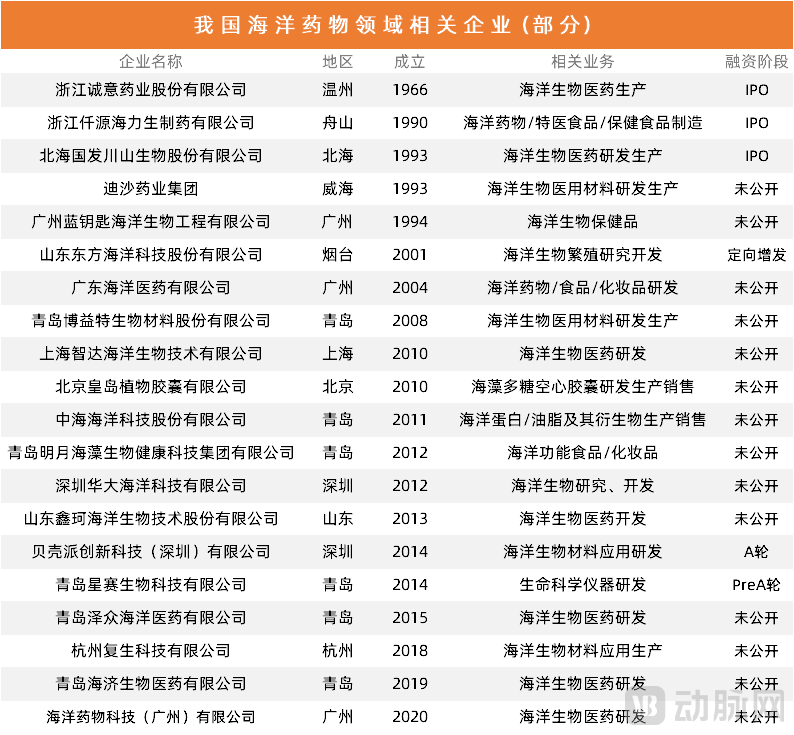
Some Relevant Enterprises in China's Marine Drug Sector
(Data source: Compiled by VCBeat based on public information)
VCBeat’s compiled statistics reveal that marine drug-related enterprises in China are currently concentrated mainly in Shandong, Zhejiang, Guangdong, and Guangxi. The primary business models adopted by companies in this sector span pharmaceuticals, biomaterials, diagnostic testing, health supplements, cosmetics, and foods for special medical purposes.
There are significant differences in business models between companies established in the marine drug sector in the late 1990s and those founded after the 2010s. TakingDISHA PHARMACEUTICAL、Qianyuan Hailisheng、Gofar SharesEarly-stage enterprises represented by such companies have overall businesses that more closely resemble the development and production of traditional generic chemical drugs,Marine drug-related products serve as the sole or few flagship products that generate commercial benefits for the company.. However, these companies were established earlier,The capabilities in factory setup, production, and sales are well-established, with a mature supply chain system in place.。
“Data from the ‘In-depth Research and Investment Strategic Planning Analysis Report on China’s Marine Biopharmaceutical Industry (2013-2017)’ shows that during 2011–2020, supported by the national marine development strategy, China’s marine economy will enter a period of comprehensive improvement, with emerging marine industries demonstrating significantly greater potential than traditional marine industries.”
Indeed, this holds true. With the rapid development of various technologies in China over the past decade, the country has made remarkable strides in areas such as marine resource exploration and biomedical research and development.Under this trend, marine pharmaceutical companies place greater emphasis on innovative application research of new marine organisms and novel compounds.Corporate research subjects are gradually expanding from common marine plants, such as kelp and seaweed, to marine animals with more complex life metabolisms, including sea hares and clams. The scope of research is also advancing from shallow seas to the deep sea, and evolving from individual-level studies to ecological research. Meanwhile, gene sequencing technologies for marine organisms are developing rapidly, with improvements ranging from detection equipment and reagents to the refinement of various biological genetic maps. Major innovative enterprises are engaging in differentiated competition in this field.
Data released by China’s Ministry of Natural Resources in November 2021 showed that the country’s marine economy was on a steady path to recovery, with market demand gradually picking up. Preliminary calculations indicated that the gross ocean product reached RMB 6.2 trillion in the first three quarters of 2021, representing a year-on-year increase of 9.5%. According to officials from the National Marine Data and Information Service of the Ministry of Natural Resources, emerging marine industries continued to recover rapidly. The marine pharmaceuticals and biological products sector demonstrated strong profitability, with over 70% of key monitored enterprises reporting year-on-year revenue growth for the year. Moreover, market vitality steadily improved, as evidenced by 13,743 newly registered enterprises in key monitored marine industries, an 8.3% year-on-year increase.
Notably,Although interest in this sector is gradually rising, news regarding investment and financing remains scarce.In addition to a batch of traditional pharmaceutical companies established in the last century, such as Chengyi Pharmaceutical, ZHEJIANG HAILISHENG PHARMACEUTICAL CO., LTD., Beihai Gofar Chuanshan Biological Co., Ltd., and Dongfang Ocean, which have already been listed,Currently, only four innovative companies—Xinke Ocean, eCyte, Zezhong Ocean, and Haiji Biologics—have been found to have secured financing.. These financings mainly came fromHaofang Venture Capital、Zhongquan Dingxin、Neovision Capital、Hengji Investment、Qingdao Venture Capital、Jufeng Sci-Tech Innovation、Jiuding Investmentand other institutions.
Currently, the larger and more steadily developing enterprises in China’s marine drug sector share a common characteristic: they are not only capable of utilizing and producing related resources but also possess advanced biotechnological capabilities in exploration, research, development, and application.
withShandong Dongfang Ocean Sci-Tech Co., Ltd.(hereinafter referred to as "Dongfang Ocean") as an example, the company was established in 2001 and later listed on the Shenzhen Stock Exchange in 2006 (SZ: 002086). Dongfang Ocean’s business primarily covers ecological aquaculture in marine ranches, processing and export of aquatic products as well as deep processing, the big health industry, bonded logistics, and recreational fisheries. The company is organized into two strategic business segments: the “Marine Business Division” and the “Big Health Business Division.”
In the marine sector, according to the company’s official website, kelp, seaweed, and sea cucumber are the primary subjects of its marine biological research, through which it has achieved a series of research outcomes.In addition to upstream activities such as kelp germplasm preservation, breeding, and seedling propagation, the company has established a domestic first-class germplasm resource bank for large seaweeds. It has successfully developed five national-level new kelp varieties and one national-level new sea cucumber variety, completed whole-genome sequencing of kelp, and established a genomic sequence information platform., laying the foundation for subsequent related research. Meanwhile,The company has also established multiple scientific research platforms, including the Engineering Technology Research Center for Seaweed and Sea Cucumber. Leveraging its advantages in environmental resources and aquaculture, it has developed a series of marine-specific medical foods, innovative drugs, and modern marine biological products with independent intellectual property rights, such as sea cucumber peptides, collagen peptides, and kelp collagen.。
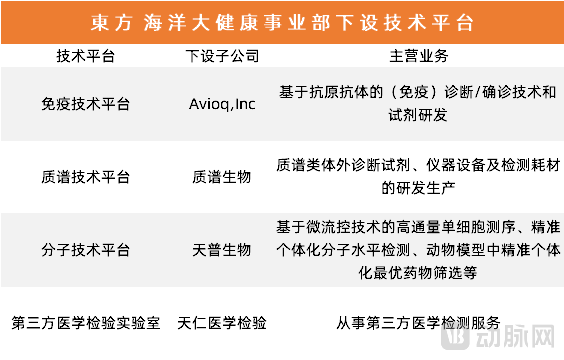
The General Health Division of Oriental Ocean comprises technical platforms and their corresponding subsidiaries (Source: Corporate Website)
Oriental Ocean’s Health Division focuses onMass Spectrometry Diagnostics, Immunodiagnostics, Molecular Diagnostics, Third-Party Medical Testing Laboratoriesand other technological platforms. This business unit oversees six subsidiaries, representing a major strategic initiative by the company to expand from marine resource research into medical industry research.
Among innovative enterprises, BGI Ocean’s business model is relatively similar to that of Oriental Ocean.BGI Marine demonstrates more prominent research strengths in bioinformatics analysis, molecular breeding, and aquatic organism big data. The best testament to this is its publication of over 100 SCI-indexed papers and the scientific research services it has provided to institutions such as the Chinese Academy of Fishery Sciences, Sun Yat-sen University, Xiamen University, Hainan University, Hainan Tropical Ocean University, Hainan Academy of Ocean and Fisheries Sciences, and the Guangdong Provincial Marine and Fishery Experiment Center.
Most notably, BGI Marine’s de novo genome sequencing technology deserves special mention.Genomic sequencing serves as the foundation for studying the molecular biology of species. This technology enables reference-free whole-genome sequencing and de novo assembly of marine animals, thereby generating a comprehensive genomic map of the target species. Whole-genome sequencing not only yields the complete genomic sequence of the species but also lays the groundwork for subsequent investigations into species-specific traits, adaptations to unique marine environments, and distinctive physiological characteristics.
In addition to basic scientific research, BGI Marine’s initiatives—including the “Transcriptome Project for 1,000 Fish Species,” the “‘Ten-Hundred-Thousand’ Omics Breeding Program for Aquatic Organisms,” the “Yangtze River Basin Species Resource Bank Project,” the “Aquatic Organism Big Data Project,” and the “Fish Antimicrobial Peptide Database Project”—have also made significant contributions to industrial development.In collaboration with research institutions, it has established extensive databases covering physiological, genomic, molecular biological, medical value, aquaculture, seed industry, market, and industrial data of marine organisms, laying a crucial foundation for the standardized, efficient, and scientific development of the industry.
Innovative enterprises are injecting new technologies and methodologies, driving China’s marine biomedical industry to evolve from a focus on single-compound development and application toward an ecosystem-based industrial model. In the future, a broader range of marine-derived substances will be developed into novel applications across innovative drugs, biotechnology, in vitro diagnostics (IVD), and other sectors.
For example, the top 10 gene editing companies globallyPrecision BioSciences, Inc.(NASDAQ:DTIL) ,The key to its proprietary ARCUS genome editing technology is the I-CreI endonuclease discovered in the alga Chlamydomonas reinhardtii.Unlike gene-editing technologies such as ZFNs, TALENs, or CRISPR/Cas9, the natural enzyme I-CreI can be evolved to edit large and complex genomes. In nature, it is responsible for modifying specific sites in algal genomes by inserting genes through the HDR process.
Two scientists at Precision BioSciences identified the inherent advantages of the I-CreI endonuclease, including precise target editing, a compact and simple structure, and efficient DNA repair. By continuously re-engineering I-CreI to confer distinct DNA recognition specificities, they developed the ARCUS genome editing technology. This technology enables “gene-for-gene replacement,” allowing the currently prominent CAR-T therapy manufacturing process to be completed in a single step. In June 2022, the company announced an exclusive collaboration with Novartis on gene therapies for hemoglobinopathies. Prior to this, the company had engaged in deep collaborations with major pharmaceutical companies and academic institutions, including Eli Lilly, Duke University, and the University of Pennsylvania, achieving significant results in research on Duchenne muscular dystrophy, relapsed/refractory (R/R) multiple myeloma, and hepatitis B virus.
In other words, the potential for marine biomedical research may still have room to expand.
Regarding the future development of China’s marine pharmaceutical industry, “acceleration” and “positive momentum” are beyond doubt; yet the critical questions remain: “How to accelerate?” and “In what direction should it progress?”
Returning to the fundamental process of marine drug development, every stage—including resource exploration, target selection, component analysis, structural modification, pharmacological evaluation, activity studies, process development, preclinical and clinical research, and commercial translation—requires support in terms of talent, technology, policy, and funding.
However, unlike the broad field of innovative drug research, the development of marine drugs involves unique considerations regarding “timing, geographic advantage, and human harmony.”Environmental changes such as seasons and daylight hours, geographical features including sea areas and ocean currents, as well as the requirements for specialized exploration and extraction equipment and personnel, determine the unique barriers to entry in this sector.
Nowadays, the number of university majors and research institutes dedicated to marine biology is steadily increasing. China has already established a foundational talent pool, and with the favorable policies in coastal regions such as Shandong, Zhejiang, Guangdong, Guangxi, and Fujian, research achievements generated under the “industry-academia collaboration” trend will gradually come to fruition.
In the past, China's marine resources were primarily utilized for the development of traditional chemical drugs and the production of generic medicines.With the advancement of biotechnology and the favorable clinical performance of cell and gene therapy (CGT), the medical community’s demand for marine resources is no longer limited to chemical drug molecules such as peptides and carbohydrates. A broader range of compounds and microorganisms are now expected to be utilized in fields including biopharmaceuticals, life science tools, diagnostic reagents, and contrast agents.。
However, the development of such products relies heavily on foundational biotechnologies, including synthetic biology, gene editing, and proteomics. In China, certain segments of this industry are still in their early to mid-stages of development; beyond the need to validate technical efficacy, breakthroughs in some underlying patents remain pending.This represents a key challenge in the current development of marine drugs, but it can also serve as a breakthrough point for industry advancement.