

Digital Health Community: Revitalizing Grassroots Healthcare through Mechanism and Digital-Intelligence Innovation
“In the past, I only visited the community hospital to pick up prescriptions. Now, I receive offline management from community physicians and online services from health managers, who remind us to monitor blood glucose, measure blood pressure, and record data. We also receive guidance on diet and exercise, as well as access to home-based medical services,” said Mr. Qian, a resident of Hebei District in Tianjin. “Over the past six months, my blood glucose has been well controlled through care at the community hospital. By following the dietary and exercise recommendations, I have also lost a significant amount of weight, and I feel much lighter overall.”
To date, more than 110,000 patients with diabetes, like Mr. Qian, have chosen to sign contracts with member units of the Tianjin Primary Care Digital Health Consortium, confidently entrusting the management of their chronic conditions to community hospitals. This figure accounts for more than half of all patients enrolled under Tianjin’s “Diabetes Health Stewardship Responsibility System.” It can be said that primary healthcare institutions in Tianjin have effectively served as “health gatekeepers” in the management of chronic diseases.
Generally, primary healthcare institutions suffer from relatively weak resource allocation and medical service capabilities, leading patients to prefer visiting “large hospitals.” In Tianjin, however, the Digital Health Community has not only strengthened the service capacity of primary healthcare institutions but also enhanced the service awareness of grassroots medical staff. This has changed public perception, encouraging residents to seek care at “hospitals near their homes,” thereby promoting more balanced development of medical services across the entire Tianjin municipality.
How do such changes occur? What has the Digital Health Community done? Through mechanism innovation and digital-intelligence empowerment—this “innovative prescription”—the Digital Health Community is making primary healthcare services more aligned with public needs and injecting new vitality into the primary healthcare service system.
Mechanism Innovation: Starting from “1+266,” Charting a Five-Stage Roadmap
“Thanks to the significant role of digital technologies and platforms in promoting the comprehensive digitization of all elements of healthcare services and facilitating the transformation and upgrading of medical models, the Digital Health Community offers a new pathway for ‘strengthening primary care.’” The 2023 New Social Governance Think Tank Report, *Digital Transformation and Governance Reform*, points out that the intrinsic logic of the Digital Health Community lies in leveraging digital platforms to improve the coordinated mechanism among health insurance, medical services, and pharmaceuticals (the “Three-Medical Linkage”), thereby empowering primary healthcare services and governance.
As a pioneering exploration in the digital and intelligent upgrading of primary healthcare service systems, the Digital Health Community has established clear practical objectives and pathways since its initial planning and construction phase. Overall, it is divided into five stages: “Building an Integrated Healthcare Service System,” “Digitally and Intelligently Upgrading Primary Healthcare Services,” “Implementing Standardized Single-Disease Management,” “Conducting Multi-Disease Management for Key Populations,” and “Exploring Diversified Services Combining Medical Insurance and Commercial Insurance.”
Taking Tianjin’s practice as an example, the development of the Digital Health Consortium aims to establish a healthcare service system based on “payment for outcomes.” Starting with the “1+266” model, it has consistently advanced along the path of “digitally and intelligently integrating medical care, health insurance, and pharmaceuticals to maximize the utility of health insurance funds,” thereby facilitating the transition of primary healthcare services from a “volume-based (treatment) payment” mechanism to an “outcome-based (health) payment” mechanism.
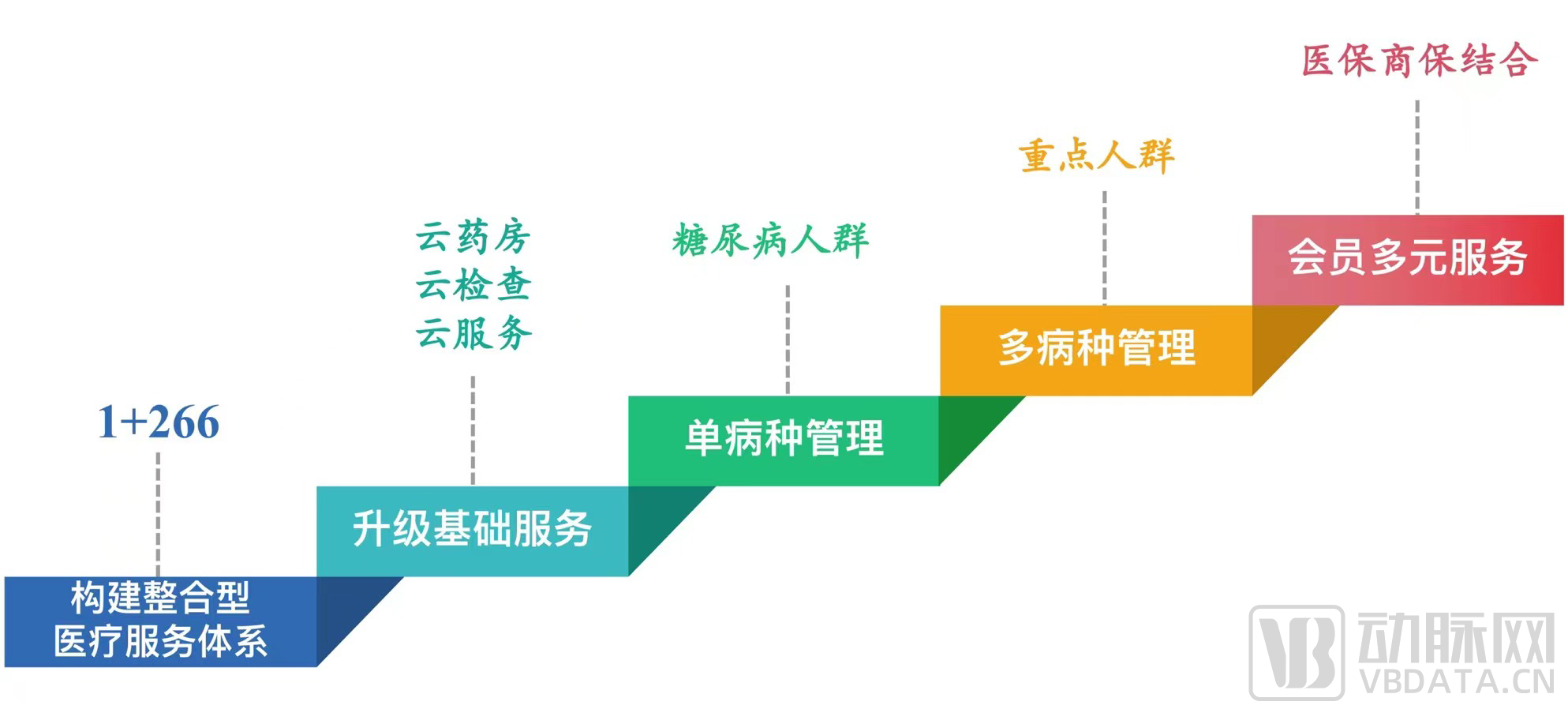 Figure: Five Development Stages of Tianjin Digital Health Community
In April 2020, under the leadership of the Tianjin Municipal Health Commission, Tianjin WeDoctor Internet Hospital took the lead in collaborating with 266 primary healthcare institutions across the city to establish a closely-knit internet medical consortium—the Tianjin Primary Care Digital Health Community—initiating the construction of an “integrated healthcare service system” at the primary care level.
Subsequently, the Tianjin Digital Health Community successively deployed unified platforms for “Cloud Management,” “Cloud Services,” “Cloud Pharmacy,” and “Cloud Diagnostics” across 266 primary healthcare institutions, thereby completing the second phase of “digital and intelligent upgrading of primary healthcare services.” Meanwhile, by co-establishing offline standardized chronic disease management centers with these primary healthcare institutions and assigning health managers to assist family doctor teams at the grassroots level, it has better leveraged digital and intelligent technologies and platforms to provide comprehensive patient care.
During the development phase of Tianjin’s Digital Health Community, the most commendable aspect lies in the innovative spirit of local government departments and relevant primary-care pilot medical institutions, which have demonstrated the courage to experiment and break new ground. This has been key to enabling the Digital Health Community to transcend entrenched interest barriers and achieve scalable, positive growth.
Particularly during the phase of constructing “standardized single-disease management practices,” with diabetes management as the entry point, Tianjin Digital Health Consortium began exploring payment method reforms centered on “disease-based and capitated bundled payments” under medical insurance, while correspondingly improving the performance evaluation mechanisms for primary care healthcare professionals. Ultimately, the Digital Health Consortium achieved outcome-based payment for medical services at the primary care level, laying a solid foundation for Tianjin to take the lead in “comprehensively promoting the health stewardship responsibility system for diabetes.”
Through advancement across the first three phases, the Tianjin Digital Health Community has established a primary care-based health management and care system that spans residents’ entire life cycles and all stages of health. It has also achieved value-based healthcare payment for single diseases, where payers reimburse based on predetermined costs tied to health outcomes, thereby effectively driving the transformation of medical services from a “disease-centered” to a “health-centered” model.
Currently, the Tianjin Digital Health Community has entered the construction phase of “implementing multi-disease management for key populations.” It is reported that, in addition to the ongoing diabetes management program, key populations with hypertension, coronary heart disease, and cancer will be gradually incorporated into the health management framework of the Digital Health Community. Furthermore, innovative medical insurance payment models, such as “global bundled payment,” will be explored and piloted within the family doctor contracted services. On this basis, the Digital Health Community will simultaneously explore diversified services integrating basic medical insurance with commercial health insurance, aiming to meet residents’ multi-level and diverse healthcare needs.
Digital Intelligence Empowerment: Bringing AI to the Grassroots and Building Five Core Digital-Intelligence Capabilities
“Under given constraints, it is difficult for healthcare systems to simultaneously achieve ‘improved quality of care, increased accessibility, and reduced costs.’” In response to traditional healthcare systems, William Kissick, a professor at Yale University, proposed the famous “Impossible Trinity,” suggesting that only by introducing new technological and model innovations can this dilemma be resolved.
In addition to institutional innovation, digital-intelligent technologies and platforms have been vigorously introduced as new technological increments during the construction of the Digital Health Community, integrating into all aspects of “medical care, pharmaceuticals, testing, health management, and administration.”
Taking Tianjin’s Digital Health Community “Four Clouds” platform as an example, the platform is functionally divided into four components. “Cloud Management” serves as a unified management platform for various entities and medical services within the health community, enhancing managerial efficiency. “Cloud Services” provides residents with multi-form, multi-tiered medical and health management services, improving service delivery efficiency. The establishment of “Cloud Pharmacy” has significantly strengthened the drug supply guarantee capacity of primary healthcare institutions. “Cloud Diagnostics” facilitates a service model characterized by “primary-level testing and upper-level diagnosis,” enabling mutual transmission and recognition of test results and the sharing of high-quality medical resources.
Meanwhile, the healthcare sector is among the earliest fields to adopt artificial intelligence, ranging from AI-assisted medical imaging diagnosis to clinical decision support systems. Given the current inability to overcome the scarcity of high-quality medical resources, digital health communities serving primary care have become an ideal application scenario for medical AI.
Aligned with the “Four Clouds” platform, the Digital Health Community has applied appropriate artificial intelligence technologies across various stages of healthcare services to build five digital-intelligence capabilities for the primary healthcare system: “medical care, pharmaceuticals, diagnostics, health management, and administration.” These capabilities support the enhancement of service capacity and quality in primary healthcare institutions, achieving remarkable results in reshaping service workflows, service models, and management paradigms at the primary care level.
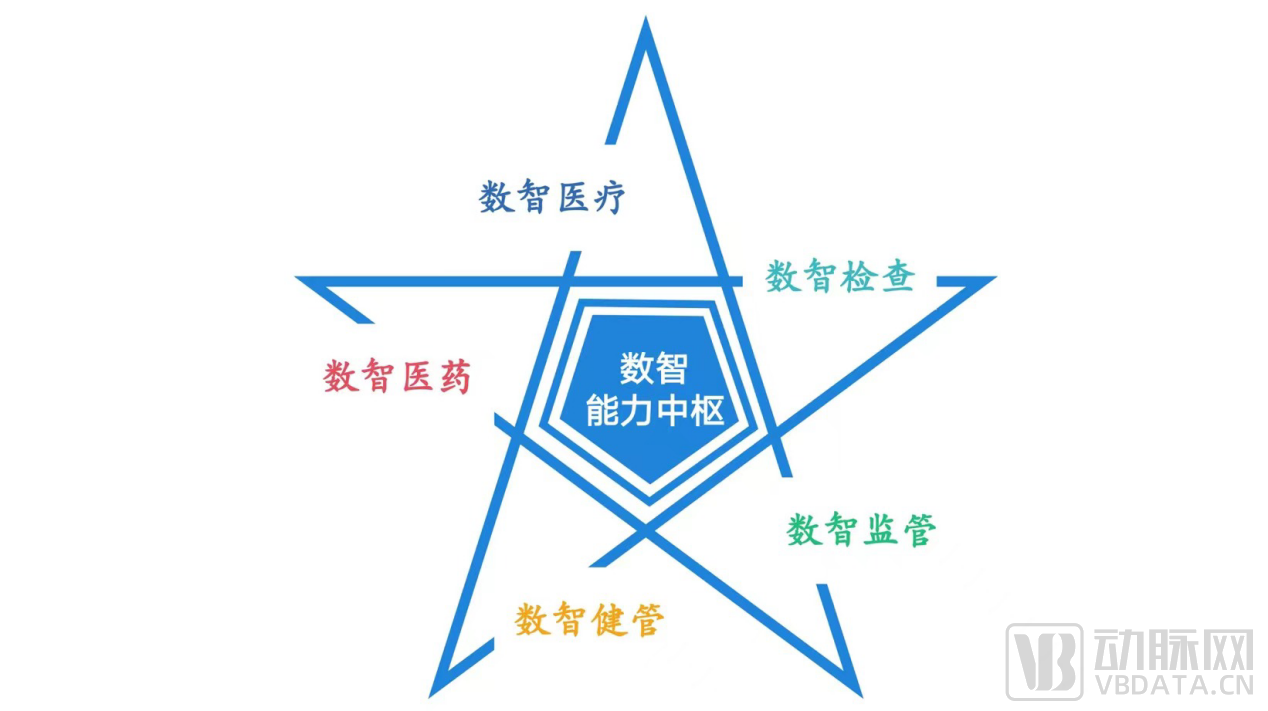 Figure: Five Digital-Intelligent Capabilities of the Digital Health Community
First, in the realm of digital-intelligent healthcare, the Digital Health Community enhances standardized service capabilities at the primary care level on a disease-by-disease basis through specialized AI diagnosis and treatment systems. Meanwhile, in digital-intelligent pharmaceutical services, the Digital Health Community leverages AI-driven pharmaceutical care to achieve unified drug supply assurance, unified prescription review, unified drug procurement, and unified medication guidance, thereby comprehensively improving primary care institutions’ capacity for drug supply stability and rational drug use. Furthermore, digital-intelligent diagnostics and testing expand the range of laboratory and imaging services available at primary care institutions by providing integrated hardware-and-software AI-assisted diagnostic technologies, thus enhancing their diagnostic and testing capabilities. In addition, digital-intelligent health management boosts primary care health management capabilities through an “AI + Health Coach” model, increasing the individual efficiency of health coaches by 150%.
Building on its comprehensive empowerment of the supply side of medical services, the Digital Health Community also empowers regulatory bodies through digital and intelligent systems. By enabling real-time monitoring of the community’s operations, it has established integrated capabilities for monitoring and management, encompassing health insurance fund administration, medical quality oversight, as well as the monitoring, assessment, and performance management of health indices.
According to public information, 266 primary healthcare institutions in Tianjin completed “end-to-end” digital upgrades in 2021, achieving comprehensive data connectivity and integrated operational monitoring and management. As of December 2022, the Tianjin Primary Digital Health Consortium had signed chronic disease management cooperation agreements with 204 primary healthcare institutions and seven secondary hospitals, and was progressively co-establishing chronic disease management centers. More than 1.68 million patients have been enrolled in health records for managed care, and over 110,000 diabetes patients have been contracted into the program and placed under the specialized outpatient health stewardship responsibility system for diabetes.
Meanwhile, Tianjin’s Digital Health Community has leveraged digital intelligence technologies and platforms to achieve standardized diagnosis and treatment, facilitate collaboration between primary and secondary care physicians, support clinical decision-making through Clinical Decision Support Systems (CDSS), and enable whole-course patient management along with health indicator monitoring. As the initiative advances, with the aim of “enhancing quality and improving efficiency,” more emerging digital intelligence technologies will be integrated into the Digital Health Community.
Construction Effectiveness: Achieved “Two Increases and One Decrease,” achieved scaled profitability within three and a half years, and expanded promotion across 20 provinces (municipalities).
“Our family doctor teams proactively provide contracted patients with regular health guidance, disease monitoring, and complication screening services, while also responding in real time to their service needs online,” said Wang Jinbo, a health manager deployed by the Tianjin Digital Health Community to primary healthcare institutions. “Our service goal is to keep patients healthy, minimizing the incidence of minor illnesses and preventing severe diseases.”
This reflects the effectiveness of the “mechanism innovation + digital intelligence empowerment” model adopted by the Digital Health Community. In addition to shifting the service mindset of primary healthcare workers, the Digital Health Community has achieved the “two increases and one decrease” outcome at the grassroots level: an increase in residents’ health indicators, an improvement in the diagnostic and treatment capabilities of primary hospitals, and a reduction in medical insurance expenditures.
Taking Tianjin’s Digital Health Community as an example, after incorporating primary healthcare institutions into contracted management, the rate of patients achieving target glycated hemoglobin (HbA1c) levels increased by 22.9%, the blood pressure control rate rose by 19.9%, and the lipid profile control rate improved by 13.3%. Meanwhile, the latest data show that in April 2023, outpatient visits at primary healthcare institutions within the Digital Health Community increased by 23% year-on-year, with 86% of contracted diabetes patients returning to primary care for treatment. Furthermore, from January to June 2023, the overall surplus rate of medical insurance funds for contracted diabetes patients exceeded 20%.
Owing to its remarkable effectiveness and exemplary impact, the Digital Health Community has remained a focal point for all stakeholders as China accelerates the upgrading of its primary healthcare service system. At the 2021 National Conference on Promoting Experience in Deepening Healthcare Reform, Tianjin’s Primary Care Digital Health Community was ranked first among the “Top Ten New Initiatives to Advance Healthcare Reform and Serve Public Health.” In April 2022, five central government departments, including the Cyberspace Administration of China, the Ministry of Agriculture and Rural Affairs, and the National Development and Reform Commission, explicitly proposed “guiding localities to explore the development of primary care digital health communities.”
The series of achievements made by the Digital Health Community in promoting the digital and intelligent upgrading of primary healthcare services have also gained market recognition. Public information shows that as early as June 2022, less than 30 months after its construction and operation began, the daily outpatient volume of Tianjin’s Digital Health Community had exceeded 10,000 visits, with monthly revenue surpassing RMB 100 million. Its service scale and revenue level were comparable to those of large Grade A tertiary hospitals. To date, after three and a half years of construction and operation, Tianjin’s Digital Health Community has achieved profitability at scale, demonstrating growth potential and breakthrough effects far exceeding those of traditional hospitals.
Currently, the Digital Health Community has achieved standardization in its construction processes, mechanism design, supporting systems, and business operations. It has been implemented in five provinces and municipalities—Tianjin, Shandong, Shanghai, Zhejiang, and Jiangxi—and is rapidly expanding into 15 other provinces, including Sichuan, Hainan, and Heilongjiang, presenting a widespread development landscape. Notably, Shandong and Tianjin have reached the third and fourth stages of construction, respectively, characterized by “standardized single-disease management practices” and “multi-disease management for key populations,” thereby achieving scalable operational growth.
In this context, the Digital Health Community has launched the “Digital Health Community Open Cooperation Initiative,” sharing its standardized development expertise and capabilities with partners. It offers an empowerment ecosystem comprising the “Intelligent Medical Center,” “Pharmaceutical and Medical Device Trading Center,” and “Health Management Academy” to enable systematic operations and scalable replication of the Digital Health Community in more regions. This initiative aims to facilitate the digital and intelligent transformation of millions of primary healthcare institutions, ensuring that the health benefits derived from mechanistic innovation and digital-intelligent empowerment reach a broader base of the population.