

IBT Infibraintech Files IPO Prospectus: Pioneering Digital Therapeutics for Pediatric ADHD in China
Rushing recklessly through public spaces and making loud noises; frequently interrupting others during conversations; either acting disruptively or daydreaming in class... Such "unruly children" are often perceived as being naturally mischievous. However, excessively hyperactive children may very well be suffering fromAttention Deficit Hyperactivity Disorder(ADHD), commonly referred to in daily life asADHD。
Screening and Treatment of ADHD: Persistent Clinical ChallengesDue to limited public awareness of attention-deficit/hyperactivity disorder (ADHD), many children with the condition are not diagnosed before school age, as parents often attribute their behavior to mere mischief. It is only after these children enter elementary school and exhibit problems such as classroom indiscipline or learning difficulties that parents begin to realize their child may be “different.”
Data from the first “Epidemiological Survey of Mental Disorders in Chinese Children and Adolescents,” released in 2021, show that the number of children with ADHD in China has reached as many as23 million people, yetOnly62%of children with ADHD receive oral pharmacotherapy. Among those undergoing treatment, 20%–50% exhibit poor or no response to medication, or experience adverse reactions. If timely intervention is not implemented, 30%–50% of ADHD symptoms will persist into adolescence, or evenLifelong Companion。
To this end,Dr. Sun Wei, Founder and Chairman of IBT Infinite Brain TechnologiesTo provide digital, full-course solutions for child and adolescent psychiatric and psychological disorders, including ADHD, “making effective mental health services readily accessible.”
I. When ADHD Meets Digital Therapeutics
The three-year pandemic spurred explosive growth in numerous healthcare sectors,Digital Therapeuticsis one of them.
With the widespread adoption of mobile internet technologies and devices, digital therapeutics have transitioned from concept to reality. Their mobility and ubiquity help, to some extent, alleviate the strain on medical resources and reshape patients’ treatment and consultation habits.
First, digital therapeutics can be delivered via computers, smartphones, wearable devices, and other platforms.Remote Intervention Unconstrained by Time and Location, reducing the time and energy patients expend by repeatedly traveling between hospitals or offline orthodontic clinics. Secondly, the serious yet gamified design of digital therapeutics has also significantly improved patients'Engagement and Adherence. Furthermore, digital therapeutics can leverage artificial intelligence and big data to customize for patientsPersonalized Intervention Model. Finally, for the healthcare industry, due to digital therapeuticsMarginal costs are very low, thereby enabling an expansion of the scope of treatment without the need for expanding medical resources, thus improving the accessibility of therapeutic interventions.
Currently, clinical trials have demonstrated that digital therapeutics can be equivalent to conventional pharmaceuticals and treatments, providing patients with disease management and therapy based on evidence-based medicine. Furthermore, when combined with other therapies, they can even produce a synergistic effect greater than the sum of their parts (1+1>2).
During the pandemic, the prevailing restrictions on outdoor activities amplified the advantages of digital therapeutics and spurred countries to accelerate the approval of digital therapeutic products. In June 2020, the FDA approved the prescription digital therapeutic “EndeavorRx” as a “video game prescription,” marking it as the world’s first approved digital therapeutic product for the treatment of ADHD, and alsoDigital Therapeutics Products Approved for the First Time as “Prescription Drugs” in Medical Treatment。
Following closely, China approved its first digital therapeutic product in November 2020, marking the launch of a new track for digital therapeutics in the country.
Professor Xue Gui, State Key Laboratory of Cognitive Neuroscience and Learning, Beijing Normal UniversityWith decades of in-depth expertise in the cognitive and neural mechanisms underlying human learning and memory, he has been dedicated to researching human cognitive capabilities and improving cognitive impairments. At this critical juncture as digital therapeutics enter the market, Professor Xue, together with partners who possess extensive entrepreneurial experience and a deep understanding of the market,Dr. Wei Sun, Dr. Leibo ZhangCo-founded IBT Infinite Brain Technologies, a brain science-driven smart healthcare company focused on mental health services for children and adolescents. Furthermore, IBT Infinite Brain Technologies has assembled a core team of top-tier global talent in brain science, medicine, psychology, and computer science from prestigious institutions including the University of Chicago, Stanford University, the Massachusetts Institute of Technology, Johns Hopkins University, Peking University Sixth Hospital, and Beijing Tiantan Hospital, Capital Medical University.
As co-founder, Dr. Zhang Leibo told VCBeat’s Orange Fruit Bureau: “Whether in the broader healthcare landscape or in market trends, it can be said thatThe establishment of IBT Infinite Brain Technologies was timed to perfection.”
II. “Screening-Treatment-Prognosis” Closed-Loop Service
IBT Infinite Brain Technologies primarily focuses on three major product directions: the Cognitive Neuroscience LAB, the Emotion Research LAB, and the Artificial Intelligence LAB.
If the Cognitive Neuroscience Lab is likened to a foundation: To investigate the physiological mechanisms underlying child and adolescent mental health, and to propose solutions in areas such as executive function, thereby strengthening the physiological foundation. Therefore,The Emotion Research LAB is the building on the foundation., with an emphasis on addressing the behavioral and emotional issues caused by illness from multiple perspectives, enabling children to achieve clinically observable improvements more rapidly. Finally,The AI LAB was established to facilitate the more effective and efficient implementation of the first two research outcomes., providing "personalized" solutions.
Based on these three major product directions, IBT Infinite Brain Technologies has built a digital therapeutics platform that covers screening, treatment, and prognosis for attention-deficit/hyperactivity disorder (ADHD) in children and adolescents.
1. Screening Phase: Advance the screening age range to 3–6 years
In the diagnosis and treatment of any disease, screening is unequivocally the foremost and critical step, and this holds true for ADHD as well.
IBT Infinite Brain Technologies’ products have lowered the age range for ADHD screening candidates from children aged 6–12 years toChildren aged 3–6 years. Although children aged 6–12 express themselves more clearly and are in a high-prevalence period for ADHD symptoms, making screening easier to conduct, patients in this age group have generally entered the primary school stage. If symptoms are not controlled in time, issues such as poor learning abilities and academic underperformance may arise. This not only affects subsequent education and advanced studies but may also lead to school aversion, low self-esteem, and even more severe psychological problems due to unhappy learning experiences.
Conducting early screening during the toddler years enables timely intervention during critical developmental periods; earlier treatment initiation leads to better long-term prognosis and also spares affected children and their families from difficulties during the school-age years.
To enable children aged 3 to 6 years to undergo early screening,“Stay Seated”, Infinite Brain Technologies integrates game elements into the system. As young children complete the games, the screening system automatically evaluates and scores their cognitive functions, including attention, self-control, memory, and social skills, thereby generating highly accurate results to assess the risk of ADHD. Compared with traditional rating scales, this digital assessment approach yields more accurate results and is better suited for young children.
2. Treatment Phase: This “Game” Is Not That Game
Accurate screening during early childhood secures the optimal window for ADHD treatment. However, in China, ADHD treatment resources are mismatched with the large patient population. Beyond limited pharmacological options, institutions specializing in psychological and behavioral interventions for ADHD are scarce, being available only in select first-tier cities.
IBT Infinite Brain Technologies’ digital therapeutics platform transcends temporal and spatial constraints, enabling more pediatric patients to equitably access medical resources. During the treatment phase, IBT Infinite Brain Technologies primarily demonstrates three major advantages, namely, based onScientific Validity, based onTechnological Personalization, based onEngaging Design for High Adherence.
Given that the patients undergoing treatment are relatively young and suffer from impaired concentration due to their condition, ensuring long-term treatment adherence has become a critical determinant of therapeutic outcomes.
To address this issue, games have become the preferred choice for many digital therapeutic solutions. However, the games designed by Infinite Brain Technologies are not traditional “level-clearing thrill” games. In the words of Dr. Zhang Leibo, “I prefer to refer to the games designed by Infinite Brain Technologies as ‘“Brain Gym”。”
Just as building muscle in the gym requires repetitive training of the same muscle groups to see results, cognitive training follows a similar principle. The games developed by Infinite Brain Technologies repeatedly train the same cognitive modules in patients and provide regular reinforcement based on scientific standards to consolidate therapeutic gains.
Furthermore, regarding game mechanism design, Infinite Brain Technologies (IBT) adaptively adjusts the difficulty level based on patient performance. This approach ensures that tasks are neither too easy, which could lead to loss of interest, nor excessively difficult, which might cause patients to feel overwhelmed. By maintaining a difficulty level that is “just within reach,” patients can better sustain treatment adherence. Clinical data show that within a one-month period, adherence among IBT users reaches 92%, and the average score on the TOVA ACS (Test of Variables of Attention, where higher scores indicate improved performance on the task) improves to 0.93.
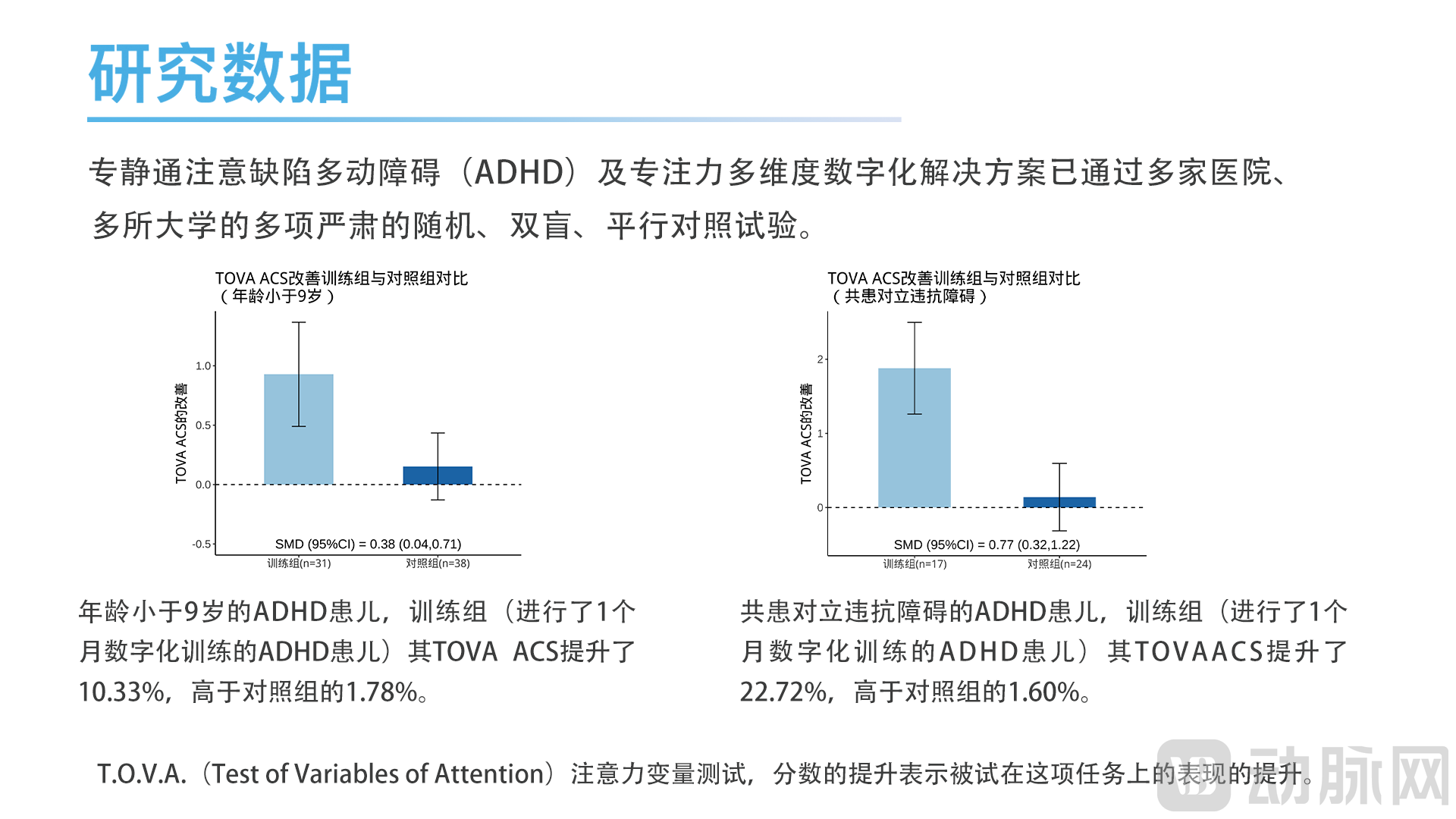 IBT Infinite Brain Technologies Research Data (Provided by Respondents)
Given that patients with ADHD often present with comorbidities such as oppositional defiant disorder, conduct disorder, and tic disorders, the management of ADHD requires not only ensuring treatment adherence but also implementingPersonalized Treatment Plan。
IBT Infinite Brain Technologies’ digital therapeutics product evaluates the current developmental level of children with ADHD by assessing five core competencies: attention, self-control, memory, perception, and cognitive flexibility. It identifies specific areas where development is relatively delayed and requires urgent improvement. Furthermore, by comparing these assessments with typical user profiles, the system selects the most suitable model for each child based on factors such as baseline information and competency distribution.
Leveraging the proprietary knowledge graph developed by Infinite Brain Technologies (IBT), artificial intelligence (AI) technology is employed to identify training games that yield the most significant improvements in target abilities for each user model, thereby generating comprehensive personalized training programs. This approach aims to provide the most tailored therapeutic services for ADHD patients with various comorbidities.
3. Prognostic Phase: Family members’ emotions can also affect treatment outcomes
Digital therapeutics cannot address all issues for every pediatric patient.
On the one hand, ADHD not only affects patients’ behavior, it can also cause adverse psychological effects. Many patients with ADHD, even after their behavior is under control, may develop psychological issues such as anxiety and depression due to past experiences of being treated differently because of their condition. According to Infinite Brain Technologies, psychological prognosis is also an important part of treatment after behavioral rehabilitation.
On the other hand, emotional issues among family members can also affect the treatment outcomes of ADHD.. Infinite Brain Technologies (IBT) has found in clinical surveys that many parents and other relatives of patients with ADHD experience emotional issues such as anxiety and depression due to their children's health problems. These emotional issues within the family can also affect the treatment outcomes for ADHD.
Therefore, Infinite Brain Technologies has established a family support system for ADHD to help family members manage their own emotions and provide emotional guidance to affected children, thereby creating a favorable objective environment for treatment.
Infinite Brain Technologies has also established the “Wujiang Future” Cloud Hospital, serving as a platform for the screening, diagnosis, intervention, treatment, and long-term management of psychiatric and psychological disorders in children and adolescents, providing effective, long-term, one-stop services. Currently,“Wujiang Future” Cloud Hospital has obtained an internet hospital license.
Dr. Zhang Leibo stated, “Only by combining the external environment with therapeutic interventions can pediatric patients achieve complete recovery, ‘from body to mind.’”
III. Digital Therapeutics Better Suited for Chinese Children
Professor Xue Gui’s extensive research experience has provided robust theoretical support and abundant clinical data resources for IBT Infinite Brain Technologies. According to reports, the digital therapeutic solutions of IBT Infinite Brain Technologies are based on300,000 Chinese Children's Big DataBased on this, it better meets the needs of Chinese pediatric patients compared to similar overseas products.
This has also been affirmed by the clinical community. Currently, products from Infinite Brain Technologies have been implemented in numerous renowned medical institutions, including public hospitals, private hospitals, rehabilitation centers, and attention-focused care facilities.Completed the validation of a commercial closed loop from 0 to 1Next, IBT Infinite Brain Technologies will explore commercialization through hospital entry and further optimize its own commercial capabilities.
Market demands are continuously evolving, driving the ongoing iteration of IBT Infinite Brain Technologies’ products.
If the initial establishment of personalized treatment protocols can be termed Infinite Brain 2.0, then the updates to Infinite Brain 3.0 and even 4.0 will undoubtedly provide more Chinese pediatric patients and their families with “1-on-1” targeted treatment plans. Moving forward, IBT Infinite Brain Technologies will continue to leverage its AI advantages and expand its database.Continuously Optimizing the "Personalized Treatment for Each Patient" Model。
Furthermore, ADHD represents only the beginning of Infinite Brain Technologies’ entry into the treatment of psychological disorders in children and adolescents. In the future, building on this foundation, Infinite Brain Technologies will expand its therapeutic offerings to serve a broader range of pediatric patients with mental health conditions, ultimately establishing a comprehensive product matrix for whole-process family-based interventions, thereby delivering compassionate mental health services to 400 million families across China.
Dr. Zhang Leibo stated, “It is better to teach a man to fish than to give him a fish. Only by establishing a family-centered, full-cycle mental health service system can we fundamentally cure more children with mental disorders and comprehensively improve the mental health of Chinese children.”