

Kenkō万家 Files IPO Prospectus: Offering One-Stop Cross-Border Healthcare Services with Access to 1,100+ Japanese Medical Institutions and 2,700+ Specialists
On August 10, the General Office of the Ministry of Culture and Tourism announced the third batch of countries and regions where outbound group tours would be resumed, with Japan included on the list. The number of destinations participating in the pilot program for resumed outbound group tours has reached 138. As outbound group travel gradually reopens, “cross-border medical tourism” is once again coming into public focus.
From the perspective of medical tourism service themes, the World Tourism Organization defines medical tourism as travel services centered on medical care, disease and health management, and rehabilitation and recuperation. On the demand side, countries worldwide face varying degrees of healthcare challenges, such as strained access to medical treatment and inadequate supporting services. On the supply side, issues such as regional imbalances in service provision, skewed distribution of medical resources, and oversupply also exist. Consequently, global “patient mobility” has emerged in response to these dynamics.
Since the 1980s, medical tourism has gradually emerged, with increasing convenience in cross-border travel and a year-on-year rise in the number of travelers adopting the “medical care + tourism” consumption model. Meanwhile, cross-border mobility for critical illness management and chronic disease management has also progressively opened up, establishing a substantial and large-scale market.
In 2023, new opportunities in cross-border healthcare have emerged. Under the impact of the pandemic, public awareness of health management and disease management has increased, leading to sustained growth in potential demand for early screening, physical examinations, and chronic disease management. On the other hand, the rapid development of online consultation, telemedicine, and digital healthcare will further strengthen the global flow of medical resources.
Jikang Wanjia is a cross-border medical service brand launched by Medical Note, a major Japanese digital healthcare platform, after two years of preparation. Currently headquartered in Tokyo, Japan (One Medica), and Shanghai, China (Shanghai Wanmindi Medical Consulting Service Co., Ltd.), it provides one-stop Japanese medical services—including remote consultations, medical treatment in Japan, health checkups in Japan, chronic disease management, and medical tourism—to overseas patients, primarily from China.

From the 1960s to the 1990s, Japan experienced a 30-year cycle of rapid economic growth, during which its domestic healthcare system and pharmaceutical industry underwent multiple transformations and expansions, accumulating a robust industrial foundation and abundant medical resources. However, starting in the 1980s, economic recession, population aging, and an overall decline in the birth rate collectively gave rise to Japan’s phenomenon of a declining birthrate and an aging population.
"Furthermore, with multiple rounds of healthcare reform and the implementation of universal health insurance,"Japan currently has ample overall medical resources, with a latent capacity to accommodate overseas patients, which aligns mutually with the growing demand for medical treatment in Japan among international patients.“Medical Note Director and COO Yuki Kobayashi stated in an interview with VCBeat, ‘Meanwhile, the high proportion of state coverage leaves Japanese medical institutions with limited profit margins, necessitating the acquisition of self-pay patients to achieve stronger profitability.’”
“A highly competitive healthcare system and high-standard universal healthcare have fostered high-quality medical services.”“In Japan, renowned for its craftsmanship spirit, doctors deliver high-quality services with meticulous, patient-centered care, particularly in one-on-one treatment for oncology and chronic disease management.”“Jikang Wanjia (Shanghai Wanmindi Medical Consulting Service Co., Ltd.) General Manager Lu Hui introduced that, in addition to high service quality and advanced treatment standards, cross-border medical care in Japan also offers lower overall costs compared to Europe and the United States. Taking cancer treatment as an example, under identical conditions of therapy, surgery, and medication, medical prices in Japan are approximately one-third of those in the United States.”
Regarding the fundamental demand base, the past two decades have witnessed a sharp population growth in Asia occurring simultaneously with trends of declining birth rates and an aging population. Consequently, the demand for medical care has been continuously and substantially increasing, accompanied by a rise in the demand for high-quality medical services. According to the "2022 White Paper on Health Investment among China’s High-Net-Worth Individuals," jointly released by Cigna & CMB and the Hurun Research Institute, the quality of medical services has become one of the key factors influencing healthcare decisions among high-net-worth individuals. Surveys reveal that the proportion of high-net-worth individuals choosing private hospitals for medical care has increased significantly, and the percentage of those opting for overseas medical treatment for major illnesses has also risen compared to 2021.
When high-net-worth individuals consider seeking medical treatment abroad, the primary challenges they face are obtaining visas, overcoming language barriers, and navigating cultural differences. Furthermore, limited awareness of overseas healthcare systems and a lack of accessible channels constitute significant obstacles to pursuing medical care abroad. Lu Hui noted, “The cross-border healthcare industry is dominated by small and medium-sized enterprises. Information and resources are fragmented and lack standardization. In particular, no company has been able to systematically integrate overseas resources to provide patients with a large-scale, selectable range of international medical services.”
As a digital health platform with access to Japan’s extensive medical resource network, Medical Note has addressed this pain point by expanding its digital health services beyond Japan and into the Asian market.
Medical Note spent ten years expanding its coverage of Japan’s medical resources, connecting Japanese physicians and patients, and establishing a membership-based digital healthcare platform centered on patients.
Medical Note has covered more than 1,100 medical institutions across Japan and boasts a robust team of over 2,700 authoritative physician advisors.Among them are medical experts from the Japanese Medical Association, the Japan Hospital Association, and the National Center for Global Health and Medicine, with areas of expertise including cardiovascular surgery, liver cancer, lung cancer, pancreatic cancer, and gene therapy for cancer.

Distribution of Medical Note’s Partner Medical Institutions in Japan
Through signed agreements, in-depth collaborations, and exclusive partnerships, Medical Note has established close cooperative relationships with medical institutions and physicians, creatingOnline Consultation + Offline Visitdigital healthcare services. Medical Note also partners with Yahoo! Search, Google, and numerous health insurance companies, maintaining a steadily growing customer base and securing an overwhelming market share. Patients in Japan can directly access hospitals, clinics, health check-up and aesthetic centers, and physicians through Medical Note.
Leveraging Medical Note’s high-linkage-rate, premium medical network, XiKang WanJia can provide overseas patients withEfficient matching, rapid response, and direct referral services for medical treatment in Japan.

Jikang Wanjia Cooperative Medical Experts (Partial List)
“In the past, patients undergoing cross-border medical care were often plagued by uncertainty and anxiety. Now, our team arranges remote consultations before departure to Japan to confirm the hospital, attending physician, and treatment plan. Based on this, we provide a one-stop service covering travel arrangements, in-person consultations, treatment, and follow-up visits. This enables patients to quickly connect with the most suitable physicians for in-depth communication, thereby saving their time,” emphasized Lv Hui.
How to Build a Service Team That Earns Patient Trust and Ensures Efficient Cooperation: Xikang Wanjia AdoptsA dual-track strategy advancing both specialization and localization, with medical teams and service planning teams based locally in Japan.Taking medical accompaniment and interpretation as an example, Jikang Wanjia has established rigorous selection criteria, requiring professionals who have lived in Japan for over 10 years and possess experience in the healthcare industry. This approach ensures both specialized medical expertise and long-term familiarity with Japan’s healthcare system and cultural nuances, thereby significantly mitigating and resolving the language and cultural barriers inherent in cross-border healthcare.
On April 27, 2021, the National Cancer Center Japan released the latest cancer survival rate data: the 5-year survival rate for patients diagnosed with cancer between 2010 and 2012 was 68.8%, surpassing even the 67% reported in the United States (2009–2015); the 10-year survival rate was 59.4%. The 5-year survival rates for major common cancers, including esophageal cancer, non-small cell lung cancer, and liver cancer, have all shown significant improvements.
Leveraging Japan’s robust anti-cancer framework, Jikang Wanjia has also established a comprehensive suite of cancer screening and treatment services. For instance, Japan has already achieved the tertiary level of cancer prevention standards and is advancing toward the new tertiary cancer prevention standards. In terms of imaging diagnostics, double readings are typically performed by at least two board-certified specialists accredited by the Japanese Radiological Society and the Japanese Society of Nuclear Medicine.. After the physical examination, it will be conducted byGeneral practitioners provide comprehensive report interpretation, engage in detailed consultations, offer integrated health recommendations and medication guidance, and conduct one-on-one tracking and management of health indicators during follow-up.
In addition to the diagnosis and treatment of critical illnesses, chronic disease management is another major strength of Japan’s healthcare system. In 1983, Japan enacted the Health and Medical Services Act for the Aged, establishing the principle of “healthcare at age 40, medical treatment at age 70,” with national legislation governing the prevention and control of chronic diseases. In December 1996, the Japanese Public Health Council adopted a resolution to replace the term “adult diseases” with “lifestyle-related diseases,” emphasizing primary prevention through improvements in personal lifestyle habits and health promotion. The “Health Japan 21” initiative launched in 2000 outlined primary prevention interventions addressing multiple aspects of daily life.
Taking diabetes as an example, the average life expectancy of diabetic patients in Japan has increased by 10 years over the past 30 years, showing a steady improvement. A detailed goal-oriented chronic disease management system, combined with globally leading originator drugs for chronic conditions, has jointly established a highly practical framework for the management and prevention of lifestyle-related diseases.Jikang Wanjia’s lifestyle-related disease management system covers conditions such as diabetes, obesity, sleep disorders, and allergies. It also focuses on health management for the preclinical prevention of lifestyle-related diseases, offering customized and personalized services including medical check-ups in Japan and medical tourism.
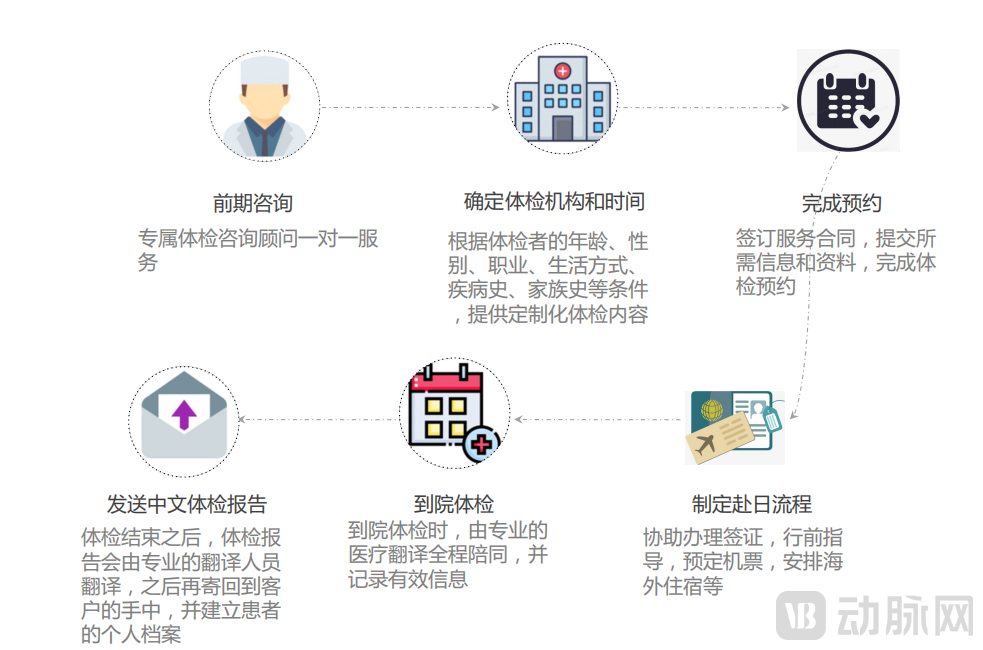
Jikang Wanjia's Medical Examination Process in Japan
To date, Xikang Wanjia has spent three years exploring the domestic cross-border healthcare sector, establishing channel partnerships with online health platforms, private hospitals, and health management companies. Partners include JD Health, Medical Forum Network, the Public Health Channel of the National Health Commission, China Eastern Airlines International Travel Service, DXY, Global Oncologist Doctors, MiJian, and AiDu.
“The character ‘繫’ in ‘Ji Kang Wan Jia’ is the traditional form of the Chinese character for ‘connect,’ and the Japanese word ‘tsunagu’ (繋ぐ) also carries the meaning of connection. The name signifies connecting the health of millions of households, as well as linking patients in China with doctors in Japan,” said Lv Hui. Ji Kang Wan Jia is also exploring new models of cross-border healthcare.
In July, Xi Kang Wan Jia and JD Family Doctor officially established a partnership to jointly create comprehensive, personalized solutions for medical consultations and health check-ups, as well as overseas second-opinion services. Yuki Kobayashi stated, “Xi Kang Wan Jia views this collaboration as an opportunity for service evolution. We hope to learn from JD Health’s business models in online pharmacy and offline health examination centers, while also expanding awareness of Japanese healthcare among cross-border medical service seekers and healthcare professionals, thereby enhancing their access to medical service products.”
Building on this collaboration, Jikang Wanjia will also explore bringing Japanese healthcare services to China through offline, physical partnerships. “The original model involved inviting patients to Japan; the next step may involve introducing Japan’s top-tier physicians, medical management solutions, and healthcare service models into the Chinese market.”
“In a market experiencing absolute growth, there are no dominant players. As an emerging sector, cross-border healthcare undoubtedly presents significant gaps and opportunities for expansion.”
When Jikang Wanjia launched its overseas business in 2020, it shifted all its operations to online consultations with an optimistic outlook.Including remote chronic disease management。Through remote interpretation of reports, customized medication and nutrient regimens, and ongoing communication with Japanese physicians, patients have achieved effective disease management and health improvement. Over the past three years, this self-care initiative has become a key business segment for Jiankang Wanjia.
The pandemic and digitalization have rapidly transformed global disease management and the clinical care ecosystem, establishing one of the key directions for the future development of healthcare models.
Yuki Kobayashi noted, “The large-scale implementation of online medical consultations has disrupted traditional healthcare-seeking behaviors, making the vision of ‘borderless healthcare’ a reality. Patients can choose care models that best suit their needs, such as undergoing diagnostic tests at nearby facilities and transmitting the results to trusted physicians for remote consultation.”
This means that, in the current era of continuous development in digitalization and cross-border healthcare, patients can transcend geographical and cultural barriers to more freely choose their attending physicians and select models for health management and disease treatment.. More flexible and patient-centered approaches to medical care will become the new standard.Meanwhile, the globalization of the cross-border healthcare market has further intensified, creating new opportunities and growth drivers for offline medical services.