

From Genomics to Multi-Omics: Unlocking Broader Applications of Nanopore Sequencing

QitanTech
Gene Sequencing Technology R&D Provider
Nanopore sequencing technology is once again gaining significant traction, with an increasing number of industry professionals discussing this technology.
In China, the past two years have seen a surge in application and business model innovations within the nanopore sequencer industry. On one hand, leading domestic manufacturers have successively launched and iterated their nanopore gene sequencers, continuously improving the ecosystem of Chinese-made nanopore gene sequencers along with related consumables and software. On the other hand, an increasing number of industrial giants from various sectors have entered the fray of product development and commercialization for nanopore gene sequencers, accelerating the commercial deployment of this innovative biotechnology and expanding its application boundaries.
Nevertheless, compared with high-throughput sequencing technology, which emerged more than a decade earlier, the commercialization of nanopore sequencing is still underway. At present, the commercial scale of nanopore sequencing remains modest. According to the latest financial report released by Oxford Nanopore Technologies (ONT), a UK-based company and the global leader in nanopore gene sequencers, its performance showed significant improvement in the first half of 2023, achieving revenue of £86 million. In contrast, Illumina, the representative company of high-throughput sequencing technology, still generated $2.263 billion in revenue during the first half of 2023, despite a decline in its financial performance.
So, how far has the commercialization of domestically produced nanopore gene sequencers progressed? What exactly is the value of its industrial chain?
“It is fair to say that nanopore sequencing technology has not yet fully matured,” Dr. Bai Jingwei, Chief Scientist at QitanTech, told VCBeat. “In most cases, nanopore sequencing serves as a complement to next-generation sequencing technologies.”
Dr. Bai Jingwei, Chief Scientist at QitanTech | Image source: Provided by the interviewee
Nanopore sequencing employs physicochemical methods that are entirely distinct from those used in next-generation sequencing technologies.
During the gene sequencing process, nanopore sequencing leverages the electrical charge of nucleic acids. In an electrified solution, the molecules to be sequenced are guided through nanoscale pores on a membrane, causing changes in the ionic current within the pores. Due to structural differences among the A, T, C, and G bases, subtle variations occur in the ionic current as they pass through the pores. By recording these subtle differences, the base sequence of the translocating nucleic acid can be determined.
Commercial nanopore sequencing primarily employs the strand-sequencing method, enabling continuous single-molecule sequencing to generate complete genomic sequences. During frequent public health emergencies, nanopore sequencers have gained broader recognition for their ability to rapidly detect unknown pathogens. In reality, however, the commercialization of nanopore sequencing technology has progressed relatively slowly. Although the technology first emerged in the late 1980s, commercial nanopore sequencers began to enter the market only from 2014 onward. While its applications in scientific research have flourished, market adoption in the in vitro diagnostics (IVD) sector has not expanded rapidly.
The underlying reasons are twofold: on one hand, achieving engineering maturity for commercial nanopore sequencers is extremely challenging; on the other hand, key metrics such as accuracy and cost still require further optimization to meet the demands of large-scale commercial applications.
According to Dr. Bai Jingwei, nanopore sequencing technology has completed the earliest stage of commercialization, having basically resolved the technical challenges involved in moving from sequencing principles to the construction of engineering prototypes. However, transitioning from engineering prototypes to commercial applications still requires exploring a series of complex and unknown issues. The former relies on scientists’ rigorous analytical thinking, while the latter places greater demands on engineering capabilities.
“Specifically, to achieve large-scale commercialization, nanopore sequencers need to continuously improve accuracy and reduce costs while maintaining ease of use. This is also the commercialization challenge that QitanTech has been contemplating and exploring,” said Dr. Bai Jingwei.
First is the improvement in accuracy based on structural biology and algorithmic models. For nanopore sequencing, the biochemical properties of the nanopore protein are key factors affecting sequencing accuracy. By continuously optimizing structural biology designs and pairing them with suitable biological enzymes, the sequencing accuracy of nanopore sequencers can be improved to some extent. For example, QitanTech’s newly released QPursue medium-throughput sequencing platform, adapted to the latest generation K2 biochemical system and equipped with a new algorithm suite, achieves a single-pass accuracy of 97%.

QitanTech QPursue-6kMedium-throughput sequencer. Image source: Provided by the interviewee.
Furthermore, algorithmic integration with raw signal data is a core component in enhancing the accuracy of nanopore sequencers. In addition to optimizing nanopores and enzymes, QitanTech has reportedly leveraged the design and tuning of general-purpose neural networks to push nanopore sequencing accuracy beyond 97% to a new level. Once nanopore sequencing accuracy reaches a certain threshold, each percentage point gain represents significant technical challenges and advancements. Admittedly, the incorporation of algorithms may increase sequencing costs to some extent; therefore, it is essential to reduce the complexity of hardware support while improving accuracy, thereby maintaining the compactness and portability of the sequencer.
Next is the cost reduction driven by sequencing throughput and chip materials. The raw data generated by gene sequencers is stored in bytes, with one base corresponding to one byte; thus, higher sequencing throughput results in larger data volumes. The widespread adoption of next-generation sequencing (NGS) technology has largely benefited from a significant increase in throughput and a precipitous drop in the cost per gigabase (Gb) of sequencing. This same logic applies to the commercialization process of nanopore sequencers.
It is understood that QitanTech has increased sequencing throughput by enhancing the integration level of its proprietary circuit designs. “This process is not easy; the mere design of an integrated circuit does not guarantee its practical usability,” stated Dr. Bai Jingwei. “From one perspective, while driving improvements in nanopore sequencing throughput, we have also addressed issues related to the foundry, packaging, and overall testing of domestically produced wafers.” The medium-throughput sequencing chip QCell-6k, recently released by QitanTech, adopts a higher-density ASIC circuit layout that integrates the biochip and circuit chip into a single unit. With each chip featuring more than 6,000 nanopores, it achieves a significant increase in throughput while simultaneously reducing sequencing costs.
Finally, an integrated build based on the application workflow enhances ease of use. As mentioned earlier, nanopore sequencers are compact in size,
It can serve as a node within an integrated, automated laboratory network, compatible with a wide variety of life science instruments, and also provide end-to-end holistic solutions spanning from sample processing to result analysis. This relatively streamlined format undoubtedly offers significant application potential in grassroots laboratories and field-based scientific research.
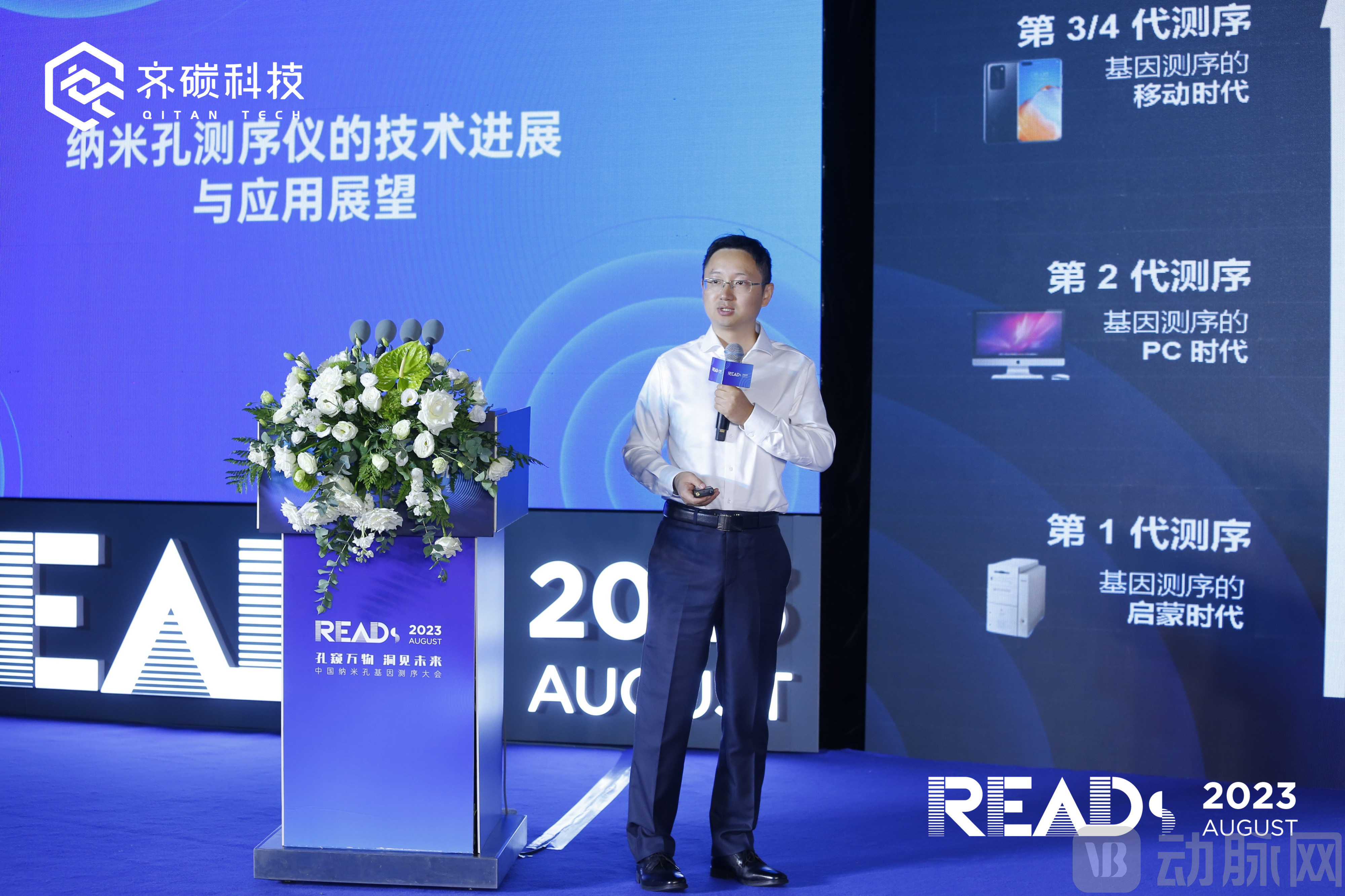
Commercialization has already begun, but where else can nanopore sequencing be applied? VCBeat found some answers at the READs 2023 China Nanopore Gene Sequencing Summit.

READs 2023 · China Nanopore Gene Sequencing Summit Image source: Provided by the interviewee
Hu Songnian, Chief Engineer of the Chinese component of the Human Genome Project and researcher at the Institute of Microbiology, Chinese Academy of Sciences, has long focused on the evolution and application of nanopore sequencing technology. He observed that over the past five years, nanopore sequencing has been involved in nearly all genome sequencing projects. Currently, generating a high-quality genome sequence has become “straightforward and robust,” primarily relying on nanopore sequencing.
Notably, Professor Hou Yiping’s research team at the West China School of Basic Medical Sciences and Forensic Medicine, Sichuan University, has applied nanopore sequencing to forensic genetic research, publishing two studies in top-tier forensic genetics journals. Furthermore, nanopore sequencing is demonstrating its value and potential across a broader range of fields—including tumor fusion gene detection, public health epidemic prevention and control, animal disease prevention and treatment, and environmental microbiomics—as its commercialization journey gains momentum.
If the genome is viewed as a complete jigsaw puzzle, second-generation sequencing assembles it from 1,000 small pieces, whereas nanopore sequencing uses only 100 pieces. Clearly, the latter significantly reduces the complexity of assembly. Furthermore, the long-read capability of nanopore sequencing enables better detection of large-scale structural variations, such as deletions and duplications within gene fragments, thereby yielding clearer and more comprehensive biological information. On April 1, 2022, Science magazine reported that the final 8% of the human genome was completed by leveraging this advantage of long-read sequencing.
Nanopore sequencing has demonstrated immense application potential in the field of genomics. Looking further into the future, there is even the possibility that nanopore sequencing could truly break through existing application boundaries. For instance, nanopore sequencing already enables direct RNA sequencing. Moreover, its applications are transcending the traditional limitation to nucleic acids, extending to the sequencing of peptides and small molecules.
Dr. Bai Jingwei stated that, in essence, this technology is a chain-sequencing method. As long as the substance to be sequenced is a continuous chain, an appropriate method can be employed to pull the substance through a nanopore, much like threading a tape, thereby generating output signals.
For instance, the application of nanopores in peptide sequencing has already enabled the sequencing of phosphorylation in short peptides, making this a highly active area of nanopore sequencing research. As the peptide chain translocates through the nanopore, the resulting ionic current blockades differ depending on whether it carries one or two phosphorylation modifications. Notably, the nanopore sequencing system is highly sensitive to peptide modifications, yielding distinct sequencing signals. Although nanopore-based peptide sequencing is still in its early stages of development with many scientific challenges remaining, further optimization in this area will undoubtedly expand the clinical applications of nanopore sequencing.
VCBeat has learned that interest in using nanopores for small-molecule detection is rapidly increasing. Nanopore modification enhances the sensitivity of small-molecule detection and generates distinct translocation signals, thereby laying the foundation for nanopore-based small-molecule sensing.
Gaining insights into all things—this is the most exciting aspect of nanopore sequencing technology. We believe that with continuous technological iteration and enhanced commercialization capabilities, nanopore sequencing can provide greater value by enabling humanity to better understand life.