

After Sharp Drop in Overseas Revenue, How Will Lepu Medical Chart Its Global Expansion?

Lepu Medical
Developer and Manufacturer of Cardiac Interventional Medical Devices and Pharmaceuticals
Nowadays, going global has become a consensus among pharmaceutical and medical device companies.
Behind this lies the confidence born from innovative breakthroughs in key technologies across multiple industries, as well as the ambition of China’s pharmaceutical and medical device sector to refuse to lag behind, aiming to take its place on the global stage and even lead the development of various niche segments worldwide.
As the only comprehensive solution provider in China covering the full lifecycle of cardiovascular disease management, Lepu Medical has successfully developed and commercialized the country’s first coronary stent, first cardiac pacemaker, first bioresorbable stent, and first coronary cutting balloon.
In 2022, Lepu Medical achieved a revenue of RMB 10,609.4421 million; in 2021, the revenues from its coronary bioresorbable scaffolds, coronary drug-coated balloons, congenital heart disease occluders, and coronary cutting balloons all ranked among the top three in the Chinese market. In numerous media reports, it is often referred to as a low-profile leader in the cardiovascular sector.
However, looking back on the path taken by this cardiovascular industry leader, it is evident that “self-rescue” efforts have played a predominant role; indeed, its genuine internationalization strategy was born out of a crisis.
However, in this cardiovascular leader’s journey of global expansion, we can see many reflections of Chinese enterprises going overseas—obtaining certifications and leveraging the momentum of pandemic prevention and control to rapidly open up overseas markets...
Yet, as the storm subsides, what lies ahead for these enterprises on their path to global expansion?
From its establishment in 1999 to its IPO in 2009, and up to the present day, as we look back on the development path of Lepu Medical, we cannot help but remark not only on its profound affinity with the number “9,” but also on the arduous nature of its journey.
In 2009, Lepu Medical successfully went public; however, starting from 2010, it experienced five consecutive years of declining performance.The reason is: “Before the growth of the stent business stagnated, we failed to identify new business segments to hedge against this risk. By the time performance growth slowed, it was already too late to take action.”
In 2014, by fully tapping into the growth potential of its existing business segments and employing a series of capitalization strategies, Lepu Medical established a platform-based business model centered on providing full-lifecycle services for patients with cardiovascular diseases, thereby constructing a business system encompassing “medical devices – pharmaceuticals – services – innovative medical services.”
The effects were almost immediate—Since 2015, Lepu Medical has achieved a 30% annual performance growth until 2018.
Even in 2018, Lepu Medical achieved a 40.08% increase in revenue.In addition to operational data, honors such as being “the only National Engineering Research Center for Cardiac Interventional Diagnosis and Treatment Devices and Equipment authorized by the Ministry of Science and Technology,” and possessing “domestic exclusive and internationally leading technological advantages in the NeoVas bioresorbable stent product and the AI-ECG electrocardiogram analysis and diagnostic product with internationally leading technology,” also highlighted Lepu Medical’s leading position in the field of cardiovascular diseases at that time.
Yet, the crisis is set to strike again. In contrast to 2010, when Lepu Medical failed to take timely self-rescue measures amid declining performance, the company has demonstrated far greater environmental acuity and a more rapid response this time around.
In 2018, many people likely recall the major event that took place in China’s pharmaceutical industry that year—the release of the “4+7 City Drug Centralized Procurement Document,” which marked the launch of the national volume-based procurement program.
Anticipating shifts in market trends, Pu Zhongjie, Chairman of Lepu Medical, proposed the fourteen-character guideline of “Innovation, Service, Internationalization, Integration, Efficiency Enhancement, and Stable Development” that year. Internationalization was formally elevated to the level of corporate development strategy.
Soon, the storm officially arrived.
During the 2019 national expansion of the “4+7” volume-based procurement program, Lepu Medical’s two core products, clopidogrel and atorvastatin calcium, were both selected for inclusion. These two products, which accounted for 30% of Lepu Medical’s revenue, saw their revenues decline by 8.4% and 11.08%, respectively, following the centralized procurement. In the 2020 centralized procurement of coronary stents, Lepu Medical’s cobalt-chromium alloy rapamycin-eluting stent system, GuReater, was selected, with its price dropping by 92.32% compared to the lowest listed online price.
andIn the face of the centralized procurement storm, Lepu Medical actively engaged in "self-rescue" efforts. In 2019, Lepu Medical pursued its internationalization strategy by integrating the original foreign trade operations and departments of all its subsidiaries to establish an International Business Division, while simultaneously expanding its product portfolio through innovative R&D of products that meet clinical needs.
Establish an International Business Division and place heavy bets on overseas markets, as the overseas "pie" is large enough.Taking medical devices as an example, according to Southwest Securities, the global medical device market exceeded $451.7 billion in 2019, five times the size of China’s domestic market. Specifically, the orthopedic market in China was approximately nine times smaller than its global counterpart, while the ophthalmology and cardiovascular markets were eight times smaller.
Furthermore, reviewing the growth trajectories of overseas giants such as Medtronic and Abbott reveals that internationalization is an inevitable path. In light of this, for Lepu Medical, which harbors ambitious aspirations, it is imperative to expand into broader markets, capture a larger share of the pie, and gradually enhance its influence in niche segments on the global stage.
However, while the overseas market is vast and offers promising prospects, competition is exceptionally fierce.Not only are local innovative enterprises involved, but global giants are also joining the competition. It is extremely difficult to carve out a path to success amidst numerous competitors with substantial funding, extensive distribution channels, and advanced technology.
Lepu Medical’s overseas revenue accounted for only 7.11% in 2019, underscoring the considerable challenges of expanding into international markets.
The challenges lie in the disparities between domestic and international regulations, differences in sales practices, skepticism surrounding the innovativeness of “Made in China” products, and the fact that the influence of Chinese brands has yet to take shape—everything remains in the zero-to-one stage.
Therefore,At that time, Lepu Medical chose to enter the market with blockbuster products, creating a breakthrough, and gradually expanded its product portfolio by leveraging the distribution channels of these flagship products.
Soon, the moment arrived—and it came with a bang.
With the outbreak of the pandemic, demand for IVD and related products surged rapidly. Lepu Medical seized the opportunity to swiftly advance the CE certification and sales of its COVID-19 antigen testing products.
In March 2020, the novel coronavirus (SARS-CoV-2) antibody test kit (colloidal gold immunochromatography assay), independently developed by a subsidiary of Lepu Medical, obtained CE marking for access to the European Union market. Meanwhile, the product also received Emergency Use Authorization (EUA) from the U.S. Food and Drug Administration (FDA), granting it approval for sale in the U.S. market.
In September of the same year, the professional version of the Novel Coronavirus (2019-nCoV) Antigen Test Kit (Colloidal Gold Method) received the CE certificate issued by TÜV Rheinland. The self-test version obtained the certification from the German Federal Institute for Drugs and Medical Devices (BfArM) in March of the following year, and received the CE certificate issued by TÜV Rheinland in June of that same year.As of the 2021 reporting period, Lepu Medical’s COVID-19 antigen, antibody, and neutralizing antibody test products had been sold to dozens of countries, including those in Europe and Southeast Asia.
Against this backdrop, Lepu Medical’s overseas performance took off, with its overseas revenue accounting for 44.04% by mid-2021.
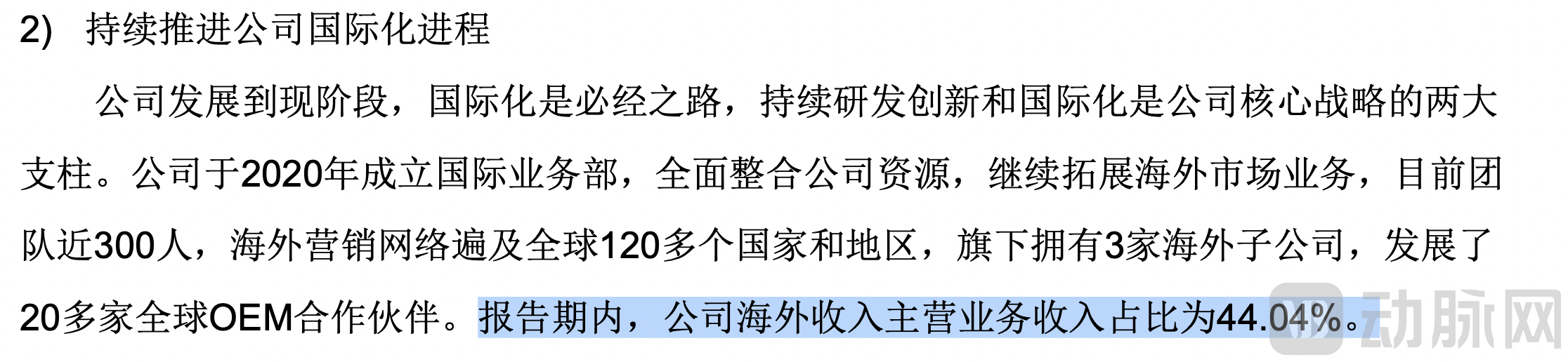
As of Lepu Medical's 2021 Semi-Annual Report
Looking at the 2021 annual reporting period, Lepu Medical’s overseas revenue still accounted for 35.27% of its total, representing a 28.16% increase compared with 2019.
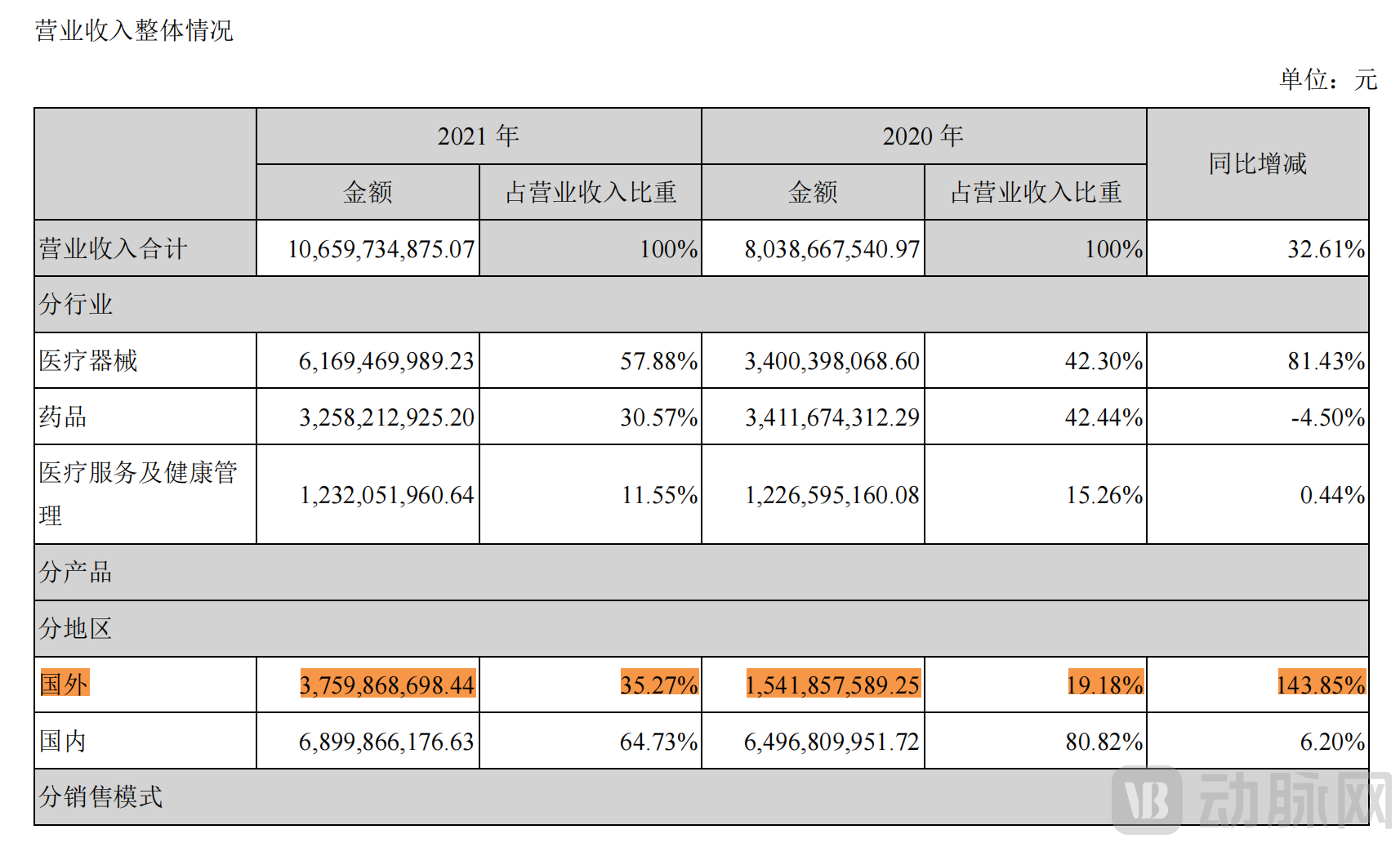
Excerpt from Lepu Medical's 2021 Annual Report
Despite the impressive performance, Lepu Medical is well aware that “the rapid increase in overseas revenue was primarily driven by a surge in sales of COVID-19 antigen testing products. With adjustments to pandemic control policies and the global slowdown of the epidemic, sales of COVID-19-related products are inevitably set to decline.”
As Lepu Medical had anticipated,In 2022, the proportion of Lepu Medical's overseas revenue fell back to 10.19%.
After the shift in market trends, apart from its once-celebrated achievements, Lepu Medical is left with only one question: What should be done this time?
This time, Lepu Medical has opted for a steady and pragmatic approach, driving its internationalization process by strengthening multiple fronts, including products, R&D, supply chain, and branding.
In terms of products, innovation is the driving force behind product optimization and iteration. Lepu Medical has possessed an innovative DNA since its inception. Looking back at the early days of Lepu Medical,Lepu Medical has developed China’s “first coronary stent,” “first cardiac pacemaker,” “first bioresorbable scaffold,” “first coronary cutting balloon,” and “first AI-ECG Platform,” creating a history of multiple “firsts” in the country’s medical device industry.
Since the launch of centralized procurement, Lepu Medical has placed even greater emphasis on innovation than before. Not only have its R&D expenses increased year by year, but its R&D speed also ranks among the top in the industry.According to Lepu Medical's 2022 annual report, the average R&D cycle for innovative cardiovascular implantable and interventional medical devices, from project initiation to final regulatory approval, is typically around six years. However, Lepu Medical's average R&D cycle is approximately four years, two years shorter than the industry average.
Furthermore, from the very inception of its internationalization strategy, Lepu Medical opted not to pursue the OEM route, but instead chose to accelerate the global clinical registration of innovative products such as bioresorbable stents, TAVR 3.0, renal denervation, AI-based ECG, and AI-powered patient monitoring.
As of the end of 2022, Lepu Medical had obtained 224 EU CE certifications and 33 US FDA clearances, among which 53 CE certifications were newly added.
However, successfully obtaining a registration certificate merely signifies that the “innovativeness” has gained regulatory approval; it does not equate to clinical acceptance. The clinical use of medical devices is often contingent upon physicians’ recognition and acceptance.
In this regard,Lepu Medical promotes its products through various channels, including academic conferences, product exhibitions, scholarly papers, and expert trials. For instance, when previously “exporting” Class III implantable products to developed countries, in addition to conducting overseas clinical trials in compliance with regulations, Lepu Medical invited relevant stakeholders to visit China to evaluate the clinical performance of these products and the accompanying medical services. The company aimed to alleviate overseas physicians’ concerns about “Made in China” products by combining clinical data with on-site inspections.
In addition to products, innovation, and brand,Lepu Medical also plans to establish overseas R&D centers to pursue globalized research and development; invest in new production bases to increase capacity and support global product supply; and build a sales and distribution network with customer service capabilities, penetrating sales channels into global medical institutions and retail outlets to enhance Lepu Medical’s global brand awareness...
It is not difficult to see that Lepu Medical’s blueprint for future international development encompasses R&D, supply chain, and sales.
It is worth noting that Lepu Medical has emphasized the need for its sales and distribution services to “possess customer service capabilities” in building its sales channels. This emphasis primarily stems from differences between domestic and international sales models. Currently, the domestic sales model relies mainly on distributors, whereas overseas markets predominantly adopt direct sales and Group Purchasing Organization (GPO) models, which impose higher requirements on companies’ after-sales service capabilities. Therefore, for a company committed to international expansion, building customer service capabilities is inevitably one of the core components of its sales competence.
In addition to the aforementioned plans regarding overseas production and the establishment of R&D bases,Lepu Medical’s plans for future international operations also include the statement: “intends to establish a business development (BD) center overseas to license in or co-develop products with leading-edge technologies.”This bears a striking resemblance to its “buying spree” campaign launched in China in 2012.
In addition,In 2022, Lepu Medical listed its Global Depositary Receipts (GDR) on the SIX Swiss Exchange, raising net proceeds of USD 220 million. This marked the first GDR listing on the SIX Swiss Exchange by a company from China’s ChiNext board, as well as the first such listing by a Chinese healthcare enterprise.
Regarding the purpose of this listing in Switzerland, Lepu Medical provided a candid explanation: “Due to the high costs, cumbersome procedures, and lengthy timelines associated with overseas clinical trials and product registrations, the continuous enrichment of our R&D pipeline necessitates sustained investment in overseas funding and other resources.”
andIn addition to serving its primary purpose of raising capital, listing in Switzerland can also enhance Lepu Medical’s visibility in overseas markets.This appears to indicate that Lepu Medical’s emphasis on brand building is becoming increasingly pronounced. The company aims not only to enhance its recognition among healthcare professionals but also to extend its brand influence into the capital market, thereby attracting investor attention.
Yet the road ahead is long and arduous. The clarion call for global expansion has sounded, but the journey remains in its early stages. This is not only a realistic portrayal of Lepu Medical’s overseas endeavors but also a true reflection of the global expansion efforts of many Chinese medical enterprises.
In the future, product innovation, supply chain capabilities, and sales prowess will remain the three major obstacles confronting Chinese medical enterprises in their global expansion. Whether by leveraging capital or relying on their own strengths, how Chinese medical companies—including Lepu Medical—will truly overcome these hurdles and reach their destination remains to be seen. As for the extent to which going global can help Lepu Medical, a domestic giant in the field of cardiovascular disease, navigate another development cycle, time will provide the answer.
References:
1. Lepu Medical's Annual Reports from 2019 to 2022 and the 2021 Semi-Annual Report;
2. “Rescuing Financial Statements Through Spin-offs? Pu Zhongjie’s Capital Manipulation Tactics May Stall Lepu Medical’s M&A-Driven Growth Model,” Sina Securities, July 2023;
3. “A Brief Analysis of Lepu Medical’s Vertically Integrated Business Model,” Cai Geng Tan, March 2021;
4. “How Medical Device Manufacturers Can Break Through and Go Global Under the Heavy Pressure of Centralized Procurement,” VCBeat, November 2022;
5. “The Story of Chinese Medical Device Companies Going Global,” TAI Shaonian, July 2023;
6. “Chinese-Made Medical Devices Go Global: New Logic Amidst Changing Tides,” Amino Observation, February 2023;
7. “Consumables Market Reshaped! Internationalization Opens New Frontiers” Cybersky Medical Devices; July 2022;
8. “Planning to List in Switzerland: Has Lepu Medical, the ‘First Stock of Cardiovascular’, Overcome the Pain of Centralized Procurement?” April 2022;
9. “Going Overseas: A Natural Progression with Significant Market Potential,” Southwest Securities, February 2023;
10. “Lepu Medical Research Report: An Undervalued Leader in Cardiovascular Care, Emerging from the Negative Impact of Centralized Procurement,” Huaan Securities, 2023;