

Olink Proteomics Achieves 47% Revenue Growth, Reaching $139.8M in FY2022 Through Innovative PEA Technology and Razor-and-Blade Business Model
Olink
Developer of Biomolecular Analysis Technology
Olink Proteomics (Nasdaq: OLK), a company dedicated to working with the scientific community to accelerate proteomics across multiple disease areas, enabling novel biomarker discovery and improving patients’ lives.
Within just a few years of its founding, Olink has rapidly evolved from a small Swedish company offering hundreds of protein assays into a Nasdaq-listed enterprise. It provides global research and industrial clients with extensive and flexible protein biomarker solutions, high-quality protein libraries, and fully validated assays covering approximately 3,000 proteins.
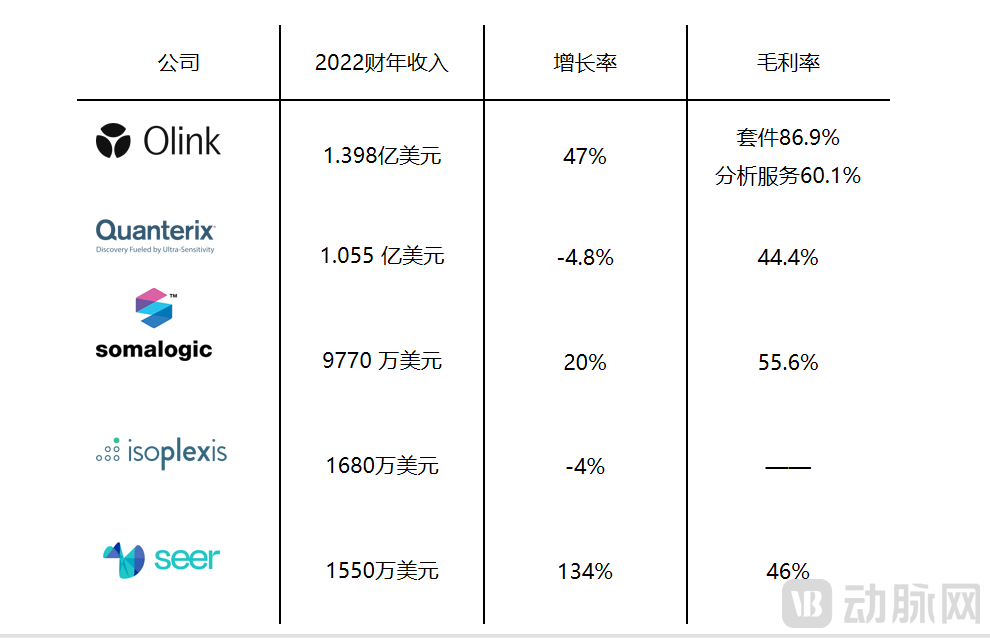
Overview of 2022 Revenues for Leading Global Proteomics Companies (Source: Publicly Disclosed Financial Reports)
Graphic: VCBeat
The 2022 annual report shows that Olink achieved full-year revenue of $139.8 million, with a growth rate as high as 47%. Moreover, its gross margins reached 86.9% for kits (products) and 60.1% for analytical services.
How Did Olink Achieve Such Results in the Early-Stage Proteomics Industry?
Sweden, particularly Uppsala University, has been a key player in the development and evolution of proteomics over the past century.
In 1926, Theodore (Thé) Svedberg invented the ultracentrifuge. This device determined the molecular weight of proteins, demonstrating that proteins are macromolecules and facilitating their differentiation. This breakthrough paved the way for molecular biology and proteomics, earning him the Nobel Prize in 1926. Another Nobel laureate, Arne Tiselius, also developed electrophoresis for the study of proteins and other molecules in Svedberg’s laboratory.
The emergence of innovative technologies in Uppsala, such as gel chromatography, liquid chromatography, Phadebas IgE allergy testing, enzyme-linked immunosorbent assay (ELISA), and surface plasmon resonance (SPR), laid the foundation for Sweden’s development in proteomics since the last century.
Olink was born precisely in the twilight of this great century of innovation.
In 2004, Olink Bioscience was founded in Uppsala, Sweden, initially spinning out from Professor Ulf Landegren’s laboratory. In 2011, Simon Fredriksson became the CEO of Olink. Building on the Proximity Ligation Assay (PLA) technology invented by Professor Ulf Landegren’s team, and under Simon Fredriksson’s leadership, Olink first published the Proximity Extension Assay (PEA) technology in 2011 and launched its first PEA-based proteomics panel in 2013.
Olink’s initial business model was highly innovative—licensing its technology to Life Technologies and Affymetrix to generate non-dilutive capital. It later spun off Q-Linea and Halo Genomics (which was acquired by Agilent).
In 2016, Olink Bioscience split into two entities: Olink Proteomics and Navinci Diagnostics (focused on spatial proteomics). Following the spin-off, Olink Proteomics clarified its path in proteomics research, driving translational medical research and commercialization around innovative proteomics methods. It was subsequently acquired by Summa Equity in 2019 and went public in 2021, with total gross proceeds from the offering amounting to approximately $264.7 million.
As genomic research deepens, particularly with regard to transcriptomic and proteomic data, findings have overturned the long-held belief that mRNA levels accurately reflect protein levels. Proteins, positioned downstream in the central dogma, are the ultimate effectors of biological activities and may play crucial roles in various biological processes and diseases. Therefore, akin to the significant impact of mapping the human genome, a systematic study of the human proteome is imperative.
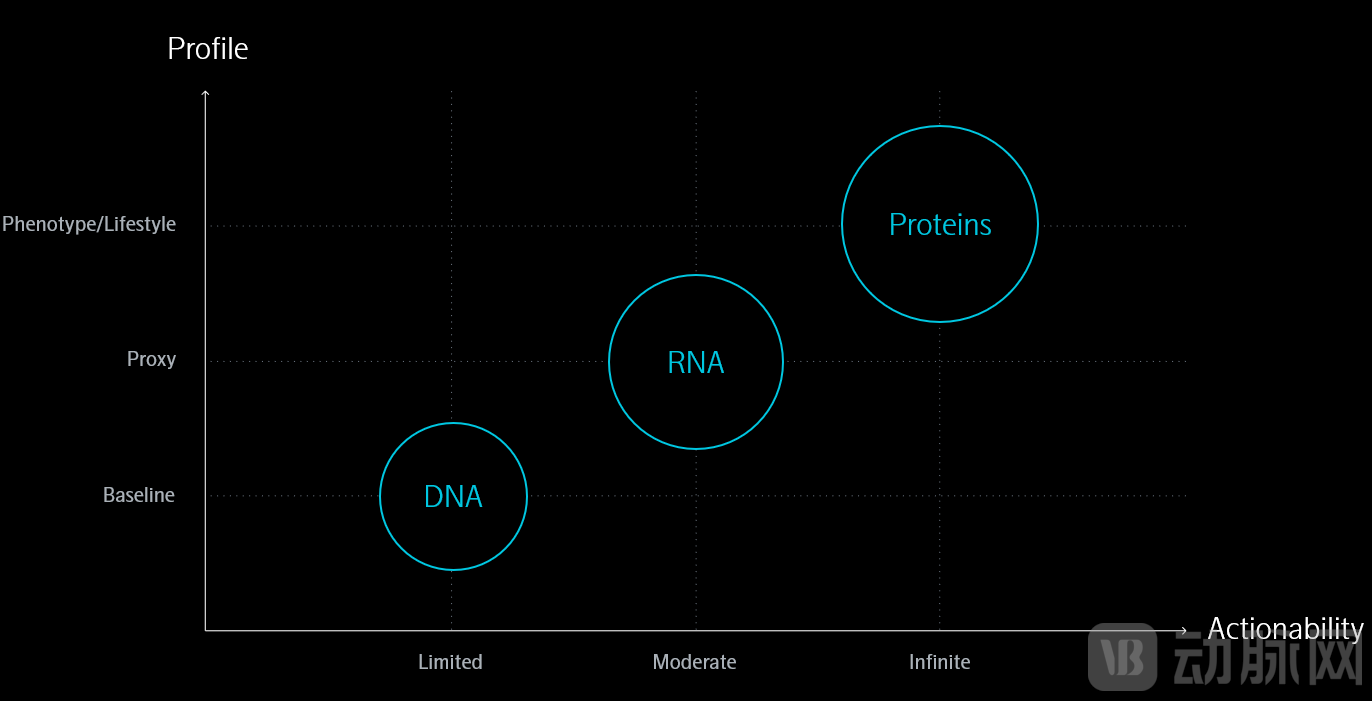
Comparison of Real-Time Biological Characteristics and Operability of DNA, RNA, and Proteins
For the past several decades, technological and hardware limitations have severely constrained comprehensive systematic studies of proteins, particularly large-scale discovery research on multiple proteins in human samples. Key challenges include a lack of detection specificity (especially in multiplexed assays), poor sensitivity, narrow dynamic range, low throughput, and difficulty in meeting the requirements for large sample sizes.
Olink’s Proximity Extension Assay (PEA) technology overcomes the comprehensive bottlenecks in protein detection regarding “multiplexing capability/specificity,” “sensitivity,” and “throughput,” enabling high-throughput, multiplexed immunoassays for proteins. It facilitates highly specific (80%–90%), highly sensitive (>60%), and thoroughly validated multiplex protein detection across a broad dynamic range from fg/mL to µg/mL, without compromising data quality or assay robustness.
Leveraging PEA technology, scientists can now simultaneously measure thousands of human proteins using as little as 1 µL of blood or certain types of biological samples.
The unique capabilities of PEA technology overcome long-standing and well-recognized challenges in immunoassays—namely, cross-reactivity in antibody binding and the loss of specificity in detected signals (Figure A). Due to PEA’s requirement for dual-antibody recognition of the target protein, coupled with high-fidelity DNA hybridization and detection, any non-specific antibody binding events that may occur do not result in a readout signal (Figure B).

(Figure A) Conventional immunoassays: Cross-reactivity resulting from nonspecific antibody binding limits the extent of multiplexing.

(Figure B) Olink’s technology: Unique DNA oligonucleotide sequences report only matched DNA pairs, with no cross-reactivity events detected.
Leveraging PET technology, Olink has launched proteomics solutions featuring multiple types and various software-hardware combinations.Break down customer requirements intoThree Aspects, thereby enabling ultrasensitive multiplexed protein biomarker detection, unbiased targeted proteomics, and precision proteomics:
Olink®Explore——Discovery of High-Throughput Protein Biomarkers via NGS
Olink®Explore, the next-generation high-throughput proteomics solution, combines PEA with NGS readouts and can be run in-house or accessed through Olink’s global network of service providers. Using the Olink Explore 3072 platform with NGS readouts, up to 4,600 samples can be analyzed per week, measuring approximately 3,000 proteins on a single NGS instrument and generating around 14 million protein data points.
Olink®Target 96 & 48—High-Quality, Flexible Protein Biomarker Analysis
Conduct targeted protein biomarker research using disease- or biology-focused 96-plex or 48-plex panels with qPCR readouts. By providing multiplex immunoassays that do not compromise data quality, Olink®Target enables more efficient decision-making in the research of human protein biomarkers. The identification of multi-protein signatures is more effective and reliable than observing individual proteins.
Olink®Focus——Validation and Application of Customized Protein Features
Olink®Focus is its customized linking solution, covering the entire process from early-stage large-scale protein biomarker discovery to the subsequent validation and application of clinically relevant protein signatures. After customers define an informative protein profile using Explore or Target, they collaborate with Olink’s custom development team to design and validate a proprietary Olink Focus panel, which includes 21 proteins from the Target and Explore libraries.
Having developed three major solutions, Olink offers customers two access models:
Provide sample testing services directly to customers through an established global network of service providers.
Olink has established 29 Explore sites, each with an LTM of approximately $700,000, providing customers with expert testing services on a fee-for-service basis.
Introducing the Olink Signature Q100, providing customers with a benchtop system for laboratory loading and accompanying reagent kits.
The Olink Signature Q100 is a dedicated benchtop system solution launched by the company. With seamless integration between panel analysis and data output, customers can directly utilize Olink Target, Olink Flex, and Olink Focus, operating them within their own laboratories. Once installed, customers can either support their internal projects or choose to become an Olink service provider.
Financial reports from previous years show that approximately 70% of Olink’s revenue and growth come from its Services segment and the Explore product line. As its scale continues to expand, Olink is shifting towardProduct Line-Led Razor-and-Blade Model。
Razor-and-Blades Model: The product sales strategy is divided into two parts: base products (typically tools or equipment, such as razors or the Olink Signature Q100 Benchtop System) and complementary products (typically essential accessories, such as blades or assay kits). Base products are usually sold at a lower price, while complementary products are necessities and consumables that require ongoing purchases. This model enables companies to attract customers to purchase the base product and generate recurring profits through subsequent sales of complementary products.
The "razor-and-blades" model has not only established a long-term, stable customer base and revenue stream for Olink but has also, to some extent, deepened the competitive moat of its position as the industry leader.
The razor-and-blades model hinges on establishing applicability barriers to create potential high-value space (profits from complementary products). Proteomics remains in the early stages of industrialization, characterized by high technological barriers and high entry thresholds, with the market still in a phase of competitive capture. At this juncture, Olink’s applicability barriers have become a powerful weapon for securing market share and gaining a first-mover advantage. In other words, Olink has leveraged itsKey TechnologiesBecome the rule-maker of the game.
Under this model, the total number of Explore installations reached 52 in 2022, with 12 installed in the fourth quarter, representing a year-on-year increase of more than double. The deployment volume of Signature Q100 reached 91 units, with 28 deployed in the fourth quarter, marking a year-on-year increase of more than two-fold. By the second quarter of 2023, the cumulative number of Explore installations had reached 74, and the deployment volume of Signature Q100 had reached 132 units.
In terms of revenue, kit revenue and analytical services revenue accounted for 53% and 40% of total revenue, respectively, in the fourth quarter of 2022. For the full year 2022, kit revenue grew by 106%, reaching a total of $55.1 million. Analytical services revenue increased by 21%, totaling $73.0 million. In absolute terms, analytical services revenue still significantly exceeded kit revenue; however, the 106% growth in kit revenue indicates that a product shift toward the “razor-and-blades” model is underway.
The product-led model is also reflected in Olink’s continuously expanding product portfolio. In July 2023, the new product Olink Explore HT was launched. With its redesigned and streamlined workflow—including a highly automated data analysis platform—scientists can accurately measure more than 5,300 proteins using just 2 µL of sample.
Compared to the previous-generation Explore products, Olink Explore HT increases the number of detectable specific protein biomarkers by 80%, while boosting sample throughput by 4-fold, data output by 8-fold, reducing the cost per data point by 30%, and lowering workflow processing costs by 20%, thereby enhancing the efficiency of sample-to-data production. Importantly, these innovations reduce the environmental footprint, with a 6-fold decrease in component count and a 10-fold reduction in external packaging.
By leveraging its analytical service model and product delivery framework, Olink appears to have solidified its position as a market leader. However, in the biotechnology sector, where innovative technologies continue to emerge at a rapid pace, front-end service providers cannot rely solely on technology and sales strategies to ensure long-term stability.
Positioned at the nexus of basic research, drug development, and clinical studies, Olink continuously develops novel protein biomarker solutions to elucidate the links between genetic variants and prognosis-related protein markers, thereby accelerating the generation of biological insights and guiding innovative drug development. The company places significant emphasis on collaboration and knowledge sharing within the scientific community, as evidenced by its establishment of customer-driven alliances and its commitment to sharing and collaborating on protein data generated via Olink technologies.
Olink provides technical support for the UK Biobank Pharmaceutical Proteomics Project (UKB-PPP), a collaborative initiative between the UK Biobank and 13 biopharmaceutical companies. The UKB-PPP is conducting one of the world’s largest scientific studies on blood protein biomarkers, systematically profiling the proteomes of 53,000 participants using the Olink™ Explore 3072 platform. This effort is expected to enhance understanding of the underlying mechanisms of diseases, thereby accelerating the development of novel biomarkers and therapeutic drugs. The database is accessible to approved researchers and scientists worldwide who are studying common and life-threatening diseases.
Meanwhile, Olink has established a global presence, expanding into North America, Europe, Asia, the Middle East, and Africa. In 2022, Olink generated $66.5 million in revenue in North America, $57.7 million in Europe, the Middle East, and Africa, and $15.6 million in China and Japan.
Beyond supply chain collaboration and global expansion strategies, Olink has also broadened its domain footprint through mergers and acquisitions. In 2020, Agrisera announced its acquisition by Olink. Founded in 1985, Agrisera is an antibody company that primarily provides off-the-shelf antibodies for plant and algal research. Agrisera was named the Plant Science Antibody Supplier of the Year by CiteAb in 2019 and obtained ISO 9001 certification in June 2021.
As exemplified by Olink’s mergers and acquisitions, the applications of proteomics in life sciences extend far beyond human health and medicine. How do protein regulatory mechanisms operate? How do they give rise to inter-individual variability? How can they be leveraged to treat diseases, improve health, and drive translational development? These are universal scientific questions pertinent to all living organisms and represent the vast, untapped potential for industrial applications of proteomics.