

WAT Medical Files IPO Prospectus for BPRelief Wearable Neuromodulation Hypertension Therapy
With the widespread adoption of smart wearable devices, smart bands have long become essential “fashion accessories” for modern individuals. Nearly all smart bands offer health management features, such as reminders to stand and move after prolonged sitting, daily exercise tracking, and hydration alerts. Although these designs are intended to help users improve their health outcomes, their effectiveness is entirely determined by user adherence.
A health tracker that delivers wellness insights without requiring any user interaction after being worn may be the ideal device for many “lazy” users.
This has already been achieved by Yuefan Medical’s BPRelief Blood Pressure-Lowering Wristband (hereinafter referred to as the “Blood Pressure-Lowering Wristband”). When worn, the wristband emits pulses that actively lower the user’s blood pressure by modulating sympathetic nervous system activity. Currently, the Blood Pressure-Lowering Wristband has received funding from Mitacs, a Canadian federal program, and has entered the clinical trial phase.
I. The Entrepreneurial Confidence of “Student CEOs”
In 2016, while pursuing his Ph.D. in Ophthalmology at the University of California, Berkeley, Ji Wufeng co-founded the Canadian medical company WAT Medical with friends.
Founding the company was not a momentary impulse on the part of young people; rather, Ji Wufeng had already accumulated sufficient confidence and resources.
During their university years, Ji Wufeng and his friends paid close attention to the medicalization of wearable devices. Consequently, they integrated TENS technology into intelligent, wearable solutions, developing the EmeTerm anti-nausea wristband and the HeadaTerm head patch for migraine relief. Both products have obtained approvals from the FDA, CE, Health Canada, and other global federal health agencies, and are protected by global intellectual property rights. The company was established solely to facilitate better market promotion of these products.
The University of California, Berkeley is the top-ranked public university in the United States. During his tenure there, Dr. Ji Wufeng received the Berkeley Innovator Award and the Laurence Fund Scholarship. Upon graduating in 2023, Dr. Ji was offered faculty positions and opportunities to practice medicine in California. However, driven by a desire to enable more people in China to benefit from the convenience of medical wearable devices, he resolutely decided to return to China with the core team of WAT Medical, a Canadian healthcare company. He subsequently re-established Zhejiang Yuefan Intelligent Technology Co., Ltd. (hereinafter referred to as “Yuefan Tech”). The blood pressure-lowering smart bracelet marks Yuefan Tech’s debut product in the Chinese market.
II. One-fifth of China's population suffers from hypertension, yet the medication control rate stands at only 15%
In daily life, patients with hypertension are not uncommon.
The "Report on Cardiovascular Health and Diseases in China 2021," released by the National Center for Cardiovascular Diseases, indicates that there are approximately 245 million people with hypertension in China. In other words, one in every five Chinese individuals is a hypertension patient. Over time, the number of hypertension patients in China continues to rise gradually. Furthermore, due to factors such as an aging population and increasing social pressure, hypertension is showing a trend toward affecting younger populations.
Early-stage hypertension may be asymptomatic, but the absence of symptoms does not mean there is no risk. Once hypertension develops, vital organs such as the heart, brain, and kidneys are affected, significantly increasing the likelihood of heart failure or sudden cardiac death, stroke, renal failure, and blindness.
Therefore, regardless of age, timely treatment should be initiated once hypertension is diagnosed. Currently, the primary treatment approaches recommended by physicians include lifestyle modifications and pharmacological control.
For patients with early-stage hypertension, lifestyle modifications can produce significant blood pressure-lowering effects. However, early-stage patients are predominantly young adults, who often struggle to allocate time and energy to adhere to a healthy diet daily and engage in sufficient physical activity due to the fast pace of modern life and high stress levels. Consequently, pharmacological therapy remains the most commonly used treatment approach among young patients.
Furthermore, although the elderly have more leisure time, their severe disease burden and comorbidities render lifestyle modifications alone insufficient for blood pressure control, making pharmacological therapy an inevitable necessity.
In fact, the efficacy of pharmacological control is not absolute. Despite the substantial resources and efforts invested by the medical community and the pharmaceutical industry in managing hypertension—resulting in the development of five major classes of antihypertensive drugs that have been incorporated into national treatment guidelines worldwide—hypertension has yet to be effectively controlled. According to WHO statistics, the success rate of blood pressure control through medication stands at only 21%, while in China, this figure remains at approximately 15%.
China has long held the saying that “all medicines carry some degree of toxicity.” In addition to suboptimal efficacy rates, medications inevitably pose risks of adverse effects and side effects on the body. The longer young people use these drugs, the greater the harm they incur.
For various reasons, there is an urgent need for a healthier and more effective product to control blood pressure in the hypertension market. Dr. Ji Wufeng, founder of Yuefan Technology, told VCBeat’s Chengguo Bureau: “Neurostimulation can readily address these issues.”
III. Controlling Hypertension Through Neuromodulation
The principle behind blood pressure-lowering wristbands is not complex. They primarily work by delivering precise electrical pulse stimulation to the peripheral nerves in the wrist, which retroactively modulates neurotransmitters in the rostral ventrolateral medulla (RVLM), a distal neural nucleus. This process reduces sympathetic nervous system activity, thereby helping to control hypertension.
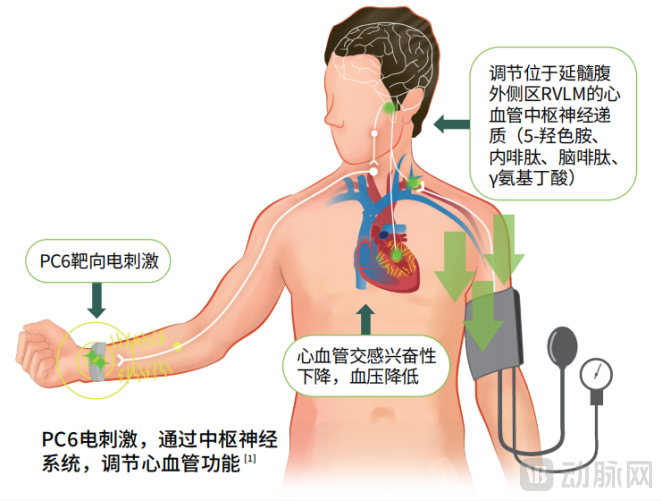
Principle of Blood Pressure-Reducing Wristbands
However, its efficacy should not be underestimated. Experimental data show that after 8 weeks of targeted neuromodulation therapy, users exhibited significantly reduced levels of blood renin and norepinephrine.
The blood pressure-lowering wristband is as effective as medication, yet its advantage of being "side-effect-free" is even more pronounced. Dr. Ji stated, "The wristband's advantages in improving hypertension control rates, protecting target organs, and providing comprehensive prevention and treatment services are unmatched by pharmaceuticals."
First, the blood pressure-lowering wristband is easy to use; patients simply wear it on their wrists without requiring manual operation. Compared with lifestyle modifications or even taking medications at fixed doses and schedules, this approach is easier for patients to adhere to. Such a convenient treatment modality that requires no deliberate action improves patient compliance, thereby significantly increasing the rate of blood pressure control.
Secondly, research by Yuefan Technology has found that the specific pulse frequency of its blood pressure-lowering wristband acts on the sympathetic nervous system to reduce blood pressure. This approach avoids the side effects associated with long-term, high-dose medication use, such as liver and kidney damage, thereby reducing the risk of drug-induced injuries in patients.
Finally, the blood pressure-lowering wristband offers a new therapeutic option for patients with hypertension. By integrating “lifestyle management, pharmacotherapy, and neuromodulation,” it provides comprehensive prevention and treatment, thereby maximizing patient benefits. Dr. Ji told VCBeat, “Taking systolic blood pressure as an example, this ‘three-pronged approach’ can achieve an additional reduction of 12.5 mmHg. This is highly valuable in clinical practice.” For every 10 mmHg reduction in systolic blood pressure, the risk of cardiovascular events decreases by 22%, and the risk of cerebrovascular events decreases by 41%. This treatment modality effectively protects target organs, mitigating hypertension-induced damage to the heart, brain, kidneys, and retina, thus preventing patients from experiencing worsening health despite ongoing treatment.
In summary, the blood pressure-lowering wristband was not designed to replace pharmacological treatment, but rather to offer a therapeutic approach that enhances the rate of effective blood pressure control while reducing medication-related side effects. It aims to help users achieve better blood pressure management alongside their existing treatment regimens, thereby alleviating psychological burden.
IV. Truly Realizing Health Management with Wearable Devices
It is reported that the blood pressure-lowering wristband has been upgraded to version 2.0, incorporating personalized control and blood pressure monitoring features. Patients can connect their smartphones to the wristband to visually track the effectiveness of blood pressure management, thereby improving treatment adherence. Furthermore, based on changes in the user’s blood pressure, the Blood Pressure-Lowering Wristband 2.0 leverages AI-driven big data analytics to determine the optimal stimulation pattern and deliver a “personalized” treatment plan.
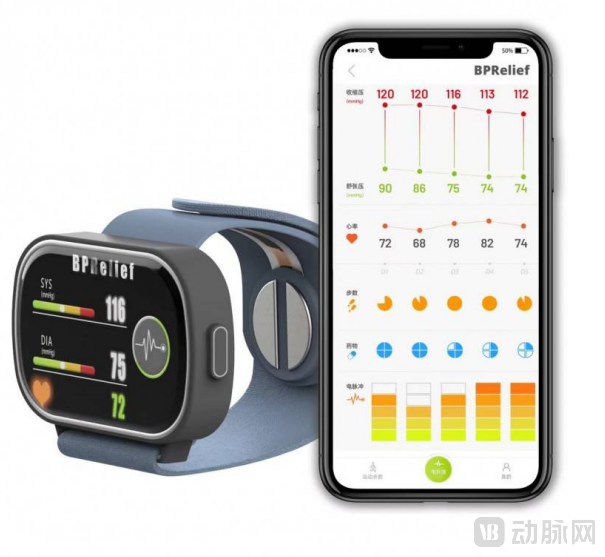
Blood Pressure-Lowering Wristband Connects to Mobile Phone
As no homogeneous products are currently available on the market, Yuefan Technology has submitted applications for its blood pressure-lowering wristband to the U.S. FDA’s Breakthrough Devices Program and China’s Innovative Medical Device program. Subsequently, a multicenter clinical trial for the device will be conducted under the leadership of Shanghai Zhongshan Hospital. The company plans to obtain medical device registration certificates in both the United States and China in 2024, thereby entering the commercialization phase.
However, the blood pressure-lowering wristband is not Yuefan Technology’s only product. In addition, Yuefan Technology has developed the BPRelief ®- Eye blood pressure-lowering eye mask, which lowers blood pressure by stimulating the vagus nerve and inhibiting sympathetic nervous system activity. This product is also poised to enter industrial-scale production in the near future.
Dr. Ji stated, “Yuefan Medical’s vision is to provide innovative home-use medical devices. In the future, Yuefan Technology will focus on developing the health-related features of wearable devices, truly enabling users to ‘wear’ their health.”