

Nuclear Medicine Takes Off: Who's Leading the 'Drug-Device Integration' Blue Ocean?

Baheal Medical
Health Brand Commercialization Platform
Radiopharmaceuticals refer to radiopharmaceutical preparations or their labeled drugs used for clinical diagnosis or treatment. Due to their radioactivity, they are often used in conjunction with PET/CT or SPECT/CT equipment in clinical practice, enabling quantitative modeling and numerical calculation of the target lesion area. The underlying principle is that both CT and radiopharmaceuticals are based on radiation; the radiation absorption measurements of tissues and organs obtained by CT can be directly used for the quantitative calculation of radiopharmaceutical dosage, thereby achieving personalized, precise, and quantitative dosing. If medical imaging equipment is regarded as the "gun," then radiopharmaceuticals are the "bullets." The development of nuclear medicine relies on both equipment and drugs; only the combination of the two can achieve effective targeted diagnosis and therapy in nuclear medicine.
Furthermore, nuclear medicine is an integrated discipline combining diagnosis and therapy. By utilizing different therapeutic radionuclide probes to combine imaging diagnosis with internal radiation therapy, it achieves the goals of visualized diagnosis and precision treatment, providing patients with quantitative, precise assessments and medication management.
The unique advantages demonstrated by radiopharmaceuticals in integrated theranostics and precision medicine are difficult for traditional drugs to match. In recent years, radiopharmaceuticals have gradually unleashed their potential in the fields of oncology treatment and the diagnosis and management of brain diseases, prompting pharmaceutical companies both domestic and international, such as Novartis, Bayer, Grand Pharma, and Baheal Medical, to enter the market.
Nuclear Medicine Has Become the Next Critical Battleground for Pharmaceutical Companies.
China's nuclear medicine sector originated in the 1950s. Despite more than six decades of development, it remains in its nascent stage due to constraints such as a shortage of talent, high development costs, prolonged R&D cycles, and limited technological accumulation. Consequently, there is still a significant gap compared with developed countries in Europe and the United States.
In terms of product pipelines, the radiopharmaceutical products currently marketed in China suffer from serious homogenization. Most are generic versions of drugs that have been available abroad for many years, featuring older formulations and narrow indications. In recent years, no innovative diagnostic radiopharmaceuticals have been approved domestically. In contrast, the international market has seen a continuous emergence of innovative radiopharmaceuticals; in the diagnostic segment alone, more than ten new drugs have been approved in recent years.
In terms of market applications, China still lags behind developed countries to some extent. Taking PET/CT and SPECT/CT scans, which are commonly used in clinical nuclear medicine diagnostics, as examples, data from 2019 show that the number of PET scans performed in China and the United States was 860,000 and 2 million, respectively, while the number of SPECT scans was 2.51 million and 18 million, respectively. In comparison, the penetration rate of nuclear medicine applications in China is significantly lower than that in mature markets, indicating substantial room for growth.
However, with the release of the Medium- and Long-Term Development Plan for Medical Isotopes (2021–2035) in June 2021, the momentum behind the development of nuclear medicine has accelerated once again. The plan proposes accelerating the establishment of nuclear medicine departments, aiming to achieve full coverage of such departments in all tertiary general hospitals by 2025, and to realize the “one department per county” goal by 2035. Furthermore, by 2025, at least 1,000 county-level hospitals nationwide are expected to reach the medical service capacity level of tertiary hospitals, thereby continuously promoting the decentralization of high-quality provincial and municipal medical resources to the county level.
In March 2023, the National Health Commission adjusted the catalog of configuration licenses for large-scale medical equipment, relaxing restrictions on the deployment of PET-type devices, which further demonstrates regulatory support for the nuclear medicine industry.
Furthermore, the state has been making continuous efforts to strengthen the nuclear medicine supply chain. At the end of 2022, CNNC Qinshan Nuclear Power Company initiated the construction of China’s largest medical isotope production base. CGN has also built a medium-energy cyclotron in Mianyang, Sichuan Province.
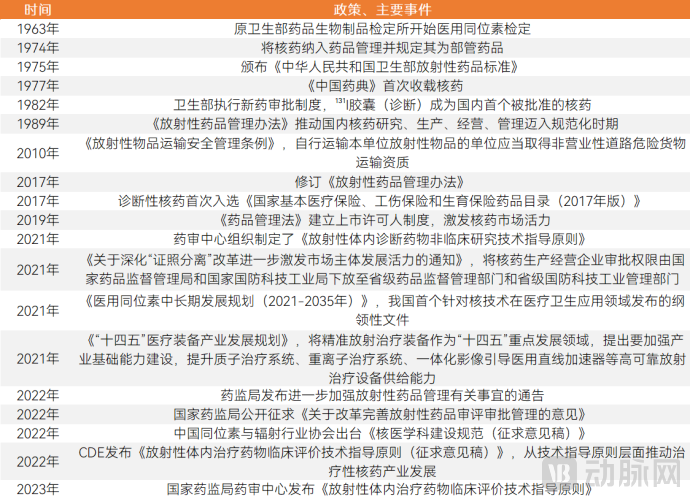
Overview of Domestic Radiopharmaceutical Policies / Graphic by VCBeat New Medicine
Policy-driven momentum and broad growth prospects have also ignited investor enthusiasm. Amid an overall downturn in the innovative drug market, financing in the radiopharmaceutical industry has risen against the trend.
According to data from VCBeat New Medicine, the nuclear medicine sector attracted nearly RMB 900 million in cumulative financing in 2022. With frequent large-scale funding rounds exceeding RMB 100 million, it emerged as the subsector with the highest proportion of such mega-financing events within the innovative drug industry in 2022. Top-tier investment firms, including Sequoia China, Qiming Venture Partners, Cowin Capital, Yansheng Venture Capital, Sinopharm Capital, and Shanlan Capital, actively invested, accelerating industrial consolidation and development.
Amid a confluence of favorable factors, China’s nuclear medicine sector has recently achieved a milestone breakthrough.
According to public reports, RadioPharma, an innovative enterprise in the field of nuclear medicine, has developed9999mTc-3PRGD2 has completed Phase III clinical trials. It is the first Class 1 new drug for tumor imaging diagnosis in nuclear medicine in China, and the first broad-spectrum tumor imaging agent for SPECT diagnostic imaging worldwide. This achievement not only fills the gap in SPECT tumor imaging agents but also positions China at the forefront of nuclear medicine SPECT drug development.
99mTc-3PRGD2 is a first-in-class RDC drug, and its clinical results show:9999mTc-3PRGD2 SPECT/CT demonstrates a favorable safety profile; compared with18Head-to-head studies of 18F-FDG PET/CT have shown that its specificity and accuracy in diagnosing lymph node metastasis in lung cancer are significantly higher than18¹⁸F-FDG PET/CT showed no significant difference in accuracy for differentiating benign from malignant lung tumors.
This also means that,99In addition to its accuracy in differentiating between benign and malignant lung tumors, 99mTc-3PRGD2 SPECT/CT also18¹⁸F-FDG PET/CT is consistent, and may also compensate for the missed diagnosis of lymph node metastases from lung tumors by contrast-enhanced CT, as well as18Misdiagnosis of Lymph Node Metastases in Pulmonary Tumors by ¹⁸F-FDG PET/CT.
It is worth noting that, compared with PET imaging technology, SPECT equipment enjoys a higher penetration rate in China. The preparation of SPECT radiopharmaceuticals is simpler, and the cost of clinical testing is more affordable—approximately one-tenth of the cost of PET imaging (with a single PET/CT scan priced between RMB 8,000 and RMB 10,000)—which holds the promise of benefiting a broader population.
99The emergence of 99mTc-3PRGD2 has not only broken the technical status quo and conventional wisdom that SPECT imaging cannot be used for tumor diagnosis, staging, and treatment efficacy monitoring. As a whole-body broad-spectrum tumor imaging agent, it shows application potential in various cancers besides lung cancer, including breast cancer, esophageal cancer, thyroid cancer, and melanoma. Nuclear medicine physicians in China have published nearly 30 clinical research papers in relevant international journals, indicating that its clinical value remains to be further explored over the long term.
Meanwhile, the valuable experience and technical expertise accumulated during the research and development of this innovative drug have laid a solid foundation for the future development of other radiopharmaceuticals for targeted diagnosis and therapy.
99The innovation behind mTc-3PRGD2 originated from a national-level team at Peking University Health Science Center. Subsequently, to commercialize this scientific achievement, RadioDiag was established in 2012, focusing on the research, development, and translation of radiopharmaceuticals at an internationally leading level.
In 2022, RadioDx signed a scientific research cooperation agreement with the Health Science Center of Peking University to establish the “Peking University Medicine–RadioDx Joint Laboratory for Nuclear Medicine and Molecular Imaging.”
In the same year, Raydio received strategic investment from Baheal Medical Group, an industrial investment group. As one of the leaders in the life sciences sector, Baheal Medical Group is committed to introducing products that truly optimize healthcare scenarios into practical applications, thereby improving clinical treatment protocols. The unique integration of diagnosis and therapy in nuclear medicine, coupled with the innovativeness of Raydio’s radiopharmaceutical products, aligns perfectly with Baheal’s philosophy of “optimizing healthcare scenarios through technological innovation.”
Baheal Medical has its own strategic logic and industrial system for the innovative application and industrialization of radiopharmaceuticals.
First is the “source innovation” strategy.Baheal Medical collaborates closely with national-level research institutions such as Peking University Health Science Center. Acting as a resource linker, it serves as a bridge between the market and R&D sectors, helping innovative enterprises optimize resource allocation, incubate and nurture innovations that truly enhance clinical healthcare scenarios, and leverage its own commercialization capabilities to bring these innovative achievements to market.
Second is the "integration of pharmaceuticals and medical devices" strategyBaheal Medical believes that radiopharmaceuticals and imaging equipment are inextricably linked; innovation in drugs can also drive innovation in equipment, thereby enabling more precise administration and assessment of radiopharmaceuticals, and ultimately achieving continuous optimization of medical scenarios.
Based on the above considerations, Baheal Medical has fully leveraged its strengths in innovation incubation to implement a comprehensive layout across the entire industry chain. In terms of specific actions, in addition to Reidiao, Baheal has also expanded into the research, development, and manufacturing of nuclear medicine molecular probes and nuclear medicine SPECT/CT systems, thereby achieving a closed loop between radiopharmaceutical R&D and equipment production.
Baheal’s continued deepening of its presence in the nuclear medicine sector is not only a microcosm of this RMB 10 billion-class pharmaceutical company’s industrial innovation strategy, but also lights a new beacon for the transformation and development of Chinese pharmaceutical enterprises—namely, completing the transition from “products” to an “ecosystem,” building multi-curve comprehensive synergy across R&D, clinical practice, and application, and achieving a leap from RMB 10 billion to RMB 100 billion.
In China, nuclear medicine has undergone more than 60 years of development, gradually achieving the transition from reliance on imports to domestic substitution. Moving forward, the key focus for the future development of nuclear medicine in China will be the shift from domestic substitution to independent innovation.
Industry insiders pointed out that, with the99The successful development of 99mTc-3PRGD2 marks a significant breakthrough in China’s R&D of nuclear medicine SPECT agents. However, in the short term, the development of nuclear medicine in China still faces shortcomings and bottlenecks, which require coordinated efforts from multiple stakeholders.
The development of radiopharmaceuticals involves multiple disciplines, including chemistry, biology, pharmacy, basic medicine, and clinical medicine. It is reported that there are currently only over 10,000 nuclear medicine practitioners in China, including nurses and technicians. According to the "Plan" for establishing more than 2,000 nuclear medicine departments, there is still a significant talent gap; at the policy level, the coverage of radioactive drugs by the medical insurance system is insufficient; ordinary citizens, and even some doctors, lack understanding of nuclear medicine and may even have misconceptions... These issues remain to be addressed.
“No matter how long the journey, perseverance leads to arrival; no matter how difficult the task, diligence ensures success.” As the implementation of the Medium- and Long-Term Development Plan for Medical Isotopes (2021–2035) deepens, we look forward to the emergence of more independently innovated radiopharmaceuticals and equipment, contributing China’s narrative to the annals of global nuclear medicine.