

Shanghai Jiao Tong University Team's Seconds-Curable, Highly Tough Wound-Repair Hydrogel Granted Innovative Medical Device Designation

Lingel Tech
Biological Materials Patent Technology Researcher
Recently, a paper published in Nature Materials has caused a sensation in the materials science community.
This paper was published by the research group of Researcher Qiuning Lin and Professor Linyong Zhu at Shanghai Jiao Tong University. The study proposes a novel, broadly applicable hydrogel crosslinking technology. Based on this technique, conventional water-soluble polymers can form strong and tough hydrogel materials within seconds of light exposure, virtually revolutionizing the mechanical properties and fabrication processes of existing hydrogel materials.
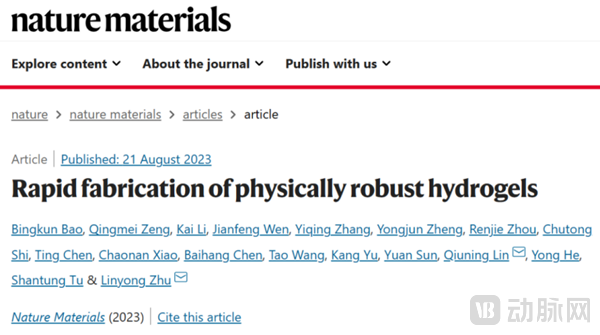
Image source: Nature Materials
Nature Materials had an impact factor of 47.656 in 2022–2023, establishing it as a top-tier academic journal in the field of materials science and related disciplines. What innovative breakthroughs in the high-strength, high-toughness hydrogel materials developed by Professor Zhu Linyong’s team led to their publication in Nature Materials? Compared with existing tough hydrogel technologies, which specific performance metrics have been enhanced by the team’s innovative approach? Furthermore, what are the clinical implications and market value of this material in the biomedical field?
With many questions in mind, VCBeat interviewed Professor Zhu Linyong to discuss the development and innovation of hydrogel technology, as well as its clinical applications.
Materials science is an interdisciplinary field that integrates physics, chemistry, metallurgy, and other disciplines. Professor Zhu Linyong, in fact, devoted his early career to deepening his expertise in chemistry, let alone venturing into the equally high-barrier fields of materials science and biomedicine.
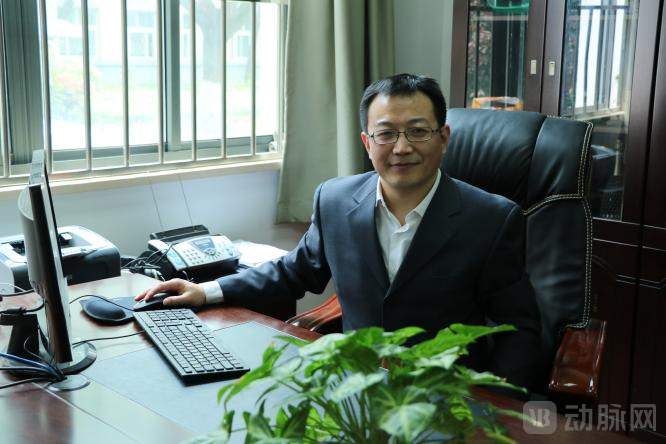
Prof. Lin Yong Zhu, School of Biomedical Engineering, Shanghai Jiao Tong University
Photo provided by the interviewee
In 1991, Zhu Linyong enrolled in the Department of Chemistry at Beijing Normal University. Upon graduation that same year, he joined the Institute of Photographic Chemistry of the Chinese Academy of Sciences (CAS) to pursue a combined master’s and doctoral program. After earning his Ph.D., he remained at the institute, which later became the Technical Institute of Physics and Chemistry, CAS, where he continued his research career.
In addition to his study and work experience at China’s top research institutes, Zhu Linyong went to the United States in 2003 for advanced studies to learn from leading international expertise in photochemistry. He subsequently conducted postdoctoral research at Washington State University and the University of California, San Diego, under the supervision of Marye Anne Fox, a member of the U.S. National Academy of Sciences and a world-renowned photochemist.
Compared to his academic and professional background in organic chemistry, Professor Zhu Linyong’s current research and work represent a “cross-disciplinary” shift. This interdisciplinary approach is one of the key reasons why his team has successfully developed high-strength, high-toughness hydrogel materials and applied them in the biomedical field.
Zhu Linyong currently serves as a Distinguished Professor and Doctoral Supervisor at the School of Biomedical Engineering, Shanghai Jiao Tong University, and as a Distinguished Professor under the Shanghai “Eastern Scholar” Program.The School of Biomedical Engineering at Shanghai Jiao Tong University leverages the university’s high-quality resources in engineering and clinical medicine, and is characterized by its focus on “med-engineering interdisciplinary integration, internationalization, and innovative translation.”
Based on the university’s medical-engineering platform, as well as Professor Zhu Linyong’s years of frequent exchanges with physicians from various departments and extensive on-site observations of clinical surgeries.Professor Zhu Linyong, with his multidisciplinary and multi-domain knowledge and experience, has bridged clinical treatment with hydrogel technology research, achieving bidirectional translation “from bench to bedside” and “from bedside to bench.”
Hydrogels are formed by the crosslinking of hydrophilic polymer chains in water, and they can be prepared through various methods, such as electrostatic interactions and covalent chemical crosslinking. Hydrogels fabricated using appropriate materials and methods find applications in multiple fields, including wound dressings, controlled drug release, soft tissue repair and replacement, tissue engineering, and biosensors.
However, “water” can both carry a boat and capsize it. Conventional hydrogels feature loose cross-linking and lack mechanical strength, making them prone to permanent fracture and thus difficult to apply in practical fields requiring long service life and high load-bearing capacity.
Consequently, scientists worldwide have devoted significant effort to enhancing the mechanical properties of hydrogels. Although researchers in various countries have achieved certain progress at this stage, it remains challenging to mass-produce hydrogel materials that combine high strength and toughness within a short timeframe using simple processes.
In response, after years of dedicated research and validation, Professor Zhu Linyong, a chemist by training, led his team in proposing the “photo-coupling reaction” hydrogel technology and applying it to various fields, including biomedicine.The hydrogel materials prepared by this technology mainly have the following three innovative advantages:
“Effortless” Hydrogel Preparation Process: Requires Only Seconds of Light Exposure
Hydrogels are formed when polymer chains dispersed in an aqueous medium undergo cross-linking via specific mechanisms. The principle underlying hydrogel preparation is a critical factor determining their properties and applications. In this regard, Professor Zhu Linyong’s team, after nearly a decade of technical optimization, proposed the “photo-coupling reaction” gel technology.
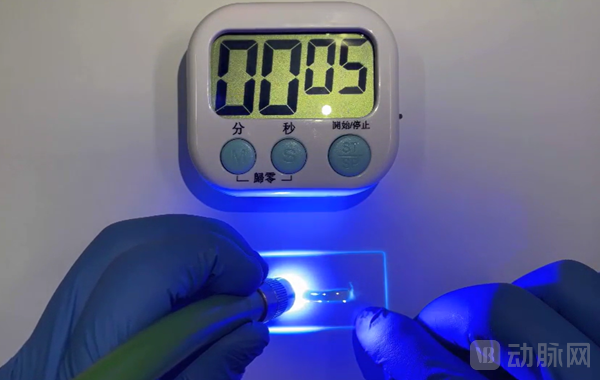
"Photoconjugation Reaction" Gel Technology
Image provided by the interviewee
In the hydrogel preparation process based on "photo-coupling reactions," high-strength and tough hydrogels can form spontaneously within seconds of light exposure, without the need for meticulous design or careful manual control. The "ease-of-use" advantage of this technology not only addresses the key challenge of complex manufacturing processes associated with traditional high-strength hydrogels, but also overcomes technical barriers to clinical translation, thereby facilitating mass production and widespread adoption of related products.
Both strong (15.3 MPa) and tough (138 MJ m⁻³)−3) hydrogel materials
In addition to the "user-friendly" preparation process, Professor Zhu Linyong’s team also modulated the mechanical properties of the hydrogel by adjusting the ratio of raw materials.When the ratio varies, the maximum toughness of the hydrogel is 138.0 MJ m⁻²-3, capable of stretching to 28 times its original length at yield, with performance comparable to high-strength steel, nylon, and synthetic rubber. When the formulation ratio is further adjusted, the hydrogel achieves a maximum strength of 15.3 MPa, surpassing existing tough hydrogel materials.
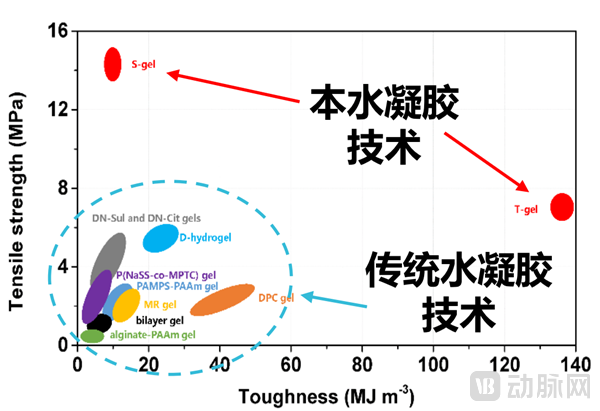
Comparison of Strength and Toughness
Image provided by the interviewee
Most importantly, regardless of the formulation ratio, hydrogel materials based on “photo-coupling reactions” can overcome the inherent trade-off between strength and toughness that plagues traditional hydrogels—typically characterized as either “soft and weak” or “hard and brittle”—thereby achieving both high strength and high toughness. Furthermore, this material boasts industry-leading resilience and fatigue resistance, capable of withstanding over 100,000 cyclic stretching cycles, and even millions of cycles under certain extreme conditions.
Excellent wet tissue adhesion (120 kPa), enabling adhesion to moist tissues such as those in the oral cavity
The high water content renders hydrogels soft, moist, and highly biocompatible and biodegradable; however, this characteristic also prevents them from adhering to wet, dynamic tissue surfaces, thereby precluding their application in soft tissues within the human oral cavity, body lumens, or at sites with hemorrhage or exudate.
In this regard, the "photo-coupling reaction" can form covalent bonds with amino groups on tissue surfaces, addressing the challenge of hydrogel materials failing to adhere to moist tissue surfaces. The maximum adhesion strength can reach 120 kPa, which is 4–5 times that of fibrin glue, a typical hemostatic agent.
August,In addition to having their papers published in top international journals, Professor Zhu Linyong’s team has also received good news from Lingel Tech (Shanghai Lingel Medical Technology Co., Ltd., hereinafter referred to as “Lingel Tech”), the medical technology company supporting the clinical translation of their technologies.
On August 23, the Center for Medical Device Evaluation (CMDE) of the National Medical Products Administration publicly announced that the self-developed product of Zhongshan Guanghe Medical Technology Co., Ltd. (a subsidiary of Lingel Tech)—light-cured wound closure adhesive—has entered the CMDE’s special review procedure for innovative medical devices.
Professor Zhu Linyong is the Founder and Chief Scientist of Lingel Tech.Lingel Tech was founded in 2021 and has completed tens of millions of yuan in Series A financing.
The approval of the “Green Channel” not only demonstrates that this self-developed product is a domestic first, internationally leading, and holds significant clinical value, but also means that the National Medical Products Administration (NMPA) will prioritize its technical review and administrative approval during future registration submissions, thereby significantly accelerating the processes of registration testing and market approval.
According to QYResearch data, the global market size for advanced wound dressings reached USD 5.846 billion in 2020 and is projected to reach USD 7.230 billion by 2027, representing a compound annual growth rate (CAGR) of 2.47%. Meanwhile, the Chinese market is expected to grow from USD 414 million in 2020 to USD 578 million in 2027, with a CAGR of 4.263%.
In light of the rapidly growing market for high-end wound dressings in China and considering domestic regulatory policies, Professor Zhu Linyong has chosen to initially focus his product portfolio on the field of medical photosensitive bioadhesives.The company has finalized two products for the closure, hemostasis, and repair of soft tissue wounds, completing engineering development, safety validation, registration testing, and multicenter clinical trials.
The first product, a light-cured skin adhesive, can be used for the bonding and fixation of skin incisions.Compared with cyanoacrylate adhesives currently available on the market, this product offers enhanced safety and biocompatibility, helping to prevent adverse events. Furthermore, owing to its superior toughness, adhesion, and elasticity, it enables precise in situ approximation of wound-edge skin, reduces tension at the wound margins, and thereby minimizes scar formation.
Meanwhile, Professor Zhu Linyong pays particular attention to unmet clinical needs, such as those involving irregular areas like the perianal and vulvar regions, or wounds of varying depths with irregular edges. There is an urgent need for a product that can rapidly seal, effectively adhere, achieve hemostasis and absorb exudate, accelerate healing, and alleviate patient suffering.
Article 2: Light-cured wound closure adhesive is a product designed for sealing and promoting the repair of irregular areas or uneven wounds.The product has completed hundreds of clinical trials, demonstrating its ability to firmly adhere to moist wound surfaces, provide effective pain relief, significantly reduce the frequency of dressing changes, and shorten wound healing time by nearly half.
Moving forward, leveraging its advantages such as excellent biocompatibility, non-immunogenicity, and tunable physicochemical properties, this patented hydrogel technology will also be applied to micro-implantable devices such as catheters and stents. For instance, through hydrogel coatings or composite materials, it can enhance the hydrophilicity of implants and reduce patients’ immune responses.
In the future, this technology can also be applied via optical projection 3D printing to the fabrication of high-precision, complex hydrogel devices that were previously unmanufacturable, such as scaffolds and blood vessels for tissue engineering and regenerative medicine, achieving a printing resolution of up to 2 μm.
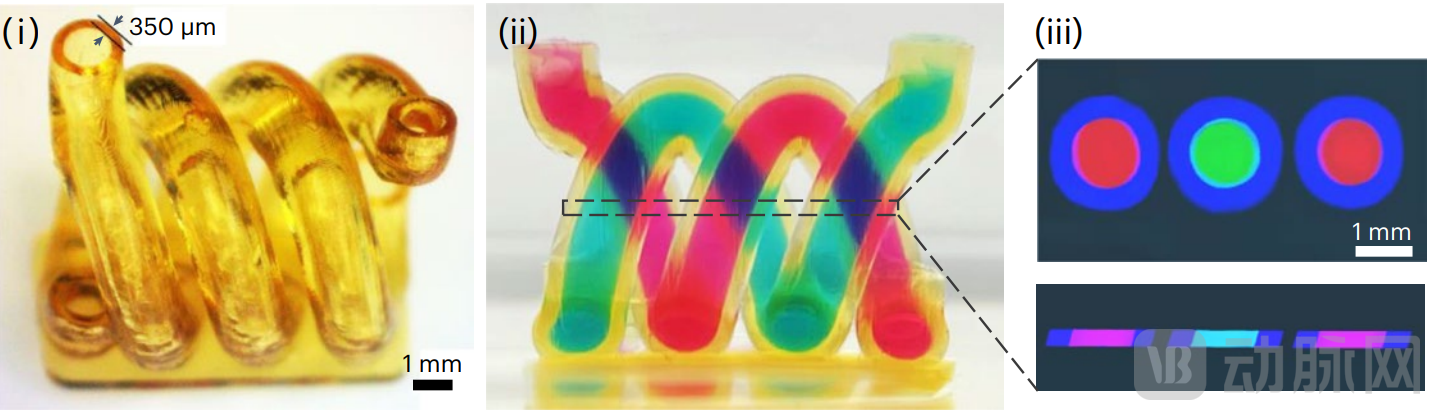
Photo provided by the interviewee
Professor Zhu Linyong’s team has established a comprehensive intellectual property portfolio for the “photo-coupling reaction”-based in situ gel technology, securing full protection across raw materials, preparation processes, formulations, products, and their clinical applications.
As of now, the team has filed applications for this proprietary technology.Held 20 invention patent applications in China, under the Patent Cooperation Treaty (PCT), the United States, Europe, and Japan; granted 10 Chinese invention patents, 3 U.S. invention patents, and 1 Japanese invention patent.This also lays the foundation for Lingel Tech's future global strategic layout.
At the conclusion of the interview, Professor Zhu Linyong stated,“‘Photoconjugation technology,’ as a platform technology, holds promise for the future development of additional materials applicable to more complex clinical scenarios. True to its name, Lingel Tech embodies the meaning of its Chinese characters: ‘Ling’ refers to a water vessel, and ‘Jiu’ signifies achievement. Leveraging the ‘photoconjugation technology’ platform as this ‘vessel,’ Lingel Tech will continue to foster a culture of innovation, aiming to become a benchmark enterprise in the hydrogel field both in China and internationally, thereby driving original innovation in China!”