Hansoh Pharma's Fourth-Generation EGFR Inhibitor HS-10504 Granted Breakthrough Therapy Designation for NSCLC with EGFR C797S Mutation
Hansoh Pharma
Pharmaceutical Research, Production, and Sales

On May 13, the CDE website announced that HS-10504 Tablets developed by Hansoh Pharma are proposed to be included in the breakthrough therapy designation for the treatment of patients with epidermal growth factor receptor.(EGFR)Tyrosine Kinase Inhibitor(TKI)After Treatment FailureLocally Advanced or Metastatic Non-Small Cell Lung Cancer with EGFR C797S Mutation(NSCLC)。
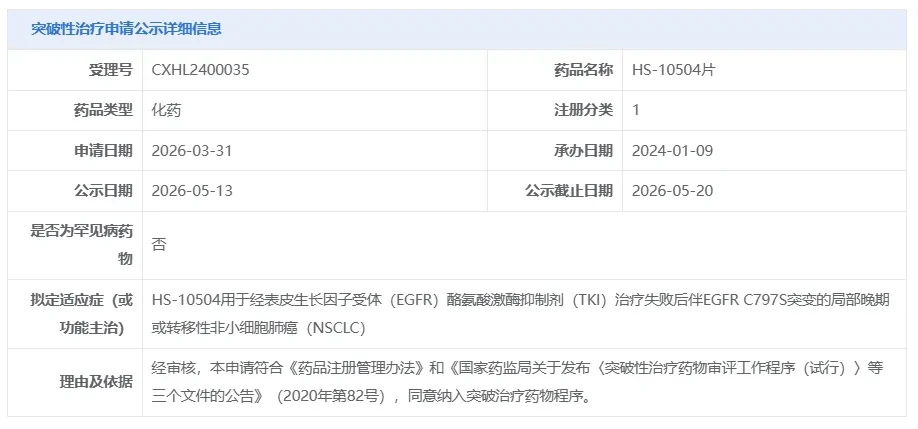
Screenshot source: CDE official website
HS-10504 is a self-developed product by Hansoh Pharma.A Novel, Highly Efficient and Selective Fourth-Generation EGFR TKI, which can act on both EGFR-sensitive mutations and drug-resistant mutations. This compound specifically overcomes the drug resistance mutations caused by third-generation EGFR-TKIs.(C797S)Serine residue at the site, and first/second-generation resistance mutations(T790M)The steric hindrance effect induced.
At the 2026 AACR Annual Meeting, Hansoh Pharma presented the first-in-human Phase I study of HS-10504 in patients with advanced NSCLC in an oral report. (NCT06461156) As a result, the study aims to evaluate the safety, efficacy, and pharmacokinetics of orally administered HS-10504.(PK)Features.
The research results show:
Accept 400 mg once daily(QD)Treatment with EGFR C797S Mutation(With or without T790M resistance mutation)Among the NSCLC patients, a total of 34 cases were evaluable for efficacy, of whichObjective Response Rate(ORR)Was 52.9%, median progression-free survival(PFS)For 9.6 months, demonstrating significant efficacy.
In terms of safety, HS-10504 demonstrated good and controllable safety characteristics, with most treatment-related adverse events.(TRAEs)The most common ≥3 TRAEs were mainly hematological abnormalities, including decreased lymphocyte count and anemia, all of which are clinically manageable.
EGFR-TKI has been widely used as a first-line treatment for EGFR-mutant advanced NSCLC. However, after receiving EGFR-TKI treatment, most patients develop acquired resistance, leading to disease progression. The mechanisms of resistance are complex, especially more pronounced after third-generation EGFR-TKI treatment.
Among them, the C797S mutation is one of the main mechanisms of acquired resistance caused by EGFR mutations. After first-line treatment with osimertinib, the EGFR C797S mutation accounts for approximately 7% of resistance mutations; after second-line treatment with osimertinib, this proportion is about 14%. In addition, among other third-generation EGFR TKIs...(Including Aumetinib and Furmonertinib)There are also relevant reports in China. The fourth-generation EGFR TKI is expected to provide a new treatment option for such patients.
Cover Source:Corporate Logo
Disclaimer:This article is for information sharing only and does not represent the position or viewpoint of Insight. It also does not recommend or introduce any treatment plans. If you have any needs, please consult and contact正规医疗机构.
Editor: Xinyao
PR Article Coordination: WeChat insightxb
SubmissionWeChat: insightxb; Email: insight@dxy.cn