

After Eight Years of Overseas Medical Investment, Tencent Slows Its Pace

Tencent
Internet Comprehensive Service Provider
"After holding back for eight months, I finally closed a deal."
In August 2023, Nigerian pharmaceutical supply chain service provider Remedial Health announced the completion of a $12 million Series A financing round, in which we finally spotted Tencent among the investors.
This marks Tencent’s first investment in the overseas healthcare sector this year. However, this is not a new target identified by Tencent in 2026. In September 2022, Tencent was already one of the investors in Remedial Health’s seed funding round. Since then, Tencent had paused its overseas healthcare expansion until recently.
“Medical Globalization” is a Hot Topic in the Industry This Year.In this wave of “going global,” while we discuss the rise of domestic brands and Chinese companies flocking overseas to seek opportunities, we also observe that over the past eight months of 2023, the pace of Chinese capital “investing in overseas projects” has slowed.
Tencent’s overseas healthcare investments have spanned eight years. In the three to four years following the pandemic, it quietly accumulated 13 overseas projects, nearly matching the total from the previous five years, earning it the title of “the most aggressive investor.” Notably, in 2022, when peers drastically tightened their spending, Tencent accelerated its overseas investment activity, making six deals throughout the year—marking another peak in its eight-year journey of global healthcare investing.
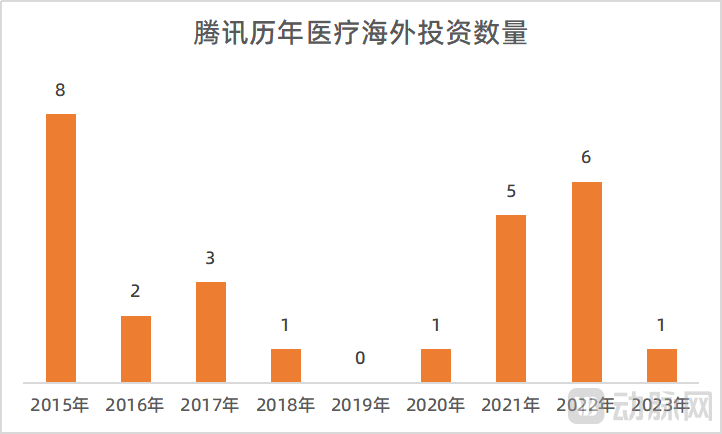
Figure: Data statistics from VCBeat and IT Juzi
However, 2022 was not a good year for Tencent—its interim results were halved, and the number of investments throughout the year shrank to one-third of that in 2021 (280 investments in 2021 versus 91 in 2022).Amidst its advances and retreats, an aggressive Tencent Healthcare appears to be taking shape.Last year, Tencent made 12 investments in the healthcare sector, accounting for over 13% of its total investment volume—a figure significantly higher than the sector’s share in previous years.
But when we sought to delve deeper, Tencent hit the brakes.
Unlike in previous years, Tencent’s VC business came to a near standstill in the first half of 2023.
According to the previously released semi-annual report, Tencent’s investment portfolio had a book value of RMB 713.7 billion in Q2 2023, essentially flat compared with RMB 713.2 billion in Q1. The fair value decreased by RMB 25.8 billion quarter-on-quarter, having a minimal impact on Tencent’s profits.
Looking at the financial report for Q1 2023, "net other income" amounted to only RMB 944 million, a year-on-year decline of 92.81%; among this, "net gains from disposal and deemed disposal of investments in subsidiaries" totaled RMB 1.044 billion, down 94.47% year on year; investment income from associates and joint ventures in Q1 2023 was RMB 80 million, representing a 101.27% year-on-year increase, compared with a loss of RMB 6.28 billion in the same period last year.
Overall, the figures related to Tencent’s investment activities this year have shrunk to a nearly “negligible” level.According to data from IT Juzi, Tencent invested in only 22 projects from January to August 2023, with a total investment amount of RMB 3.928 billion. It can be said that the activity level of Tencent’s venture capital arm has “returned overnight to where it was ten years ago.”
In 2019, Martin Lau, President of Tencent, publicly stated that investment had become a core strategy for the company. Four years later, this core strategy has shifted not merely to “contraction,” but to a complete “pause.” What is Tencent waiting for? When will its investment engine restart? We do not know.But times have indeed changed, and tech giants are shifting the way they tell their stories. At this point, Tencent’s investment “gap year” may only just be beginning.
Although discussions about “internet traffic hitting a ceiling” have been ongoing since 2019, Tencent’s investment activities peaked in 2021. The company invested in 280 projects throughout the year, averaging one deal every 1.3 days. Its 2021 semi-annual financial report revealed that investment operations accounted for half of Tencent’s profits.
However, the contraction came swiftly. At the end of 2021, Tencent distributed nearly 90% of its JD.com shares, valued at over HK$100 billion, as an interim dividend, sounding the horn for a comprehensive retreat from its investment front.
In 2022, Tencent faced performance pressures, with a return to core businesses and cost reduction and efficiency enhancement becoming the “main theme.” Its venture capital (VC) business underwent “portfolio rebalancing and strategic pivots” amid tightening. First, it shifted toward “hard tech,” such as significantly reducing its stake in Meituan and selling off shares of Huayi Brothers and New Oriental Online in the secondary market, while increasing investments in hard technology and the real economy. Second, it accelerated its “global expansion,” with 41% of its 91 investments in 2022 being overseas projects, marking the highest proportion of overseas investments in its history.
A review of the financial reports from the past two years shows that investment activities have indeed provided Tencent with “steady happiness.” However, a closer look at the internal dynamics of this segment reveals rapid volatility—ranging from historical highs to across-the-board contraction, followed by portfolio rebalancing and strategic pivots, and culminating in near stagnation this year.
This not only indicates that the internal and external environments are undergoing drastic changes, but also reflects Tencent’s “anxiety.”
The investment operations of major internet companies are fundamentally aimed at deepening their “moats.” The rapid shifts in their investment activities are clearly driven by the search for additional growth curves. Thus, even in a challenging year like 2022, Tencent’s venture capital arm remained highly active. Last year, Tencent crafted many new narratives for the future, not only investing in multiple artificial intelligence, autonomous driving, and biomedicine companies, but also increasing its bets on the agricultural sector.
As a result, the overseas expansion of the healthcare sector reached its peak in 2022.
This year, Tencent has accelerated its investment pace; meanwhile, it prefers to “scout” for projects at universities and actively seeks out emerging markets.
For instance, Microbiotica’s research is based on a collaboration with the University of Cambridge, and Manifold Bio is a project incubated by Harvard University. Additionally, it marked the first investment in healthcare services in Nigeria. The recently completed investment further strengthens its commitment to the North African market.
When we examine the 2021 investments in aggregate, this trend becomes even more pronounced.
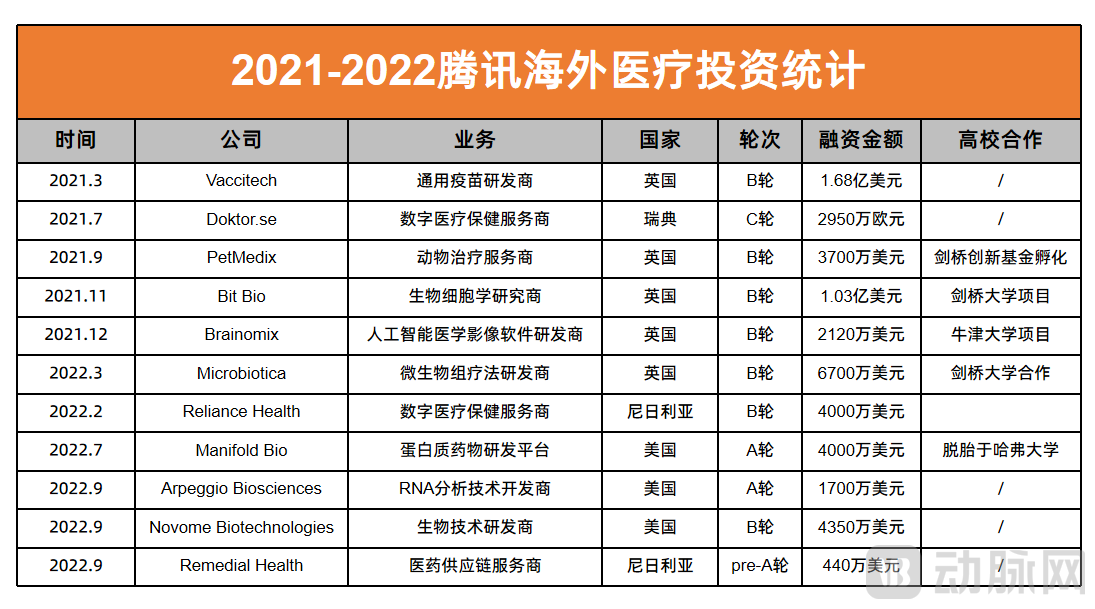
Figure: Data statistics from VCBeat and IT Juzi
Of the 11 projects, 45% are affiliated with Cambridge, Oxford, or Harvard, and these entities are primarily innovative drug developers. In addition to the aforementioned initial focus on the African market, attention to mature markets has shifted away from a heavy reliance on North America, with the European market—characterized by lower policy risks—being highly favored.
A review of overseas healthcare investments over the past two years reveals an investment style similar to that of 2015. While Tencent primarily focused on healthcare services at that time, it now leans more towards biotechnology and pharmaceutical technology. In both periods, the strategy has been characterized by investing in early-stage startups, making smaller bets, and executing frequent transactions.
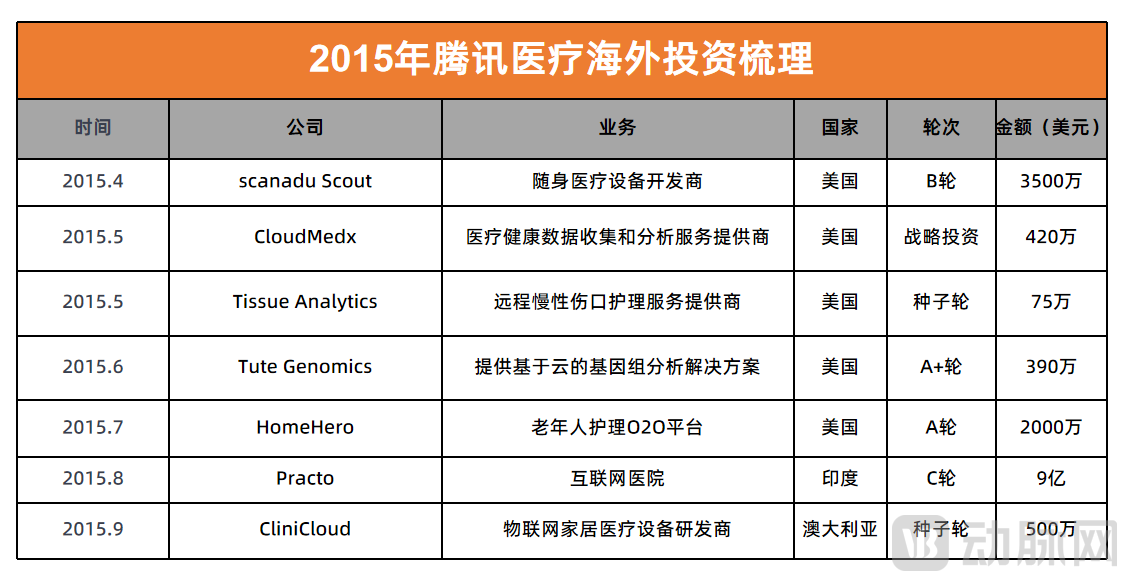
Figure: Data statistics from VCBeat and IT Juzi
However, in 2022, Tencent placed greater emphasis on "utility."In this round of investment, over 60% of projects opted for Series B entry rather than seed-stage funding. These companies possess core technological strengths, have largely mature business models, and have already undertaken initial market-oriented explorations.
Next, it is a matter of waiting for these new narratives to mature. The growth of hard technology and the real economy is driven primarily by new technologies and products, rather than the category expansion and scale expansion that internet companies have previously relied on. This period must allow time not only for portfolio companies to grow but also for Tencent to undergo its “mindset transformation.”
This year marks the first year following a major adjustment to Tencent’s investment operations. Therefore, even though performance improved in mid-2023, its venture capital (VC) business has truly entered a “gap year.”
Entering 2023, Tencent has indeed “stepped back from the rat race,” having already amassed a diversified portfolio. Going forward, the market performance of these new markets and more cutting-edge projects may well serve as the key benchmark for Tencent’s subsequent overseas expansion.
The “pause” in overseas expansion of the healthcare sector this year may also be related to past performance in international markets.
The global expansion of major Chinese internet companies is, in essence, an effort to replicate more “Chinese-style internet” models overseas.However, in reality, Tencent’s overseas healthcare narrative has not been smooth sailing without the drive of traffic and business synergy.
In 2015, Tencent set its sights early on the Indian market. At that time, Practo was India’s largest internet healthcare platform, commanding a 90% market share and having already expanded into the Philippines and Singapore. Leveraging its investment experience in China, Tencent sought to identify a star player in India’s internet healthcare sector.
Consequently, Tencent decided to lead the company’s $9 million Series C financing round. This marked Tencent’s largest overseas investment in its healthcare sector in 2015. A year and a half later, during Practo’s Series D financing round, Tencent further increased its stake, becoming the company’s second-largest shareholder. Over eight years of overseas expansion, Tencent has only reinvested in three projects, underscoring the high expectations it places on Practo.
However, Practo remains unprofitable. According to its 2022 financial report, Practo’s revenue stood at INR 2.02 billion, while its net loss surged from INR 995 million in FY21 to INR 2.033 billion in FY22. In contrast, its competitors are experiencing rapid growth. For instance, 1mg doubled its revenue scale in FY22, reaching INR 6.27 billion; MFine reported revenue of INR 500 million in 2022 and achieved profitability. These “latecomers,” backed by Indian domestic capital giants such as the Reliance Group and the Tata Group, are staging a remarkable comeback.
Atomwise has also delivered disappointing results. As a “first-tier” player in the AI-driven drug discovery sector, the company has attracted investments from Chinese tech giants Tencent and Baidu as part of their overseas expansion strategies.
In 2012, convolutional neural networks (CNNs) first demonstrated human-level performance in the ImageNet image recognition competition. It was also in this year that the first wave of AI-driven drug discovery companies emerged overseas, with Atomwise being one of them; Tencent participated in its Series A and B funding rounds.
But despite an early start, it missed the early market. Compared to its British peers Exscientia and Benevolent AI, which started at the same time, Atomwise’s pipeline progress has clearly lagged behind.
Currently, both UK-based companies are publicly listed, with multiple in-house pipelines having entered clinical trials. In terms of external collaborations, Exscientia secured a major partnership with Sanofi, featuring a $100 million upfront payment and a potential total value of $5 billion; BenevolentAI has also repeatedly delivered milestone achievements to AstraZeneca. In contrast, Atomwise remains at Series B funding. Although Atomwise announced the advancement of its proprietary pipeline development during its Series B financing round in 2020, there has been no news so far indicating that any of its candidates have entered clinical stages.
Internet Giants Enter the Healthcare Sector: An Extension and Supplement to Core Business, Shaped by Their Corporate “DNA”Tencent excels at “connecting everything.” On its home turf, in addition to its capital advantages, Tencent is backed by a colossal ecosystem integrating “social networking + content + payments.” Consequently, even as it crosses over into the healthcare sector, Tencent retains significant advantages in medical resources, user base, traffic, content, and financial data.
But overseas, Tencent’s “magic” clearly fails to work, with its investment efficiency falling far short of that in China.
In China, Tencent is regarded as a paragon of "steady, precise, and decisive" investment strategy within the industry. For instance, Tencent invested in Shuidi Mutual Aid during its angel round and in Sipei Health during its Series B financing. As early as 2014, Tencent invested $70 million in DXY.cn, and it also served as a lead investor in DXY.cn’s $500 million funding round in 2020.
Since 2019, Tencent has generated returns through exits via initial public offerings (IPOs). Data from IT Juzi shows that since 2014, Tencent’s healthcare sector has made 70 investments in China, with seven projects exited, representing an exit rate of 10%. Many of these companies attracted Tencent’s attention in their early stages of development.
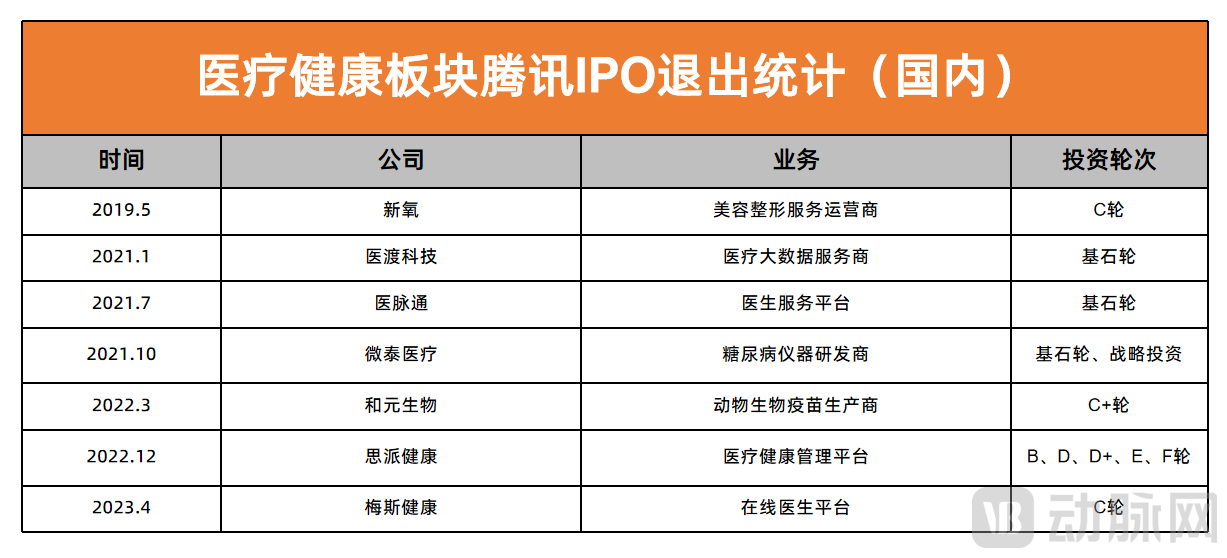 Figure: Data statistics from VCBeat and IT Juzi
Among overseas investments, only GRAIL has yielded returns through exit. In 2020, Illumina proposed to acquire GRAIL for $8 billion, enabling Tencent to exit its investment. In terms of IPO successes, only the universal vaccine developer Vaccitech stands out. As the designer of AstraZeneca’s COVID-19 vaccine, Vaccitech received Series B funding from Tencent in 2021. Two months later, it listed on the NASDAQ; however, its current market capitalization has shrunk to one-sixth of its initial public offering value.
In fact, Tencent’s healthcare investment strategy overseas aligns with its domestic approach: in mature markets (such as Europe and North America), it favors biopharmaceuticals and cutting-edge technology projects; in emerging markets (such as India and Nigeria), it enters through internet healthcare and medical services. Essentially, this represents an extension of its domestic investment experience to international markets.
However, overseas, with Tencent’s social advantages and business synergies no longer in play, it has become significantly more difficult to promote its narratives around medical services and internet healthcare, preventing the company from fully leveraging its strengths even in areas where it typically excels.
From the perspective of investment efficiency, Tencent’s overseas expansion in its healthcare sector remains driven more by strategic objectives than financial ones, aiming to identify emerging technological trends and help Tencent quickly establish a foothold in new markets and technologies.
The initial contours of the global landscape are beginning to emerge.
After eight years of global expansion, Tencent has laid out 24 projects worldwide.
In terms of sector coverage, multiple core tracks—including internet healthcare, precision diagnostics, drug R&D, healthcare digitalization, high-value medical devices, and synthetic biology—are all included, with veterinary care also featured. Tencent remains bullish on global healthcare innovation.
In terms of market coverage, Tencent has established a presence in North America, Australia, Europe, India, and North Africa.
In recent years, Tencent’s strategic approach has become increasingly clear. When entering emerging markets such as Sweden, India, and Nigeria for the first time, it has chosen to enter through medical services, focusing on fundamental needs to lay the groundwork for future scaling. Previously, Doktor.se, a Swedish digital healthcare service provider invested in by Tencent, announced that it was preparing for an initial public offering (IPO).
In mature markets such as the United States and the United Kingdom, we adhere to a strict quality-over-quantity strategy, seeking to acquire projects that combine “hardcore innovation” with “an established market scale.” The investment rounds are slightly later-stage compared to previous years. Companies like Microbiotica and Novome have the potential to drive technological transformation within the industry.
We can view Tencent’s overseas talent acquisition and expansion in recent years as a streamlined and vanguard version of its domestic push to capture market share in the healthcare sector, with the initial framework of its global layout now taking shape.
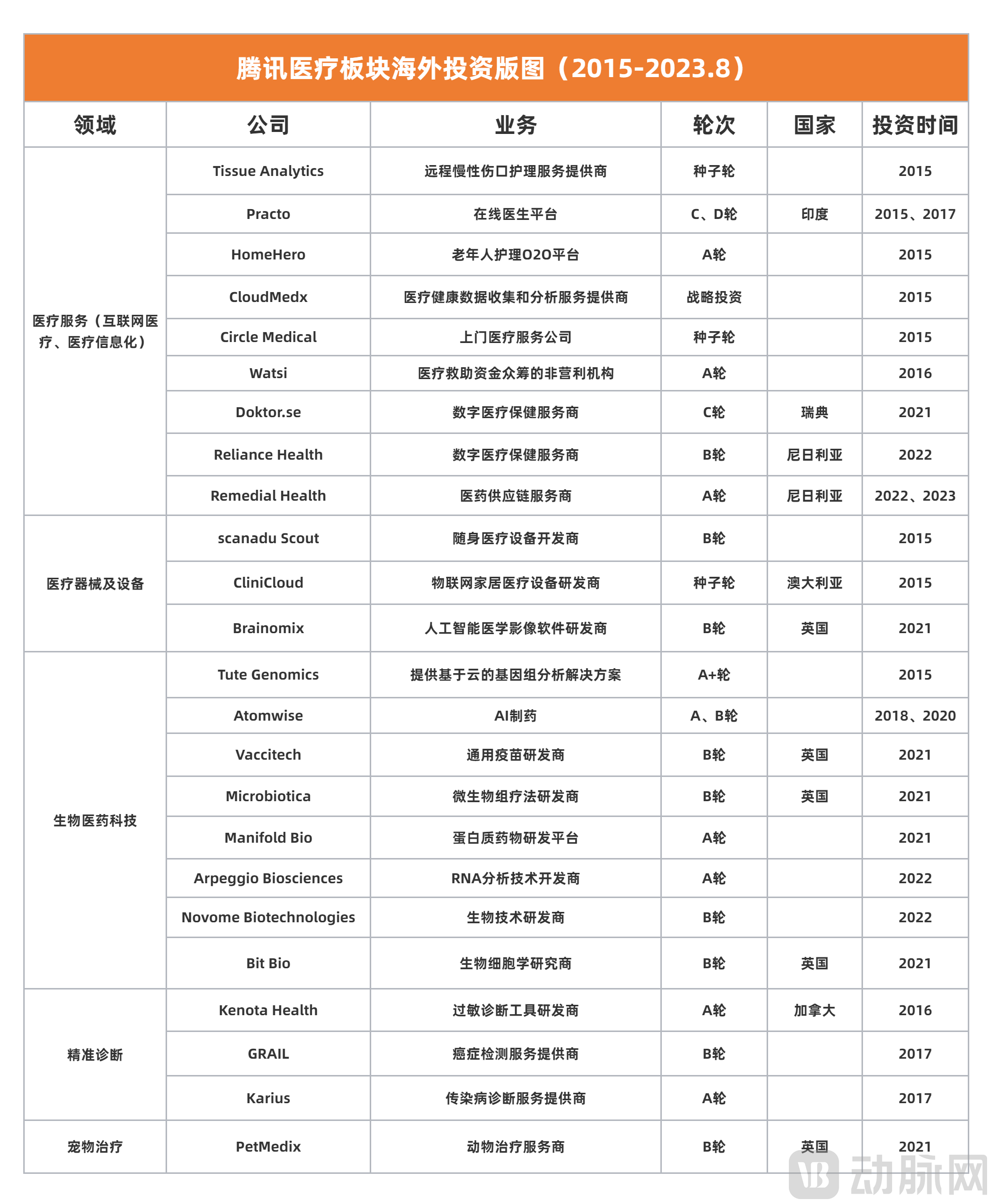
Figure: Data statistics sourced from VBInsight and IT Juzi; projects without a specified country are based in the United States.
Of course, the above overview may only represent a portion of Tencent Capital’s overseas investments in the healthcare sector; Tencent itself also participates as a limited partner (LP) in many other investment vehicles.
Returning to the trend of Chinese healthcare companies expanding overseas mentioned at the beginning of this article, we should pay closer attention to the ongoing evolution of outbound capital investment.
This new wave of capital going global coincides with the “globalization” of Chinese enterprises: leveraging their domestic supply chains, technologies, and talent pools, a large number of companies are expanding their businesses worldwide, with capital providing strong impetus for this overseas expansion. The healthcare industry is no exception. In fact, this reflects a shift in the dividend period of overseas expansion—from the earlier phase dominated by internet companies exporting brands and business models to a new phase driven by technology and industrial capabilities.
This trend is becoming increasingly evident.Thus, as Tencent advances its healthcare ambitions, the global expansion of Tencent-affiliated healthcare innovators and self-developed products will inevitably constitute another facet of its overseas strategy.
Tencent has also begun its attempts.
For instance, in the field of high-end international medical services. In April 2022, Beijing Shengnuo Yijia underwent changes in its business registration, with Tencent holding a 20% stake. Shengnuo Yijia is a professional organization that has established official partnerships with renowned hospitals abroad and provides comprehensive overseas medical consultation and services for Chinese patients. Currently, it is the largest domestic agency facilitating medical treatment abroad.
For another example, Tencent has made strategic moves in the medical device sector.
In September 2021, Tencent’s self-developed “Pneumonia CT Imaging Triage and Assessment Software” officially received a Class III medical device registration certificate. Tencent became the first internet technology company in China to obtain a Class III medical AI certification. In March 2022, Tencent acquired a stake in Shenzhen Saihe Medical Technology Co., Ltd., becoming its second-largest shareholder and formally commencing the sale of medical devices.
Tencent has also independently developed its first product to apply artificial intelligence technology to the medical field, Tencent Miying.
From this perspective, Tencent’s overseas expansion in the healthcare sector is far from halting. Moving forward, Tencent may need to shift its strategy from seeking “China stories” abroad to telling “China stories” abroad.
Over the past decade, Tencent has emerged as the leading player in China’s venture capital landscape, with a portfolio exceeding 1,500 investments. The healthcare sector represents Tencent’s “second-tier” investment focus, encompassing nearly 100 projects. How can more Chinese medical innovations and entrepreneurs be propelled onto the global stage? This presents a significant new opportunity for Tencent’s venture capital arm.
Perhaps this is also Tencent’s more long-term and grand narrative.