

Kexun Biochip Advances High-Precision, High-Sensitivity Cancer Biomarker Detection via Full-Chain Microfluidic Innovation
“Microfluidics, as a critical enabling technology, can integrate with numerous disciplines and holds immense potential; its future impact may far exceed our current understanding,” stated Professor Han Lin, CTO of Shandong Kexun Biochip Technology Co., Ltd. (hereinafter referred to as “Kexun Bio”), in an interview with VCBeat.
In 2006, Nature published a special feature on “Lab-on-a-Chip,” suggesting that microfluidics technology could become the “technology of this century.” Due to its advantages—including miniaturization and automation integration, high throughput, minimal sample requirements, and reduced contamination—microfluidics has been increasingly adopted in fields such as biomedicine, point-of-care testing (POCT), and single-cell sequencing. It is emerging as an enabling technology with the potential to drive disruptive applications.
According to a research report published in 2022 by Yole Développement, an international MEMS-focused consulting firm, the global market size for microfluidic chips totaled $18.1 billion in 2021 and is projected to reach $32.3 billion by 2027, representing a compound annual growth rate (CAGR) of 10.1% from 2021 to 2027.
The immense potential of microfluidics technology has driven countless startups to enter the field. In 2020, Kexun Biology, founded by Xing Zhiqing, founder of Pansheng Group, with Professor Han Lin from Shandong University serving as CTO, was established in Shandong Province. The company is dedicated to developing highly sensitive, highly specific, rapid, and high-throughput chips and devices for tumor marker detection, providing fast and cost-effective testing solutions for early auxiliary cancer screening, precision medicine, and prognosis monitoring.
Undertook National Key R&D Projects and Won First Prizes in Multiple Innovation and Entrepreneurship Competitions
Microfluidics refers to the science and technology involved in systems that use microchannels (with dimensions ranging from tens to hundreds of micrometers) to process or manipulate small volumes of fluids (in the range of microliters, nanoliters, or even attoliters).It is an emerging interdisciplinary field involving chemistry, fluid physics, microelectronics, new materials, biology, and biomedical engineering.. At this scale, the characteristic feature of fluid motion is that it is dominated by surface forces (surface tension, fluid drag) rather than body forces (gravity, inertia).
“Interdisciplinary collaboration has driven the rapid development of microfluidics technology,” said Professor Han Lin. Integration across disciplines is becoming a defining characteristic of contemporary scientific research, and interdisciplinary fields are emerging as a key source of technological innovation. “The convergence of different disciplines holds the greatest potential for major breakthroughs, bringing about revolutionary changes in scientific research or technological applications. In recent years, efforts to promote interdisciplinary development have been vigorously advanced at all levels—from the national and societal spheres to universities. Moreover, enthusiasm for interdisciplinary collaboration in China may far exceed that overseas,” added Professor Han Lin.
Professor Han Lin’s academic journey is a quintessential example of interdisciplinary integration. She earned her bachelor’s degree from the School of Physics at Shandong University in 2003, followed by a master’s degree from the Institute of Microelectronics at Tsinghua University in 2006 and a Ph.D. in Electrical Science and Technology from the Department of Electrical Engineering at Princeton University in 2011. Subsequently, she conducted postdoctoral research in the Department of Biomedical Engineering at Yale University. Transitioning from fundamental physics and electronic science to biomedical engineering, Professor Han has dedicated over a decade to the interdisciplinary field of bio-microelectronics. She also served as Chief Scientist at Isoplexis, an emerging U.S. company pioneering single-cell proteomics. In response to China’s critical needs for novel biosensing technologies in areas such as life and health, marine security, and resource exploration, Professor Han has developed a series of biochips and detection systems with independent intellectual property rights.
At Shandong University, Professor Han Lin presides over nearly 10 national and provincial/ministerial-level projects, including topics under the National Key Research and Development Program, grants from the National Natural Science Foundation of China, the Shandong Province Distinguished Young Scholars Fund, and major scientific and technological innovation projects in Shandong Province.Professor Han Lin served as the principal investigator for the project “Micro- and Nano-Biochemical Sensing Materials and Devices (2017YFB0405400)” under the National Key R&D Program of China during the 13th Five-Year Plan period., the 2021 Shandong Province Major Innovation Engineering Project “Key Technologies for High-Throughput Tumor Marker Detection Chips and Automated Equipment,” and won multiple first prizes in competitions such as the China·Jinan New Kinetic Energy International High-Level Talent Innovation and Entrepreneurship Competition and the Biomedicine and Big Health/4th Innovation and Entrepreneurship Competition.
“From a market perspective, whether in the field of scientific research or in the application of the life and health industry, the overseas monopoly on biomolecular detection products is particularly severe. More than 95% of biochips rely on imports, and there is a particular lack of products with independent intellectual property rights. As an emerging interdisciplinary technology, microfluidics can achieve ‘overtaking on a bend’ and break into life and health-related fields, against the policy backdrop of China’s vigorous promotion of interdisciplinary development and the ‘Four Orientations,’” stated Professor Han Lin.
Antibody Barcode Microarray Chip Technology Based on Inorganic Nanomaterials for Rapid, Precise, and Highly Sensitive Quantitative Detection of Disease Biomarkers
Microfluidics technology is widely applied in the IVD field. “During nucleic acid testing, most industry players utilize microfluidics for PCR amplification processes with certain improvements. Due to the inherent limitations of PCR technology, biochips based on PCR amplification can only achieve semi-quantitative detection. This means that the potential of microfluidics technology has yet to be fully realized,” said Professor Han Lin.
Greater accuracy, speed, simplicity, cost-effectiveness, and portability have always been the trends in technological innovation within the medical field.“From the perspective of application depth, microfluidic technology can provide more refined solutions for widely used nucleic acid detection, developing optimized approaches for different categories of nucleic acids, such as short-chain RNA. From a broader perspective, in addition to nucleic acid detection, we should also develop assays for a wider range of biomolecules, such as proteins,” added Professor Han Lin.
Currently, the primary methods for detecting disease biomarker proteins include ELISA, immunofluorescence assays, electrochemical immunoassays, and surface plasmon resonance. These techniques all involve steps such as antibody incubation, sample incubation, labeling, and multiple washing procedures, resulting in cumbersome operations that hinder rapid and simple detection. Furthermore, they are difficult to perform under conditions with limited space and equipment.
In light of this current situation, Professor Han Lin led the Kexun Bio team,Leveraging the advantages of microfluidic chip technology,We have developed a multi-channel microfluidic sensing system based on the uniform immobilization of antibody barcode arrays via large-area assembly of novel nanomaterials within microchannels, coupled with rapid fluorescence scanning. This system enables simultaneous, high-throughput, highly sensitive, highly reproducible, and highly reliable detection of multiple disease biomarkers from ultra-trace samples.“Leveraging antibody microprinting technology, each slide-sized microfluidic chip can simultaneously detect multiple markers for 60 samples, increasing production efficiency by more than tenfold compared to conventional testing equipment.”
On chip raw materials,Kexun Bio Adopts Novel Inorganic Nanomaterials, not only is it cost-effective and has low requirements for environmental conditions, but it can also shield non-specific signals, thereby reducing background noise to a very low level. This achieves a significant improvement in the detection sensitivity of the product, with repeatability and stability superior to most products on the market. Combined with flow-based antibody immobilization, it further achieves high-density and uniform antibody immobilization.
In addition,Kexun Biology also integrates microarray barcode immobilization technology.“The microfluidic channels are on the micrometer scale. The number of channels can be tailored to meet specific testing requirements, enabling the simultaneous measurement of multiple analytes within a single reaction unit. Compared with conventional chemiluminescent immunoassays, all reactions are confined to micrometer-diameter channels, reducing reagent and consumable usage per test to 1/200–1/300 of that required by standard methods, thereby significantly lowering detection costs,” explained Professor Han Lin.
Precisely integrating multi-indicator protein microarrays with multi-channel microfluidic chips to develop a range of high-precision diagnostic products for tumor markers, bacteria, viruses, and more.
Leveraging antibody microprinting technology and microarray barcode immobilization technology, Kexun Biology has pioneered the development of a detection chip and associated equipment for twelve tumor markers.
On the chip, Kexun Biology utilizes a novel inorganic nanomaterial substrate combined with microfluidic technology. This approach requires only a small blood sample volume (2–10 μL) and offers high sensitivity (with a detection limit as low as 10 pg/mL), high specificity (where specific detection signals differ by more than 100-fold for tumor markers at the same concentration), high throughput (each chip can simultaneously detect over 1,000 analytes), and rapid testing capabilities (40 minutes for 40–100 individuals). It provides a fast, low-cost testing solution for early auxiliary cancer screening, treatment efficacy assessment, and precise prognosis. “This significantly reduces testing costs and lowers screening expenses, striving to create an affordable early cancer screening program accessible to the general public, thereby truly addressing the challenges of late-stage diagnosis and difficult treatment in oncology.”
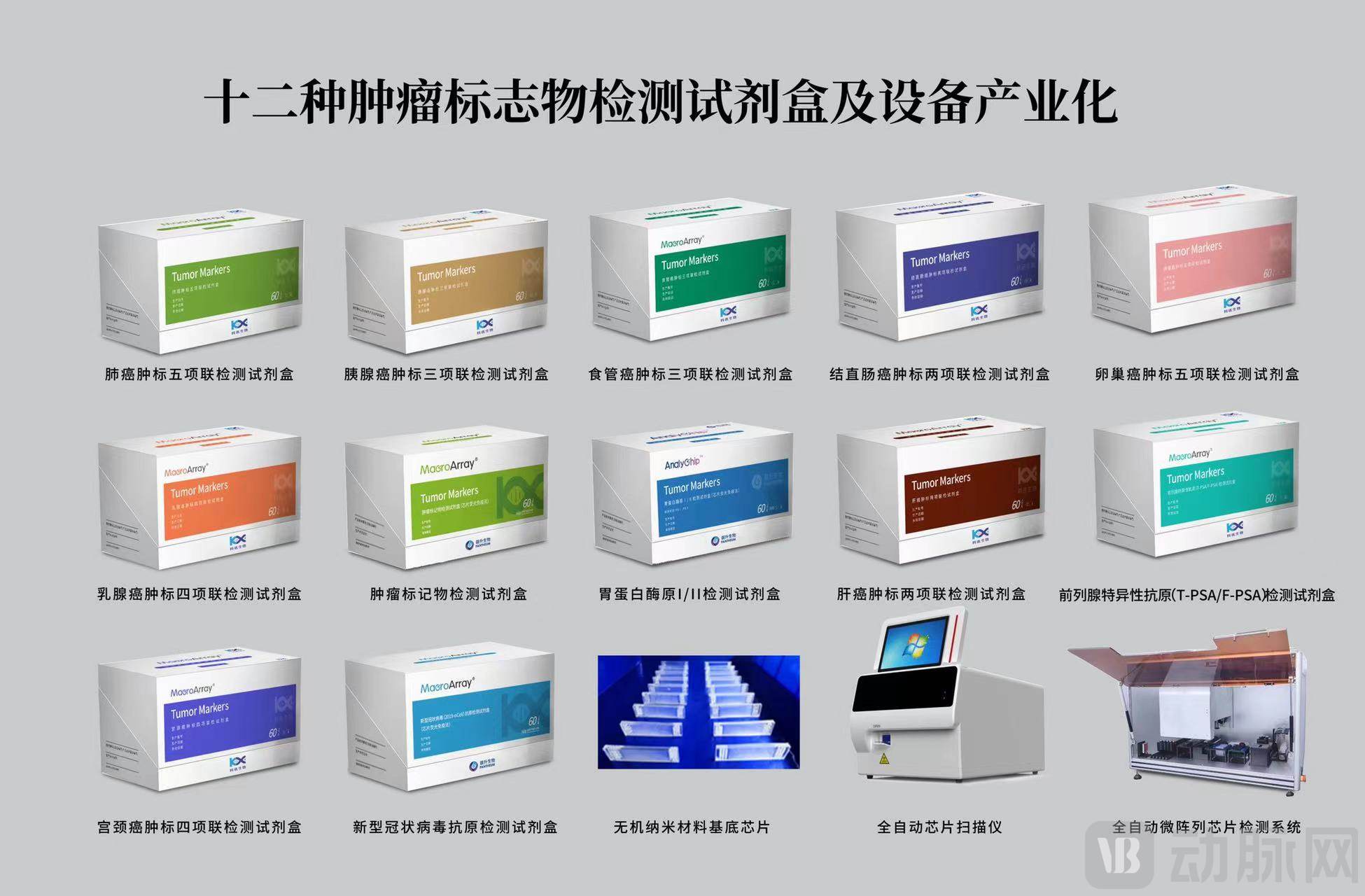
Kexun Biology 12-Tumor Marker Detection Kit
On the equipment front, Kexun Biology has developed an automated microfluidic chip scanner and an automated microarray chip detection system. The automated microfluidic chip scanner utilizes two laser wavelengths, 532 nm and 635 nm, in conjunction with high-sensitivity photomultiplier tubes to perform chip scanning. It features high throughput, high sensitivity, and excellent consistency. Additionally, it incorporates more than ten proprietary technologies spanning optics, signal processing, and motion control systems, enabling dual-channel detection.
"The fully automated microarray chip detection system is suitable for the pre-processing of large-volume, highly infectious, and contaminating samples. The equipment can operate and be managed automatically, performing tasks such as scanning and registering sample information, sampling, reagent dispensing, and completing the entire biochip detection process as required. This minimizes direct contact between laboratory personnel and samples, thereby reducing the risk of infection. 'The fully automated microarray chip detection system also has a broad range of applications, being suitable for genomics, crude proteomics, immunology, cytology, microbiology, and other related fields,' added Professor Han Lin."
“As a key technology ushering medicine into a new era characterized by rapid pace and affordability, the upstream supply chain for microfluidic chip technology remains immature.” It has been revealed that Kexun Bio, which already possesses full-industry-chain development capabilities, is constructing an automated production line for chip substrates to further enhance product quality control, yield rates, and production efficiency. Meanwhile, the company is expanding into CDMO services to provide innovative solutions for the upstream microfluidics sector. Currently, by achieving independent breakthroughs in large-area, low-cost, mass-produced micro-nano fabrication techniques, multi-layer flexible microchannel design, and mass production of detection chips, Kexun Bio has realized the batch manufacturing of microfluidic chips, substrates, supporting reagent kits, and related equipment, and is capable of offering CDMO services to external clients.