

ADI Unveils Next-Gen VSM Chip ADPD7000: A 4-in-1 AFE Redefining Wearable Health Monitoring Standards

Analog Devices
Semiconductor Device Manufacturer
“Fried chicken with ginseng tea, craft beer with goji berries, staying up late while applying facial masks, clubbing with knee pads…” This phenomenon of “punk wellness” among contemporary youth is both a tongue-in-cheek joke and a genuine expression of health consciousness. Young people constantly oscillate between indulgence and restraint, and under the pressure of modern society, they have not escaped emerging “complex ailments” such as insomnia, obesity, and irritability. However, this has elevated public attention to holistic health to unprecedented levels. Bolstered by China’s long-standing traditions of health preservation, people are eager to find targeted solutions for every aspect of life—from lifestyle habits and emotional well-being down to specific minor ailments. As a result, precise monitoring and tech-enabled wellness have become the main themes of the broader health industry, thereby defining the future direction of smart wearable devices as their key enablers.
“Currently, to better support the monitoring of various vital signs and achieve maximum population coverage and accuracy, wearable devices are striving toward higher performance,” stated He Yuan, Senior Marketing Application Manager for Analog Devices’ China Product Division, in a recent interview. ADI’s latest product in the wearable health sector—the all-in-one health sensor analog front-end chip, the ADPD7000—strongly supports his viewpoint. As the newest addition to the Vital Signs Monitoring (VSM) portfolio, the ADPD7000 series is specifically designed to measure various vital sign signals and is suitable for wearable VSM devices. Building on its predecessor, the ADPD7000 adds galvanic skin response (GSR) measurement functionality, integrating photoplethysmography (PPG), electrocardiography (ECG), and bioelectrical impedance analysis (BIA) into a single four-in-one solution. This enables more accurate monitoring of human physiological indicators such as blood oxygen saturation, heart rate, ECG, body fat percentage, and even emotional responses.
“30-year-olds with 60-year-old diseases” is increasingly becoming a social reality. Data shows that the number of people with chronic diseases in China has exceeded 400 million, with an incidence rate of over 34% among those aged 15 and above. In particular, conditions such as diabetes, hypertension, and heart disease—once considered “diseases of the elderly”—are occurring more frequently in younger populations. “Since most chronic diseases exhibit symptoms to varying degrees at an early stage, it is advisable to monitor these sub-health states for early detection and timely treatment. This is precisely the rationale behind the existence of wearable medical devices,” stated He Yuan.
By providing early warnings for sub-health conditions through real-time monitoring, the market for wearable medical devices continues to expand amid the growing trend of younger individuals prioritizing health management and an aging global population. According to data from Ruilue Market Research, the global market size for wearable medical devices reached RMB 77.483 billion in 2022 and is projected to reach RMB 187.13 billion by 2028, with an estimated compound annual growth rate (CAGR) of 16.09%. However, the performance of wearable devices has been uneven, and their measurement accuracy has long been criticized within the industry for “failing to provide assistance while instead triggering data anxiety.” Only in the past two years have some wearable products gradually received approval as Class II medical devices, leading consumers to shift their perceptions—the development trajectory of wearable devices is now poised to offer users medically referenceable insights.
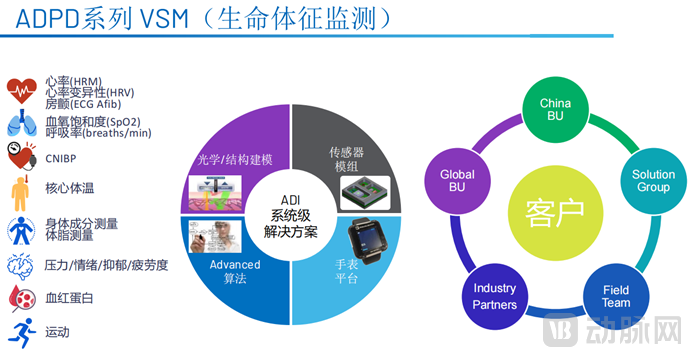
Significant challenges exist in this process. For instance, unlike the ideal controlled environment of in-hospital measurements, wearable devices must account for numerous additional factors, including constraints related to aesthetic design, contact area, placement, and materials. Furthermore, variations in user skin tone and body hair, as well as environmental conditions, can affect measurement accuracy. A typical example is the capture of optical signals during heart rate and blood oxygen saturation monitoring, where darker skin tones result in weak reflected light, and excessive body hair introduces “dynamic noise.” Even scars and tattoos pose challenges to accurate monitoring.
“Wearable devices must remain in harmony with our surrounding environment and physiological state,” He Yuan pointed out. “Even in harsh environments, we have the means to achieve medical-grade or even superior performance. Of course, for customers to develop final products, it is not enough to merely meet performance requirements; they must also make trade-offs across many other dimensions, such as size, power consumption, and cost.”
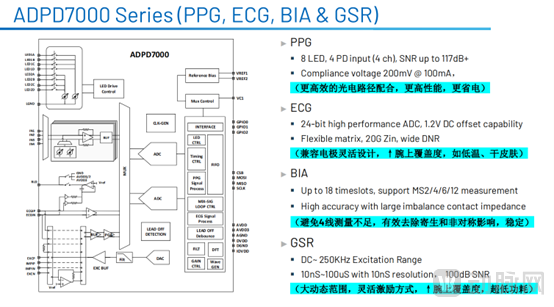
In fact, wearable products often have even higher hardware design requirements than medical devices. For instance, they require a wider dynamic range and must maintain monitoring accuracy despite having significantly smaller electrode areas compared to clinical monitoring environments. This necessitates highly sophisticated circuit designs within wearable devices. To achieve more efficient optoelectronic path coordination, the ADPD7000 supports twice as many channels as the LED channels in its predecessor, the ADPD6000. More LEDs mean more measurement points, thereby enhancing data accuracy. Furthermore, multiple LEDs enable the reception of multiple wavelengths, providing more comprehensive measurement capabilities. According to He Yuan, “The product series will support more channels in the future, but the current eight-channel configuration offers an excellent balance between cost-effectiveness and functionality.”
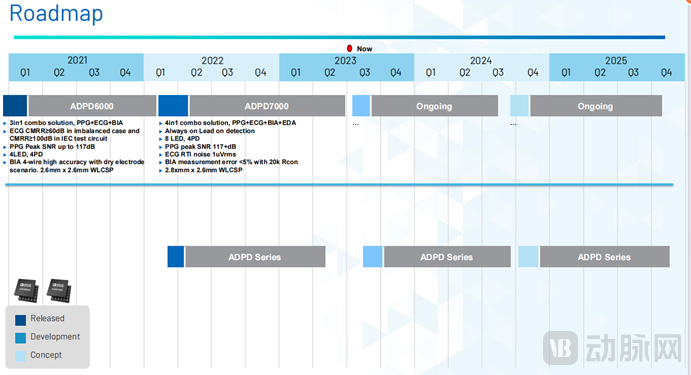
Furthermore, the ADPD7000 increases the input impedance to 20 GΩ, enabling a higher dynamic range. This significantly enhances wrist-worn coverage and accuracy, even in extreme monitoring conditions such as low temperatures or dry skin. “In cases of dry skin, it is often difficult to obtain ECG measurements, which is why large electrodes with conductive gel are used for ECG testing in hospitals. However, this approach is impractical for wearable devices. From this perspective, the design requirements for wearables are even more stringent than those for medical devices,” explained He Yuan.
The degree of skin dryness also affects the imbalance in input impedance between the two pairs of test lines during Bioelectrical Impedance Analysis (BIA), which introduces measurement errors. To address this issue, the ADPD7000 series effectively mitigates parasitic and asymmetric effects through sophisticated hardware-software coordination, thereby delivering more accurate measurement results. This capability offers a significant competitive advantage for wearable devices.
“When market homogenization is severe, products that truly deliver value to users are precious. However, market trends inevitably move toward greater value, so higher performance and the effective integration of more features are inherently valuable.” Addressing industry challenges, He Yuan stated that Analog Devices (ADI) takes extreme scenarios into account when designing many solutions, ensuring performance reliability to the greatest extent possible.
As Schopenhauer stated, human consciousness is the greatest prison. While there are many factors contributing to the trend of chronic diseases affecting younger populations, emotional stress is undoubtedly one of the primary causes. The World Health Organization (WHO) has also indicated through surveys that adverse emotional factors underlie more than 200 conditions, including myocarditis and coronary heart disease. “Stress is always accompanied by anxiety and can even progress to depression; when it takes hold, the entire process may occur silently,” He Yuan specifically noted. “To address how such emotional fluctuations and stress changes can be continuously captured via wearable devices, the ADPD7000 has added a GSR (Galvanic Skin Response) function.”
In fact, Galvanic Skin Response (GSR) is not a new technology; it was applied in polygraph tests many years ago. As a form of biofeedback, GSR can detect emotional changes in the human body, reflecting physiological and psychological responses. The underlying principle is that when the body is subjected to external stimuli, the skin undergoes changes in electrical potential. This phenomenon is known as the Galvanic Skin Response, also referred to as Electrodermal Activity (EDA) or Skin Conductance (SC). Changes in human emotion can be statistically quantified by observing GSR data. Given the increasing prevalence of mental health issues caused by emotional stress in today’s high-pressure environment, the implementation of GSR monitoring in wearable devices is highly anticipated. According to He Yuan, the GSR measurement channel of the ADPD7000 reuses the circuitry for ECG and BIA, allowing it to be combined with heart rate, heart rate variability, and other data for integrated analysis. By leveraging sensor fusion technology, this approach enables a more refined assessment of users’ mental states.
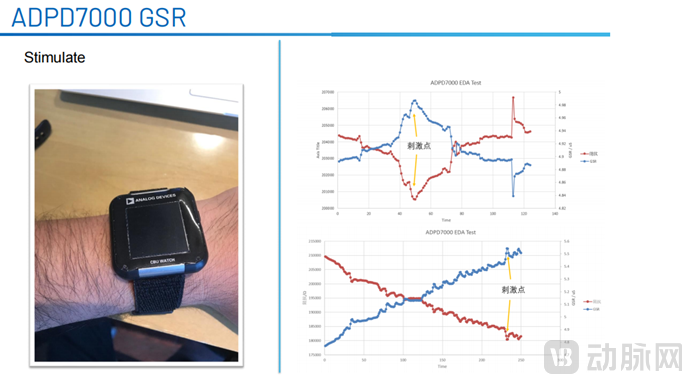
Unlike body fat and heart rate measurements, which have objective standards, subjective metrics such as emotion and stress pose greater challenges. How does the ADPD7000 achieve accurate monitoring within the compact form factor of wearable devices? “First, these types of tests have accumulated extensive experience over time and established systematic standards, with applications already present in many professional fields; Analog Devices (ADI) has been actively involved in this area. Second, ADI is at the technological forefront in this domain. Even in wearable devices, certain metrics can approach the performance levels of professional equipment costing tens of thousands of yuan,” emphasized He Yuan. “Compared to previous products, the GSR functionality of the ADPD7000 offers a higher dynamic range, measurement range, and accuracy. Furthermore, its ability to automatically switch excitation frequency and amplitude when signal quality is poor represents a particularly notable innovative feature.” In addition to wearable applications, GSR based on the ADPD7000 has also gained development support for driver status monitoring in vehicle cockpits, attracting attention from industry manufacturers at the recent Electronica China in Shanghai.
On the other hand, battery life and cost are the most concerning issues in the wearable field. Analog Devices (ADI) has always provided extremely high energy efficiency in power and chip technology, which is one of the key points of competitiveness for its wearable solutions. The ADPD7000 combines GSR with PPG, ECG, and BIA to form a four-in-one analog front-end, undoubtedly posing an ultimate challenge to its low-power technology. “The ultra-high signal-to-noise ratio of the ADPD7000 allows monitoring with only very weak light, while the newly added GSR also operates at ultra-low power, enabling continuous detection without significantly affecting battery life,” introduced He Yuan. “Additionally, the 200mV compliance voltage in PPG will save system power design, simplify customer system design, and reduce BOM costs.”
ADI’s deep localization strategy enables its China team to respond nimbly to local market innovation demands, better integrate into the domestic industrial ecosystem, while still serving global markets. In He Yuan’s presentation, he repeatedly emphasized that the ADPD7000 was developed by a local team, reflecting ADI’s core “In China for China” strategy. “For vital signs monitoring (VSM) solutions like the ADPD7000, I prefer to add a ‘C’ in front—making it CVSM—to signify products more specifically developed by ADI’s China Product Business Unit for Chinese customers.” Furthermore, ADI’s relationships with ecosystem partners go far beyond simple product sales; the company provides a full-stack solution that includes access to industry resources and connections between domestic and international partners. It is reported that ADI’s partners have already achieved breakthroughs using this chip series in areas such as non-invasive blood pressure measurement and more precise monitoring of emotions, depression, stress, and fatigue levels.
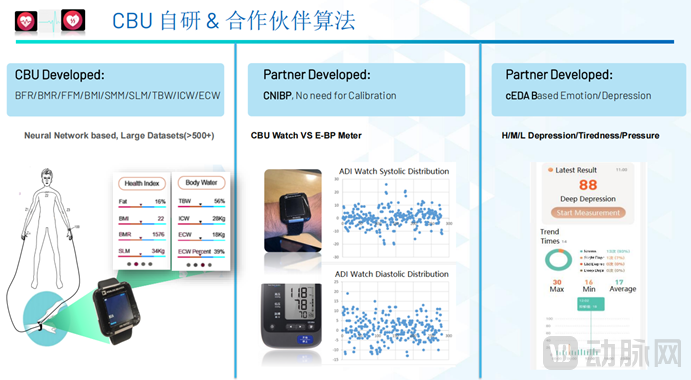
System-level solutions like the ADPD7000 offer a wide range of additional services beyond the chip itself, such as optical structure design, hardware and software design, algorithms, and system integration. “The combination of the self-developed ADPD7000 chip with proprietary algorithms is also an advantage of local design. Analog Devices has developed its own algorithms for heart rate, blood oxygen saturation, heart rate variability, off-wrist detection, atrial fibrillation, sleep monitoring, total body water content, and hemoglobin levels. These practical applications demonstrate the advantages of integrating ADI’s hardware with its algorithms,” He Yuan explained.
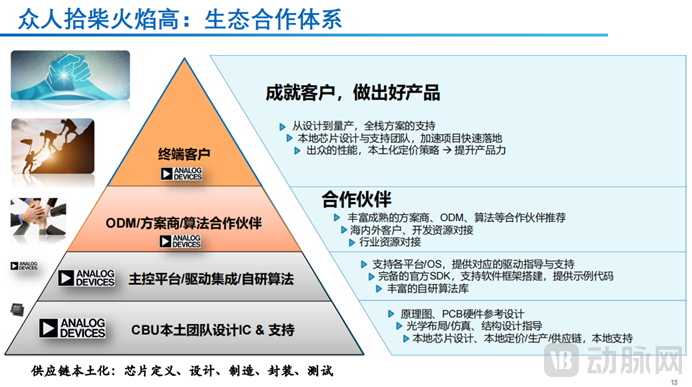
“We also have a robust support system for our customers. In addition to our local product lines, systems team, sales, and FAEs, we have extensive industry partners that enable us to provide comprehensive support,” emphasized He Yuan. As a leading solution provider in the industry, Analog Devices (ADI) has been deepening its localization strategy in recent years. To better serve local customers, ADI established the China Product Business Unit, which handles the entire local value chain—including chip definition, design, manufacturing, packaging, and testing. Leveraging advantages such as cutting-edge technology, abundant resources, 24-hour service response, and a local supply chain, ADI helps manufacturers develop differentiated products and accelerates their mass production and market deployment through concrete actions.