

METiS Therapeutics, Dubbed 'SpaceX of Pharma,' Debuts on HKEX with $30 Billion Valuation as Global AI Drug Delivery Pioneer
METiS TechBio
AI-Driven Drug Formulation Developer


Author | Pencil Dao Xiwen
Editor | Pencil Dao Wang Fang
The world's first AI drug delivery stock is born, with a market value of 30 billion.
On May 13, METiS TechBio (7666.HK) officially listed on the Hong Kong Stock Exchange, becoming the world's first AI drug delivery company to go public and the first AI large-molecule biopharmaceutical stock in Hong Kong.
According to the data provided by METiS TechBio to Pencil News, the scale of this fundraising exceeds HKD 2.1 billion (approximately RMB 1.8 billion), setting a record for the largest IPO fundraising in the Hong Kong healthcare sector since 2026.
Behind the IPO, there is a strong signal: AI pharmaceuticals, the trend has changed.
In the past few years, the hottest direction in the AI pharmaceuticals industry has been "AI drug discovery." Simply put, it involves using large models to help pharmaceutical companies identify targets, screen molecules, and predict drug structures.
Global capital once flooded in疯狂涌入. Around 2021, the valuations of AI pharmaceutical companies such as Insilico Medicine, Exscientia, and Recursion rapidly soared, with financing rounds in the primary market reaching new heights one after another.
But the industry soon discovered: finding a drug does not mean it will truly work.
Because after a drug enters the human body, it faces an even more challenging problem: how to accurately deliver the drug into the target cells (as shown in the figure).
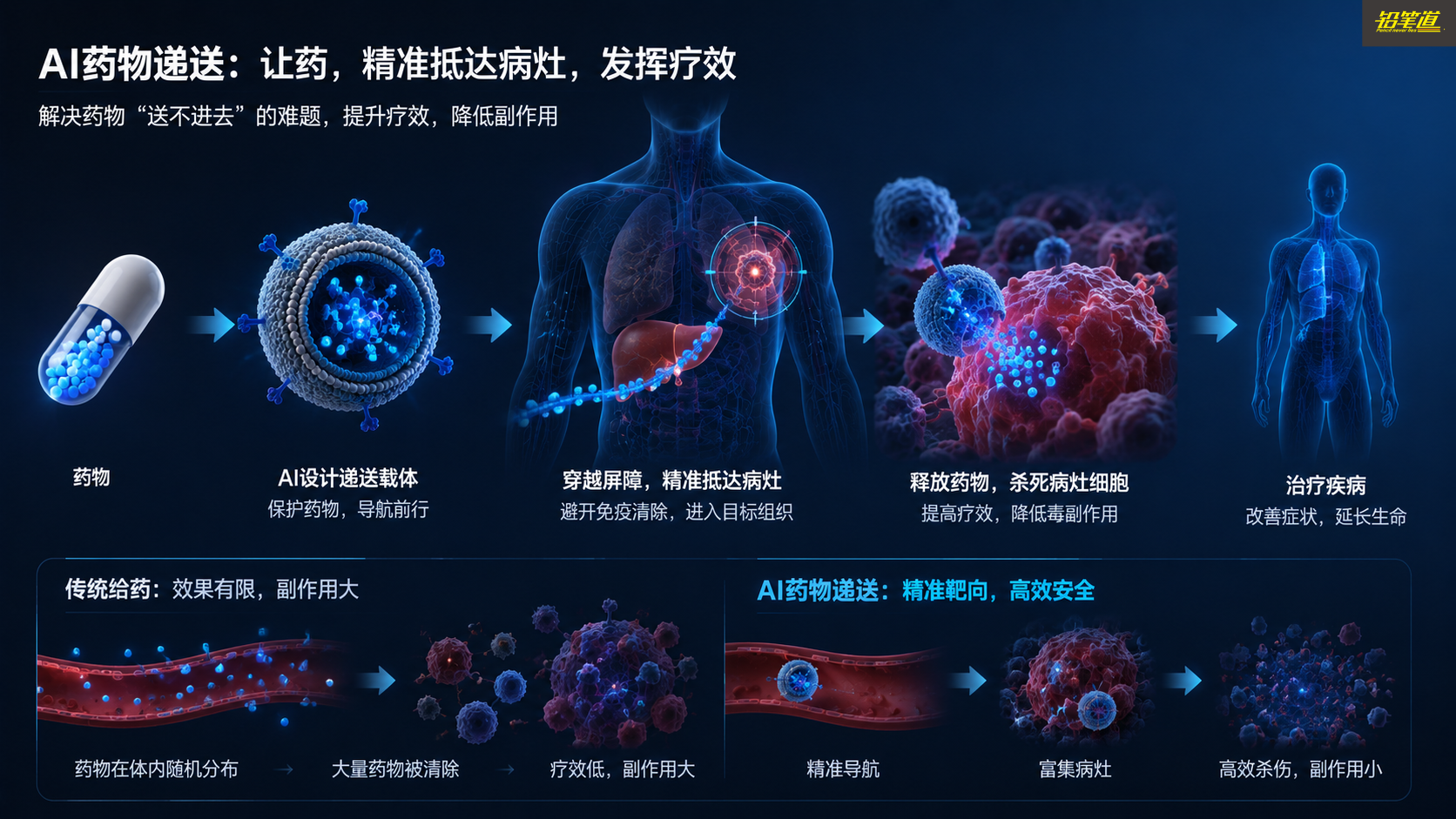
Thus, a previously relatively low-key track has suddenly started to heat up: drug delivery. If the drug itself is likened to a "bullet," then the delivery system is more like a "navigation system."
And METiS TechBio has stepped into precisely this direction.
Break the Fundraising Record
METiS TechBio's IPO broke a record this time: approximately 201 million H shares were issued globally, raising over 2.1 billion Hong Kong dollars, setting a record for the largest healthcare IPO in Hong Kong's stock market since 2026.
This set of data is not common. Because in the past two years, the overall Hong Kong stock market for innovative drugs has actually been very cold.
Many unprofitable biotech companies have seen their shares trade below the IPO price for a long time after listing, and financing in the primary market has also cooled down significantly. Many investment institutions are no longer willing to pay for the "AI + pharmaceuticals" story as they did in previous years.
This IPO of METiS TechBio, however, has attracted a group of strong funds: BlackRock, Hillhouse, IDG, Deerfield, RTW, GF Fund, and China Asset Management, etc.
An important reason behind this is:The direction it is heading is somewhat different from that of AI pharmaceutical companies in the past few years.——Not focusing on "AI drug discovery," but on "AI drug delivery."
In the past, many AI pharmaceutical companies mainly focused on: helping drug companies "find candidate drugs faster," such as using AI to identify targets, screen molecules, and predict structures.
What METiS TechBio has tapped into is a later and more challenging aspect: drug delivery. Simply put, the issue with many drugs isn't that they can't be developed, but rather that they "can't be delivered effectively."
Especially in recent years, with the rise of RNA, mRNA, and protein drugs, an industry challenge has become increasingly prominent: how to accurately deliver drugs into target organs.
Because many drugs, once entering the human body, are either prematurely degraded, cleared by the immune system, unable to reach the affected area, or have excessive toxic side effects.
Thus, the previously behind-the-scenes and supportive "drug delivery" has gradually become a new hotspot in AI-driven drug development.
The SpaceX of the Pharmaceutical Industry
METiS TechBio was founded in 2020. Just six years into its entrepreneurial journey, the company completed its IPO on the Hong Kong Stock Exchange, becoming one of the unicorn companies in China's AI pharmaceuticals industry to achieve an IPO in the shortest time.
Its founder, Lai Cai-da, was born in Taiwan, China, in 1989. He graduated from the Department of Chemical Engineering at National Taiwan University for his undergraduate studies and later pursued a Ph.D. in Chemical Engineering at the Massachusetts Institute of Technology (MIT).

Later, after joining McKinsey, he began to work on digital transformation projects for global large pharmaceutical companies.
It was also during that time that he gradually noticed a gap in the industry: In the past, most AI pharmaceutical companies focused on "how to find drugs faster," but few tackled another key factor that determines a drug's success—how to deliver the drug to the affected area.
It was also during that time that he started to internally incubate the "AI Drug Delivery" direction with Chen Hongmin, a member of the U.S. National Academy of Engineering and an expert in nanodelivery.
The company defines its goal as "the SpaceX of the pharmaceutical industry."
The two indeed have similarities. What SpaceX solves is: how to precisely send rockets into space; how to improve launch efficiency; and how to reduce launch costs.
What METiS TechBio aims to solve is: how drugs can precisely reach the target organs in the human body; how to improve delivery efficiency; and how to reduce R&D costs and failure rates.
Designing Drug Delivery Materials with AI
METiS TechBio's current core direction is to use AI to design and screen nanodelivery materials.
The company has currently built a lipid material database at the tens of millions level, and developed lipid generation algorithms and a screening platform. You can think of it as: first, it established a "super material warehouse," then trained AI to "automatically find answers" within it.
To date, its delivery system has covered: liver, lung, heart, muscle, tumor tissue, central nervous system, gastrointestinal tract, and other directions.
The company has more than 10 pipeline products, including 4 preclinical candidates, 3 clinical-stage products, 1 pre-NDA product, and 2 animal health products.
Among them, MTS-004 is the first AI-powered formulation new drug in China to complete Phase III clinical trials, mainly used for the treatment of PBA (Pseudobulbar Affect). Another key product, MTS-105, targets solid tumors and has currently received orphan drug designation from the U.S. FDA.
But to be honest, this industry is still far from truly mature. Although AI pharmaceuticals are very popular, globally, there are actually not many companies that have truly completed large-scale commercial validation.
Especially drug delivery, which itself is still a high-risk, high R&D investment, and long-cycle track.
Although METiS TechBio currently has multiple preclinical and clinical stage products, its overall revenue scale is still relatively small. In 2025, the company's revenue was approximately 105 million yuan, mainly from upfront payments for product collaborations.
At the same time, the company's R&D investment has remained consistently high. From 2023 to 2025, the company’s R&D expenditure will continue to be maintained at approximately RMB 270 million.
This means that AI drug delivery is still a "high investment, slow return" industry.
But capital is still willing to keep betting, essentially because: if the next generation of drugs really enters the RNA, mRNA, and protein era, then "how to deliver the drug" will likely become one of the most important issues in the biopharmaceutical industry in the next decade.
Who Makes the Most Money?
Is drug delivery really a business that can make a fortune? The answer has already emerged.
In the past few years, the companies that have truly made a fortune globally are not necessarily "AI drug discovery companies," but rather platform companies that master delivery technologies.
The most typical case is the American biotechnology company Halozyme. Its core asset is not a blockbuster drug, but a delivery technology platform called Enhanze.
This technology can convert many large medications that originally required prolonged intravenous infusion into subcutaneous injections.
In the past, some cancer drugs required patients to receive intravenous infusions in the hospital for several hours; after switching to subcutaneous injections, the process can be completed in just a few minutes.
The results are: better patient experience; lower hospital infusion resource utilization; higher pharmaceutical sales efficiency.
As a result, major pharmaceutical companies such as Johnson & Johnson, Roche, and Bristol-Myers Squibb began purchasing technology licenses from Halozyme.
And Halozyme's real money-making method is also quite interesting. Instead of developing all the drugs by itself, it collects technology licensing fees from pharmaceutical companies, receives milestone payments during the R&D process, and then continuously takes a cut based on drug sales.
In a sense, it is more like a company that "sells highways."
In 2025, Halozyme's revenue is approximately US$1.397 billion, including over US$800 million in royalty income, representing a year-over-year increase of about 50%. The company forecasts revenue between US$1.7 billion and US$1.8 billion for 2026, with adjusted EBITDA (Earnings Before Interest, Taxes, Depreciation, and Amortization) expected to exceed US$1.1 billion (approximately 8 billion yuan).
More crucially: its substantial revenue does not come from "selling drugs," but rather from "others using its delivery technology."
A similar case is the U.S. RNA drug company Alnylam. One of the truly core barriers for this company is also the RNA delivery system. In the first quarter of 2026, Alnylam's single-quarter product revenue exceeded $1 billion for the first time.
However, METiS TechBio is not entirely the same as Halozyme and Alnylam.
Halozyme is essentially a mature "delivery platform company," primarily relying on technology licensing fees, milestone payments, and sales royalties from pharmaceutical companies.
Alnylam, on the other hand, operates in a dual model of "RNA delivery platform + self-developed pipeline," both licensing out its delivery technology and selling its own RNA drugs. Its delivery system is the company’s core technological barrier.
By contrast, METiS TechBio is now pursuing a dual-driven model of "platform licensing + self-developed pipeline + product licensing." On one hand, it provides delivery capabilities to pharmaceutical companies; on the other hand, it advances its own drug pipelines, which can be licensed out once mature.
Simply put: It wants to be both "the one selling shovels" and "the one digging for gold."
This article does not constitute any investment advice.