

Minsheng Health Files IPO Prospectus: Domestic Top 5 OTC Vitamin Brand Drives Second Growth Curve with Probiotics Amid Intensifying Market Competition
On September 5, Hangzhou Sanofi Minsheng Consumer Healthcare Co., Ltd., an over-the-counter (OTC) pharmaceutical company based in Hangzhou, listed on the ChiNext board of the Shenzhen Stock Exchange, with its market capitalization surging more than 200% at the opening.
Many people may not be familiar with Minsheng Health, but they have certainly heard of its flagship product—21 Super-Vita®. According to Minsheng Health’s prospectus, the sales revenue for “21 Super-Vita” Multivitamin and Mineral Tablets (21) amounted to RMB 396 million, RMB 423 million, and RMB 439 million in 2020, 2021, and 2022, respectively, accounting for as high as 91.32%, 86.70%, and 80.46% of the company’s total principal business revenue during the same period.
Around 2002, a flood of television advertisements and celebrity endorsements propelled 21 Jinweita®Rapidly gaining widespread popularity. This dietary supplement, composed of 21 vitamins and trace elements, can prevent and treat various diseases caused by vitamin and mineral deficiencies, appealing to a broad consumer base. In the field of vitamin and mineral supplements, 21 Jinweita®On par with brands such as Centrum, Elevit, and By-Health. In the 2021 Comprehensive Statistical Ranking of Over-the-Counter (OTC) Drug Products in China, 21 Super-Vita®Ranked No. 5 on the “Vitamins and Minerals” list.
Then, despite becoming a memory for a generation, 21 Super-Vita®After experiencing its most glorious years in the early 21st century, sales figures have struggled to rebound. Minsheng Health has been exploring a second growth curve and ultimately set its sights on probiotics. In 2020, Minsheng Health completed the acquisition of Health Technology, expanding its product portfolio to include probiotics. It subsequently launched a series of probiotic-related products, including Minsheng Puribao Probiotic Granules, Minsheng Ganyibao Probiotic Powder (Children’s Formula), and Minsheng Kanglibao Probiotic Solid Beverage.
In recent years, probiotics have attracted increasing attention from businesses. This trend includes cross-industry giants seeking a second growth curve, such as Jiangzhong Pharmaceutical, COFCO Group, and BGI Genomics, as well as emerging brands that have secured venture capital from top-tier institutions, such as Woderlab, Meiri Dejun, Biomed, and WeKnow. So, is the time-tested “probiotic approach” necessarily beneficial? And why do these tiny probiotics consistently draw investor interest? We attempt to analyze the underlying logic.
About four to five years ago, probiotic products for adults were still quite niche, primarily concentrated in the over-the-counter (OTC) pharmaceutical sector with a focus on improving gut function. Consequently, when probiotic powders and probiotic compressed candy tablets expanded into the consumer market, they achieved instant popularity.
The current probiotic product market is already highly competitive. In recent years, dairy and health supplement giants have pinned high hopes on their probiotic product lines, investing heavily to enter the probiotic sector through industrial mergers and acquisitions, establishing subsidiaries, and other means.
Given the unique nature of probiotic product development and manufacturing, commercialization scenarios often differ from those of traditional pharmaceuticals and health supplements. In their initial foray into the probiotics sector, industry giants opted to acquire established probiotic companies to accelerate their market entry and gain a competitive edge. Among them, By-Health, Ausnutria, and Juneyao Health have successively completed industrial acquisitions and were the first to reap the benefits of the probiotics market.
The strategic expansion into probiotic products through industrial M&A has been led primarily by major health supplement companies. In August 2018, By-Health completed the acquisition of Life-Space Group (LSG), an Australian probiotic company and the owner of the Life Space brand, for AUD 670 million. In July of the following year, Ausnutria indirectly acquired a 26.1% equity stake in Fenghua Biotechnology Co., Ltd. through convertible bonds, thereby strengthening its R&D and supply chain foundation in the probiotics sector. In December 2020, Juneyao Health announced a three-year cooperation agreement with Wecare Probiotics (Suzhou) Co., Ltd. to promote the application of Wecare’s probiotic products in Juneyao’s offerings and to collaborate on chronic disease health management applications.
Of course, Hangzhou Sanofi Minsheng Consumer Healthcare Co., Ltd., a player in the over-the-counter (OTC) drug sector, also rapidly acquired its probiotic product line through mergers and acquisitions, although it has not yet reached the stage of generating substantial commercial value. Notably, Juneyao Health’s probiotic business has delivered impressive performance over the past six months, helping the company achieve a remarkable turnaround in its financial results. In the first half of 2023, Juneyao Health’s revenue from probiotic foods exceeded RMB 70 million, representing a year-on-year increase of 221%.
It is understood that Juneyao Health has established strategic partnerships with universities such as Jiangnan University. By integrating the businesses of Juneyao Runying and Fanyuan Supply Chain through bankruptcy reorganization, it has preliminarily built an integrated ecological chain model of “raw materials–products–channels.” Currently, Juneyao Health’s probiotic products mainly include: probiotic lactic acid bacteria beverages and probiotic chewable tablet series under the brands “Qingyoushuang” and “Changyinshuang”; probiotic snack food series primarily featuring dark chocolate and filled biscuits; and probiotic solid beverage series primarily under the brands “UE Jun” and “Xianmei Jun.”
Juneyao Health stated that it has stockpiled dozens of unique functional strains, establishing a high technological barrier, and has successively developed probiotic-based health foods to cultivate as its future core product portfolio. With the fulfillment of orders from key clients in the second half of the year, the company’s capacity expansion plans will be accelerated further. Juneyao Health is currently establishing business relationships with several renowned international companies, planning to supply probiotic products with higher technical requirements.
Giants that have entered the probiotic market by establishing subsidiaries or building their own product lines can be broadly categorized into two groups. One group consists of dairy companies and traditional pharmaceutical enterprises, which often launch their own probiotic brands through collaborations with upstream probiotic raw material suppliers. This approach has become increasingly common in recent years. For instance, Bright Dairy crossed industry boundaries to introduce its Bright Jcan probiotics; Mengniu launched its M8 Active Probiotic Powder and Mengniu Yourui Probiotic Solid Beverage; and China Resources Jiangzhong brought its Lihuo Probiotics to market in May 2020.
Another category of companies builds its probiotic product lines based on fundamental research capabilities in probiotic strains, placing greater emphasis on scientific attributes and functionality. In May 2016, BGI Precision Nutrition was officially registered and established. Youmeida, the probiotic brand under BGI Precision Nutrition, has received significant attention within BGI Genomics, with the CEO personally promoting it on multiple occasions.
It is understood that the BGI Research Institute has independently established a specialized probiotic strain bank with a collection exceeding 50,000 samples. With extensive research findings on the correlation between gut microbiota and health, as well as substantial strain reserves, the institute has also built a proprietary genomic functional screening platform for strains. By integrating in vitro experiments, animal studies, and clinical trials, this platform facilitates the development of probiotic product series better tailored to the physiological characteristics of the Chinese population.
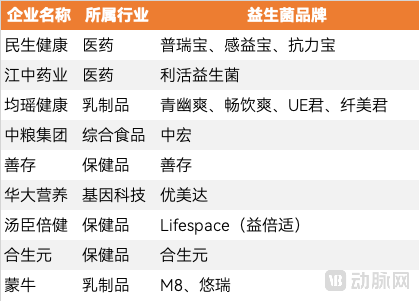
Major Companies with Probiotic Product Portfolios Data Source: VCBeat Database
Furthermore, according to statistics from Tianyancha, there are currently more than 3,000 probiotic-related enterprises in China, with nearly half established within the past five years. From cross-industry giants to new entrants, the fierce competition in China’s probiotic market is poised to erupt.
Globally, the overall market size has continued to grow for many years.
According to statistics from Statista and Grand View Research, the global market size of the probiotics industry expanded from $42.8 billion in 2016 to $58.17 billion in 2021, with a compound annual growth rate (CAGR) of approximately 7.6%. The market is projected to surpass the $100 billion mark by 2029.
The underlying logic lies in the deepening understanding of the functions of probiotic communities through basic research, and the diversification of product development based on this knowledge, which meets people's growing health consumption demands.
On the one hand, the functional boundaries of probiotics are continuously being expanded.According to the World Health Organization's definition, probiotics are live microorganisms that confer health benefits to the host when administered in adequate amounts.
Generally, probiotics include Lactobacillus, Bifidobacterium, yeast, Clostridium butyricum, and others. Currently, the most commonly used probiotics are Lactobacillus and Bifidobacterium, both of which have a relatively high safety profile. Extensive previous studies have demonstrated that probiotics can modulate the structure of the human gut microbiota and alleviate various intestinal and other diseases, indicating significant commercial application value.
In addition to the functions often mentioned in previous probiotic product promotions, such as regulating bowel habits and improving sleep, the efficacy of probiotics in areas including cancer, inflammatory bowel disease, metabolic disorders, respiratory diseases, and kidney diseases is also being continuously validated and developed.
Specifically, in the field of oncology, probiotics are primarily used to enhance patients’ responses to immunotherapy. For inflammatory bowel disease and metabolic disorders, many probiotic strains have already seen preliminary clinical application. In the realm of kidney diseases, Chinese scientists published research in *Cell Metabolism* in 2021 on the use of *Lactobacillus casei* Zhang for treating nephropathy, providing some clinical evidence. Building on these foundational studies, probiotics will undoubtedly facilitate the management of a broader range of diseases and enable the translation of novel therapeutic applications.
On the other hand, the second factor is the diversification of downstream probiotic products to meet the differentiated needs of various population groups.Currently, the earliest vehicle for probiotics—dietary supplements—is continuously optimizing its performance to achieve diversified health benefits, with steadily increasing viable cell counts. In addition to providing gut health benefits, major manufacturers have developed products targeting metabolic disorders such as blood glucose regulation and non-alcoholic fatty liver disease (NAFLD), as well as neurological conditions like autism and anxiety, based on research into probiotic functions. Although the efficacy of these applications remains to be fully validated, advances in fundamental probiotic research are being incorporated into product development at an accelerating pace.
Beyond early dietary supplements, probiotics are increasingly being incorporated into cross-category foods such as dairy products, carbonated beverages, and coffee, as well as daily necessities like toothpaste and facial cleansers, thereby creating differentiated advantages for these latter products. This shift has enabled probiotics to gain acceptance among a broader range of end users. For instance, Mengniu has launched a new lactic acid bacteria-infused sparkling water called “Ru Ci Qi Zhi,” which highlights its zero-sugar, zero-fat formulation and the special addition of lactic acid bacteria. After all, high-tech-looking white powders are not particularly user-friendly for the elderly and children. In the highly competitive food and beverage sector, integrating health-oriented novel concepts has become a key strategy for creating blockbuster products.
Of course, whether the current probiotics industry can fully meet the demands of consumers’ health consumption upgrades remains questionable.
First, basic research related to the mechanism of action of probiotics needs to be further deepened.At present, the probiotic mechanisms of many probiotics remain unclear, and the key active substances responsible for their efficacy are not well defined, which constitutes a critical factor limiting the functional performance of probiotic products. However, elucidating these probiotic mechanisms is by no means an easy task.
The underlying reason is that the beneficial effects of probiotics largely depend on the human body’s own microbiota. Within the intricate network of the human microecological system, identifying the true bioactive substances responsible for the benefits of probiotics is understandably challenging. This often requires the application of cutting-edge technologies such as multi-omics and big data analytics, placing high demands on researchers’ technical capabilities.
Secondly, the development and preparation processes of probiotic strains remain to be optimized.On one hand, the development of new probiotic strains is time-consuming and labor-intensive. At present, with advances in biotechnology, probiotic research companies have gained access to better hardware equipment and software resources, thereby shortening the cycle for functional studies of probiotics and reducing costs. Nevertheless, the development cost for a single probiotic strain often still reaches hundreds of thousands, or even millions, of yuan. Furthermore, the process of identifying an advantageous functional probiotic strain—from screening and isolation from nature, through safety and efficacy evaluations, to final application and development into end products—is also very lengthy.
On the other hand, further breakthroughs are needed in key industrial application technologies for the probiotic industry, such as high-density cultivation, high-activity preparation, and high-stability maintenance technologies. Industry practitioners have noted that it is technically challenging to accurately and comprehensively simulate the intestinal environment in laboratory settings. Although domestic enterprises have made significant progress in certain application technologies for probiotic industrialization, there is still room for improvement. This necessitates strengthened collaboration between domestic research institutions and enterprises to rapidly enhance China’s level of key application technologies in probiotic industrialization.
Third, the relevant industry standard system remains to be established.Currently, China lacks national standards for the probiotic industry in the strict sense. Previously, to regulate the use of probiotics by enterprises, domestic regulatory authorities successively issued the List of Probiotic Strains Allowed for Use in Health Foods, the List of Fungal Strains Allowed for Use in Health Foods, the List of Microbial Strains Allowed for Use in Foods, and the List of Microbial Strains Allowed for Use in Infant Foods, specifying multiple permissible strains such as Bifidobacterium animalis and Bifidobacterium lactis. However, there is still a lack of relevant standard systems for the production and manufacturing of final probiotic products.
This has, to some extent, led to chaos in the probiotic product industry. According to media reports, journalists investigating a certain online platform found that many probiotic manufacturers can customize any probiotic product according to customer demands, with very low pricing. For instance, domestically produced functional bacterial powders for gut health cost approximately RMB 6,000 per kilogram, while imported bacterial powders range from RMB 10,000 to RMB 20,000 per kilogram. The cost per box is only around RMB 5, yet the retail price reaches tens or even hundreds of yuan.
Furthermore, a native probiotic strain library tailored to the Chinese population has yet to be established. As probiotic products primarily emphasize health benefits, rigorous validation and regulation are essential, with a sufficiently large and diverse sample repository serving as a critical foundation. Naturally, this is a process that requires a lengthy development cycle.
The entry of industry giants and capital has raised awareness of probiotics among a broader audience, but there is still a long way to go from concept to products with proven efficacy.