

Marine Scientific Research Under the Shadow of Nuclear-Contaminated Water Discharge: Challenges and Innovations
Oceans cover 70.8% of the Earth’s surface. They nourish the planet, sustain all living beings, and serve as both the origin and foundation for the proliferation of life. The oceans provide humanity with abundant biological, mineral, and even energy resources, while also holding endless potential and unknowns yet to be explored.
However, at 1:00 p.m. local time in Japan on August 24, 2023, the Japanese government announced the official commencement of the discharge of nuclear-contaminated water into the ocean. The release of this water into the sea will not only affect water quality but may also pose hazards to marine organisms, including fish and algae.
The impact on humanity extends beyond food safety concerns, posing a grave threat to marine scientific research.Since the 1960s, global research into marine biomedical drugs has emerged from its nascent stage and subsequently entered the phase of industrialization. Well-known examples such as sodium cephalosporin, chondroitin sulfate, and cytarabine are all derived from marine sources.
With Seawater Now Polluted, Where Should Marine Scientific Research Go?
I. Century-old marine traditional Chinese medicine is being tested alongside marine chemical drugs and biological products
Since ancient times, powerful nations have always emerged along the coastlines; today, marine scientific research has also become a battleground for competition among major powers.In recent years, maritime powers such as the United States, Japan, Germany, and the United Kingdom have significantly increased their investment in research and development within the marine biomedical and pharmaceutical products industry., technological innovation in marine biology has become one of the fundamental guarantees for the sustained and healthy development of the global marine industry.
China has placed particular emphasis on marine scientific research and supported the development of a marine innovation-driven economy during its 12th and 13th Five-Year Plan periods. Leveraging national policy support and their own competitive advantages, many coastal research institutes have actively pursued research in marine biotechnology innovation.
In the field of biomedicine, marine innovation research is primarily categorized into four major types, namely:Traditional Chinese medicines, chemical drugs, biological products, and medical devices.
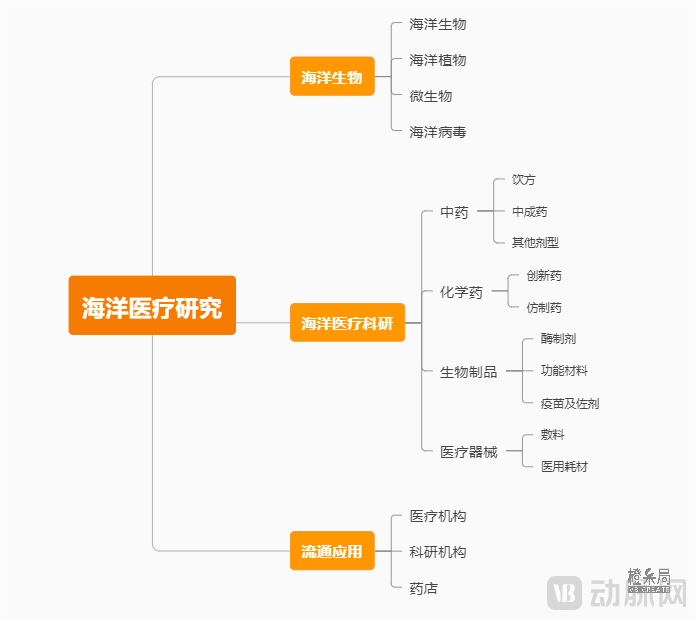 Classification and Process of Marine Medical Research
Marine Traditional Chinese Medicine refers to natural drugs that grow in the ocean and can prevent and treat diseases under the guidance of the basic theories of Traditional Chinese Medicine.China is the earliest country in the world to apply marine drugs. The Shen Nong Ben Cao Jing, compiled in the first century AD, records approximately 10 types of marine drugs. Therefore, China has a history of over one hundred years in the field of marine traditional Chinese medicine development.
Nowadays, the development of marine traditional Chinese medicine has also ushered in a systematic and large-scale transformation. In 2009, China's first large-scale compendium of marine drugs《Chinese Marine Materia Medica》Compiled and published. This reference book systematically reviews the application and current status of marine drugs in China, providing foundational scientific data for the research and development of traditional Chinese marine medicines and modern marine pharmaceuticals. Furthermore, in 2018, Mr. Guan Huashi, an academician of the Chinese Academy of Engineering, initiated and championed the establishment of China’s"Blue Pharmacy"Development plan provides new insights into the issue of marine Chinese medicine resources.
In addition to sorting out and verifying existing marine traditional Chinese medicines, the state has also vigorously advocated for the development of new marine traditional Chinese medicines. In 2021, ChinaKey Laboratory of Marine Traditional Chinese MedicineUnveiled in Qingdao, the laboratory focuses on the targeting and efficacy of marine traditional Chinese medicine (TCM), providing modern scientific evidence for the pharmacological actions of marine TCM.
Built on a centuries-old history of medicinal use and augmented by modern technologies, China’s development of marine traditional Chinese medicine (TCM) has consistently ranked among the world’s leaders. However, progress in the field of marine chemical drugs has been somewhat less impressive.
Unlike marine traditional Chinese medicine,Marine chemical drugs are derived from marine organisms and microorganisms, utilizing modern scientific methods to extract, isolate, and purify active ingredients for subsequent pharmaceutical synthesis.
Due to pain points such as the proportion of professional and technical personnel in marine biomedicine being less than 1%, a limited number of discovered medicinal marine species, insufficient capital investment, and an underdeveloped market space, the development of marine chemical drugs in China has remained lukewarm, with a significant gap still existing compared to marine-developed countries such as the United States and France.
However, with the Chinese government’s increasing emphasis on marine medicine in recent years, coastal provinces such as Shandong, Guangdong, Zhejiang, Jiangsu, and Fujian have significantly increased their investments in the marine biopharmaceutical industry, gradually narrowing China’s gap in the development of marine chemical drugs. In 2019, Ocean University of China collaborated with the Shanghai Institute of Materia Medica, Chinese Academy of Sciences, to jointly develop a drug using marine brown algae extracts as the raw material.Sodium Oligomannate CapsulesSuccessfully listed.This drug fills the 17-year global gap in the launch of new anti-Alzheimer’s disease medications.
Coincidentally, Sun Yat-sen University has established the National Engineering Research Center for South China Sea Marine Biotechnology, which is currently developing new marine genetic engineering drugs.Sea Anemone Cardiotonic PeptideandSea Snake Neurotoxindevelopment, with the aim of providing new therapeutic options for patients with cardiovascular diseases.
In addition to drug development, the development of marine biological products and medical devices is also an important avenue for the utilization of marine resources. In addition to research institutes, many enterprises are also involved in this field. In recent years, with the rising popularity of the "blue economy,"A cohort of enterprises specializing in the research, development, and production of marine biopharmaceuticals and related products has emerged in the market., such as Qingdao Bright Moon Seaweed Group Co., Ltd., Shanghai Green Valley Pharmaceutical Co., Ltd., and Xiamen Kingdomway Group Co., Ltd.
Taking Bright Moon Seaweed as an example, the company extracts seaweed-based biological products using large brown algae as raw materials, with its flagship product being sodium alginate.Accounting for over 80% of the global total, and can be applied in fields such as functional foods, cosmetics, pharmaceuticals, bio-tissue engineering materials, and printing and dyeing.
Furthermore, China also hasSponge Spicules, Alginate Medical Dressings, Coral Bone GraftsSuch medical devices are making significant strides in the global market.
In summary, both marine pharmaceuticals and marine medical devices are experiencing a surge, signaling that significant opportunities for the utilization of marine biological resources have arrived.But all of this existed before the discharge of nuclear-contaminated water.
II. Under Nuclear-Contaminated Water, the Future of Marine Scientific Research Is Marked with a “?”
For the healthcare industry, safety is not only a lifeline but also the fundamental baseline for development. Since the discharge of nuclear-contaminated water, the safety of all marine-based economies has been called into question, and marine scientific research is no exception.
When raw materials are contaminated by nuclear radiation, many research projects have to be terminated. There are two reasons for this:First, changes in the properties of raw materials make it difficult to achieve the expected research outcomes; second, contamination renders the raw materials radioactive, failing to meet safety standards.
Nuclear contaminated water contains significant amounts of radioactive tritium. Tritium exhibits high mobility and cycling capacity within the biosphere, rapidly exchanging with hydrogen atoms in all substances and binding to cellular components to form organically bound tritium.It is highly likely to disrupt the original cellular structures of marine organisms, microorganisms, and other life forms, or lead to subsequent research results that differ significantly from expectations.Taking marine chemical drug research as an example, the process requires extracting active ingredients from marine organisms and microorganisms. However, nuclear radioactive substances are highly likely to cause mutations in these active compounds, leading to research failure. Given that pharmaceutical R&D already involves significant uncertainty, such operations have become increasingly challenging.
In addition,Raw materials sourced from the ocean may also be subject to nuclear contamination due to bioaccumulation., or may affect the health of researchers, and the products manufactured may also fail to meet safety standards. For instance, dressings prepared using seaweed as a raw material do not require complex processing such as the extraction of active ingredients; however, if the raw materials are contaminated, the product quality will inevitably be significantly compromised.
The harms that nuclear-contaminated water poses to the ocean remain highly uncertain,Mass mortality of marine organisms makes it highly likely that the food chain will be disrupted.This will have a profound impact on the development of marine traditional Chinese medicine (TCM). Marine TCM is inherently based on natural marine flora and fauna, developed through the exploitation of their therapeutic properties. Today, it faces the risk of raw material shortages and even extinction. Furthermore, it remains uncertain whether marine medicinal materials with previously verified pharmacological properties will remain applicable.
The notion that “marine life may be contaminated by nuclear radiation, posing health risks” has become deeply ingrained in public consciousness, which will undoubtedly deal a blow to the entire marine economy.Both established marine product enterprises and marine scientific research achievements that are on the verge of or require future commercialization will be affected by this.
III. Can Technology Lead Marine Scientific Research Out of Its Predicament?
Can Technology Lead Marine Scientific Research Out of Its Predicament Amid Uncertainties in Maritime Security?
1. Artificial propagation to ensure raw material yield and safety
FromRaw Material Safety and ShortagesFrom this perspective, artificial propagation may offer an effective solution to this problem. Take giant clams, a marine traditional Chinese medicinal material, as an example. According to the *Hai Yao Ben Cao* (Materia Medica of Sea Drugs), giant clams have the effects of calming the mind, detoxifying various poisons, and treating insect stings. However, due to their scarcity, they are rarely used in medicine despite their excellent therapeutic efficacy. In 1996, giant clams were listed in the IUCN Red List of Threatened Species, facing the risk of extinction. In 2019, the South China Sea Institute of Oceanology, in collaboration with the Sanya Zhongke Marine Research Institute, achieved artificial population expansion of giant clams, successfully establishing large-scale artificial breeding and seedling production for multiple species for the first time. With the support of new technologies, the conservation status of four giant clam species has been downgraded to Vulnerable, and one species has been downgraded to Least Concern.
In addition to giant clams, marine organisms such as seahorses, seaweed, and coral have all achieved successful artificial propagation. Based on this, even in the event of ocean pollution,PartThe quantity and safety of raw materials for marine scientific research have been ensured.. Moreover, artificial propagation allows for autonomous control over raw material yield,It could become the key to resolving the “chokepoint” problem in marine raw materials in the future.
Furthermore, China has established a mature industrial framework for artificially formulated seawater technology, laying a solid foundation for the artificial propagation of marine organisms.
2. Synthetic technologies for the R&D of marine chemical drugs and biomimetic materials
FromMarine Chemical Drug R&DFrom this perspective, synthetic biology technology appears to revitalize it. Hailed as “the science that can create everything,” synthetic biology enables the replication of active ingredients once they have been successfully extracted from marine organisms and microorganisms into samples.Driven by advances in synthetic biology, the constraints on the research and development of marine chemical drugs will also be “relaxed.”
For medical materials derived from marine organisms,Biomimetic MaterialsCapable of simulating their functions, properties, and structures. In the aftermath of ocean pollution, biomimetic materials can also serve as substitutes for natural marine materials, acting as a reserve force in the development of marine medical materials.
3. Cultivating saline-alkali lands to “relocate” marine organisms
At its root, all problems stem from seawater pollution. Relocating marine flora and fauna may help avoid a series of primary issues triggered by contaminated seawater.
August 2023,Xinjiang’s First Smart Ecological Marine Aquaculture Base on Saline-Alkali LandHaving passed inspection, it is about to be put into use. Currently, the aquaculture base has leveraged its advantages of abundant sunlight and saline-alkaline water to develop a comprehensive set of “seawater aquaculture” techniques on the edge of the desert, achieving economies of scale. It has successfully cultivated eight varieties of “seafood,” including tilapia, grouper, Pacific white shrimp, abalone, and lobster.
The Success of Marine Aquaculture in Xinjiang's Saline-Alkali Lands SignifiesSystematic Replication of Methods for Marine Aquaculture in Inland Saline-Alkali LandsCurrently, research teams at universities such as Shihezi University, Tarim University, and Northwest A&F University have listed saline-alkali land mariculture as a key research direction. It is believed that in the near future, large-scale conservation of saline-alkali lands and the farming of marine flora and fauna will no longer be a distant goal. Only in clean waters can the development of marine scientific research be sustained and advanced.
Of course, both artificial propagation and synthesis are premised on technological innovation and development.Today, we must still prioritize the development of original innovation capabilities and accelerate the development of upstream technologies in life sciences to reduce risk factors in scientific research caused by changes in the external environment.
IV. As long as Hai remains, the research can continue
Whether from the perspective of marine safety or the development of marine scientific research, Japan’s discharge of nuclear-contaminated water will jeopardize global public welfare. Many marine researchers are experiencing unprecedented confusion and distress:“The investment that had been agreed upon is now indefinitely postponed due to the discharge of nuclear-contaminated water.”
Marine scientific research is facing unprecedented challenges, with both the research and market sectors pausing to reflect: How should this path forward be navigated?
Among them,Some researchers have chosen to shift their research focus, turning crisis into opportunity.A researcher studying sponge spicules revealed to Chengguo Bureau that they are conducting research based on the ability of sponges to adsorb heavy metals, aiming to address the impacts of nuclear contaminated water discharge.
Researchers in marine pharmaceutical chemistry are also attempting to use synthetic techniques to screen and synthesize nuclide-selective adsorption materials, with the aim of purifying nuclear-contaminated water.
A researcher who once studied marine traditional Chinese medicine is still actively working on coastal fish farms. However, his purpose for visiting the ocean this time is not, as before, to seek “prescriptions” from the sea, but rather to explore solutions for the artificial propagation and conservation of marine flora and fauna.
The purity of the oceans is facing challenges. Many marine researchers remain reluctant to abandon the scientific endeavors they have upheld for years, and are all seeking new pathways. They say:“As long as Hai is still here, the research can continue.”