

CB1 Receptor: A Resurgent Target in the Weight-Loss Drug Boom
Skye Bioscience
Cannabinoid Derivatives Developer
CB1(cannabinoid receptor-1,Cannabinoid Type 1 Receptor)Plays an important role in appetite regulation and other cardiometabolic pathways,It is a potential drug target for the treatment of pain, inflammation, obesity, and substance abuse.
Thanks to the booming weight-loss sector this year, CB1 has returned to the public spotlight.On August 10, Novo Nordisk announced the acquisition of Inversago for $1.075 billion., the centerpiece of this acquisition is clearly Inversago’s lead candidate, INV-202, a CB1 inhibitor with potential for treating metabolic disorders such as obesity and diabetes.
Against this target, Johnson & Johnson had previously invested in Bird Rock Bio, whose developed namacizumab is the world’s first and onlyCB1Negative allosteric modulatory antibody.
Skye Bioscience is alsoCB1, another eye-catching biotech in this sector, recentlyUndertook a strategic initiative to expand the company’s resources and capabilities, with a focus on developing therapeutic products targeting cannabinoid receptors.
August 21,Skye BiosciencewithAcquired Bird Rock for $20 millionOn the same day, Skye also announced the completion of a $17 million financing round, stating that this funding is expected to sustain its cash flow through 2024. The round was jointly led by 5AM Ventures, Versant Ventures, and another investor via a private investment in public equity (PIPE).
Skye focuses on leveraging the endocannabinoid system (CB) to develop potential novel therapeutics, targeting CB1 for the treatment of glaucoma and other major disease areas involving fibrosis, inflammation, and metabolic processes. Skye’s drug development is based on an exclusive license agreement covering all fields for the SBI-100 and SBI-200 patents granted by the University of Mississippi.
Research on endocannabinoid receptors is not a novel topic, but safety concerns have consistently hindered its development. As early as 2006, Sanofi obtained approval for the CB1 antagonist weight-loss drug rimonabant in Europe. However, subsequent clinical trials revealed that this medication, marketed as Acomplia, could double the risk of developing psychiatric disorders, leading the European Medicines Agency (EMA) to withdraw its approval in 2009.
Following this, Merck, Pfizer, and other pharmaceutical companies also abandoned the development of CB1 pipeline candidates. Evaluate Pharma predicted that this class of drugs would result in a $14 billion market loss. “The reason Merck halted the development of endocannabinoid receptor-targeting agents is that these molecules invariably entered the brain during trials; even minimal penetration posed safety risks,” said Heymsfield, a former R&D scientist at Merck.
Skye aims to circumvent the safety concerns that have previously plagued CB1-class drugs.
The acquisition of Bird Rock primarily secured the asset nimacimab,As a large-molecule antibody, nimacimab is distinct from other small-molecule CB1 inhibitors in that it does not readily cross the blood-brain barrier, even at doses far exceeding the anticipated effective dose. This characteristic minimizes the risk of psychiatric side effects such as anxiety and depression. Phase I clinical trials demonstrated that nimacimab had no impact on cognitive function and did not increase the risk of psychiatric disorders. Furthermore, nimacimab offers multiple advantages: compared with control compounds, it effectively inhibits CB1 signaling, and no toxicity associated with nimacimab has been observed. These data support the safe and effective targeting of peripheral CB1 receptors by nimacimab for disease treatment, without potential effects on the central nervous system.
“Preclinical and clinical data demonstrate that nimacimab has a favorable safety and tolerability profile,” said Paul Grayson, CEO of Bird Rock and Partner at Versant.In clinical practice, we did not observe any effects on the central nervous system,This is the challenge that other CB1 inhibitors have always faced.。”
Skye plans to advance two distinct yet complementary Phase II drug candidates targeting CB1. The newly secured funding will support the readout of Phase I data for its CB1 agonist SBI-100, the Phase IIa clinical trial data for glaucoma expected in the first half of next year, and the Phase II clinical trial of nimacimab.
“We plan to advance the proof-of-concept clinical trials for these two drugs within the next two years,” said Punit Dhillon, CEO and Chairman of the Board of Skye. “SBI-100 Ophthalmic EmulsionGlaucoma TreatmentofPhase IIa data are expected to be announced in the first half of 2024. We also plan to initiate a series of Phase II studies on nimacimab starting in 2024, to evaluate itsChronic Kidney Diseasepotential.”
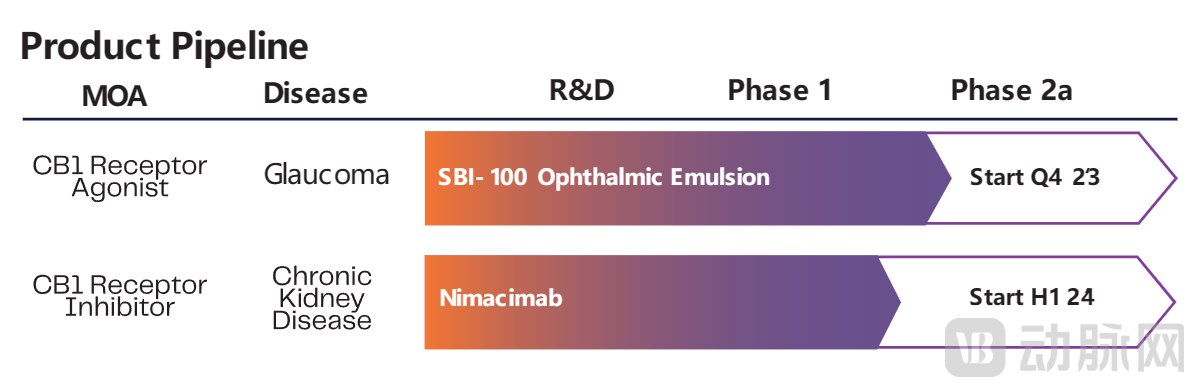
▲ Skye Pipeline Layout
“Endocannabinoid Receptors Hold Promising Prospects.“Andy Schwab, Executive Partner at 5AM Ventures, the lead investor in this financing round, stated: “We recognize the merits of Skye’s CB1 agonist technology focused on glaucoma and see synergies with Bird Rock’s CB1 negative allosteric modulator.”
As the first and only CB1 negative allosteric modulator, nimacimab is indicated for multiple conditions, including chronic kidney disease, obesity, and NASH. It has the potential to become a leader in the CB1 field, creating substantial commercial value in a market with unmet needs for CB1-targeted therapies.
Another investigational drug, SBI-100 OE, is a novel tetrahydrocannabinol (THC) prodrug and a patented topically administered CB1 agonist for the treatment of glaucoma and ocular hypertension.
Glaucoma can lead to vision loss and blindness by damaging the optic nerve cells at the back of the eye. Certain types of glaucoma result from elevated intraocular pressure caused by impaired drainage or excessive production of aqueous humor, which in turn damages the optic nerve. According to the Glaucoma Research Foundation, more than 60 million people worldwide have glaucoma, making it the leading cause of blindness among adults aged 60 and older.
Current therapies aim to lower intraocular pressure by reducing aqueous humor secretion or enhancing its outflow. However, statistics show that nearly 40% of patients do not respond to first-line treatments, and 50% ultimately require two or more therapeutic agents to control intraocular pressure. More importantly, none of these existing therapies address the root cause of glaucoma: the death of vision-critical cells. This presents a significant opportunity for biotech companies to develop novel, more effective treatments.
Compared with already commercialized drugs, SBI-100 OE can lower intraocular pressure to a greater extent and for a longer duration.Moreover, in multiple animal models, THC has been shown to protect neuronal cells from injury, ultimately preventing cell death.THC not only lowers intraocular pressure but also reduces biomarkers associated with fibrosis and inflammation,Supports multiple mechanisms of action, enabling expansion into a broader range of indications.
Skye Bioscience is currently conducting a Phase I clinical study of SBI-100 OE in Australia, with preliminary data expected to be reported in the third quarter of 2023. In addition, the company is preparing for a Phase IIa clinical study of SBI-100 OE to evaluate its efficacy and safety in patients with glaucoma or hypertension, and expects to complete the dosing of the first patient in the Phase IIa trial by early in the fourth quarter.
In addition to the two pipeline candidates mentioned above, Skye is also exploring potential development plans for SBI-200. SBI-200 is a proprietary derivative of cannabidiol (CBD), and preliminary trial data indicate that it possesses potential analgesic, anti-inflammatory, anti-fibrotic, anti-infective, and anticonvulsant activities, suggesting its applicability across multiple indications.
“Staying focused is the hardest part.“Regarding the biggest challenge Skye is currently facing, Punit Dhillon stated:“There are many opportunities in the endocannabinoid field; for startup biotechs, expanding a drug’s application to multiple areas can easily lead to distraction.”, but if the net is cast too wide, it will ultimately become what the saying goes, ‘jack of all trades, master of none.’” Punit Dhillon, the company’s founder, is also the co-founder, CEO, and director of OncoSec Medical Inc., a biopharmaceutical company developing immunotherapies for solid tumors. Prior to joining OncoSec, he served as Vice President of Finance and Operations at Inovio Pharmaceuticals.
The development of CB1-targeting drugs has been fraught with challenges. After emerging in the early 2000s, progress stalled due to safety concerns that led to drug failures. This year, however, CB1 has regained attention as a novel target for weight-loss medications. Concerns regarding previous neurological side effects were certainly well-founded, and the CB1 target undoubtedly carries risks; yet it also presents significant opportunities. As evidenced by Novo Nordisk’s acquisition of Inversago, major pharmaceutical companies are eager to explore drugs with new mechanisms and targets. How to identify commercialization potential and successfully bring products to market in the CB1 space, where crisis and opportunity coexist, remains an endeavor that requires continued exploration by companies such as Skye Bioscience.