

Harvard-Spinout i2o Therapeutics Files IPO Highlighting Oral GLP-1 Platform and Metabolic Pipeline

i2o Therapeutics
Biopharmaceutical R&D and Manufacturer
This year, the field of metabolism has seen a string of good news. Leveraging GLP-1 as a “golden target,” Eli Lilly’s market capitalization successfully surpassed $500 billion, while Novo Nordisk’s exceeded $400 billion. Faced with this enormous market opportunity, countless biotech companies have flocked to the space.
Biotech companies diving into this space are showcasing their unique strengths. Some are dedicated to researching untapped novel targets, such as Versanis, which was acquired by Eli Lilly for $1.925 billion in July; its ActRIIA/B antibody demonstrated, for the first time, the effect of reducing fat without losing muscle mass. Another example is Inversago, acquired by Novo Nordisk for $1.075 billion on August 10 for its novel weight-loss drug, a CB1 inhibitor.
There are also companies actively developing oral formulations with higher compliance and better efficacy. Compared with injectable therapies, oral administration imposes stricter safety requirements and warrants greater attention to safety issues.
i2o Therapeutics is a biotechnology company founded on a novel oral biologic delivery platform, dedicated to developing safe and effective oral formulations of therapeutics traditionally limited to injectable administration. The company aims to treat type 2 diabetes, obesity, and related conditions through fully oral and implantable therapies, with an initial focus on developing an oral formulation of a novel GLP-1 analog.
August 29,i2o Therapeutics Announces Completion of $46 Million Series A Financing, advancing the research and development of patented drugs and innovative drug delivery platforms, particularly peptides and GLP-1-based combination peptides. On April 10, 2020, the company secured a $4 million seed financing round, co-led by Sanofi Ventures and the Juvenile Diabetes Research Foundation’s T1D Fund, and later received strategic investment from Colorcon Ventures. In February 2021, i2o Therapeutics andSanofireached a collaboration to develop nanomedicines, and in January 2022, again with Johnson & Johnson’sJanssenReached a cooperation agreement to develop oral delivery of macromolecules.
One challenge in drug delivery is achieving oral administration of peptide and protein drugs.
According to data from Verified Market Research, the global peptide drug market was valued at $26.98 billion in 2019 and is projected to exceed $51.24 billion by 2027. Currently, most marketed peptide drugs are administered via injection; however, patient compliance with injectable therapies is low. Approximately 60% of patients with diabetes fail to achieve stable glycemic control due to intolerance of long-term, repeated injections. Consequently, oral peptide drugs have remained a major focus of research and development, yet very few have been successfully translated into clinical practice.
The significant challenges associated with oral administration largely stem from drug acid hydrolysis and enzymatic degradation in the stomach. For a long time, researchers have developed various novel technologies aiming to overcome the limitations of oral drug delivery. The oral GLP-1 peptide drug semaglutide, launched by Novo Nordisk in 2019, utilizes SNAC, an absorption enhancer developed by Emisphere. SNAC causes a transient, localized increase in pH at the gastric mucosal surface, thereby inactivating pepsin and preventing drug degradation.
Of course, the bioavailability of oral semaglutide remains low, leaving substantial room for improvement. Small-molecule GLP-1 drugs are successively entering clinical trials, holding promise for further optimizing adherence issues associated with these blockbuster weight-loss medications.i2o Therapeutics’ ionic liquid technology is claimed to be applicable for the oral delivery of biologics such as peptides and proteins.。
i2o leverages ionic liquid technology developed by Samir Mitragotri, a dual member of the U.S. National Academy of Engineering and the U.S. National Academy of Medicine and a professor at Harvard University. This technology enables drugs that typically require needle-based delivery to be reformulated and encapsulated for oral administration. The encapsulation utilizes a unique film coating that dissolves in the small intestine to release the active pharmaceutical ingredient, thereby ensuring the safe release of drugs that would traditionally not survive the harsh environment of the digestive system.
Mitragotri’s innovative technology has been proven to overcome the three major barriers hindering the oral delivery of protein drugs: digestive enzymes in the intestine that readily destabilize drug molecules, a thin mucus layer in the gut that acts as a physical barrier, and tight junctions between intestinal epithelial cells that prevent protein transport. Published in PNAS in 2018, this technology was demonstrated by Mitragotri’s laboratory to successfully enable the oral administration of insulin in animal models using ionic liquids. The Harvard Office of Technology Development has granted i2o Therapeutics an exclusive license to develop safe and effective oral formulations for a range of biologics, macromolecules, and peptide-based drugs.i2o Therapeutics has developed a proprietary library of over 150 ionic liquids., with extensive intellectual property and specialized expertise.
Dr. Mitragotri stated, “Our technology has the potential to enable oral administration of drugs in a safer, more effective, and more patient-friendly manner, thereby alleviating the treatment burden associated with dozens of therapies previously limited to intravenous or subcutaneous injection.”
The “Global Burden of Metabolic Diseases Report” published in Cell Metabolism shows that over the 20-year period from 2000 to 2019, the prevalence of type 2 diabetes mellitus (T2DM) increased by more than 1.5% annually, while the prevalence of non-alcoholic fatty liver disease rose by 0.83% per year. Although many countries have implemented policies to curb the epidemics of diabetes and obesity, the annual number of deaths attributable to T2DM and the years of healthy life lost continued to increase by approximately 0.08% and 0.77%, respectively.
A recent article published in The Lancet estimates that, at the current rate, approximately 1.3 billion people will have diabetes by 2050, making it a leading cause of global mortality and disability. “Diabetes will become the defining disease of this century, and the world has underestimated its true scale and threat.”
“At a time when global attention is focused on the surging prevalence of diabetes and obesity, which will have a profound impact on healthcare systems and the socioeconomic landscape in the future,”Our cardiometabolic clinical assets and novel drug delivery platforms are of critical importance..” Kurt Graves, Chairman, President, and Chief Executive Officer of i2o Therapeutics, stated: “Our ultimate goal is to deliver novel GLP-1 combination products and innovative drug delivery solutions, helping to eliminate barriers related to drug affordability and supply. This represents a significant opportunity to raise the standard of care and address substantial unmet needs, such as poor medication adherence.”
i2o Therapeutics has been actively advancing the preclinical development of its lead GLP-1 asset using ionic liquid technology, with a research and development focus on promoting proprietary drug candidates and innovative delivery platforms.Particularly the R&D of peptides and GLP-1-based combination peptide drugs. Meanwhile, the Company also completed a series of corporate and strategic transactions, developing and acquiring multiple proprietary peptides and implantable delivery technologies in the cardiometabolic field.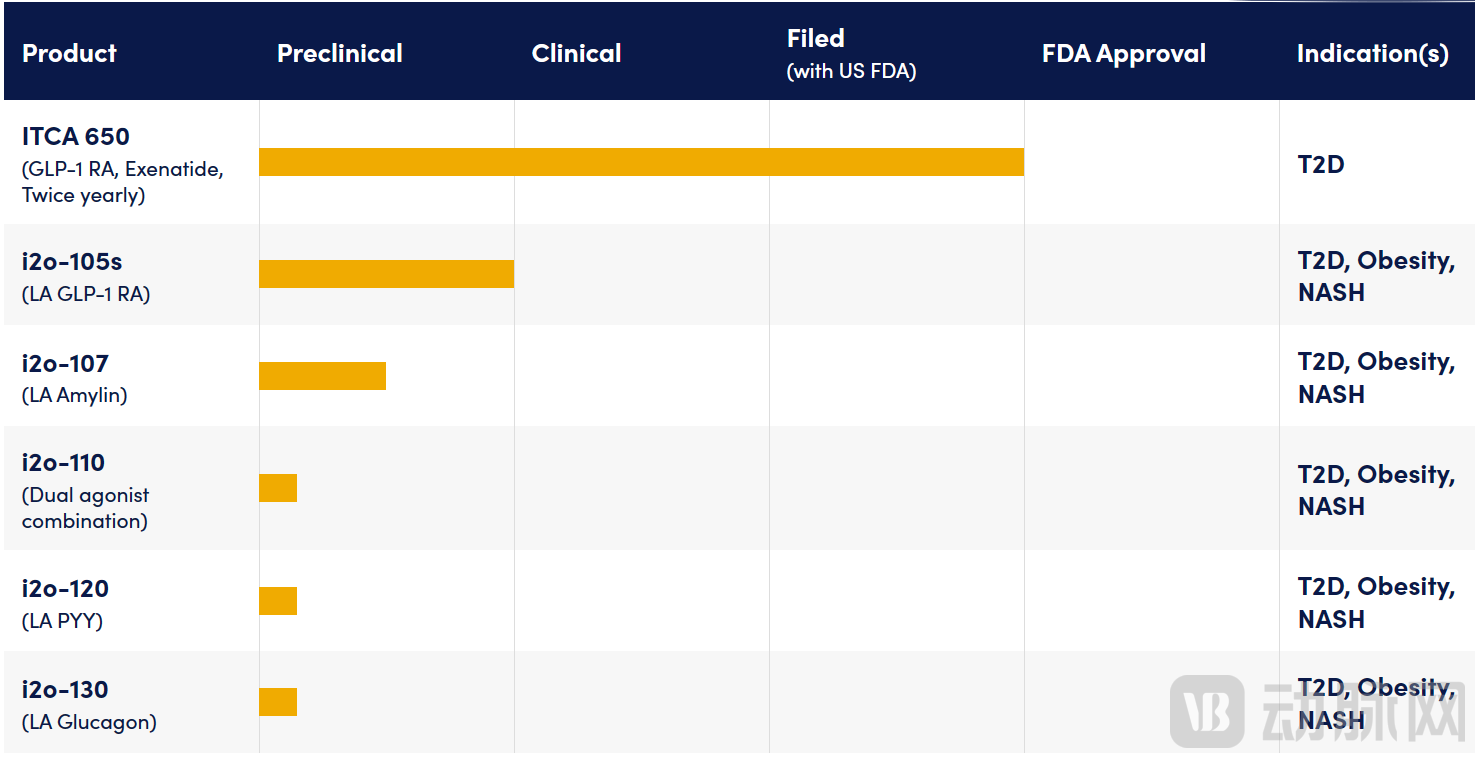
▲ i2o Therapeutics Pipeline Layout
i2o’s cardiometabolic clinical pipeline, acquired from Intarcia Therapeutics, comprises six drug candidates.including those rejected twice by the FDA for the treatment ofITCA 650 for Type 2 DiabetesDue to concerns regarding product quality and clinical deficiencies, the candidate drug was initially rejected in 2017, and a subsequent application submitted in 2019 was again denied for similar reasons. The next regulatory hurdle for ITCA 650 is the FDA public hearing scheduled for September 21. Despite these shortcomings, i2o Therapeutics has clearly not abandoned this asset; it may potentially integrate ITCA 650 with its proprietary ionic liquid technology to improve the formulation, thereby revitalizing this repeatedly rejected drug.
The combination of long-acting GLP-1 and other peptides holds significant potential to redefine the standard of care for metabolic diseases. The company’s five other assets, including long-acting GLP-1, amylin, glucagon, and peptide tyrosine-tyrosine (PYY), are all in the preclinical stage and are being evaluated for the treatment of type 2 diabetes, non-alcoholic steatohepatitis, and obesity.
In addition to the above drug pipeline,As a complement to its oral ionic liquid technology, i2o also possesses the sustained drug delivery platform, Medici., this platform targets type 2 diabetes and utilizes a small subcutaneous permeable implant designed to deliver continuous maintenance doses twice a year, thereby requiring only two administrations annually.
Furthermore, to support the company’s robust growth, i2o Therapeutics has entered into a new four-year sponsored research and license agreement with the Mitragotri Laboratory, further strengthening its intellectual property portfolio and leadership in the field of ionic liquids, where additional uses and applications are being advanced.
 ▲ i2o Leadership Team
Mr. Graves, Chairman, President, and Chief Executive Officer of i2o Therapeutics, served as Chairman, President, and Chief Executive Officer of Intarcia Therapeutics for the past 30 years, as former Chairman of Radius Health, and as a board member of Achillion Pharmaceuticals and Seres Health. Previously, Mr. Graves also served as Executive Vice President at Vertex Pharmaceuticals, where he led Corporate Development, Strategic Drug Development, and Project Management, and headed Commercial Operations. He spent nearly 10 years at Novartis, and earlier in his career, he worked for nearly 10 years at Merck and Astra-Merck.