

Breaking the Stronghold: How Domestic IVD Players Are Disrupting the $100B Industry with Self-Developed Total Laboratory Automation Systems

Fosun Diagnostics
In Vitro Diagnostics (IVD) Product Developer, Manufacturer, and Distributor

Mindray
Medical Device R&D Manufacturer
Automated assembly lines have always been regarded as the crown jewel of the in vitro diagnostics (IVD) industry.
A large-scale TLA (Total Laboratory Automation) system can capture 70% or more of the testing workload in hospital clinical laboratories, and automation lines have always been the strongest competitive moat for MNCs (Multinational Corporations). In the era of centralized procurement, automation lines have become a critical battleground for IVD companies.
In the past, the “Roche-Abbott-Beckman-Siemens” quartet dominated China’s total laboratory automation (TLA) market, but this landscape is now beginning to reverse. Five years ago, Roche’s annual TLA installations in China reached 100 lines, while second-tier players Beckman and Abbott each installed approximately 80 lines per year, with domestic brands posting modest installation figures. This year, however, installations of domestic brands have surged, reaching parity with multinational corporations (MNCs).
Currently, domestic automated laboratory lines have exerted some pressure on Roche and Sysmex, but have not yet fully shaken the dominant position of multinational corporation (MNC) brands. As Chinese-made laboratory lines enter their prime years, how can domestic brands sustain their competitive momentum?
Many industry insiders are well acquainted with the time and location of the installation of China’s first laboratory automation track system: in 2001, the First Affiliated Hospital, Zhejiang University School of Medicine, introduced Hitachi’s specimen pre-processing system and modular system. The track system connects processing modules with testing systems, reducing manual operations and enhancing automation levels, thereby shortening sample turnaround time by up to 80%. The first domestically produced brand of such a track system did not enter the market until 2017.
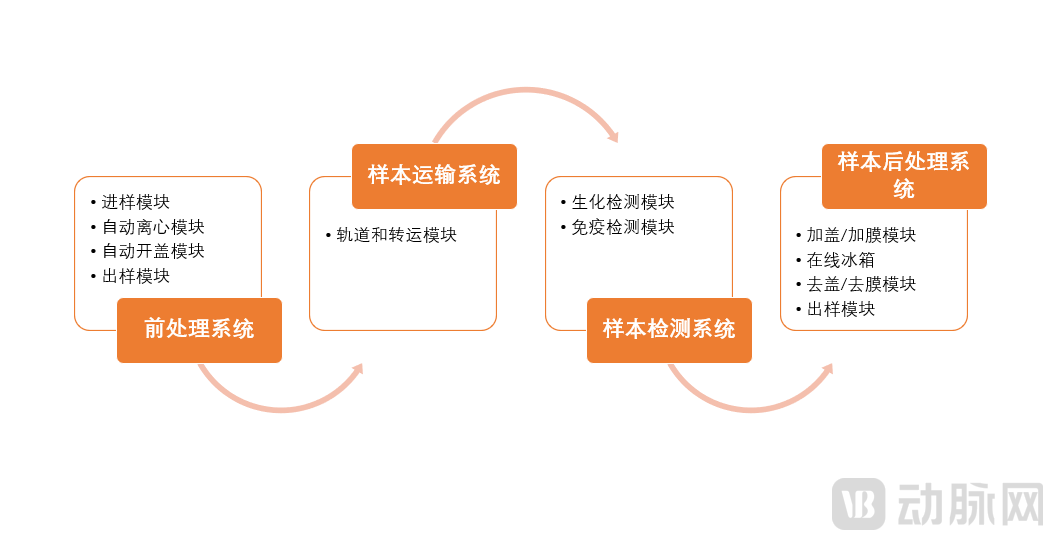
Main Components of the Assembly Line System
The prolonged absence of domestic products was due to the extremely high R&D barriers associated with production lines. The barriers to independent R&D of production lines by Chinese brands are mainly reflected in three aspects:
First, it must be equipped with high-speed biochemistry and immunoassay modules, along with a comprehensive menu of diagnostic reagents.Only a few domestic companies possess the capability for independent research and development of high-speed testing modules. The key technologies for biochemistry modules lie in analysis throughput and speed; achieving high speed while ensuring efficient cleaning and stable robotic arm movement was once a major challenge for Chinese manufacturers. The technical barrier for immunoassay lies in reagent development based on magnetic bead methods, where maintaining analytical stability while ensuring high sensitivity is also a significant difficulty.
The second major challenge is the “operating system” software module of the pipeline.Middleware is key to enhancing the automation and intelligence of laboratory automation lines. High efficiency of a single instrument does not necessarily translate to high efficiency of the entire line; software is the soul of the automation line. It tracks samples, results, and quality control, and achieves efficient operation through intelligent scheduling for load balancing.
The challenge in software development lies not in the complexity of programming, but in the fact that the pipeline simulates hospital workflows; thus, the software design tests the depth of understanding of clinical laboratory workflows and scenarios.
The third major challenge is the R&D capability for mechanized solutions.Assembly line products undergo high-frequency mechanical movements, making them prone to failures. Therefore, there are stringent requirements for material fatigue resistance and mechanical stability. The most criticized issue with existing assembly lines is their insufficient stability; some systems become inoperable within just six months of installation, forcing laboratory departments to revert to standalone analyzers.
There are two approaches to addressing the aforementioned three major challenges: one is achieving breakthroughs through independent research and development, and the other is purchasing externally or outsourcing assembly line production.From the perspective of global laboratory automation lines, the automation components of systems from Roche, Beckman Coulter, Siemens Healthineers, and Abbott are predominantly supplied by a few upstream international companies. As a complete and complex system, it is difficult for a single manufacturer to simultaneously achieve hardware automation, software intelligence, analytical instrument precision, and high-quality reagents. Therefore, automated product solutions are typically formed through integration.
Domestic brands also initially followed the path of purchasing external solutions. In 2018, domestic brands began to build their own automated assembly line products through overseas OEM partnerships. In the early stages, the assembly lines of Mindray, Autobio Diagnostics, and YHLO were all sourced from IDS. For analytical modules, domestic brands’ automated laboratory systems predominantly adopted high-throughput clinical chemistry analyzers from companies such as Hitachi, Canon, and Beckman Coulter as their chemistry analysis modules.
After 2022, more domestic brands began to expand their automated assembly line products. In 2022, the number of Class I filings for such systems reached as many as 16, with most domestic brands still relying on OEM-assembled automated lines.
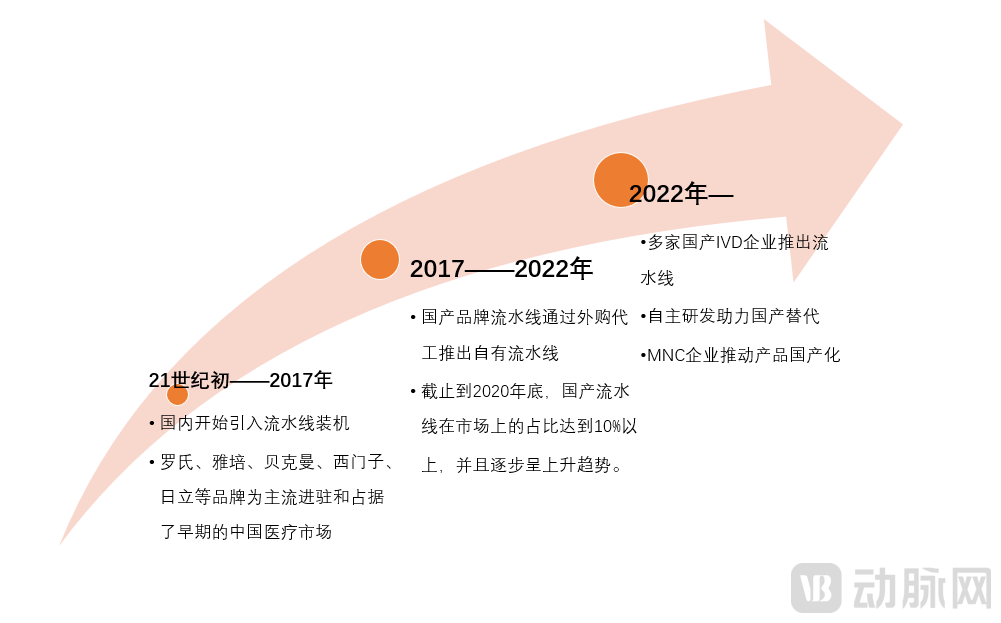
Development History of Domestic Automated Laboratory Lines
While OEM assembly lowers the barrier to entry for production lines, it also drives up costs.. Failure to master core underlying technologies also hinders subsequent iterative upgrades. Therefore, while assembling an automated production line may seem straightforward, developing one that operates stably, achieves high installation volumes, maintains controllable costs, and gains market acceptance is highly challenging.
Domestic automated laboratory assembly lines are emerging in large numbers. From the perspective of endogenous drivers, this represents an inevitable path for the growing strength of Chinese manufacturers. Over the past two decades, domestic companies have gradually achieved import substitution for biochemical reagents and low-to-medium speed biochemical analyzers, while filling domestic gaps in chemiluminescence reagents and high-speed instruments. Through more than a decade of technological accumulation, Chinese manufacturers have initially built the capability to deploy automated laboratory assembly lines.
From the perspective of changes in the external environment, the industrial strategic significance of assembly lines has become more prominent.In 2022, Jiangxi Province launched centralized procurement for biochemical liver function reagents. This policy has intensified market competition within the industry. In the future, it will become increasingly difficult to achieve instrument installations by relying solely on standalone units. The trend toward hospital automation lines is becoming more pronounced. Only by increasing the installed base of instruments to drive reagent sales can companies solidify their market position.
As domestically produced automation lines are intensively launched, the once vacant market for such systems in China is becoming increasingly crowded. It is worth noting that a rush of entrants can easily lead to industry overheating and product homogenization. Amidst the backdrop of fierce competition, some companies have found ways to break free from this involution.
As a veteran IVD company in the industry, Fosun Diagnostics has strategically positioned itself in laboratory automation. Rather than pursuing an OEM route, it has remained committed to the independent research and development of both instruments and reagents, actively listening to customer feedback to meet the diversified demands within China’s complex healthcare system.
Fosun Diagnostics originated from “Fosun Changzheng,” a long-established IVD company founded in 1989. In 2021, it announced a strategic transformation and was renamed “Fosun Diagnostics.” Following the transformation, the company has established a full-industry-chain layout covering key raw materials, reagents, and instruments.
Following its transformation, Fosun Diagnostics launched its own biochemical and immunological automation line, the F-A7000 series, in less than two years.Notably, the three core modules of the Fosun Diagnostics F-A7000 series automated laboratory track—the high-speed chemistry module (F-C800p), the immunoassay module (F-i3000), and the intelligent sample distribution system—have all been independently developed.
The intelligent laboratory represents Fosun Diagnostics’ ultimate goal for the future, while its current assembly line design reflects the company’s foresight regarding the development trends of domestic assembly line products. As the market for domestically produced assembly lines enters its second half and becomes increasingly crowded, in which directions does Fosun Diagnostics anticipate the domestic in vitro diagnostics (IVD) market will evolve over the next few years?
First, Fosun Diagnostics has established a self-developed R&D platform, based on the anticipation that independent innovation will widen the gap in its assembly line products.
From the perspective of the current market landscape, most domestic and international companies have chosen to acquire core analytical modules for biochemistry and immunoassay instruments through OEM arrangements. Among domestic enterprises, only a few, such as Mindray, Autobio, Maccura, and Fosun Diagnostics, have pursued independent R&D paths. Opting for in-house development of reagents, instruments, and intelligent software represents a high-investment, long-cycle strategy.
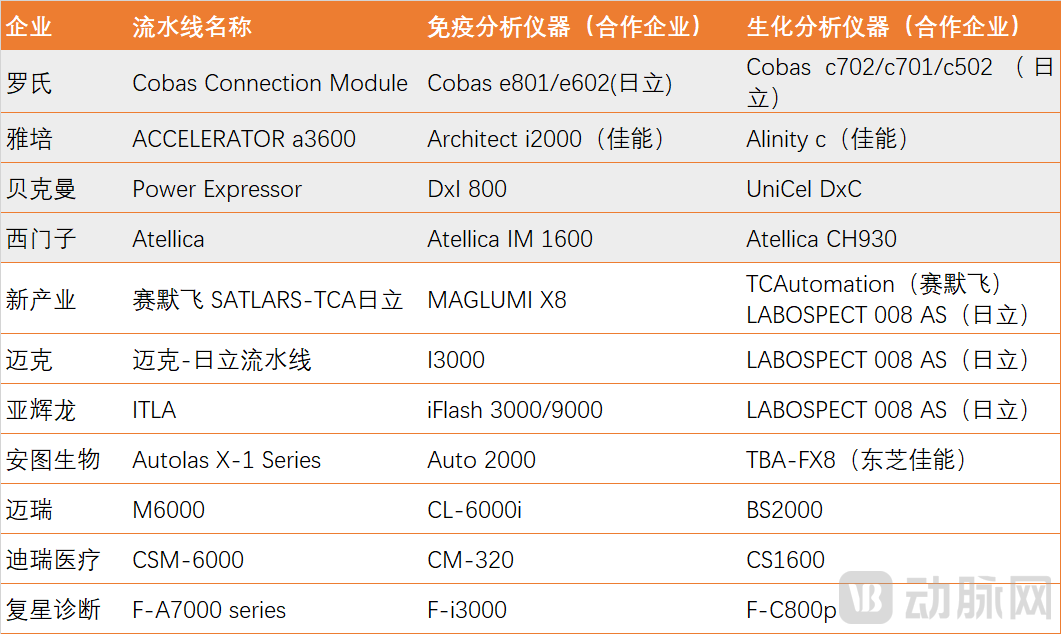 Partial Assembly Line SolutionsProducts from partner companies are not labeled as independently developedSource: Guolian Securities, public information
Why Pursue In-House R&D When OEM Is Available?
An industry R&D executive stated, “Keeping core technologies in-house is a long-term investment. If a platform-based company lacks a complete R&D system and capabilities, it will quickly hit a ceiling as market competition intensifies. Focusing solely on reagents or instruments leads to compatibility issues between the two; only with high compatibility between instruments and reagents can higher comprehensive testing speeds be achieved. In-house R&D also accelerates subsequent product iterations. Although independent R&D increases costs in the short term, it ultimately enables better cost control in the long run.”
Specifically regarding products, the self-developed platform can continuously empower product development and establish differentiated advantages. Fosun Diagnostics, previously renowned for its reagents, has accumulated significant momentum through independent research and development.
Through independent research and development, Fosun Diagnostics can exceed industry standards.Fosun Diagnostics’ independently developed F-i3000 fully automated chemiluminescence immunoassay analyzer achieves an ultra-low carryover contamination rate of <0.1 ppm, a feat accomplished by only a few products currently on the market, whereas the industry standard for this parameter is 10 ppm.
Self-developed instruments and reagents can achieve better compatibility.Regarding the retest rate for abnormal sample results that impacts workflow, MNC brands typically maintain a retest frequency of a few percent, whereas some domestic manufacturers see rates exceeding ten percent. Fosun Diagnostics, with its independently developed instruments and reagents, has achieved superior control over retest rates, thereby avoiding repetitive operations that could disrupt customers’ overall workflows.
In-house R&D also creates a “snowball” effect, accelerating product iteration. Less than a year after the launch of its first-generation laboratory automation line, Fosun Diagnostics is poised to release its more powerful second-generation system, which integrates the F-C2000 biochemistry analyzer with a throughput of 2,000 tests per hour and the F-i6000 high-speed fully automated chemiluminescence immunoassay analyzer.
Compared to 800-tests-per-hour biochemistry analyzers, 2000-tests-per-hour systems demand significantly higher sample processing throughput. Even with a dual-sample probe configuration, the pipetting time is reduced by one-fifth, posing substantial technical challenges. The increased speed compromises pipetting accuracy; furthermore, faster reaction disk rotation imposes stricter requirements on mechanical control precision, optical detection pathways, and washing system efficiency to minimize cross-contamination.
Fosun Diagnostics’ second-generation laboratory automation line not only addresses the aforementioned issues but also sets higher standards for itself, aligning its technical specifications with the industry’s top-tier benchmarks and requiring two key performance indicators to surpass those of multinational corporation (MNC) brands.The 2,000-test-per-hour biochemical analyzer under development has a minimum sample volume of ≤1 μL, and the second-generation automation line from Fosun Diagnostics has a minimum reaction volume of ≤80 μL. Currently, only a very small number of companies in the market can meet these two technical requirements.
In terms of stability, Fosun Diagnostics has set a requirement for the second-generation assembly line to operate fault-free under full load for 90 days.
Regarding reagent products, Fosun Diagnostics’ future immunoassay menu is expected to reach 200 items, comprehensively meeting hospital testing needs.
Another key capability that widens the gap between enterprises is the holistic performance of products, rather than single-dimensional parameters. This requires domestic companies to gain deep insights into customer needs and focus on product design from the perspective of overall performance to address user pain points, instead of merely improving individual parameters.
Taking Fosun Diagnostics as an example, in terms of enhancing throughput, a core performance metric of automated laboratory assembly lines, the company has not only focused on improving the testing speed of its analytical modules but has also adopted a multifaceted approach to address bottlenecks limiting overall line throughput.
High failure rates can impair the overall throughput of automated laboratory lines. To address the longstanding criticism of high failure rates associated with domestically produced automation lines, Fosun Diagnostics’ automation system adopts rack-based transport, eliminating the need for bulky transfer modules that are prone to frequent failures. Through an innovative turntable design, Fosun Diagnostics enables rack reorientation and track switching. This streamlined turntable structure not only reduces the incidence of failures but also minimizes the system’s footprint.
In terms of workflow design, the Fosun Diagnostics automation line optimizes sample allocation through intelligent scheduling, effectively preventing specimen congestion and wait times. This enhances specimen throughput on the track and overall testing efficiency, enabling intelligent distribution for biochemistry and immunoassay testing.
Fosun Diagnostics prioritizes laboratory application scenarios and customer needs in the design of its automation lines, with even minor details refined through extensive research.
Taking the footprint of Fosun Diagnostics’ automation line as an example, Fosun Diagnostics even conducted on-site surveys of elevator widths in hospitals across China and found that most hospital elevators are no wider than 1.2 meters. Consequently, Fosun Diagnostics designed its modules to be less than 1 meter in width.
Beyond the product dimension, there is no doubt that the core capability differentiating companies in the next stage will be commercialization prowess, with installed base determining the quality of corporate survival.
In the Current Market Landscape, MNCs Hold an Absolute Advantage in the Existing Market; How Can Domestic Companies Break Through?
The current installed base stands at 3,000 automation lines. With an approximate replacement cycle of six years, the existing market generates an annual demand for 500–600 new lines. The market size derived from this replacement demand is already substantial. Furthermore, as Tier-3 hospitals continue to expand, they will install additional automation lines.
From the perspective of incremental market growth, many county-level people's hospitals and secondary hospitals in China are also introducing automated laboratory assembly lines during their expansion and renovation projects. Hospital renovations present the optimal entry point into this incremental market. Driven by policies such as fiscal interest-subsidized loans supporting new healthcare infrastructure development, the construction of medical consortia, and mutual recognition of laboratory test results, there is substantial demand for automated laboratory assembly lines in the primary care market.
As primary care hospitals become key to the expansion of domestic automated laboratory lines, high-volume systems traditionally designed for large central laboratories are facing challenges in penetrating this lower-tier market. What kind of products can unlock the primary care sector?
Recognizing the importance of the grassroots market, Fosun Diagnostics has positioned its total laboratory automation (TLA) solutions for small and medium-sized laboratories, including secondary hospitals, select tertiary hospitals, and as a supplementary TLA system for large tertiary hospitals.
In response to the aforementioned issues, Fosun Diagnostics told VCBeat, “First, there are significant differences between users in small and medium-sized laboratories and those in large tertiary hospitals. Hospitals have an urgent need to improve efficiency by reengineering laboratory processes and introducing new lean management practices; automation lines are an inevitable choice for these laboratories. However, hospitals often handle relatively smaller sample volumes and have limited space, while also needing to account for departmental development over the next three to five years. Therefore, scalable, flexible, and compact automation lines would closely match the needs of these hospitals, achieving cost control not through reduced configurations but through optimized design.”
Therefore, our first-generation pipeline fully took these factors into account, controlling costs through self-developed instruments while offering a comprehensive menu of biochemical and immunoassay tests. In terms of middleware software design, we developed user-friendly middleware. Unlike users in tertiary hospitals, who are highly proficient in software operations and can customize workflows on complex platforms, primary care facilities have fewer operators and require more straightforward middleware solutions.
“Our middleware enables users with only standalone instrument experience to get up to speed quickly. In the future, as we expand our customer base, we will develop more customized software solutions for specialized hospitals such as obstetrics and gynecology hospitals and oncology hospitals. Given the significant differences in specimen sources and testing panels among these specialty institutions, we will continuously upgrade our products to meet diverse needs.”
Enterprises capable of securing the future of laboratory automation lines must possess profound market insights, excel in R&D for instruments and reagents, demonstrate product iteration capabilities underpinned by foundational technology platforms, and, more importantly, exhibit the courage and capacity for self-transformation.
Indeed, while a significant gap remains between domestically produced products and those of multinational corporations (MNCs) in the transition from collaborative contract research and development to independent R&D, the rapid pace of innovation among domestic players cannot be overlooked.
Fosun Diagnostics launched its self-developed laboratory automation system within two years of its transformation and is accelerating iterations to soon introduce the second-generation system, demonstrating a pace of change that cannot be underestimated. The key to its rapid development lies in the long-term investment, accumulation, and eventual breakthroughs in R&D.
Domestic enterprises possess substantial growth potential. We are confident that these companies, driven by a strong commitment to transformation, high R&D investment, diversified product portfolios, and a customer-centric strategic layout, will earn market trust through sincerely crafted products in the future.
In the past, multinational corporations (MNCs) would go over a decade without iterating their products after launch. As domestic companies intensify their efforts in the laboratory automation line market, they are emerging as the “catfish” in this sector, injecting new momentum into the industry with their robust vitality. We look forward to seeing domestic players achieve more milestones in the laboratory automation line market.