

Envision Micro Launches Innovative Millimeter-Scale Fallopian Tube Endoscope, Deeply Focusing on Female Assisted Reproduction

VCBeat
Internet Medical Health Media
More than a decade ago, while Zhu Chunming was still working in endoscope sales, he observed a phenomenon:Despite the surge in popularity of endoscopes, imported brands firmly command over 90% of the domestic market.。
“If only we could build our own brand.” This idea began to take root in Zhu Chunming’s mind.
It was not until Zhu Chunming discovered that a research institution in Taiwan, China, was developing disposable hysteroscopes that he found the impetus to take the next step. His well-honed business instinct told him that this would be a major trend.
 Zhu Chunming, Founder and CEO of Enshiwei. Photo provided by the interviewee.
To trace the technological origins of disposable hysteroscopes, Zhu Chunming relocated his entire family to Taiwan to follow the supply chain. In 2016, armed with confidence, Zhu returned to mainland China and began assembling his own team. In 2017, he founded Century Minimally Invasive Medical Technology Co., Ltd., initiating the research and development of disposable endoscopes. In 2022, Zhu establishedEnshiwei (Suzhou) Medical Technology Co., Ltd. (hereinafter referred to as “Enshiwei”)。
No matter how many times he has started a business, the direction has always been what he has been pursuing.Meeting the substantial clinical demand in gynecology and reproductive medicine with single-use endoscopes.
Partnering with the foremost experts in technology and clinical practice
The development of innovative medical devices often requires three key factors:Market, Technology, and Clinical。
“Industrialization is not merely about technological research; rather, it requires market-driven R&D. Ultimately, the potential of technology must gain clinical validation to be considered part of the industrialization process for innovative medical devices,” Zhu Chunming emphasized to Chengguo Bureau.
Following this approach, Zhu Chunming was introduced by an intermediary to Dr. Zhao Pengpeng, a researcher at the Zhejiang University Binjiang Institute. Dr. Zhao earned his Ph.D. in micro-optics from the University of Freiburg and conducted scientific research there for over ten years, dedicating himself to the research and development of micro-optical devices and systems. “With my more than twenty years of market experience and Dr. Zhao’s extensive R&D expertise and strong innovation capabilities, we immediately hit it off and decided to jointly advance the development of gynecological endoscopes,” recalled Zhu Chunming.
After integrating technology with women’s health, Zhu Chunming and Zhao Pengpeng then partnered with Beijing Tiantan Hospital, Capital Medical University.Prof. Feng LiminUpholding Clinical Excellence. Since 1992, Professor Feng Limin has performed over 20,000 hysteroscopic examinations, hysteroscopic surgeries, and laparoscopic surgeries. He specializes in hysteroscopic and laparoscopic procedures, as well as the treatment of pelvic floor dysfunction, cervical lesions, gynecologic malignancies, and gynecologic endocrine disorders.
“Professor Feng is a leading expert in gynecological diseases in China. She was highly interested when we shared our ideas with her, stating that this was precisely what she had been seeking for many years.” With affirmation and support from clinical experts, Zhu Chunming became even more convinced that his team’s technology addressed a genuine need among clinicians.
Therefore, in the subsequent R&D efforts, Zhu Chunming has consistently sought a balance among market demands, technological advancements, and clinical practices. “OurEach step requires approval from all three parties.“Only in this way can the resulting products possess market, technological, and clinical value,” stated Zhu Chunming.
“Focusing solely on gynecology”
As a common medical device, endoscopes rely on light sources for assistance, entering the human body through natural orifices or small surgical incisions to directly visualize changes in relevant areas. They are essential tools for precise diagnostic examinations and minimally invasive treatments in internal medicine and surgery. In clinical practice, medical endoscopes have a wide range of applications, covering multiple key departments such as gynecology, orthopedics, urology, neurosurgery, and general surgery.
It is worth mentioning that, in terms of product layout, Zhu Chunming and Enshiwei firmly choseGynecological DiseasesThis direction.
“The demand in gynecology is substantial; our innovative devices can achieve specialization, refinement, uniqueness, and innovation within the gynecological field.” From the rationale provided by Zhu Chunming, we can also sense the allure and vastness of the women’s health market.
In recent years,The Women’s Health Sector Has Emerged as a Dark Horse, Attracting a Surge of Capital Investment。
From the perspective of China’s secondary market, a large number of companies in the women’s health sector have pursued initial public offerings (IPOs). Companies such as Medlander, Giant Biogene, and Jinbo Bio have successfully listed. The fervor for IPOs in the secondary market has further spilled over into the primary market. Numerous domestic and international investment institutions have entered the women’s health sector, with many companies securing new rounds of financing.
IncludingGynecological endoscopy, including in the field of assisted reproduction, is a market with huge growth potentialTaking hysteroscopy as an example, nearly 70 million patients with abnormal uterine bleeding and 56 million patients with infertility in China urgently require early screening, diagnosis, and treatment each year. However, traditional hysteroscopy is costly and operationally cumbersome, far failing to meet the massive demand in gynecological outpatient services. “With the awakening of gender awareness, the commercial value of women’s health has become increasingly prominent. Moreover, patients exhibit low price sensitivity; therefore, women’s health is overall a highly profitable sector,” stated Zhu Chunming.
To address this significant clinical pain point, Enshiwei’s disposable handheld hysteroscope offers a novel option for both clinicians and patients. The factory-sterilized design of the disposable handheld hysteroscope substantially reduces the risk of cross-infection, while eliminating the need for hospitals to invest in costly endoscope processor systems; precise examinations can be performed after simple assembly.
The 4mm ultra-thin endoscope can be inserted into the human body through natural orifices, eliminating the need for cervical dilation and anesthesia. This approach reduces surgical risks and avoids postoperative pain, enabling outpatient gynecological examinations with no hospitalization required—patients can leave immediately after the procedure. This significantly lowers surgical costs for both hospitals and patients and effectively alleviates hospital bed pressure.
Moreover, Zhu Chunming revealed that in the field of gynecology,Enshiwei has established a comprehensive portfolio of gynecological medical endoscopes, including colposcopes, endocervical scopes, hysteroscopes, and fallopian tube scopes. To date, multiple products have entered the final stages of Class II medical device registration.
“Companies that truly innovate stand out more”
Amid the current capital winter, investors have not resigned themselves to inaction; instead, they are taking a step back to reflect. In this environment, companies that are genuinely innovative stand out more prominently and are more easily discovered.
In March 2023, Enshiwei announced the completion ofTens of Millions in Angel Funding, this round of financing was exclusively invested by Yuanming Xin Zhaoyuan. From the perspective of investment and financing, Enshiwei is recognized. The reasons include its team, market, and technology. (The team and market aspects have been mentioned above and will not be repeated here).
Within Enshiwei’s product portfolio, Orange Bureau has identified multiple “first-of-their-kind” products, including China’s first portable single-use hysteroscope, China’s first portable single-use salpingoscope, and the world’s first OCT endometrioscope/OCT salpingoscope.
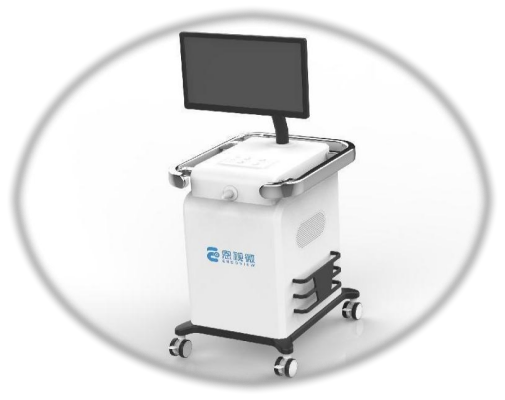
Optical Coherence Tomography (OCT) Endoscope, Image Provided by Interviewee
WithOptical Coherence Tomography (OCT) EndoscopeAs an example, optical coherence tomography (OCT) endoscopy is a novel optical biopsy technique developed after X-ray imaging, magnetic resonance imaging (MRI), and ultrasound imaging. It enables high-speed, high-resolution, non-invasive, real-time cross-sectional imaging of internal human organs. Consequently, OCT technology has become the gold standard for ophthalmic diagnosis and holds significant clinical guidance value for percutaneous coronary intervention (PCI).
Unlike traditional time-domain and frequency-domain OCT technologies, Envision Micro has developedThe Latest Generation of Swept-Source SS-OCT Technology, featuring rapid imaging speed, high signal-to-noise ratio, and superior phase stability.
Unlike the 360-degree side-scanning mechanism of OCT imaging probes currently on the market, Envision Micro has developed an innovative product featuring a built-in miniaturized distal forward-scanning device. This technology enables real-time, high-resolution imaging of large-area intraluminal tissues, such as those in the stomach and bladder, as well as submucosal layers at depths of 1–2 mm. With a resolution of up to 10 micrometers—more than ten times higher than that of endoscopic ultrasound—it represents an industry first for applications in the endometrium and fallopian tubes.
Meanwhile, the high resolution of SS-OCT offers distinct advantages in detecting subtle changes such as early tissue dysplasia and carcinogenesis: it enables the acquisition of morphological information from tissues that are difficult to detect or sample, representing a novel “non-invasive optical biopsy” technique for human body cavities.
By integrating SS-OCT technology with optical endoscopy, clinicians can acquire not only surface optical images of tissues but also ultra-high-resolution cross-sectional imaging, which holds significant clinical value for pathological screening and preoperative planning.
“First-of-its-kind” innovative products have given Zhu Chunming and Enshiwei technological confidence, but they have also brought challenges. “Focusing on the R&D of innovative medical devices requires more time and capital,” said Zhu Chunming. Currently, Enshiwei alsoHas already begun the next round of financing, and is continuously recruiting talent to strengthen its R&D capabilities.
When it comes to market education for innovative products, Zhu Chunming believes that even as a new technology, innovative gynecological endoscopes do not require extensive market education.Because the market itself demands it.。