

AI-Powered Oculomotor Digital Biomarkers: A Brain Health 'Thermometer' for 500 Million Households
On June 5, 2023, Apple unveiled its new product, the Vision Pro. CEO Tim Cook declared, “Apple Vision Pro will usher us into the era of spatial computing.” Among the technologies featured in this new product, one that has drawn significant attention isEye Tracking Technology—This technology has revolutionized the mode of human-computer interaction.
This technology is not exclusive to the tech industry; it has long been applied in clinical practice.
In 2019, researchers from Loughborough University published a study in *Aging* that investigated eye movement performance in patients with mild cognitive impairment (MCI) using the antisaccade task (AST). This study provides"Eye tracking is a useful diagnostic biomarker in dementia assessment"provided further support. For a time, the application of eye-tracking technology in the diagnosis of brain disorders became a hot research focus pursued by scientists.
Ye Jianfeng, who holds a Master’s degree in Neurocognitive Sciences from Grenoble INP, FranceHe has long focused on the diagnosis and treatment of cognitive disorders. Years of scientific research and clinical experience have led him to recognize that early screening and diagnosis for patients with Alzheimer’s disease (AD) have not yet been widely adopted, primarily due to the operational barriers associated with current AD early-screening methods.
After careful consideration, Ye Jianfeng decided to design a precise and easily scalable early screening device for cognitive impairment based on eye-tracking technology. In 2020, he joined forces with neuroscience experts from top academic institutions such as MIT and Cambridge, as well as renowned specialists in the field of Alzheimer’s disease services, to co-found a company dedicated to the diagnosis and treatment of brain disorders.Zhisheng Technology。
I. Entrepreneurship: A Coincidence, Yet Inevitable
Since its inception, Zhisheng Technology has focused on addressing the challenges in early diagnosis and treatment of Alzheimer’s disease (AD). Ye Jianfeng explained, “This is not only to address clinical pain points, but also to stay true to our original aspiration.”
For himself, the hardships faced by families of Alzheimer’s disease (AD) patients have long been a scar in Ye Jianfeng’s heart.
From 2015 to 2018, Ye Jianfeng was atPursuing Neurocognitive Sciences at Grenoble INP, FranceMaster’s degree, with a focus on the interaction mechanisms of the brain’s auditory-visual pathways. In 2018, heGrenoble University Hospital(CHU Grenoble) completed a clinical research project that uses screen trajectory tracking technology to differentiate between types of Parkinson’s disease patients.
CHU Grenoble is one of the earliest hospitals worldwide to apply Deep Brain Stimulation (DBS) for the treatment of Parkinson’s disease., possessing extensive technical expertise and experience. Nevertheless, cases of ineffective outcomes following Deep Brain Stimulation (DBS) surgery due to misdiagnosis still occur. Therefore, Ye Jianfeng’s research focuses on leveraging artificial intelligence to capture objective behavioral data from patients and develop algorithmic models capable of differentiating among various types of Parkinson’s disease, thereby enabling more accurate diagnoses. This clinical research project has helped him establish the philosophy and accumulate experience in translating technological innovations into clinical research applications.
At CHU Grenoble, he witnessed numerous new technologies that integrate artificial intelligence for the screening and diagnosis of neurological disorders, laying the foundation for the subsequent development of eye-tracking technology for Alzheimer’s disease (AD). He also gained insight into the hardships faced by families of AD patients.
One woman’s story has remained with him to this day. The woman’s mother was a patient with Alzheimer’s disease (AD). Considering France’s slightly superior medical care and the greater convenience of providing care, she relocated her mother from distant Taiwan, China, to France. However, the unfamiliar environment did not improve her mother’s condition; instead, it worsened. Throughout the caregiving process, she endured considerable hardship and even missed some important moments in her child’s growth. Yet she never gave up. This was because, although her mother had forgotten nearly everything, she never forgot her daughter’s name.
This woman’s story moved Ye Jianfeng, and he thought:If the mother had undergone screening in the early stages of disease onset, her condition might have been brought under control in time, sparing the daughter from having to choose between caring for her mother and maintaining her own life.—This is also the reason why Ye Jianfeng, after leaving clinical practice, joined a well-known domestic digital therapeutics company specializing in Alzheimer’s disease (AD) to engage in the research and development of technical products.
His professional experience in the industry has given him a deep understanding of the current landscape of Alzheimer’s disease (AD) in China. Through discussions with clinicians, he recognized that merely providing post-diagnosis digital interventions is insufficient; accurate early screening and assessment are crucial for prevention and effective intervention.
In society, the diagnosis and screening of Alzheimer's disease (AD) have long presented clinical challenges.
The immense patient population with Alzheimer’s disease (AD) and the resulting burden on families and society need no further elaboration. As China transitions into an aging society, this issue has become increasingly severe. Although the government is vigorously promoting early screening for AD, progress has been somewhat slow due to technological limitations.
Early screening for Alzheimer’s disease (AD) primarily involves two approaches: scale-based assessments and medical imaging. Results from scale-based assessments are not only susceptible to patients’ subjective willingness but also require a certain level of education. Furthermore, these assessments necessitate accompaniment by trained professionals, making them time-consuming and labor-intensive. Meanwhile, medical imaging faces challenges such as high costs, limited portability of equipment, and the need for invasive procedures, which hinder equitable access to healthcare benefits at the primary care level.
In summary,The lack of assessment and detection methods that are objective, accurate, and practically applicable is a major pain point in the current early screening and diagnosis of Alzheimer’s disease (AD).Pain points always go hand in hand with opportunities. Ye Jianfeng has long been focused on eye-tracking technology, which may well be the ideal solution to these pain points.
In early 2019, Ye Jianfeng’s clinical research project in France was recommended by the Chinese Embassy in France for him to return to China and participate in a startup competition for overseas students. This fortuitous opportunity finally allowed his years of research to be commercialized. Without hesitation, he chose to return to China to start a business, leading to the establishment of Zhisheng Technology.
II. “AD screening is as simple as taking a temperature”
Achieving broad and universal early screening for Alzheimer’s disease (AD) has long been the research goal of Ye Jianfeng. Therefore, Zhisheng Technology’s AD early screening system not only employs highly universal eye-tracking technology but also achieves absolute minimalism in its device design—No special equipment is required; screening can be performed using only a standard camera.
Zhisheng Technology empowers every smart terminal (smartphones, tablets) with eye-tracking capabilities through AI technology. This technological approach not only reduces detection costs but also facilitates the deployment of Alzheimer’s disease screening at the grassroots level, even reaching rural areas.
In addition to facilitating widespread adoption, accuracy of results is essential for diagnostic devices.
To accurately capture users' eye movements, Zhisheng Technology has constructed a five-dimensional spatial coordinate system integrating camera data, 3D head positioning, and pupil tracking. By training models on specialized datasets, the company achieves precise eye-tracking and prediction of attention focal points.
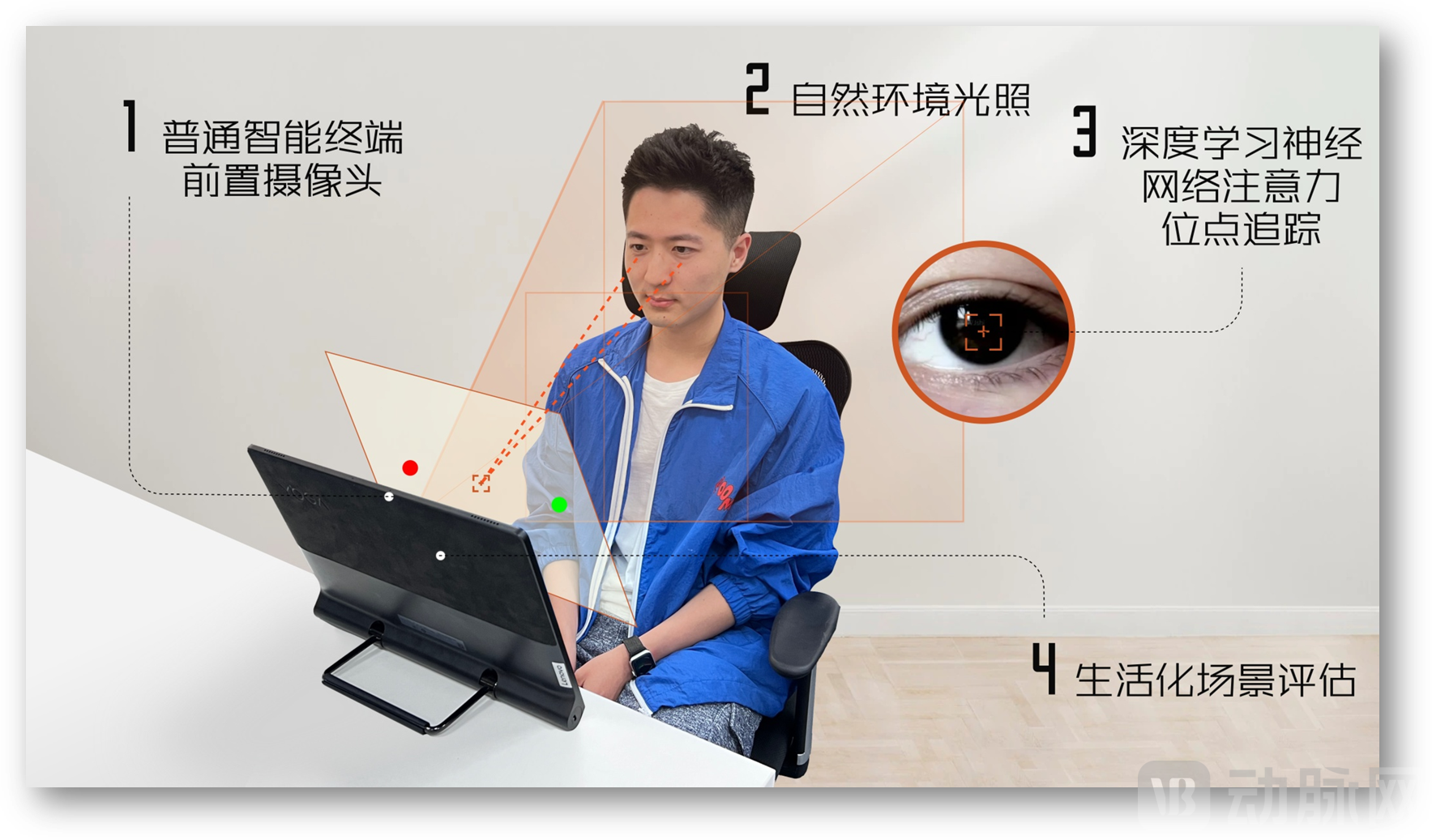
Screening can be completed using standard smart terminals (Image courtesy of Zhisheng Technology)
Currently,ZhiSheng Technology's AI eye-tracking model achieves a spatial accuracy within a 1 cm diameter in laboratory settings. The temporal accuracy depends on the camera configuration of the device, generally maintaining a frame rate of no less than 30 frames per second. Users can complete tasks at a distance of 30–80 centimeters from the camera.Ye Jianfeng stated, “This technical parameter is at a leading level internationally.”
Furthermore, to enable eye-tracking assessment in open environments while minimizing user disruption, Zhisheng Technology has leveraged AI technology to achieve automatic correction for head movements and angular changes. This eliminates the need for users to keep their heads stationary and avoids cumbersome calibration steps before each use, truly enabling unobtrusive assessment. Even without professional medical knowledge, grassroots personnel can easily operate the system, truly realizing“AD screening is as simple as taking a temperature”。
With advanced technical support, Ye Jianfeng excels in applying these technologies to brain function assessment and disease screening. Through close collaboration with clinical experts, the AI eye-tracking product for Alzheimer’s disease (AD) assessment has completed clinical validation with over 650 cases, demonstrating significant efficacy in distinguishing between healthy elderly individuals and AD patients.Accuracy (area under the ROC curve) can reach 92.3% (pending publication). This product has receivedHuashan HospitalandRuijin Hospitalrecognition by experts, and has participated inTwo National Key Science and Technology ProjectsandMultiple Key Interdisciplinary Projects at the Municipal Level in Shanghai.
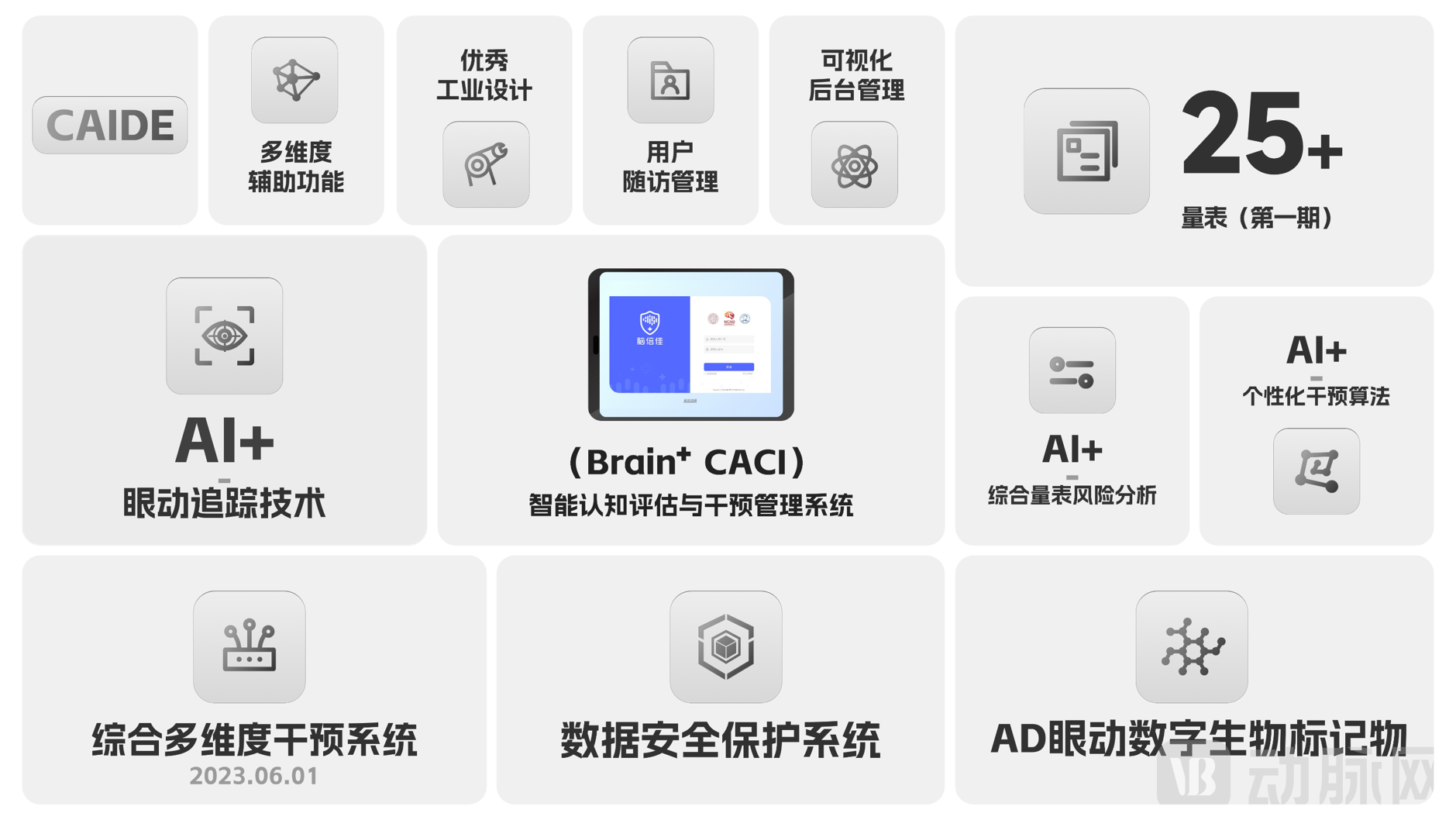
Advantages of the Zhisheng Technology AD Diagnostic Platform (Image from Zhisheng Technology)
III. BHI: Enabling Early Warning for Brain Diseases
Nowadays, the application of eye-tracking data as digital biomarkers in the assessment of brain disorders is gradually expanding. “Digital biomarkers are an iterative technology derived from traditional behavioral assessment methods,” mentioned Ye Jianfeng. The U.S. Food and Drug Administration (FDA) defines them as:Transforming human-generated “signals” into quantifiable, clinically interpretable objective standards through digital means, to discover, explain, or predict disease progression trends.
ZhiSheng Technology’s efforts in leveraging eye-tracking data for Alzheimer’s disease (AD) screening have laid the foundation for developing more diagnostic and screening tools for brain disorders. Currently, ZhiSheng Technology has developed solutions targetingDepressionandPediatric ADHD Screeningproducts. Among them, the pediatric ADHD screening product has completed preclinical data validation in over 700 cases, and the research findings have been accepted for publication by the journal Frontiers in Psychiatry.
Furthermore, Zhisheng Technology not only applies AI-based eye-tracking technology to the diagnosis of various medical conditions but also continuously pioneers new technological frontiers. Leveraging artificial intelligence, multidimensional data analysis will enhance the accuracy of our results and improve fault tolerance. “Our goal is to create a ‘thermometer’ for brain health—simple, objective, and accurate!” To this end, Zhisheng Technology has specifically proposedBrain Health Index (BHI)concept. Ye Jianfeng told Chengguo Bureau: “This concept is similar to the Body Mass Index (BMI); it leverages artificial intelligence technology and multi-dimensional data analysis to enable individuals to easily understand their current brain health status.”
Today, Zhisheng Technology has gained increasing recognition from industry professionals and institutions.
· April 26, 2023, JointHuashan HospitalThe Founding Ceremony of the China Vascular Cognitive Impairment Collaborative Alliance Was Held in Chongqing, and the NaoBeijia System Was Unveiled. The NaoBeijia System is a digital diagnosis and treatment system for cognitive impairment designed for medical institutions, facilitating digital assessment of neurocognition, intervention management, electronic record creation, and follow-up tracking.Currently, the system is already in use at more than 60 Grade A tertiary hospitals, while over 20,000 hospitals across China have a demand for enhancing their clinical digitalization capabilities.
· In August 2023, the Institute of Neurology at Huashan Hospital, CPIC Blue Public Welfare, and Zhisheng Technology entered into a strategic partnership to jointly develop“Trinity” Early Screening Model for Brain Health, including the integration of brain health risk factors, AI-based eye-tracking assessments, and subjective self-rating scales. It is reported that the pilot project of this model in Chongming District, Shanghai, completed brain health profile assessments for over 5,000 individuals in just 15 days, receiving positive feedback. The CPIC Blue Public Welfare Initiative plans to promote this model across 16 cities, with an expected completion of brain health profile screenings for 100,000 people by the end of the year.
· In September 2023, Junlong Life Insurance launched a specialized insurance product tailored for the elderly, covering conditions such as Parkinson’s disease, Alzheimer’s disease, and post-stroke cognitive impairment. As the exclusive provider of brain health technology, Zhisheng Technology offers diverse brain health assessments and intervention management services to policyholders. The launch of this insurance product holds significant importance for Zhisheng Technology, markingZhisheng Technology has completed the construction of a full-process service system spanning disease screening, diagnosis, and intervention management., while also addressing payment issues for technology services, thereby achieving a closed-loop commercial service model.
There is still a long way to go in the diagnosis, treatment, and elucidation of the underlying mechanisms of brain disorders. Ye Jianfeng remains optimistic about the future: “I believe that advances in artificial intelligence have propelled brain science research into a new historical stage.”The name of Zhisheng Technology signifies insight into the brain and weaving life.“Current AI applications are merely the first step. By leveraging accumulated technology and data, Zhisheng Technology aims to drive a deeper understanding of the human brain.”