

Neumora Therapeutics, the Best-Funded CNS Biotech of Recent Years, Files for IPO with $250M Raise Target

Neumora
Precision Drug Developer for Brain Diseases
At the end of last month, Neumora Therapeutics, a frontier biotechnology company in the CNS field, submitted its initial public offering (IPO) plan and applied for listing on the Nasdaq.
Neumora is set to issue 14.71 million shares at a price of $16 to $18 per share, raising up to $250 million, with the company currently seeking a valuation of up to $2.74 billion.
NeumoraThe marketing application has attracted significant attention.On one hand, Neumora is the CNS company that has raised the most funding in recent years, committed to seeking a transformation in new drug development within the CNS field. The company aims to draw lessons from the advancements in precision oncology and apply them to neuropsychiatry and neurodegenerative diseases. Instead of classifying diseases and developing drugs based on organs, it approaches disease understanding and new drug discovery from the perspectives of targets, mechanisms, and genetics.
Neumora has become one of the four biotechnology companies to announce IPO plans since late July this year.. According to BioPharma Dive data, a total of 104 companies completed IPOs in 2021, but only 22 companies successfully went public last year. So far this year, only 14 companies have completed IPOs on the U.S. stock market; among them are three nuclear medicine and biotech startups: RayzeBio, Adlai Nortye (an innovator in tumor immunotherapy), and Jyong Biotech (a company focused on treating urological diseases).
Among them, the IPOs of Neumora and RayzeBio bothRaised over $200 million in funding,MarksIPO Market Begins to Rebound Again.
Most importantly, Neumora already has two drug candidates in clinical trials, which provides investors with greater confidence.In fact, biotech companies that have entered the clinical stage are more likely to pursue an IPO.According to data from BioPharma Dive, the biotechnology industry experienced a boom in IPOs in 2020 and 2021, with many companies going public even at the preclinical stage; however, among those that completed IPOs in 2023, half had drugs in mid-to-late-stage clinical trials.
RBNC Therapeutics Under the Classic Capital Operation Model
Neumora was founded in October 2021. The company’s core mission is to redefine neuroscience research and development through a data-driven precision neuroscience platform, develop targeted therapies for brain disorders, address the heterogeneity of CNS diseases, and match patient populations with appropriate targeted treatments.
This company is not a traditional scientist-led startup, but rather the long-gestating outcome of preparations by ARCH Venture Partners, a prominent U.S. investment firm.
In 2020, ARCH Managing Director Bob Nelsen, along with Kristina Burow and Paul Berns, had been quietly raising hundreds of millions of dollars to launch Neumora Therapeutics, a large-scale company focused on neuroscience. Before fully unveiling the plan, they gave Neumora an ambitious operational codename—RBNC Therapeutics(Really Big Neuroscience Company ), which undoubtedly demonstrates their high expectations for transforming new drug development in the CNS field.
Neumora’s growth trajectory has indeed unfolded as planned, with a typical biopharmaceutical capital-operating model having crafted it into a star biotech highly favored by the market: backed by substantial funding, supported by a professional team, and equipped with a promising product pipeline.
Neumora has investors such as ARCH Venture and Amgen,Having been established for just two years, the company has secured over $600 million in financing.The Series A financing round was led by ARCH Venture Partners, raising over $500 million in total, including a $100 million equity investment made separately by Amgen. In 2022, the company completed another $112 million in Series B financing, with ARCH Venture Partners and Amgen continuing to participate as follow-on investors. According to Neumora’s prospectus, Amgen holds a 24.4% stake in Neumora, making it the largest shareholder, ahead of ARCH’s 20.4% holding.
As the company enters its IPO phase, Neumora requires the addition of more professional executive managers.Shortly before filing for its IPO, Neumora replaced its CEO, transitioning from ARCH Managing Director Paul Berns to Henry Gosebruch, former Executive Vice President and Chief Strategy Officer of the multinational pharmaceutical company AbbVie.During his tenure at AbbVie, Gosebruch and his team were responsible for overseeing the pipeline progress of AbbVie’s partners, completing more than 100 business development/M&A transactions and venture capital investments. Prior to joining AbbVie, Gosebruch served as Co-Head of the North America M&A Group at JPMorgan Chase, where he participated in announced M&A deals totaling over $375 billion during his 20-plus-year career. This represents a significant strengthening of Neumora’s management team.

Neumora CEO Henry Gosebruch, Source: Neumora Official Website
The most closely watched aspect remains Neumora’s product pipeline. The prospectus shows,Neumora has seven clinical and preclinical product pipelines, which were not developed in-house but acquired through the purchase of startups and licensing agreements for commercialization.
At its inception, Neumora acquired five smaller startups: Blackthorn Therapeutics, which was developing novel drugs for depression; Abelian Therapeutics, with expertise in the field of microglia; Alairion, which was developing treatments for sleep disorders; Propellex, a company focused on innovative therapies for Parkinson’s disease; and Syllable Life Sciences, a technology company that uses computational data science to understand how behavior and body language convey an individual’s mental state.
These acquisitions helped Neumora launch multiple drug programs, four of which were backed by ARCH Venture Partners. Clearly, ARCH aimed to consolidate its portfolio companies into a larger, more powerful CNS-focused entity. These acquisitions align closely with ARCH’s positioning of Neumora as an RBNC Therapeutics company.
In addition to acquiring startups, Neumora entered into a strategic collaboration with Amgen, securing global licenses to develop and commercialize two of Amgen’s compounds for the treatment of neurodegenerative diseases. This formed the company’s initial product pipeline.
However, Neumora is also continuously adjusting its strategic layout. The prospectus reveals that, based on feedback from the FDA, Neumora has removed NMRA-094, a product candidate for the treatment of obstructive sleep apnea, from its pipeline. This asset was acquired through the acquisition of Alairion. Meanwhile, the company also terminated another asset acquired from Propellex less than a year ago.
Thus,Neumora has established seven core product pipelines, which are central to its current IPO stage., among which navacaprant for the treatment of patients with moderate-to-severe major depressive disorder has entered Phase III clinical trials, and NMRA-511 for the treatment of agitation associated with Alzheimer’s disease has entered Phase I clinical trials.
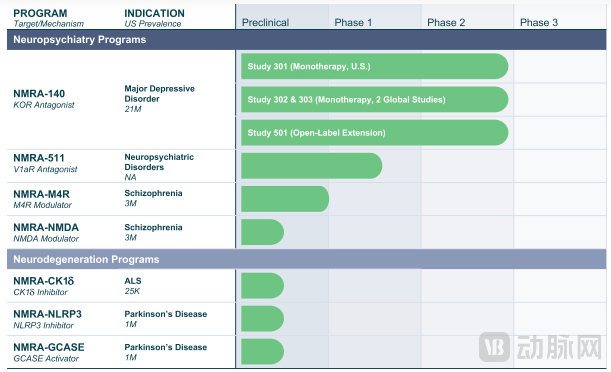
Neumora’s Product Pipeline, Source: Neumora Prospectus
Precision Science Data-Driven: Redefining CNS Drug Development
Brain diseases are highly heterogeneous, often arising from multiple complex driving factors. However, these conditions are currently classified based on clinical symptoms rather than being defined by genetic or mechanistic underpinnings. In drug development, this classification approach contributes to patient heterogeneity, subjectivity in clinical trial endpoints, and a low likelihood of regulatory approval, resulting in high failure rates for the development of targeted, effective therapies.
“Traditional neuroscience drug development is constrained by a “one-size-fits-all” therapeutic approach, often resulting in suboptimal efficacy, high placebo effects, and frequent failures in conventional clinical trials.“Neumora co-founder Kristina Burow previously stated,”We founded Neumora to pioneer the future of precision medicine for brain diseases.”
To achieve this goal, Neumora has built a scalable precision data science platform, starting with the elimination of heterogeneity in brain diseases. This platform aims to match patient populations with appropriate targeted therapies by mapping the driving mechanisms of brain diseases to identify and define patient subtypes.
Powered by Neumora’s Precision Toolbox, this platform integrates a suite of translational and clinical tools, proprietary machine learning algorithms and methodologies, and longitudinal, multimodal patient data. A comprehensive database has been established, encompassing genetic, imaging, electroencephalography (EEG), digital, and clinical data across a range of neuropsychiatric and neurodegenerative disorders, to precisely define target patient populations. The Precision Toolbox will enable Neumora to execute strategic initiatives aimed at identifying biomarkers that can optimize clinical trial design and expand indication opportunities, thereby supporting the company’s ultimate goal of increasing the likelihood of matching the right drug to the right patient.
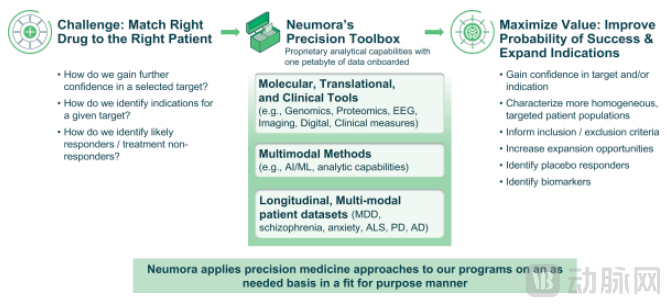
Neumora’s Precision Data Science Platform and Operational Strategy, Source: Neumora Prospectus
Regarding this new CNS drug development strategy, Dr. Morgan Shen, Co-Director of the Stanley Center for Psychiatric Research at the Broad Institute of MIT, stated: “This approach marks a significant advance in neuroscience, with the potential to truly revolutionize how we treat brain disorders, akin to how gene sequencing has transformed precision oncology drug development over the past decade.”
Similarly, Neumora’s product pipeline is advancing rapidly.The fastest is navacaprant for the treatment of moderate-to-severe major depressive disorder (MDD),This drug is an asset acquired by the company through its acquisition of BlackThorn. Navacaprant is a novel, highly selective oral kappa opioid receptor (KOR) antagonist designed to modulate dopaminergic pathways, which play a critical role in regulating mood, cognition, and behavior. The KOR system is a well-known pathway mediating depression-like states, and its modulation represents a novel therapeutic approach for major depressive disorder (MDD) and other central nervous system (CNS) disorders.
Prior to its IPO application, navacaprant entered Phase III clinical development as a potential monotherapy for MDD.In a prior Phase II clinical study, navacaprant monotherapy demonstrated statistically and clinically significant reductions in depressive and anhedonia symptoms in patients with moderate-to-severe major depressive disorder (MDD). Neumora expects to release the top-line results from the KOASTAL-1 study in the second half of 2024, with pivotal Phase III clinical trials anticipated to support a New Drug Application (NDA) for navacaprant monotherapy in 2025.
Excluding navacaprant, NMRA-511 has also entered Phase I clinical trials,This is a selective V1aR antagonist currently undergoing clinical trials for the treatment of agitation in Alzheimer’s disease.
Can Neumora Buck the Trend?
Due to the downturn in capital markets and equity indices such as the XBI over the past 18 months, few biotechnology companies have gone public this year.Listing during this phase of IPO slowdown will test investors’ confidence in biotechnology products and the market, posing challenges for Neumora as well.
The prospectus shows that as of June 30, 2023, Neumora had $334.1 million in cash, equivalents and marketable securities, with total liabilities of $29.8 million. According to the company's current operating plan, as of the date of the prospectus release, Neumora's assets will provide for operating expenses and capital expenditures for at least the next 12 months.
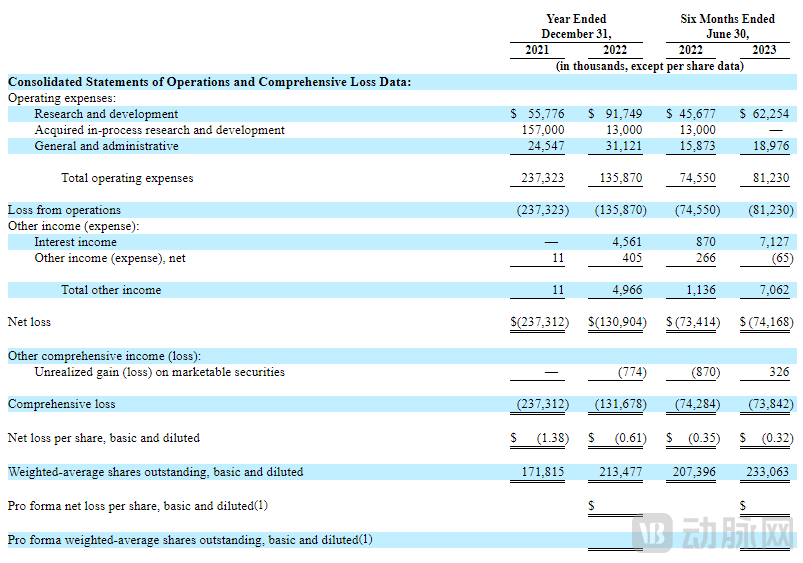
Neumora Financial Data, Source: Neumora Prospectus
Although biotech companies with clinical-stage product pipelines are more likely to succeed in an IPO, this does not eliminate other risks facing Neumora.
According to Neumora’s prospectus, the company’s net losses were $237.3 million and $130.9 million for the years ended December 31, 2021, and December 31, 2022, respectively, with a net loss of $74.2 million in the first half of 2023. As of December 31, 2022, and June 30, 2023, the company’s accumulated net losses totaled $467.5 million and $541.7 million, respectively. These net losses are primarily attributable to the five startup companies acquired by Neumora in 2020. Such net losses are expected to persist as pipeline development continues and Neumora prepares for its transition to a publicly listed company.
Meanwhile, Neumora is a CNS-focused startup. Historically, both multinational corporations (MNCs) and biotech companies have had very limited success in developing new drugs in the CNS field. In its prospectus, Neumora estimated that since 2019, spending on neuroscience research and drug development in the United States alone has exceeded $110 billion, accounting for approximately 33% of all disease-specific expenditures.
However, among all new therapies approved during this period, only approximately 12% were indicated for the treatment of brain disorders. According to data from BIO, between 2011 and 2020, the clinical development success rate for new drug candidates developed with patient biomarker testing was approximately 16%, whereas the success rate for those developed without patient biomarker testing was only 8%.
This means that Neumora’s path to future new drug development will not be easy, and navacaprant, which has entered Phase III clinical trials, will face significant challenges.
Undeniably, it has had a positive impact on the capital market. According to multiple sources, life sciences investors have begun encouraging startups to organize their documentation in preparation for an initial public offering (IPO).
Reference Article:
1. Neumora Prospectus
2. Neumora, a richly funded brain drug developer, readies for an IPO,BioPharma Dive