

Behind the Surge: The Driving Forces of China's Innovative Medical Device Commercialization
If 2022 was a year marked by an accelerating pace of integration among academia, research, industry, and healthcare, with China’s medical device industry continuously advancing into the core realms of innovation, then 2023 was a year characterized by the deepened convergence of academic and industrial innovation chains, ushering in an explosive phase for the translation of innovative achievements.
Over the past few years, not only has the National Medical Products Administration (NMPA) accelerated and strengthened the formulation and revision of supporting regulations, such as the Measures for the Administration of Drug and Medical Device Registration, thereby continuously unleashing policy dividends, but it has also successively issued the Special Review Procedures for Innovative Medical Devices and the Priority Review Procedures for Medical Devices. These initiatives have enabled innovative products and those urgently needed in clinical practice to “queue separately and expedite through the process.” Moreover, a growing number of researchers and industry practitioners are beginning to integrate the academic innovation chain with the industrial innovation chain, breaking down barriers between cutting-edge theories and clinical needs, and facilitating the implementation of innovative technologies.
According to data from the National Medical Products Administration, as of July this year, China has cumulatively approved 130 innovative drugs and 217 innovative medical devices. In the first half of this year alone, 24 innovative drugs and 28 innovative medical devices were approved for market launch.
Despite the industry’s rapid growth, translating cutting-edge technologies into practical applications is by no means an easy task.
Medical innovators and entrepreneurs must not only contend with intensifying competition in an increasingly crowded field, but also maintain a clear understanding of their projects and personal positioning. Simultaneously, they need to address challenges related to laboratory space, equipment, technology transfer, commercialization, regulatory compliance, and intellectual property. It can be said that before innovative achievements are truly implemented, medical innovators and entrepreneurs will inevitably face a difficult uphill battle.
In the face of opportunities, we must consider how to leverage the momentum to successfully translate and implement cutting-edge technologies.
Industrial innovation is inseparable from innovative incubation,
Incubators: An Essential Pathway for the Implementation of Innovative Medical Device Projects
The transformation of innovative achievements involves multiple stages, including basic scientific research, technological breakthroughs, commercialization of research findings, promotion and application, industrial upgrading, and service-oriented economic development. For entrepreneurs newly entering the healthcare industry landscape, each stage presents specific and formidable challenges. Throughout this process, professional guidance and services are essential to prevent a significant disconnect between the innovation chain and the industrial chain—a gap that medical innovation incubators are well-positioned to address.
It is precisely for this reason that, in the face of enormous industrial opportunities in the early-stage medical market, some countries have taken the lead in adopting an incubator model to facilitate the translation of innovative achievements.
Today, the incubator model has also become a driving force behind the explosive growth in the innovation and commercialization of domestically produced medical devices.
Incubators typically boast professional technical teams that can provide effective assistance with this issue. They are also capable of connecting clinical institutions, universities and research institutes, investment firms, and industry companies to conduct systematic analysis and planning for scientists’ innovative projects, thereby formulating rational development pathways to facilitate rapid corporate growth. Furthermore, incubators usually offer corresponding training programs to help medical innovators and entrepreneurs quickly advance and develop into qualified business leaders.
Furthermore, the incubator will provide scientists with technical support to address industrial resource challenges. In tackling the most challenging issue of commercial implementation, the incubator is uniquely positioned to offer multi-dimensional solutions, assisting enterprises with capital acquisition, team building, and market integration.
However, incubators follow diverse development models. On the core issue of how to better nurture startups, different incubators offer vastly different answers.
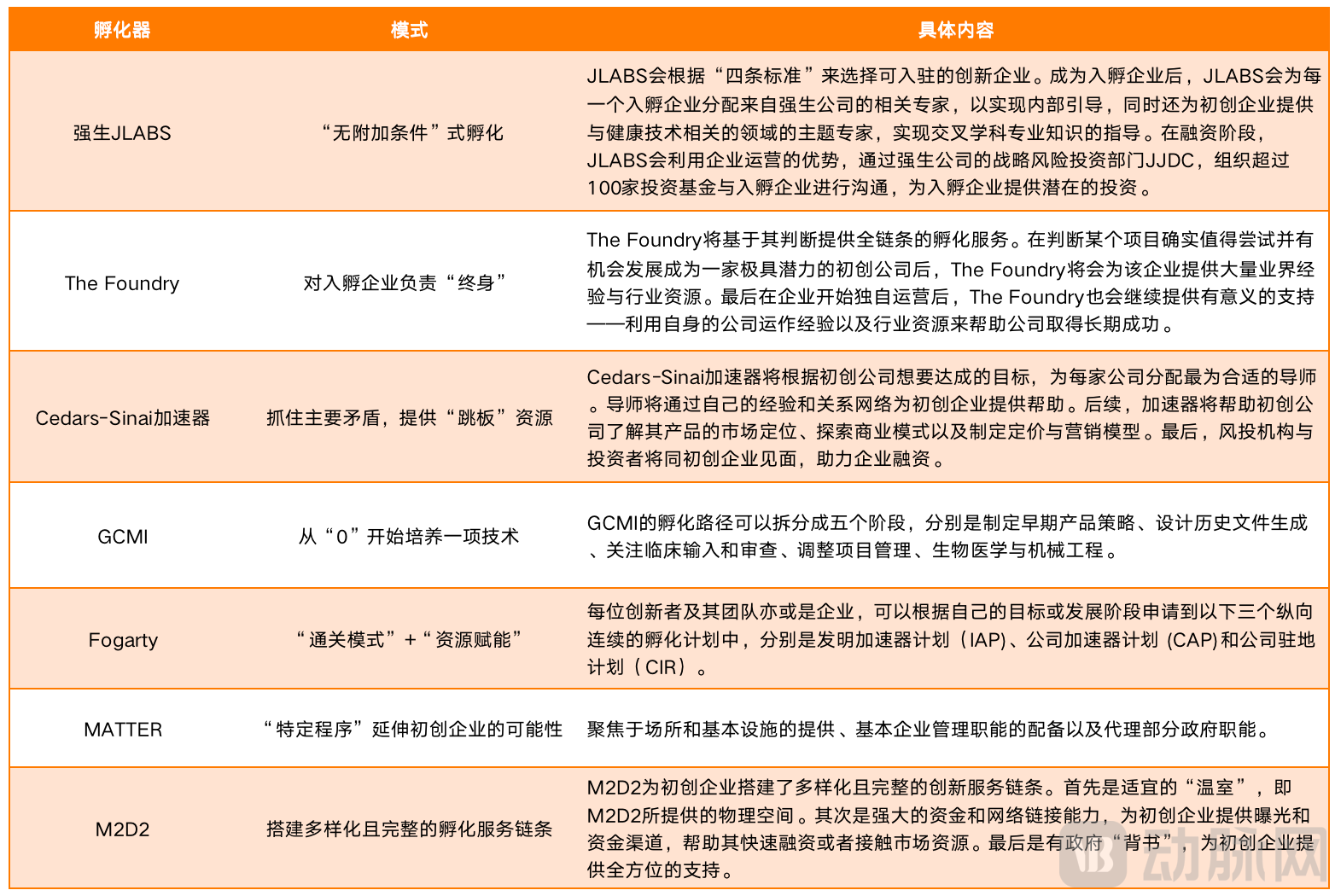
The Seven Leading Global Medical Incubator Pathways
Source: VCBeat’s Orange Fruit Bureau, “How Are the World’s Top Seven Medical Incubators ‘Supporting’ Startups?”
An analysis of the data presented in the chart reveals that, although each incubator has its own strategic focus, the value they generate is undeniable. For instance, since its establishment in 1998, The Foundry has incubated and founded 23 healthcare companies over a 23-year period. Excluding the startups launched in the past three years, more than 70% of the 20 companies founded by The Foundry between 1998 and 2018 have either been acquired or gone public.
Currently, leading industrial hubs across China are actively exploring pathways for the high-quality development of innovative medical devices and have established their own incubator models to facilitate the translation and implementation of innovative achievements. Meanwhile, with the in-depth advancement of the Outline Development Plan for the Guangdong-Hong Kong-Macao Greater Bay Area, the region has been striving over the past two years to build a “Healthy Bay Area,” fostering close collaboration in high-quality medical and health resources and promoting the growth of the health industry.
The Greater Bay Area Innovation Center for High-Performance Medical Devices (hereinafter referred to as the “Innovation Center”) is an industry incubation and venture capital platform established to deeply promote the high-quality development of China’s medical device industry and enhance the independent R&D capabilities and industrialization levels of high-end, precision, and advanced medical devices.
Multiple Policies Implemented,
The Greater Bay Area Accelerates the Translation of Medical Devices
The Innovation Center possesses inherent advantages and a foundational DNA for driving the commercialization of innovative medical devices.
Not only does itLocated in the Guangdong-Hong Kong-Macao Greater Bay Area, leveraging the pioneering leadership of cities such as Guangzhou, Shenzhen, Zhuhai, and Zhongshan, as well as the foundational advantages of Foshan, Dongguan, Zhaoqing, Jiangmen, Huizhou, Hong Kong, and Macao in connecting with the global biomedical industry landscape. It can also fully utilize regional innovation resources and market opportunities,Create an Innovation Environment and Collaboration Platform of International Standards。
In addition,Effective Integration of a Series of Innovative Policies, thereby also promoting the agglomeration and circulation of the Greater Bay Area’s advantages.
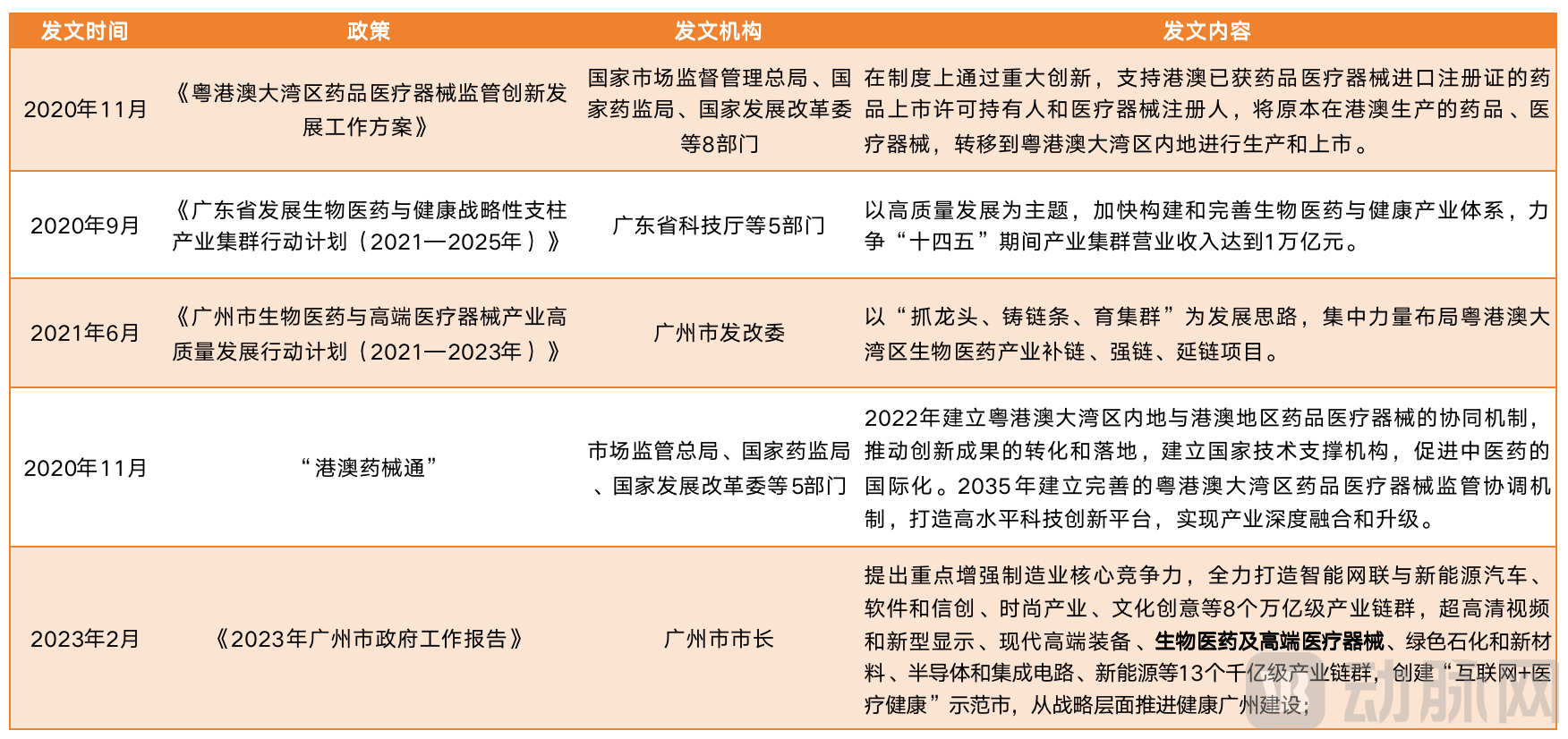
Selected Favorable Policies
Compiled from publicly available online information
Since its establishment, the Innovation Center in the Greater Bay Area has initially built an industrial innovation consortium led by enterprises, supported by universities and research institutes, and featuring collaborative synergy among various innovation entities. This structure effectively integrates innovation resources and elements, thereby enhancing the efficiency and quality of innovation. By strengthening the deep integration of the innovation chain, industrial chain, capital chain, and talent chain, the Center has cultivated an innovative ecosystem for the translation of scientific and technological achievements in medical devices. This accelerates the efficient translation and application of frontier technologies and innovative products in high-performance medical devices, driving technological innovation in the healthcare sector.
Specifically, the Innovation Center focuses on cultivating and introducing innovative projects in frontier areas of medical devices, including brain science, cardiovascular and peripheral vascular diseases, minimally invasive therapy, active medical devices, mechanical-digital intelligence, and biomaterials. It provides common technological support and tackles key technical challenges to facilitate collaborative innovation between medicine and engineering. The Center offers end-to-end support for innovative projects in these frontier fields, thereby promoting the implementation of industrial breakthroughs. Guided by national strategic needs and leveraging innovative resources, it assists enterprises in achieving original, leading-edge scientific and technological innovations and their industrial translation.
Notably,The “Openness” of the Innovation Center.
The Innovation Center serves innovators at all stages, providing diverse, full-industry-chain services to medical device innovation projects and teams from universities, research institutes, healthcare institutions, and other entities.
has also established a framework oriented toward the innovative development of medical devicesOpen Public Innovation Platform, Core Carrier of the Full-Industry-Chain Innovation Ecosystem——Bio-Island Innovation R&D Center, for innovators and entrepreneurs in the medical device industryPrecisely match the essential software and hardware support required for innovation incubation, including R&D laboratories, medical-engineering interaction platforms, and collaborative office spaces., to reduce the costs and risks of innovation and accelerate the exchange, incubation, and translation of innovative projects.
And in the face of implementing innovative projects,The Innovation Center and Guangzhou Development District Industrial Fund Investment Group jointly established the Huangpu Pioneer Medical Venture Capital Fund., for the purpose ofSupporting the Innovation and Incubation of Ultra-Early-Stage Medical Device Projects, and has invested in a portfolio of high-quality projects in niche sectors such as high-value neurointerventional consumables and organoids.
In summary, in addition to sharing similarities with the world’s seven leading medical incubators in terms of sector focus, screening of incubated enterprises, provision of resources and services, and deep market linkages, the Innovation Center closely aligns with current domestic policy initiatives. It leverages its unique insights into the development of Chinese-made medical devices to facilitate the translation of innovative achievements into practical applications.
Launch the IHM MedTech Planet Landing Recruitment Program,
“Incubation + Investment + Infrastructure” Accelerator Package Helps Innovative Ideas Take Root
With breakthroughs in core technologies, the trend toward “high-end” medical devices has become increasingly pronounced. It is now an inevitable trend to promote the commercialization of innovative achievements in medical devices and advance toward the high-end segment. For enterprises, the era of relying on a single product for effortless success is over. To secure a position in the industry, companies must maintain their innovation vitality and enable domestically produced medical devices to gradually gain prominence in the high-end market through rapid technology follow-up, technological optimization and iteration, as well as original independent R&D.
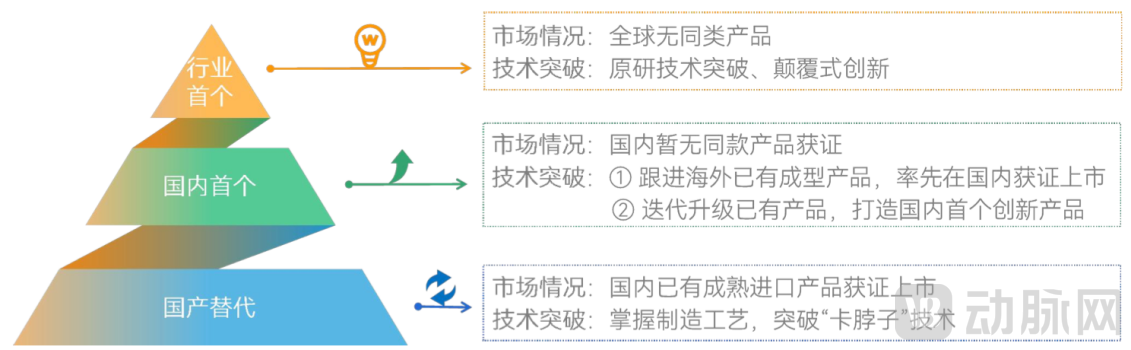
Three Stages in the Development of High-End Domestic Medical Devices
Data source and charting: VCBeat, “2023 Research Report on the High-End Medical Device Industry”
Despite possessing innovative technologies, medical entrepreneurs and innovators must still navigate at least three stages prior to this: import substitution with domestically produced alternatives, achieving the first domestic instance, and securing the first industry-wide implementation.
To support medical innovators and entrepreneurs through this challenging uphill journey, the Innovation Center and the Huangpu Pioneer Medical Venture Capital Fund have jointly launched the “IHM MedTech Planet Landing Program” (hereinafter referred to as the “Landing Program”), an early-stage support initiative for medical device entrepreneurs. This program seeks out innovators and entrepreneurs who are genuinely committed to creating clinical value with their medical devices. Through a6 monthsof professional courses and thematic activities, to provide for the camp program“Incubation + Investment + Infrastructure” Full Acceleration Package, coveringKey elements such as capital, industrial resources, and implementation spaceeffective support。With thisHelp early-stage medical device projects and startups effectively enhance their competitiveness, accelerate commercialization, and enable the efficient clinical translation and application of cutting-edge technologies.。
Recruitment Plan
It is understood that,The initial recruitment quota for the Landing Plan is 20 participants.,Key recruitment targets include innovators and entrepreneurs from three sectors: brain science, pan-vascular intervention, and minimally invasive surgery.Meanwhile,The “X Track” has been established for entrepreneurs pursuing more innovative directions., including but not limited to drug-device combinations, implantable medical devices, and active devices.

Recruitment Track
Guided by Practitioner-Mentors, Empowered by Multi-Dimensional Experts
Leveraging the Innovation Center’s resource-linking capabilities, the mentorship team for this landing program comprises seasoned practitioners from the medical innovation sector. They will share their firsthand experiences and insights gained from years of industry engagement, provide in-depth guidance to entrepreneurs, and facilitate industry collaboration opportunities and direct investment for the participating projects.
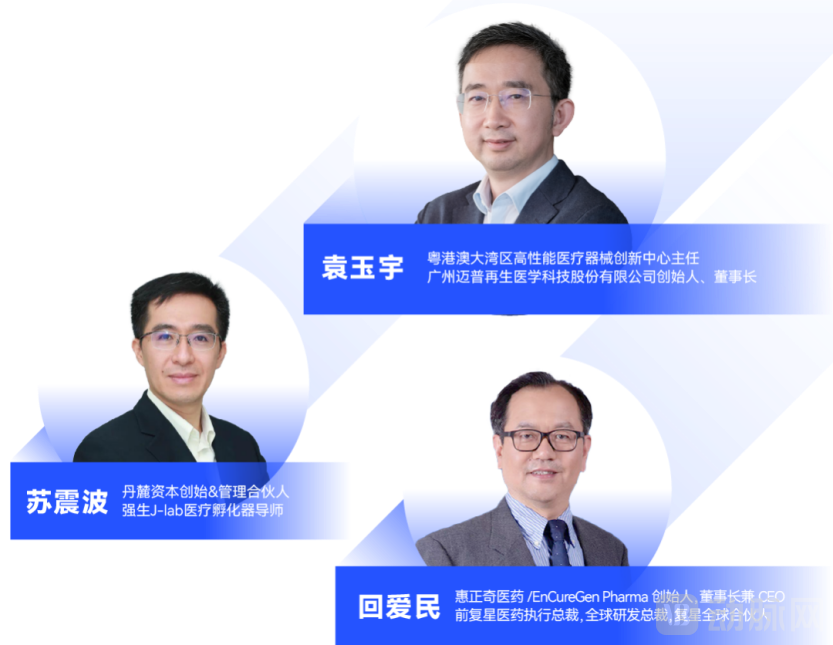
Practical Mentor
Meanwhile, the Landing Plan will also invite senior experts from diverse fields, including clinical institutions, universities and research institutes, investment firms, and industry companies, to provide precise guidance on startup projects from clinical, technical, investment, and industrial perspectives, helping entrepreneurs clarify their strategic thinking. During the program, mentors and innovation partners will form study groups with participants based on specific tracks. They will maintain regular interaction through activities such as mentor consultations, group workshops, and targeted matchmaking sessions, facilitating focused discussions and efficient communication.
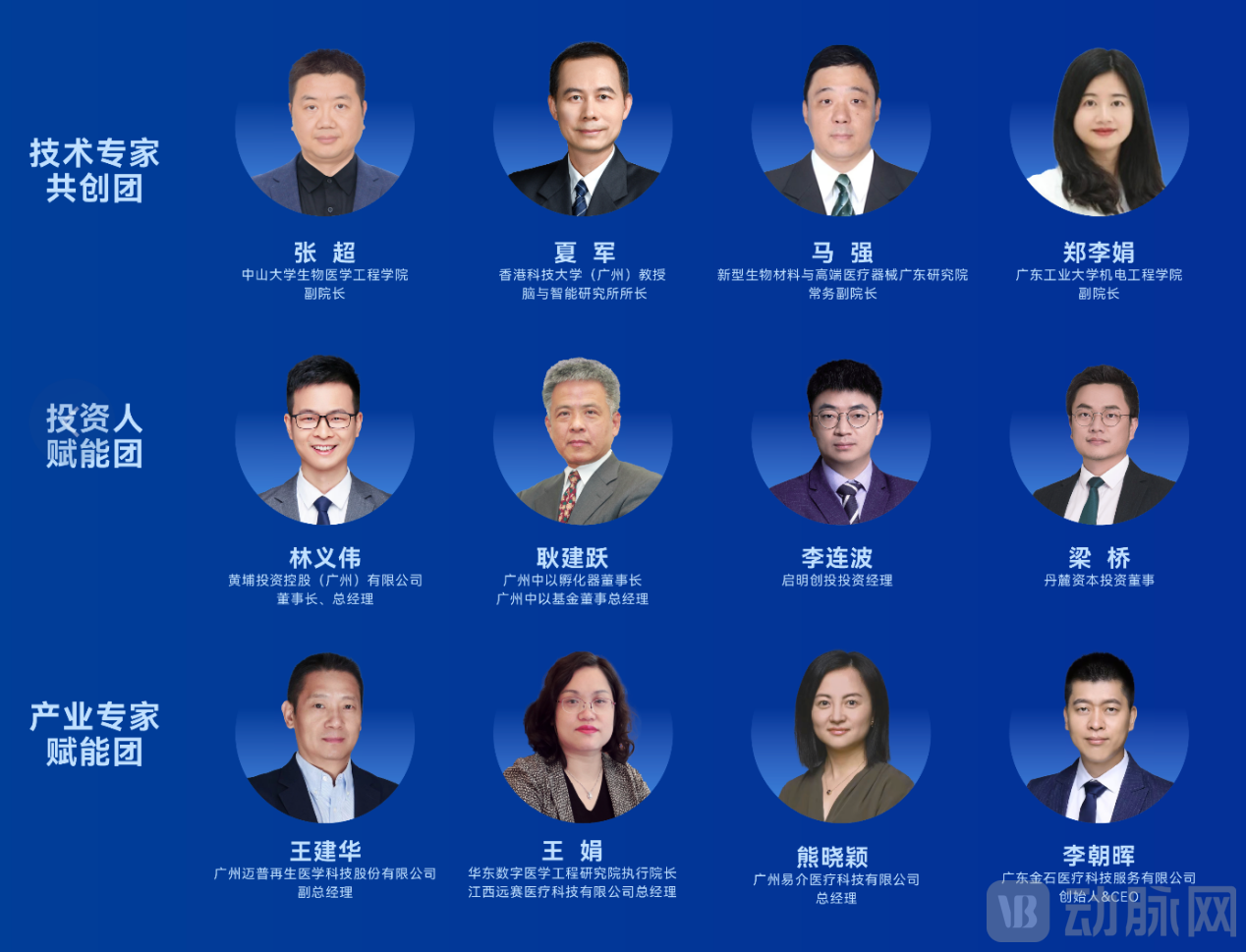
Multidimensional Experts (Partial)
Rigorous Professional Courses Aligned with Key Stages of MedTech Entrepreneurship
The Landing Plan curriculum is designed around the critical stages of medical device entrepreneurship, covering core modules from R&D to industrialization and commercialization. Led by seasoned industry practitioners who integrate real-world case studies into their instruction, the program systematically introduces methodologies for medical device innovation. During the camp, a variety of themed activities, such as the “Clinical Navigation Workstation,” will be held. These sessions invite clinical experts from specialties relevant to each product track to engage deeply in product optimization, offering user-centric insights to help participating projects accurately address genuine clinical needs.
To further drive the implementation of innovations, this landing program will also provide participants with benefits such as angel fund investment opportunities, inaugural innovative membership in the IHM MedTech Planet, specialized thematic consulting, and Planet Scholarships.
Registration Guide
Participating entities or individuals can scan the QR code below to register immediately and complete the application for startup projects. The registration deadline is October 31. You may follow the WeChat Official Account “IHM MedTech Planet” to receive subsequent invitations and event details.


References:
1. “How Are the World’s Top Seven Medical Incubators ‘Supporting’ Startups?” by VCBeat
2. “2023 High-End Medical Device Industry Research Report,” VCBeat
3. “Enhancing Drug Regulatory Capabilities to Effectively Safeguard Public Medication Safety,” Guangming Online