

Candela Files for IPO Amid Leadership in Global Energy-Based Aesthetic Devices

Candela
Medical Aesthetic Device Developer
The winds of change in the medical aesthetics industry have shifted from surgical plastic surgery to non-surgical procedures.
Unlike invasive procedures such as facial plastic surgery and body liposuction, non-surgical medical aesthetics has rapidly emerged as an industry favorite, thanks to its non-invasive or minimally invasive nature and low risk profile.
Based on differing mechanisms, non-surgical medical aesthetics are generally categorized into two major types: injectables and energy-based devices. Injectables achieve facial wrinkle reduction and contouring by administering materials such as hyaluronic acid, botulinum toxin, and collagen. With the advent of biostimulatory agents like poly-L-lactic acid (commonly known as “baby face injections”) and calcium hydroxylapatite fillers (“girl’s needle”), injectable aesthetics have transitioned from an era of mere filling to one of tissue regeneration. Energy-based devices utilize modalities such as lasers, radiofrequency, ultrasound, and intense pulsed light to tighten deep skin layers, remove pigmentation, and resurface the epidermis. Compared with injectables, energy-based treatments offer higher safety profiles and lower risks, gaining increasing favor among consumers.
As a manufacturer of energy-based medical aesthetic devices, Candela has been deeply rooted in the industry for over forty years.
Candela’s co-founder and first CEO was Horace W. Furumoto, a Japanese-American who was born and raised in Hawaii and holds a Ph.D. in Physics from The Ohio State University. He was also the founder of another laser aesthetics company, Cynosure.
In 1970, Dr. Furumoto and another physicist, Harry Ceccon, co-founded Candela in the United States. In its early days, Candela was solely a laser company serving small-scale industrial markets.Candela did not enter the medical field until 1981.。
In 1983, Candela collaborated with Massachusetts General Hospital to develop the SPTL1, the first pulsed dye laser. Approved by the FDA in 1986, it became the gold standard for laser treatment of vascular lesions. Over the following two decades, Candela developed nearly ten energy-based devices and technologies, including Q-switched lasers.
However, Candela’s development was far from smooth. After its founder, Dr. Furumoto, left Candela in 1990 and acquired the company’s non-medical laser business, Candela’s performance declined steadily. By 2008, Candela was on the verge of bankruptcy and began seeking new investors.
In 2009, Syneron, an Israeli manufacturer of aesthetic devices, announced that it would acquire Candela for $65 million., the two companies merged and were renamed Syneron Candela. Following the merger, Syneron Candela developed a range of innovative products, achieving the third-largest global market share. Founded 30 years after Candela, Syneron rapidly expanded on the strength of its proprietary elōs technology, listing on the NASDAQ in 2004 and delisting in 2017.
In 2017, Apax Partners, a UK-based private equity (PE) firm, acquired 100% of Syneron Candela for $400 million., later renamed Candela, known in Chinese as Syneron. In 2018, Candela, having been acquired twice in succession, began to flex its financial muscle by acquiring the Danish medical device company Ellipse, thereby adding Ellipse’s intense pulsed light (IPL) technology, Nordlys Star VII, to its product portfolio.
In 2021, Candela once again applied for an initial public offering on the NASDAQ in the United States, but withdrew its listing plans a year later.
Since entering the energy-based medical device market, Candela has continuously innovated amidst a series of corporate milestones, including initial public offerings and delistings, acquisitions, and the withdrawal of a secondary listing. The company has developed a comprehensive portfolio of products for the treatment of benign vascular and pigmented lesions, wrinkle reduction, acne, leg veins, cellulite, and hair removal, encompassing three core energy modalities: laser, radiofrequency, and ultrasound.Currently, Candela has more than ten products approved by the NMPA, and its products have been sold to over 100 countries and regions worldwide.。
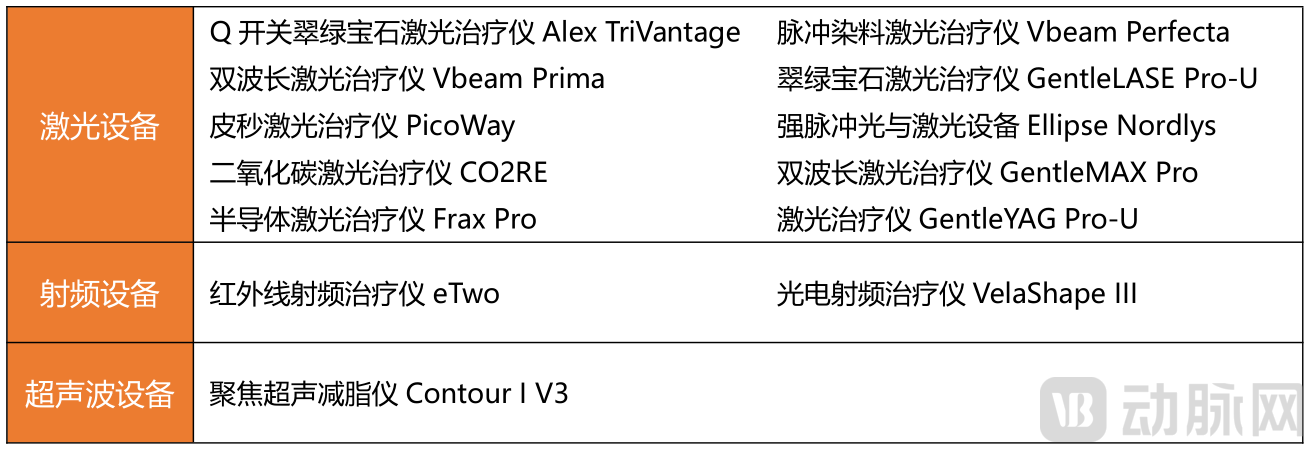
Candela Devices with NMPA Certification
Data Source: NMPA
From the perspective of working principles, different energy source technologies can reach distinct skin layers, thereby achieving various medical aesthetic effects. When energy-based devices act on the epidermis, they can provide anti-inflammatory, antibacterial, acne-clearing, spot-reducing, and skin-brightening benefits; when applied to the dermis, they achieve skin tightening, wrinkle reduction, and stimulation of regeneration; when targeting the subcutaneous fat layer, they facilitate fat reduction and body contouring; and when acting on the SMAS (Superficial Musculoaponeurotic System) fascial layer, they stimulate collagen regeneration to achieve anti-aging effects.
Most light-based devices target the dermis; however, with technological advancements, radiofrequency and ultrasound devices can penetrate deeper into the fascial layer, thereby delivering superior body contouring and skin-tightening effects.
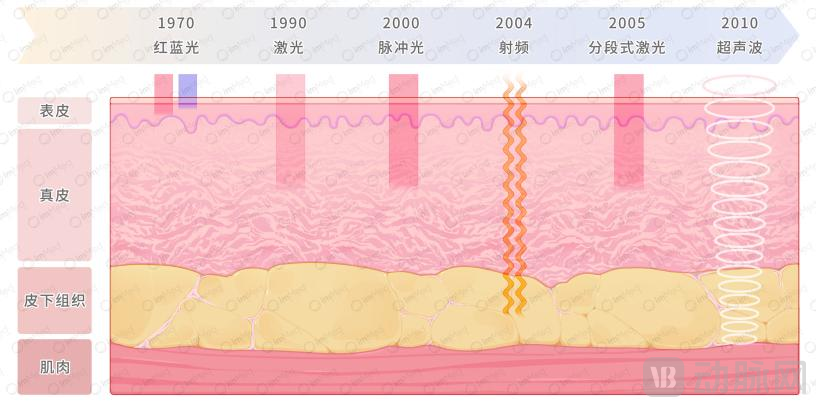
Schematic Diagram of Energy Sources Acting on Different Layers of the Skin | Illustration: Yimu Visual
From the perspective of consumer demand, consumers primarily have four major needs: skin whitening, skin rejuvenation, anti-aging, and body contouring, all of which can be met by energy-based medical aesthetic devices.
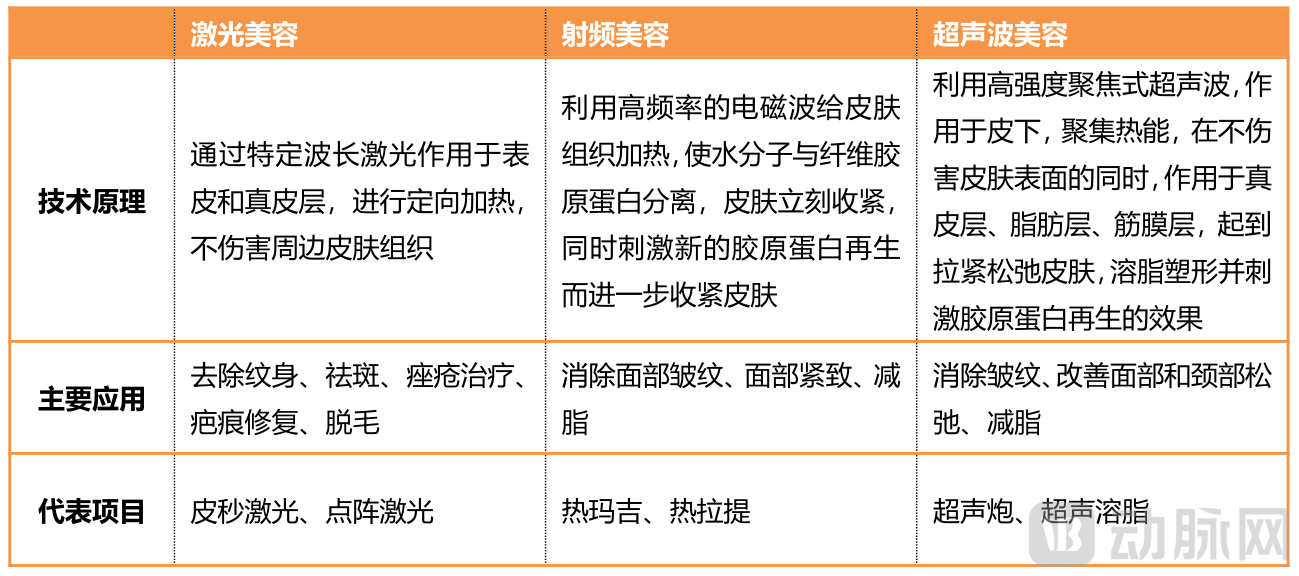
Introduction to Laser, Radiofrequency, and Ultrasound Medical Aesthetic Procedures
1. Laser Aesthetics
Lasers are a form of electromagnetic radiation. Based on laser emission modes, laser-based aesthetic treatments can be categorized into picosecond lasers, fractional lasers, and Q-switched lasers, among others. Picosecond lasers utilizePulse width is in the picosecond range.of the laser output high energy to shatter melanin; fractional laser throughAn array composed of a large number of small laser spotsto emit laser light, which creates multiple microscopic thermal injury zones upon acting on the skin, thereby triggering the skin's self-repair mechanism to facilitate skin regeneration; Q-switched laser refers to the modulation of pulse width, utilizingNanosecond-level pulse widthInstantly emits high-energy laser pulses to shatter melanin.
When classified by the lasing medium, laser cosmetology can be further divided into CO2 laser, dye laser, ruby laser, alexandrite laser, and others.
According to data from VCBeat’s “White Paper on Energy-Based Devices in Medical Aesthetics,”In China’s energy-based medical aesthetics device market, laser medical aesthetics devices constitute the largest subsector of the optoelectronic medical aesthetics device market, accounting for approximately 60% of optoelectronic medical aesthetics procedures.. With mature technology and a diverse product portfolio, laser aesthetic devices are expected to further expand their share of the energy-based device market in the future.
Candela’s product portfolio is dominated by laser-based devices, with approximately ten models accounting for over 50% of the total.
Among these, the Vbeam Perfecta is a pulsed dye laser device that emits pulsed laser energy at a wavelength of 595 nm. This energy penetrates the epidermis and dermis and is absorbed by oxyhemoglobin within blood vessels. Throughout the treatment, the dynamic cooling device (DCD) spray cooling protects the skin, ensuring that cutaneous structural tissues and functions remain unaffected. The Vbeam Perfecta can be used to treat various benign vascular lesions, pigmented lesions, and fresh scars, as well as for skin rejuvenation.
Alex TriVantage is a nanosecond laser device featuring three wavelengths: 755 nm Q-switched alexandrite laser, and 1064 nm and 532 nm Q-switched Nd:YAG lasers. It can remove tattoos of various colors and treat multiple epidermal and subcutaneous pigmented lesions. The 755 nm laser targets light skin to remove green tattoos; the 1064 nm laser targets dark skin to remove blue and black tattoos; and the 532 nm laser targets light skin to remove red, orange, and brown tattoos. In addition, GentleLASE Pro is an alexandrite laser device that utilizes 755 nm laser for hair removal, treatment of superficial benign pigmented lesions, and wrinkle reduction.
The PicoWay picosecond laser system delivers high peak power and picosecond-duration pulses. By adjusting parameters such as wavelength, fluence, repetition rate, and spot size, it can treat a wide range of skin types from light to dark. It is effective for removing black and blue tattoos, treating freckles, and managing benign epidermal pigmented dermatoses.
2. Radiofrequency Aesthetics
Based on the number of electrode tips, radiofrequency (RF) is primarily categorized into monopolar RF, bipolar RF, and multipolar RF. Monopolar RF features one grounded electrode and one electrode in contact with the skin; it delivers higher energy and offers strong penetration, making it suitable for deep-tissue treatments. Bipolar RF consists of two electrodes, one positive and one negative,Compared with monopolar radiofrequency, bipolar radiofrequency delivers lower energy and has a shallower penetration depth, but offers more precise control over the treatment area and higher safety.; As for multipolar radiofrequency, it can essentially be viewed as various combinations of multiple sets of monopolar or bipolar radiofrequency.
In the past three years, China has witnessed a surge in the market launch of radiofrequency medical aesthetic devices. According to the "White Paper on Energy-Based Medical Aesthetic Devices" by VCBeat Research Institute,More than 20 radiofrequency (RF) aesthetic devices have been approved in China, with imported products accounting for over 70% and mostly holding Class III medical device certifications. In contrast, domestic brands primarily focus on the mid-to-low-end market, with most obtaining Class II medical device certifications.。
Both of Candela’s radiofrequency products approved by the NMPA are Class III medical devices.
The eTwo infrared radiofrequency therapy device utilizes bipolar radiofrequency technology and is equipped with two handpieces: Sublime and Sublative. The Sublime handpiece combinesInfrared (IR) Light and Bipolar Radiofrequency Technology, stimulating neocollagenesis to remodel the deep skin and reduce localized wrinkles, with a comfortable and painless treatment process. Sublative willBipolar Radiofrequency and Fractional TechnologyBy combining these mechanisms, it releases heat energy in a fractional pattern to stimulate the production of collagen and elastin, making it suitable for treating atrophic acne scars and reducing local wrinkles. Compared with ablative fractional treatments, Sublative offers higher safety and a shorter recovery period; compared with non-ablative fractional treatments, Sublative provides better efficacy. In addition, Candela has introduced a focused treatment handpiece, Sublative iD, for the eTwo system. This handpiece has a smaller surface area of only 11 mm × 3 mm, enabling targeted treatment of smaller areas such as the perinasal, perioral, and periorbital regions.
Another product that utilizes radiofrequency energy is VelaShape III.This optoelectronic radiofrequency therapy device integrates bipolar radiofrequency, infrared light, negative pressure, and rollers to achieve non-invasive body contouring, cellulite treatment, and improvement of laxity in the body and face.. Specifically, bipolar radiofrequency is used for continuous heating of deep tissues at a depth of 20 mm; infrared radiation is employed for heating superficial tissues at a depth of 3–5 mm; vacuum negative pressure ensures precise energy delivery and enhances circulatory metabolism; and mechanical rollers provide superficial massage to improve comfort.
3. Ultrasonic Beauty Treatment
Ultrasound refers to sound waves with frequencies above 20 kHz, which are inaudible to the human ear. Compared with laser and radiofrequency technologies, focused ultrasound offers two major advantages in anti-aging treatments.First, focused ultrasound offers superior skin penetration, reaching directly to the fascial layer for more significant results in treating skin laxity. Second, it is non-invasive to the epidermis, and the temperature at the treatment points is significantly higher than that of other anti-aging technologies, thereby optimizing collagen remodeling.。
The demand for anti-aging treatments is most pronounced in the medical aesthetics market for middle-aged and elderly consumers, with a primary focus on individuals aged 40 and above. Compared to younger demographics, this older cohort boasts higher and more stable disposable income, greater per-transaction spending power, and stronger sustained consumption capacity, underscoring the significant potential of this market segment.
Focused ultrasound technology was first clinically applied for non-invasive tumor treatment. In the field of medical aesthetics, focused ultrasound can be used not only for anti-aging but also for non-invasive lipolysis.
Candela’s UltraShape V3 (Contour I V3) focused ultrasound fat reduction device utilizes pulsed focused ultrasound technology to selectively and precisely disrupt adipocytes using a specific frequency (200±30 kHz) that has the greatest impact on fat cells, while leaving blood vessels, nerves, and surrounding tissues largely unaffected. The entire process delivers energy in pulses, with temperature changes not exceeding 0.5°C, ensuring no burns or pain. Additionally, the UltraShape V3 features a built-in 3D tracking system to ensure precise and uniform energy coverage across the treatment area.
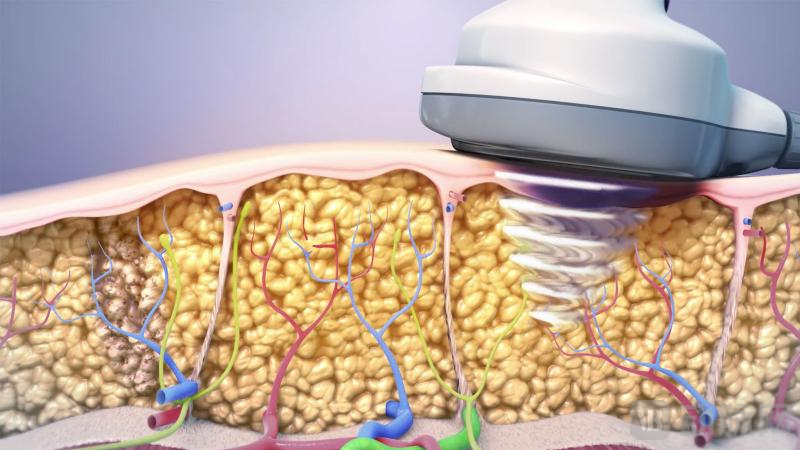
UltraShape V3 Mechanism of Action. Image source: Candela official website
The energy-based device industry in medical aesthetics is a technology-intensive sector characterized by multidisciplinary integration and exceptionally high technical barriers.Due to a shortage of interdisciplinary talent and core technologies, the market for mid-to-high-end energy-based medical aesthetic devices used by licensed medical aesthetic institutions in China is nearly monopolized by overseas manufacturers, with imported brands accounting for over 80% of the total market share in the compliant sector.。
Amid vast market substitution opportunities, an increasing number of enterprises, capital investors, and R&D and management talents are entering the energy-based medical aesthetic device sector. Currently, there are two primary approaches to establishing a presence in this field: mergers and acquisitions, and independent research and development.
Mergers and acquisitions have been primarily driven by leading players in the pharmaceutical and medical device sectors, with imported brands such as High Tech, Alma, Viora, and Sisram being acquired by Chinese enterprises. Meanwhile, domestic companies like Chirui Laser, Keying Laser, GSD, and Fomulaire are intensifying their independent R&D efforts to catch up, allowing domestically produced products to gain momentum. As more industry participants actively engage in the market, technological barriers in energy-based aesthetic medical devices will be broken down, driving a continuous increase in the market share of domestic companies and accelerating the process of import substitution.