

Chongqing's Former Richest Man Moves into Taikang Community, Signaling the Rise of Premium Elder Care in China

Taikang Community
Chain养老机构
Recently,85 years oldYin Mingshan, Former Richest Man in Chongqing and Founder of Lifan GroupHe has moved into a nursing home. According to his secretary, this was Yin Mingshan’s own decision, with the public explanation being that he did not want to burden his children.
Although there are many stories to tell about Yin Mingshan personally and the Lifan Group, these are not the focus of VCBeat. As an observer focused on changes in the healthcare industry, VCBeat would like to take this opportunity to discussThe Elderly Care Industry: “So Close, Yet So Far” from the Public。
Is Elderly Care All About Bustle?
In recent years, with"Aging"The three-character term is constantly mentioned, and an increasing number of people, though not having experienced it firsthand, have come to recognize the severity of this social issue.
According to data from the National Bureau of Statistics, as of the end of 2021,The population aged 60 and above in China reached 267.36 million, accounting for 18.9% of the total population; the population aged 65 and above reached 200.56 million, accounting for 14.2% of the total population.. With reference to the international standard of "14% of the population aged 65 and above," China has entered a stage of deep aging society.
But this is far from over; China’s aging process continues to accelerate. According to Du Peng, Director of the Institute of Gerontology at Renmin University of China, who recently disclosed in a public forum that, influenced by the baby boom of 1963,2023 will be the year with the largest net increase in China’s elderly population, and by 2050, the number of people aged 60 and above in China will grow to nearly 500 million.。
Stimulated by the massive market size, a large number of insurance companies and real estate enterprises have been scrambling to enter the elderly care industry in recent years, even making it a standard part of their business portfolios. Of course, this industrial chain has not only seen familiar players but also many “newcomers.” According to incomplete statistics from the Artery Orange database,Over the past year and a half, a total of 13 elderly care-related startups in China have secured financing in the primary market., among whom are investors includingHillhouse, Changling, Tencentand other top-tier investment institutions.
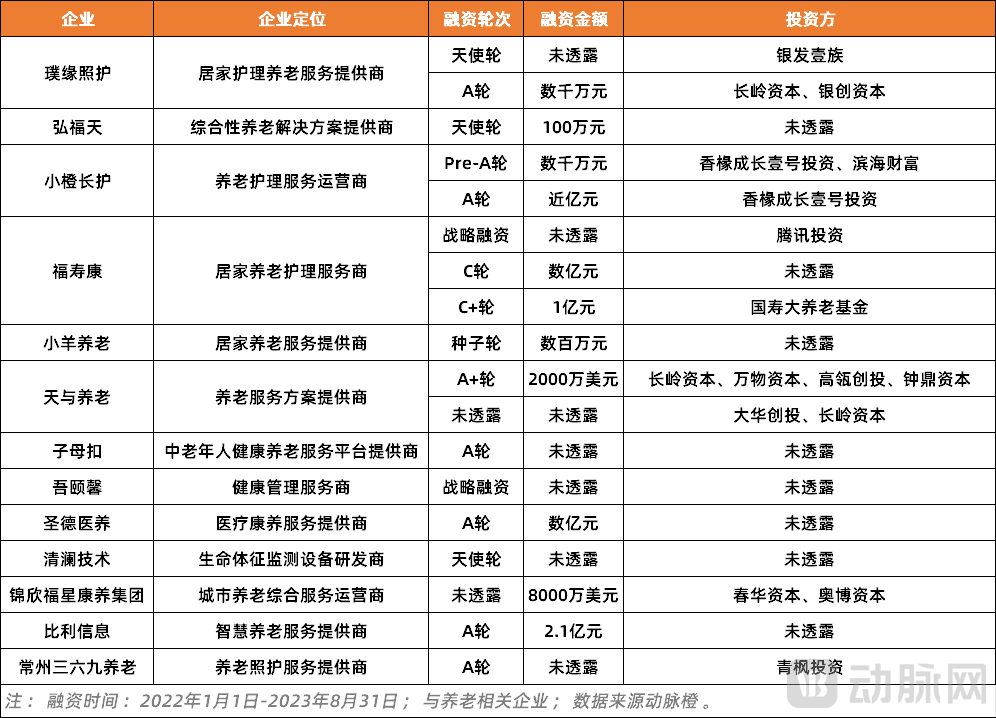 Figure 1. Financing Status of Elderly Care Startups in China from 2022 to August 2023 (Data Source: VCBeat))
Therefore, it is a fact that the elderly care industry is close to us, as everyone is quietly paying attention to the changes in this industry. However, from another perspective, it seems far away from us, mainly referring to its low coverage rate and the immaturity and inconsistency of overall services.
Recently, an article published by New Weekly“Is Saving 3 Million Enough for a Dignified Retirement?”The article has sparked heated discussion within the industry, with two main areas of focus: first, an increasing number of middle-aged individuals, and even young people, are beginning to pay attention to their own retirement planning;Secondly, the high cost of elderly care, according to the investigation,Monthly fees at nursing homes in China's first-tier cities are generally over 10,000 yuan., of course, the monthly fees at some high-end nursing homes range from 50,000 to 100,000 yuan.
This is no exaggeration. Take, for example, Taikang Community Yuyuan in Chongqing, where Yin Mingshan recently moved in.The price for the “Comfortable One-Bedroom Apartment” is RMB 11,720 per month, while the “Cozy Two-Bedroom Apartment” is priced at RMB 19,960., which does not include other additional fees.
But “high cost” is not the most core issue in the elderly care industry., the greatest limitation is actually the weak willingness to pay.. This needs to be examined from two perspectives: on one hand,Traditional Conceptions Have Marginalized Elderly Care Within Household Expenditures, both the elderly and their children are more willing to invest funds in the younger generation. According to survey data, since the pilot launch of the personal pension system last November, 71% of respondents expressed willingness to participate but ultimately did not take action.
Conversely, weak willingness to pay reflects a deficiency in elderly care service capacity.. Bu Jiangyong, founder of Tianyu Pension, stated in a previous interview with VCBeat that, unlike purchasing tangible goods, elderly care is essentially an intangible service,Therefore, if the quality of elderly care services can guarantee "stable expectations," and a certain degree of social consensus is formed through transparent information-sharing mechanisms, the willingness to pay for essential needs can be unlocked at the current stage, thereby achieving healthy growth.Conversely, even if users have sufficient ability to pay in the future, it does not necessarily mean that their willingness to pay will increase.
According to incomplete statistics from CRIC Health & Elderly Care,As of August 2023, among the 30 typical real estate enterprises that have entered the health and elderly care industry, only eight have achieved a bed capacity ranking within the top 50.Among typical real estate enterprises, only China Resources Land and Poly Developments have a bed capacity exceeding 10,000. Vanke and Greentown follow closely behind, with a scale of less than 10,000 beds. Furthermore, among typical real estate enterprises that have never appeared on the list, except for Country Garden and Landsea, whose bed capacities exceed 2,000, the bed scale of other typical real estate enterprises is generally below 2,000, indicating a relatively low market share.
Therefore, from an overall perspective, although population aging in China is an objective reality and the associated market demand genuinely exists, the country’s elderly care industry remains in its early stages of development. Coupled with the relatively low barriers to entry within the sector, how companies can distinguish themselves has become a key issue for success in this high-potential market.
A RMB 10 Trillion Market: Who Can Actually Make Money?
The Qianzhan Industry Research Institute conducted estimates based on historical market data,As of 2022, the market size of China’s elderly care industry reached approximately RMB 9.4 trillion.. According to projections in the White Paper on China’s Elderly Care Industry released by the Chinese Academy of Social Sciences, the scale of China’s elderly care industry will reach RMB 13 trillion by 2030. These two data points mutually corroborate that China’s elderly care industry has rapidly grown into a market worth RMB 10 trillion.
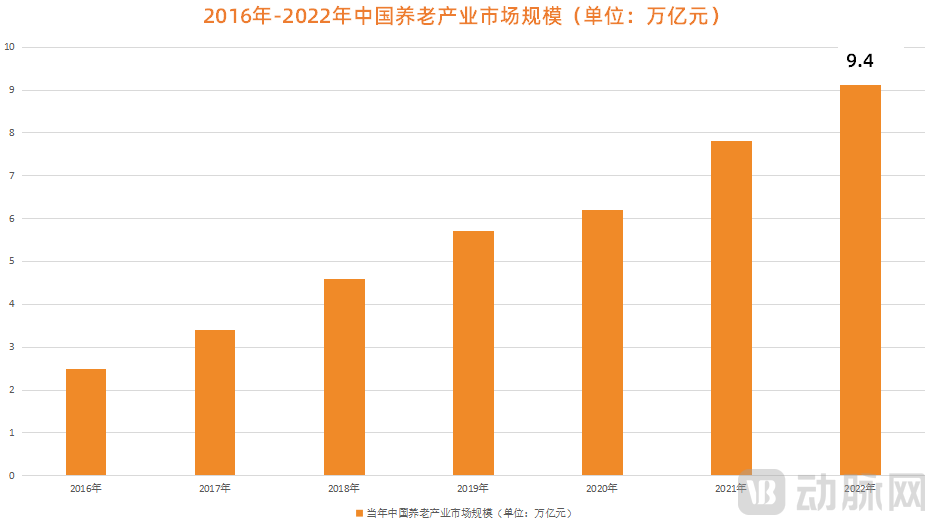
Figure 2. Market Size of China’s Elderly Care Industry, 2016–2022
(Data sources: National Bureau of Statistics, Ministry of Civil Affairs, CCID Consulting, Qianzhan Industry Research Institute)
However, as the market continues to expand, industry competition is also intensifying. According to data from the National Bureau of Statistics,As of the end of 2022, there were nearly 40,000 elderly care institutions across China.. Even so, in 2023, many institutions continued to expand their footprint. Taking Taikang Community as an example, by the end of August, it had established a presence in 35 projects across 31 cities nationwide, with over 9,400 residents. Four additional senior living communities are expected to commence operations this year, pushing the total number of residents beyond 10,000.
This means that the elderly care industry is receiving widespread attention, while market competition is quietly accelerating.. So, what kind of elderly care institutions will take the lead? VCBeat has conducted an analysis on this.
Over the past year or two, across the entire healthcare sector, both entrepreneurs and investors have placed greater emphasis on user needs themselves. This trend certainly applies to the elderly care industry as well, since, in a sense, elderly care possesses certain consumer-oriented attributes, naturally leading to higher expectations for the services provided.
Following this logic,Elderly care services prioritize the physical health of seniors.. Specifically, elderly care institutions should establish a comprehensive medical service chain, including regular health check-ups and timely access to medical consultations, with particular emphasis on common cardiovascular and cerebrovascular diseases among the elderly.
Taking Chongqing Taikang Community Yuyuan, where Yin Mingshan recently moved in, as an example,At the outset of its formal operations, Taikang signed co-construction agreements with Chongqing Songshan Hospital, Sanbo Chang’an and Sanbo Jiangling Hospitals, and Chongqing Kanghua Zhonglian Cardiovascular Hospital., both parties will engage in in-depth cooperation in the field of integrated medical and elderly care in the future.
Certainly, in addition to physical health,The Psychological Needs of the Elderly Are Gradually Expanding. An investor who has long focused on the elderly care industry revealed to VCBeat that currently, in first-tier and coastal cities,It has become a common phenomenon for seniors aged 75 and above to proactively move into nursing homes., the underlying reason is that older adults feel undervalued and unneeded, even perceiving themselves as a burden to their families, resulting in a profound sense of invisibility.
This is not baseless; according to the results of a survey conducted by the Chinese Academy of Sciences,In China, 80% of the elderly population experiences varying degrees of psychological issues. Among those aged 60 and above, approximately 15% suffer from depression, a rate far exceeding the 3.4% prevalence observed in the general adult population.。
Fortunately, this “hidden corner” is being recognized by more elderly care institutions, which have begun to take action. According to observations by VCBeat, many such institutions are not only hiring full-time psychiatrists and collaborating with psychological service providers, but also organizing a series of cultural and recreational activities—such as singing and group exercise routines—to foster greater communication and interaction among older adults, thereby enhancing their sense of belonging.
The final point is to establish a closed-loop system for elderly care services and implement more refined division of labor.. When discussing the reasons for moving into Taikang Community, Yin Mingshan stated in an interview, “Compared to the ‘all-in-one’ approach of a single live-in nanny at home,Taikang Community has implemented a more refined division of labor across all its services, with professionals assigned to every stage., this not only ensures service quality but also significantly enhances efficiency.”
In fact,Current elderly care institutions are rapidly transitioning from providing solely accommodation services in the past to offering comprehensive lifestyle services., thereby meeting the multifaceted needs of older adults in terms of physical health, spiritual and cultural enrichment, and social interaction. Meanwhile, elderly care institutions are placing greater emphasis on enhancing service quality by strengthening standardization, normalization, and specialization, so as to improve service efficiency and satisfaction.
In this process,“Smart Elderly Care,” built on a digital foundation, is beginning to demonstrate greater vitality and has become a new concept fiercely pursued by the current capital market.. Taking specific application scenarios as examples, mobile internet platforms enable online appointment scheduling, consultation, and payment; IoT devices facilitate remote monitoring, positioning, and alarm functions; and artificial intelligence technologies support voice recognition, image recognition, and sentiment analysis. The integration of these new features is making elderly care services more comprehensive and convenient.
In other words, changes in market demand and the integration of numerous digital technologies are stirring the long-stagnant pool of elderly care, unleashing greater potential.It goes beyond the mere concept of providing a space, offering instead a new lifestyle for more seniors that is healthy, warm, and vibrant.。
Nearly Half of Institutions Are in the Red: How to Break Free from the “High Investment, Low Return” Vicious Cycle?
Elderly care is, indeed, a RMB 10 trillion market quietly awaiting an explosive takeoff.However, generating profits from it is not as easy as one might imagine.. It is reported that Vanke Real Estate has been rooted in the elderly care industry for more than 10 years and has laid out 170 elderly care projects across China, but so far, it has hardly made any profit.
In fact, this is not an isolated case. A person in charge of a certain elderly care institution told VCBeat, “Based on current market conditions,Elderly care institutions need an occupancy rate of around 60% to cover their operating costs, yet the average occupancy rate across China remains below 30%, meaning nearly half of such facilities in the country are currently operating at a loss.。”
There are, of course, many reasons behind this. For instance, low market penetration forces elderly care institutions to allocate more funds to market expansion; another factor lies in the inherent characteristics of the elderly care industry, namelyHigh initial investment, long payback period, and high operating costsTake the most typical operating costs as an example. Although digitalization has penetrated various service scenarios, the demand for manual labor remains substantial. Coupled with the prevailing trend of a shortage of talent in the industry, the profit margins of elderly care institutions are further narrowing, thereby intensifying operational pressures.
Therefore, for a senior care institution, enhancing service capabilities and building end-to-end services are naturally crucial. These constitute the “hardware” of the institution, serving as both its industry reputation and foundation.However, beyond this, strengthening the “soft power” centered on operations is also particularly crucial.。
For instance, in marketing, it is essential to cultivate distinct brand characteristics, precisely define user personas, and achieve strong market verticalization.. In fact, achieving this can not only help elderly care institutions rapidly gain prominence but also ensure that marketing budgets are spent where they matter most, avoiding the pitfall of “making hasty and ill-considered decisions in times of crisis.”
And judging from current development trends,High-End Elderly Care Institutions Are Becoming the Mainstream of the Industry, many middle- and high-income individuals, guided by the principle of “more dignified aging,” are flocking to leading elderly care institutions. Taking Taikang Community as an example, according to its Suyuan promotional video,Swimming Pool, Gateball Court, Gym, Dance Studioactivity venues, are all standard features of the Vitality Centers in Taikang Community’s various communities, and are additionally equipped withSenior University, Multi-Purpose Hall, Social, Wellness & Recreation, Cultural & Entertainment, and Gourmet Centerand other carriers.
Additionally, in terms of operational models, it is essential to effectively integrate with one’s own industry ecosystem to create a closed-loop service system and reduce cost expenditures.Exit. The elderly care industry has attracted a multitude of participants, including not only real estate enterprises and insurance companies but also some tech giants. Alibaba, Baidu, and Tencent have all ventured into the elderly care sector; however, in terms of scale, real estate enterprises and insurance companies are evidently the most active players in this industry.
It is reported that, whether real estate enterprises or insurance companies,Strategic entry into the elderly care industry aims to identify a second growth curve; therefore, augmenting existing industrial operations is undoubtedly the most effective operational approach.. withTaikangTaking Taikang as an example, as a leading insurance giant in China, it has integrated life insurance with senior living communities, achieving a closed-loop healthcare ecosystem through its “insurance + medical and elderly care” model. On one hand, Taikang is comprehensively strengthening the insurance payment side, striving to expand its customer base and business scale; on the other hand, it is promoting the development of physical service infrastructure by building top-tier medical and elderly care communities to provide customers with superior solutions. Meanwhile, through the synergy between payers and service providers within this closed loop, Taikang has enhanced overall operational efficiency and service quality, thereby establishing competitive barriers.
The same applies to real estate enterprises. For example,Polyas an example, Poly, as one of the earliest real estate companies to enter the elderly care industry, officially promoted its projects in Beijing, Shanghai, Guangzhou, and other regions in 2011Elderly Care Real Estate Project; In 2012, Poly launched its first elderly care product—the Poly Anping Hexi Club Linyu Senior Living Center—which became a strategic component of Poly’s senior housing real estate business. In 2013, Poly publicly unveiled its first physical model units for senior apartments and promoted age-friendly renovations in 51 communities.
Finally, with regard to channel expansion, elderly care institutions need to collaborate with multiple parties possessing advantageous service resources.. As previously mentioned, elderly care institutions are evolving from a single-service model toward diversification. Consequently, deep integration with related industries such as healthcare, social welfare, and tourism and leisure has become a key development direction for these institutions at the current stage. This approach not only broadens the industrial and value chains but also facilitates resource sharing and complementary advantages.
Therefore, whenever Taikang Community establishes a presence in a new location, it quickly enters into business collaborations with local supporting service institutions.
Final Thoughts
In the movie *The Wandering Earth*, there is a line that leaves a lasting impression, ““At first, no one paid attention to this disaster, until it ultimately became inextricably linked to everyone.””. This statement could not be more apt in describing the current elderly care industry. For many people, aging may seem like a distant concern, but everyone will eventually grow old.
While there is little need for individuals to feel anxious about retirement planning at this stage, for entrepreneurs and investors, now may be the optimal time to make precise, forward-looking strategic moves in anticipation of a vast and foreseeable market.
1. “Real Estate Developers Need to Enhance Operational Capabilities to Seize the Senior Housing Market” — Information Times;
2. “A Post-90s Nursing Home Director Aims to Turn Elderly Care into a ‘Haidilao’ Experience—Would You Move In?” — Mammoth Capital Bureau;
3. “Is Saving 3 Million Yuan Enough for a Dignified Retirement?” — New Weekly;
4. “Tencent Enters the Fray, Just Invested in a ‘Nursing Home’” – Investment Circle.