Baidu Lingyi Zhihui Unveils China's First Industrial-Grade Medical Large Model and Files IPO Prospectus
A few months ago, OpenAI’s GPT series stepped out of the lab, redefining for the world the boundaries of artificial intelligence’s capabilities and sparking a global wave of next-generation AI research and development.
In China, general-purpose models such as Baidu’s Wenxin, Tencent’s Hunyuan, and Alibaba’s Tongyi Qianwen have been launched successively. Many of these models have surged to the forefront globally in terms of intelligence and application potential, proving competitive with Google’s Bard and OpenAI’s ChatGPT.
These general-purpose models are fundamentally similar in nature and can be regarded as the “foundation” of next-generation artificial intelligence. They power a range of consumer-facing applications, yet their capabilities extend far beyond this. The more substantial value lies beneath the surface—deeply penetrating specific scenarios to enable large language models to achieve revolutionary reconstruction at the technical level.
However, building a model that meets professional requirements is no simple task. This is particularly true in the healthcare sector, where vast amounts of big data appear to lie dormant on the surface. Yet, when delving into specific application scenarios, developers remain constrained by data scarcity, often finding their progress stalled by challenges related to data volume, quality, and acquisition costs.
However, Baidu Lingyi Zhihui has successfully taken this step, leveraging its leading position in the field of general-purpose large language models and its profound expertise in medical big data governance. At a press conference held the day before yesterday, Lingyi Zhihui unveiledChina's First Industry-GradeThe “Lingyi Large Medical Model” Provides Answers, Solving Healthcare Challenges in the Era of Large Language Models.
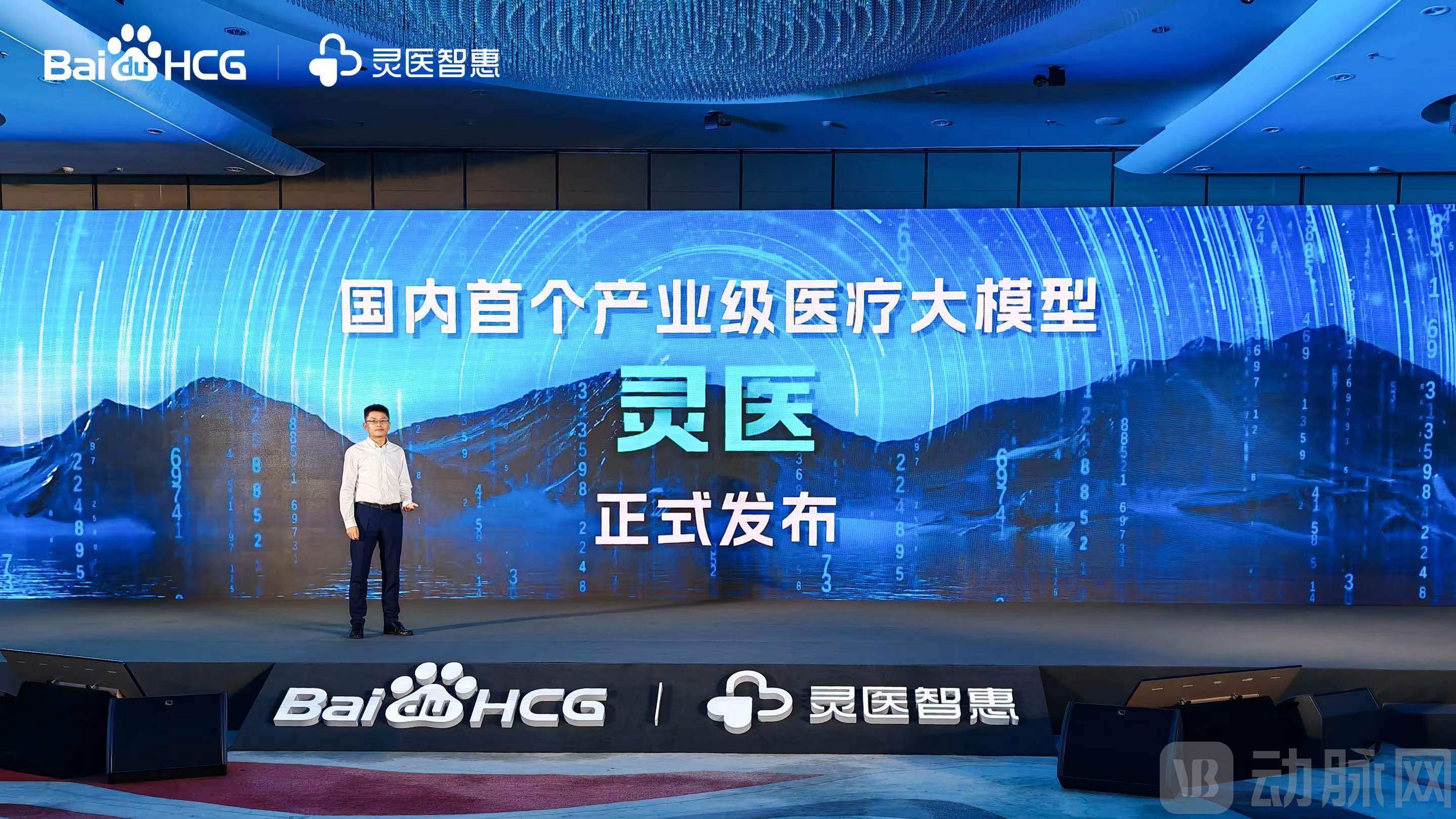
Are Hundreds of Billions of Medical Tokens Merely the Foundation? Lingyi Zhihui “Demonstrates” the Essential Conditions for Building Large Medical Models
How to integrate machine learning with “logical reasoning” is the “holy grail” problem in the field of artificial intelligence. Most approaches have either emphasized reasoning or leaned toward learning, with few attempts truly balancing both to unleash the full potential of AI. It is only with today’s large language models that a deep fusion of vast knowledge and data has been achieved, successfully breaking down the boundaries between reasoning and learning.
However, general-purpose large language models still have limitations in practical applications. A typical issue is that when we ask questions during study or work, AI occasionally provides responses that are completely irrelevant to the query, or buries small amounts of useful information within lengthy texts, requiring us to process the output further.
In such a scenario, consumer-facing (C-end) users might adjust their questioning strategies and re-engage with the artificial intelligence. However, for enterprise-facing (B-end) users, particularly in serious domains like healthcare, a single erroneous response can, at best, erode physicians’ trust and, at worst, compromise patient health, thereby hindering the practical deployment of AI applications. The resulting consequences are beyond what the algorithm itself can bear.
Therefore, the transition from general-purpose domains to the healthcare sector,It is essential not only to evaluate the model’s generalization capability, enabling it to handle diverse queries across various medical scenarios, but also to ensure “precision and safety,” guaranteeing that every response provides users with accurate recommendations.

To meet the demands for high generalizability and high precision, Lingyi Zhihui hasAlgorithms, Computing Power, and DataSimultaneously exerting efforts on all three elements.
First, at the algorithmic level. Vertical models have evolved from general-purpose models, but the process of building general-purpose models is extremely complex and costly. Therefore, when developing large medical language models, most enterprises tend to use open-source foundation models, which often results in generated models with syntactic and logical issues that are incapable of handling complex medical tasks.
In contrast, the Lingyi large model is built on Baidu’s domestically developed ERNIE Bot, boasting unique capabilities in Chinese text reasoning, comprehension, and generation. It incorporates multiple enhancement technologies, including knowledge augmentation, retrieval-augmented generation, and context augmentation, which effectively improve the accuracy and diversity of the model’s outputs.
Next are the data and knowledge layers. During model training, Lingyi Zhihui incorporates information from three key stakeholders—physicians, patients, and pharmaceutical companies. It has leveraged over 10 million high-quality medical Q&A datasets accumulated in-house, more than 20 million multilingual medical literature resources, over 200 million daily user medical search queries, and upwards of 500 million pieces of authoritative health education content. These vast medical training datasets, combined with reinforcement learning from human feedback (RLHF), ensure that every response generated by the Lingyi Large Model is traceable and well-substantiated.
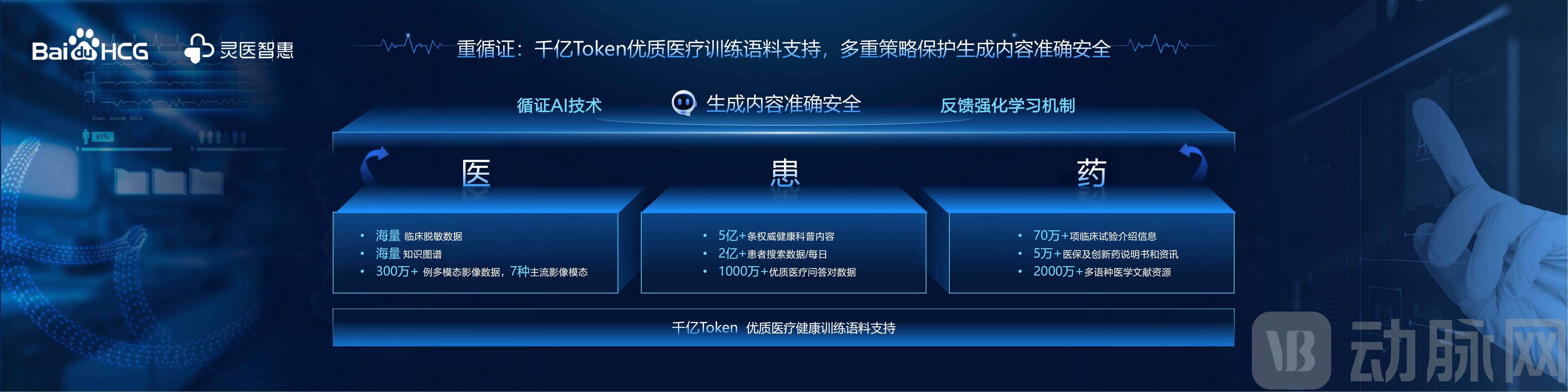
To ensure data accuracy and diversity, Lingyi Zhihui has established deep strategic partnerships with authoritative medical knowledge bases in the industry, such as People’s Medical Publishing House Intelligent Data and Elsevier. These collaborations focus on smart healthcare-related products and services, thereby embedding evidence-based AI into its core foundation. Additionally, Lingyi Zhihui has partnered with Gushengtang and Zero Hypothesis, providing targeted access to over 200 medical institutions, including public hospitals, pharmaceutical and medical device enterprises, internet hospital platforms, and chain pharmacies. Furthermore, the company has deployed numerous R&D personnel to hospitals to explore the deep integration of its models with clinical application scenarios, further refining the usability, accuracy, and safety of its models.
Finally, at the level of computing power. The construction of vertical models requires completingGeneral Pre-training, Domain Post-Pretraining, Task Fine-tuningThis series of technical steps is designed to progressively enhance model performance. However, for large models, each pre-training phase consumes substantial amounts of data and computational resources.
Under cost pressures, many companies developing large medical models can only reduce parameters, keeping them in the range of hundreds of millions to billions, to afford subsequent training and optimization. Alternatively, they skip pre-training altogether and perform only task-specific fine-tuning at the upper layers. However, those with10,000-GPU ClusterandFull Lifecycle ModelThe Lingyi large language model, supported by the development toolchain, requires no concern regarding computational power.
This means that the Lingyi large language model can leverage sufficient computing power to achievePre-training, to better optimize underlying parameters rather than merely performing local fine-tuning. This enables the Lingyi large language model to continuously optimize in real-world applications, driving the accuracy of its outputs ever closer to “1”.
Evaluation results from over 100 physicians with more than a decade of experience at Grade A tertiary hospitals indicate that the Lingyi Large Language Model is capable of handling doctor-patient interactions across various medical scenarios, significantly outperforming other large language models in terms of accuracy, logical coherence, safety, and comprehension.
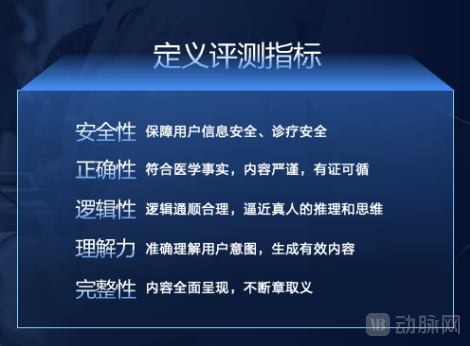
Positioning at the “Industrial Grade”: The Confidence and Capabilities of the Lingyi Large Language Model
"Industrial-grade" refers to the creation of end-to-end large model solutions that transcend the limitations of single scenarios, encompassing the full spectrum of real-world healthcare operations, including clinical diagnosis and treatment, operational management, scientific research, and education and training. Compared with point-based products, linear solutions align more effectively with business workflows, prevent data silos caused by impeded data flow, and ensure user safety, experience, and efficiency.
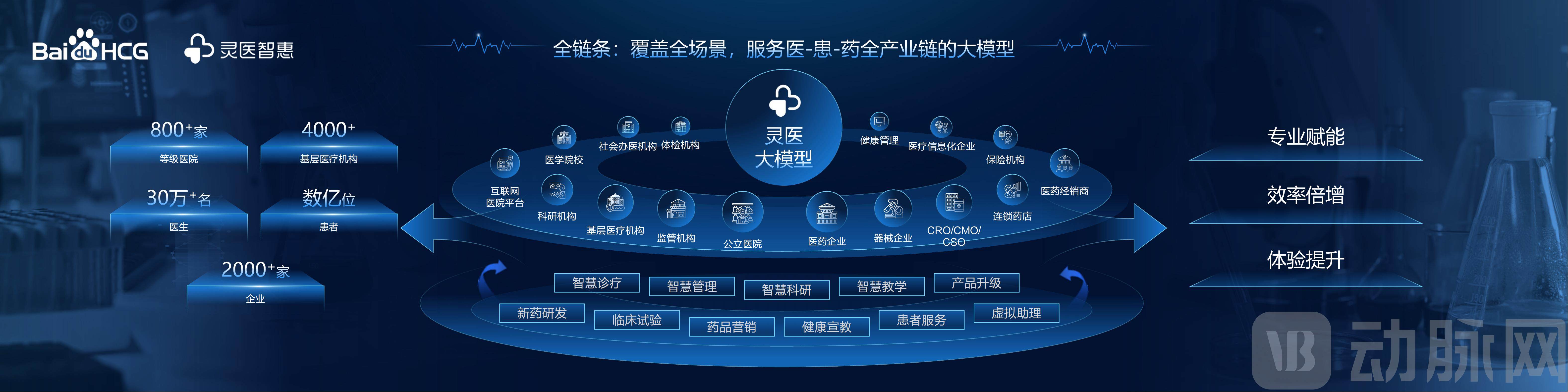
Constructing such a complex product matrix is no simple feat. Beyond technological breakthroughs, the rich “real-world experience” derived from the Lingyi large model is equally critical. As China’s first “industry-grade” large model for the healthcare sector, Lingyi has accumulated capabilities across nearly 100 types of medical AI machine learning tasks, integrating smart healthcare service experience from more than 800 hospitals, 2,000 pharmaceutical companies, and over 4,000 primary care institutions.
Meanwhile, the “industry-grade” positioning also facilitates the commercialization process of the Lingyi large language model. Specifically, Lingyi divides its commercialization pathway into three layers: the capability layer, the model layer, and the application layer.
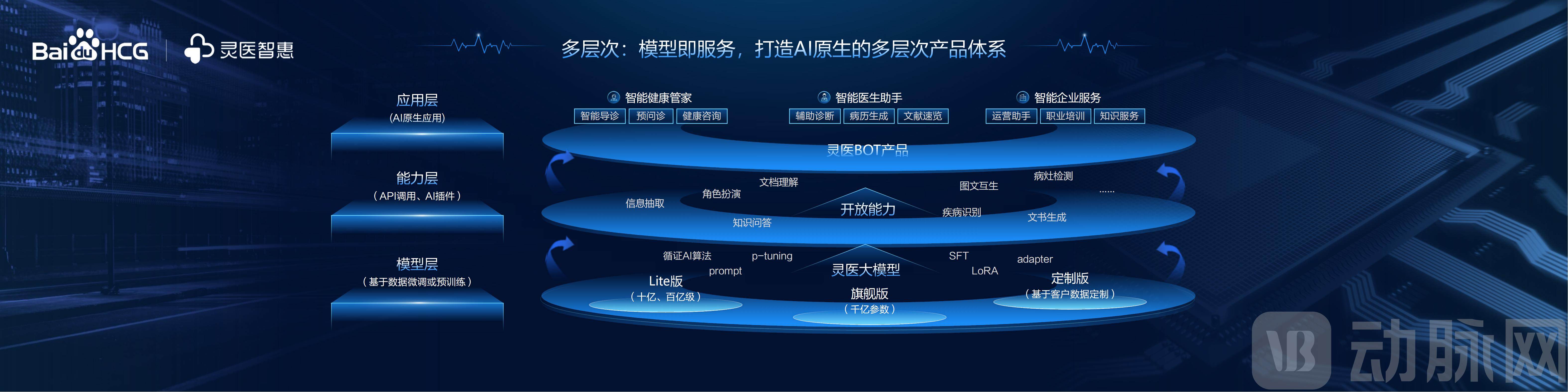
Given the vastness of the healthcare sector, even a company of Baidu’s scale cannot achieve comprehensive coverage across all scenarios. Therefore, a more effective strategy is to build a large-model ecosystem and collaborate with partners to jointly empower the healthcare industry.
Capability LayerThe value lies precisely herein. Lingyi Zhihui primarily focuses onAPIorAI Pluginby providing services in this manner, prioritizing the opening of existing foundational capabilities to partners at this layer, such as document understanding, medical record generation, and medical Q&A. Partners can invoke these capabilities via APIs or embed large model functionalities into their existing product systems through AI plugins, thereby creating AI-native application products and continuously expanding Lingyi’s industrial application scenarios.
Model LayerOffers services based on data fine-tuning or pre-training. As the foundation of the entire architecture, the Lingyi Large Model is available in three versions: Lite, Flagship, and Customized. Among them, the Flagship version, a model with hundreds of billions of parameters, primarily focuses onPublic Cloud Servicesto provide services to a broad user base, achievingOut-of-the-boxeffects, users need not worry about deployment costs.
Lite Edition is designed forHospital clients or clients who place a high priority on private dataModel services provided. As these clients have high privacy requirements and do not need excessive computing resources, this solution supports private deployment. It offers models with parameter scales in the billions and tens of billions, tiered accordingly, to strike a balance between model capabilities and deployment costs.
Finally, there is the customized version, which primarily targets clients with proprietary high-quality data and certain R&D capabilities. It offers customized model training or fine-tuning services for specific scenarios, such as specialized departments and diseases. Research-oriented hospitals and pharmaceutical companies are the main target customers of the customized version.
Application LayerIt provides AI-native applications to end users such as patients, hospitals, and enterprises. As an industry-grade large language model, its service scenarios cover the entire big health industry chain, integrating public hospitals and research institutions, while also providing cutting-edge digital tools for pharmaceutical and medical device companies, internet hospital platforms, and chain pharmacies.
Specifically, these applications currently fall into three major categories: intelligent physician assistants, intelligent health managers, and intelligent enterprise services, thereby addressing the specific needs of “physicians–patients–pharmaceuticals.”
For patients, the Lingyi large language model can serve as a “Health Steward.” Powered by this large model, Lingyi Zhihui’s “AI Medication Guide” not only converts printed package inserts into audio but also provides real-time interpretation of medication-related knowledge for patients. In hospital settings, the “Intelligent Health Steward” enhances user interaction and delivers more accurate Q&A results to assist with patient triage and guidance, while also offering personalized health services based on full-lifecycle medical and health data.

In the broader health and wellness landscape, Lingyi Zhihui emphasizes “professional empowerment” by providing features such as operational assistance, vocational training, and knowledge services. Taking pharmaceutical company services as an example, the Lingyi large language model can help various departments within pharmaceutical enterprises comprehensively enhance production efficiency while intelligently managing the domain-specific knowledge accumulated by the company. Its core approach is to leverage intelligent technologies to reduce various operational costs, thereby facilitating enterprises’ digital transformation.
At the event, Gushengtang, a leading provider of traditional Chinese medicine (TCM) medical services, shared details of its collaboration with the Lingyi large language model. A company representative stated that Gushengtang has leveraged the underlying technological capabilities of the Lingyi LLM to restructure its online consultation services and launched an intelligent health assistant for patients. This assistant provides 24/7 accurate triage and guidance as well as intelligent customer service, supporting open-ended doctor-patient Q&A. According to the latest survey data, since the collaboration began, patient satisfaction with the appointment registration experience has increased by 12%, and the work efficiency of customer service staff has improved by 76%.
From the overall development of vertical-domain large language models (LLMs), LLMs across various industries are primarily focused on improving quality and efficiency, with few enterprises pursuing scenario-based innovation. Reviewing Baidu’s existing product layout, the Lingyi Large Model appears to have adopted a similar approach, leveraging new technologies to reconstruct service capabilities and deeply empower established scenarios.
However, a closer examination of the underlying logic behind Lingyi Zhihui’s product line reveals that it is not merely a redo of outdated industries; in fact, a transformation encompassing the entire landscape of medical applications is brewing.
According to representatives from Lingyi Zhihui, the company can effectively reduce the cost of clinical data governance by leveraging large language models (LLMs), helping hospitals and physicians establish more specialized databases and thereby facilitating the training of intelligent algorithms for specific diseases. Empowered by large models, the development cost of individual AI applications will be significantly reduced, with savings reaching up to 90%.
The development of this capability will bring disruptive changes to the AI industry. Previously, the transition from general-purpose large models to vertical large models progressed slowly, constrained by factors such as the scarcity of medical data and high training costs. Now, supported by its self-developed new technology stack, Baidu has the capacity to govern and automatically analyze multimodal clinical data, optimize various costs incurred during model training and fine-tuning, and thereby trigger a new wave of intelligent applications.
Against this backdrop, we may see more intelligent applications deeply empowering healthcare institutions and even the broader health industry in the future.
Baidu has laid a solid foundation for the road ahead.
The Lingyi Large Model is now officially open for invitation-only testing to enterprise clients. Scan the QR code below to apply quickly.