

Phastar Files IPO Prospectus: A Global Clinical Data Science CRO Powering Drug Development with Over 8 Million Data Sets

Phastar
Medical Data Analysis Service Provider
“Digitalization” has become a widely recognized transformation goal in the field of clinical research.Remote monitoring, online recruitment, private deployment, and intelligent integrated platforms... Digital clinical CROs in China have developed rapidly in recent years, with investment institutions showing considerable enthusiasm, thereby accelerating the rapid advancement and coverage of digital clinical trials in the country.
For pharmaceutical companies, the digital transformation of clinical trials can most directly improve efficiency, reduce costs, and enhance quality. The most significant change following this transformation is the generation of vast and rich datasets. Consequently, issues related to data compliance, utilization, analysis, management, and reuse represent the next frontier for clinical CROs to break through.
Domestic clinical CROs face fierce competition and high barriers to differentiation, while investment and financing activities have yet to recover. Coupled with the growing demand for overseas expansion from innovative pharmaceutical companies, the industry is beginning to worry whether this “bubble” is on the verge of bursting.
Let us therefore leverage “data” as a strategic entry point to examine what overseas clinical data science CROs are doing.
VCBeat recently interviewed Phastar, a UK-based clinical data science CRO founded in 2007.The company has currently established offices in the United Kingdom, the United States, Canada, Australia, Kenya, Japan, India, China, Denmark, and Germany.
Statistician Kevin Kane founded Phastar in 2007. Prior to this, Kevin had nearly 20 years of experience working as a statistician at large multinational pharmaceutical companies such as Amgen, GlaxoSmithKline, and Wellcome, and he was also a former board member of PSI (Pharmaceutical Industry Statisticians).
Building on years of delivering high-quality services and a relentless commitment to excellence, Phastar’s service portfolio now encompasses clinical trial protocol design, regulatory agency communications, statistical analysis and reporting, AI-driven data management, data science oversight, and data visualization analytics and products.
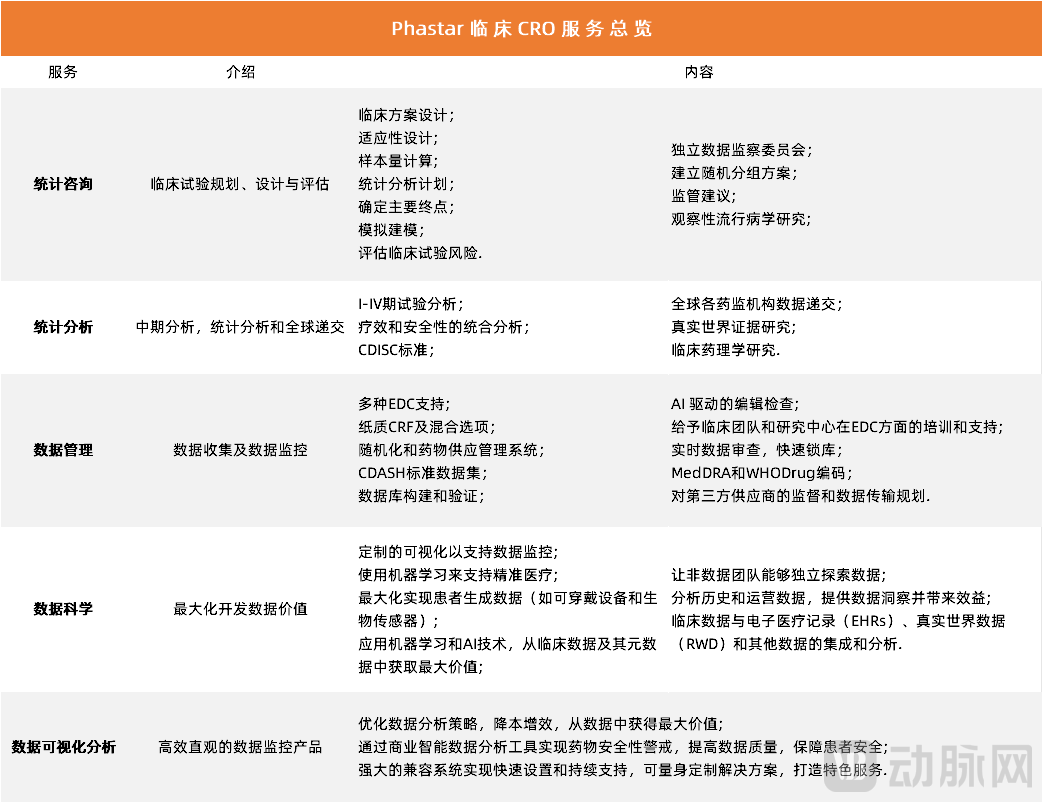
Overview of Phastar’s Clinical CRO Services (Source: Phastar)
Statistical consulting, clinical study reports, and data management services are areas in which most domestic CRO providers have already developed mature capabilities, whileThe concepts of data science regulation and advanced data visualization remain relatively unfamiliar to certain domestic CROs and pharmaceutical companies.。
Clinical Data Science is a multidisciplinary field encompassing statistics, data management, clinical trials, and artificial intelligence. Broadly speaking, within clinical trials, data science drives value creation in three key areas: developing opportunities for data generation, collecting and identifying data, and analyzing data to support clinical decision-making—namely, the “production,” “collection,” and “utilization” of data.
Digitized clinical trials generate data with greater dimensionality, higher frequency, and larger volume. Data obtained through new approaches, such as wearable devices and biosensors, require novel methodologies to interpret the underlying significance. These data acquisition methods shorten sampling intervals, and the pursuit of real-time data analysis imposes higher demands on data management and computational analytical capabilities. The increased dimensionality and volume of data help researchers more accurately understand the true progress of clinical trials, and the rational use of such data can provide critical guidance for trial conduct.
Taking the clinical research of psychotropic drugs as an example, mitigating the psychological effects induced by placebo administration requires consideration across multiple dimensions, including data generation, statistical analysis, and endpoint selection. By employing diverse data collection dimensions and statistical methodologies, the impact of the “placebo effect” on trial outcomes can be minimized as much as possible. Furthermore, selecting the most appropriate clinical endpoints ensures the successful completion of clinical trials and facilitates regulatory approval.
Driven by technological advancements and the increasing adoption rates across the global healthcare ecosystem—including healthcare systems, patients, regulators, and pharmaceutical companies—digital health is expanding rapidly today. The COVID-19 pandemic, coupled with rising smartphone ownership and internet accessibility, as well as greater acceptance of innovative technologies among patients and healthcare professionals, has further accelerated the integration of digital technologies within the healthcare industry.
The U.S. National Institutes of Health (NIH) and the National Institute for Health and Care Excellence (NICE) have recently approved an AI-powered application called Sleepio, which delivers cognitive behavioral therapy (CBT) for insomnia. The use of such applications, which leverage machine learning and AI to provide treatment, diagnosis, and monitoring, has been increasing globally this year.
The Impact of the COVID-19 Pandemic on Clinical Trials: Researchers Have Gained a Tangible Understanding of the Challenges in Centralized Patient Management, While Also Being Inspired to Boldly Explore Remote Monitoring in Clinical Trials. To date, numerous wearable devices and sensors approved by regulatory authorities worldwide have become available for patients participating in clinical trials, enabling the monitoring of drug safety and efficacy outside traditional healthcare settings.
Such devices not only improve patient compliance but also enable real-time recording of medication adherence and other operations through remote monitoring, with timely flagging and alerts for non-compliant behaviors. More portable devices also reduce restrictions on patients’ mobility, thereby ensuring that vital sign data—such as body temperature, heart rate, blood oxygen saturation, and respiratory rate—more closely reflect their actual activity levels, further enhancing the authenticity of clinical trials.
In terms of specific applications, data collection devices must be carefully selected in accordance with the clinical study protocol to ensure accuracy and ease of use, while also safeguarding patient safety and data quality. The challenge in collecting data from wearables and sensors lies in guaranteeing data privacy and security. Furthermore, it is necessary to comply with varying regulatory constraints on data collection and management across different regions, which places high demands on the team’s expertise and experience. Moreover, implementing digital transformation in clinical trials requires collaborative execution by a multidisciplinary team. Statisticians, data managers, data scientists, clinicians, regulatory experts, project managers, and other professionals must all possess a high level of expertise and work together seamlessly.
Phastar boasts a team of seasoned experts that has delivered nearly 100 high-quality clinical research services for over 60,000 patients across 22 therapeutic areas, cumulatively processing more than 8 million sets of clinical data.
Although the digital transformation of clinical research in China is still in its developmental stage, the desire for innovative pipelines to “go global” remains strong.
Excitingly, with the support of the China-UK bilateral fund, Phastar will actively engage in the clinical development of innovative drugs in China. Leveraging its global experience in clinical research and regulatory understanding, as well as its authoritative expertise and skilled application in digital clinical trials, Phastar will help drive domestic innovative drug pipelines toward market approval and international expansion.