

High Demand and Technical Challenges in Soft Tissue Percutaneous Puncture Drive Chinese Companies to Accelerate in the Intelligent Surgical Robotics Race

Würzburg Dynamics
Developer of Precision Safety Diagnosis and Treatment Surgical Robots
Minimally Invasive and Intelligent SurgeryofWaveArrived,Surgical robots are emerging as a prime growth sector in the global healthcare industry.
Looking at the global surgical robotics industry, laparoscopic surgical robots are the most mature, forming a competitive landscape with the da Vinci system as an oligopoly and several Chinese-made systems closely trailing. Specialized robots for orthopedics, neurosurgery, and other fields have also reached relative maturity, with multiple products approved for market launch, presenting a competitive market pattern where domestic and international players vie for dominance.
Looking back at China, with the successive introduction of national industrial policies such as the “14th Five-Year Plan for the Development of the Medical Equipment Industry” and the “Implementation Plan for the ‘Robotics+’ Application Initiative,” the prosperity of the surgical robot sector has continued to rise.
Following the flow of capital, in addition to increasing investments in laparoscopic and orthopedic surgical robotics companies—whose development is maturing and whose competitive landscapes are becoming increasingly clear—institutions are also gradually turning their attention to the nascent soft-tissue percutaneous interventional surgical robotics sector, in search of the next “da Vinci.”
Percutaneous interventional procedures for soft tissues are widely used, with the most prevalent applications in organs such as the lungs, kidneys, and liver.
Lung cancer is one of the most prevalent cancers worldwide, and pulmonary nodules are among the early signs of the disease. Public data indicate that there are approximately 150 million patients with pulmonary nodules in China, meaning that one in every ten people has small pulmonary nodules. Although the majority of these nodules are benign lesions, about 5% are malignant.
The key to early diagnosis and screening of lung cancer lies in the characterization of pulmonary nodules. Currently, for patients requiring biopsy of pulmonary nodules, clinical approaches primarily consist of percutaneous lung puncture and transbronchial needle aspiration, with percutaneous lung puncture being the most widely used.
According toProfessor Xu Jinfu, Department of Respiratory and Critical Care Medicine, Shanghai Pulmonary HospitalIntroduction: Bronchoscopic and percutaneous needle biopsies are the primary methods for confirming the diagnosis of pulmonary diseases. Percutaneous lung biopsy demonstrates significant advantages for peripheral lung lesions, leading to substantial clinical demand; however,Percutaneous lung biopsy is classified as a Level III or IV surgical procedure.High demands are placed on physicians’ experience and supportive medical equipment, yet current medical technology has not yet met the needs of doctors and patients.
Professor Li Jing, Department of Respiratory and Critical Care Medicine, Guangdong Provincial People's HospitalIt was stated that, compared to lesions in fixed locations such as those in orthopedics, percutaneous lung puncture is more challenging. Due to the respiratory motion of the lungs, lesions undergo significant displacement, posing substantial challenges for puncture localization.
Similarly, given the high technical difficulty of percutaneous lung biopsy,Professor Liao Huai, Department of Respiratory and Critical Care Medicine, The First Affiliated Hospital of Sun Yat-sen UniversitywithProfessor Cheng Chao, Department of Thoracic SurgeryIt was also stated that current manual lung biopsy procedures heavily rely on physicians’ experience, requiring strong spatial imagination to construct three-dimensional anatomical structures. The learning curve is steep, and physicians capable of independently performing percutaneous lung biopsies are mostly concentrated in large tertiary hospitals. There is a shortage of senior specialists, hindering the widespread adoption of the technique and leaving substantial unmet clinical demand.
Regarding surgical complexity,Department of Respiratory and Critical Care Medicine, Shanghai Pulmonary HospitalProfessor Bai JiuwuFrankly speaking, the current clinical challenge in percutaneous lung biopsy is that dynamic patient respiration makes lesion localization difficult. Inaccurate positioning often necessitates multiple needle insertions. This is particularly true for small lesions located at challenging angles and in proximity to bones and blood vessels, where uncontrollable respiratory amplitude leads to a significant discrepancy between the planned needle trajectory and the actual needle path. In extreme cases, 2–10 needle adjustments may be required, thereby increasing the patient’s radiation exposure and the risk of complications.According to statistics from the “Chinese Expert Consensus on Percutaneous Needle Biopsy for Thoracic Tumors (2020 Edition),” traditional percutaneous needle biopsy is associated with a relatively high incidence of complications, such as an average pneumothorax rate of approximately 20% and a hemorrhage rate of 7%.
Similarly, safety, precision, and efficiency are also the core clinical demands of percutaneous nephrostomy.
Due to patient respiration, the kidneys are subject to movement, with positional shifts reaching the centimeter level during deep breathing. Given that renal papillae measure less than 0.5 cm in size, performing precise surgery is extremely challenging. Even under general anesthesia with apnea, it remains difficult to control kidney displacement to ensure precise and safe surgical procedures.
Professor Li Xiancheng, Department of Urology, the Second Affiliated Hospital of Dalian Medical UniversityIt was stated that percutaneous nephrolithotomy (PCNL) has a wide range of indications, such as infectious stones, large staghorn calculi exceeding 2 cm, and multiple renal stones, for which PCNL is the only viable treatment option. However, due to the low patient volume, high technical difficulty, and significant risks associated with the procedure in primary care hospitals, physicians often develop an apprehension toward performing it. Consequently, very few doctors have mastered this technique, and those with proficient expertise are exceedingly rare.
Professor Zeng Guohua, The First Affiliated Hospital of Guangzhou Medical University, having performed over 10,000 endourological procedures, is a renowned academic leader in the field. Professor Zeng stated that renal puncture procedures are currently mostly performed under ultrasound guidance; however, percutaneous nephrolithotomy (PCNL) demands extremely high precision. It is difficult for young physicians to achieve accurate localization independently, often requiring 30–40 minutes to successfully complete the puncture, resulting in a steep learning curve. Even for senior experts who perform hundreds of such surgeries annually, guaranteeing successful puncture with a single needle insertion remains challenging.
From a clinical perspective, the demand for percutaneous renal puncture is extensive. Procedures such as percutaneous renal biopsy, renal drainage, percutaneous nephrostomy, percutaneous nephrolithotomy (PCNL), dilation of ureteral strictures, and treatment of renal pelvis and ureteral tumors all rely on percutaneous renal puncture techniques. According to incomplete statistics, for PCNL alone, general tertiary hospitals perform over 500 cases annually, while some leading hospitals even conduct more than 2,000 to 3,000 procedures per year.
Shenzhen WeiDe Precisely Medical Technology Ltd. (“WeiDe Precision”), which completed a RMB 100 million Series A financing round in December 2022, has drawn the attention of VCBeat.

Founded in 2019, this company is dedicated to becoming a global leader in intelligent robotic systems for soft-tissue surgery. It was co-founded by a team of returnee PhDs who previously held positions at globally renowned enterprises and academic institutions in related fields, including Siemens (Germany), Philips (China), the Max Planck Institute (Germany), Heidelberg University (Germany), and the University of Bern (Switzerland).
Dr. Xie Weiguo, the founder, possesses an interdisciplinary educational background in “Medicine + Engineering” and has over 20 years of experience in R&D and industrialization in the field of intelligent robotics. He previously developed a percutaneous (needle-based) ablation robot for liver tumors during his overseas tenure.
Leveraging the influence and appeal of its founding team, the company rapidly assembled a talented workforce spanning medical imaging, artificial intelligence, software and hardware development, and advanced equipment manufacturing.
In less than three years since its establishment, Würzburg Dynamics has efficiently developed robotic systems for percutaneous interventions in the lungs and kidneys, becoming the only company in China to master both intraoperative CT-based and intraoperative ultrasound-based technical pathways for surgical robots.
Traditional needle biopsy heavily relies on the operator’s subjective experience and tactile feedback, making it difficult to establish standardized procedural protocols. Respiratory motion leads to challenges in targeting, reduced accuracy, and a low rate of successful needle placement on the first attempt. Multiple punctures may result in complications such as pneumothorax, pulmonary hemorrhage, hemoptysis, and hemothorax.
Würzburg Dynamics has developed a lung puncture robot, offering a comprehensive high-precision solution for percutaneous lung biopsy procedures. Addressing clinical pain points in soft tissue percutaneous interventions—such as reduced procedural accuracy due to patients’ spontaneous breathing under local anesthesia and the inability of intraoperative imaging to automatically identify target sites in real time—the system’s key highlights include:
Automated 3D reconstruction from CT images in 3 seconds, providing detailed visualization of the anatomical structures of bones, organs, bronchi, blood vessels, and lesions, to precisely plan puncture paths and depths;
Real-time registration of multimodal data, including patient respiratory rate, posture, and dynamics; the near-infrared optical navigation system achieves real-time compensation for respiratory deformation and displacement.
Multi-axis robotic arm automatically reaches the needle insertion point along the planned path with one-click operation, and the guide determines the needle insertion angle;
A closed-loop technology system comprising three core modules delivers a complete, fully automated solution for near-submillimeter high-precision soft-tissue interventional surgery. This system assists clinicians in enhancing surgical precision, safety, and ease of use, while significantly improving operational efficiency and shortening the learning curve.
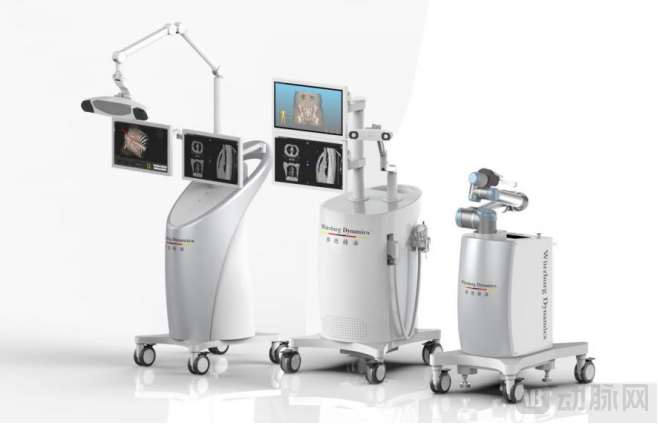
Würzburg Dynamics' Self-Developed Lung Puncture Robot
The pulmonary surgery robot has completed type testing and entered registration clinical trials (in collaboration with renowned hospitals in Shanghai, Guangzhou, Dalian, etc.).
In addition to its robotic system for pulmonary interventional procedures, the Würzburg Dynamics team is also actively exploring the technological integration of “robotics + AI” and “CT + ultrasound,” becoming the first company in China to master both the “CT + ultrasound” dual-pathway approach. It is reported that currentlyThe renal interventional surgery robot has completed prototype development and has begun animal experimental validation.
Würzburg Dynamics Precision Soft Tissue Intelligent Surgical RobotBy employing a tripartite “brain-eye-hand” model, this system assists physicians in performing percutaneous punctures more safely, precisely, intelligently, and efficiently, thereby reducing patient radiation dose and complications while improving surgical efficiency.
The dual-path technology platform not only enables the development of puncture-based products for multiple anatomical sites but also comprehensively expands the platform’s capabilities to explore broader possibilities, with extensive applications such as tumor resection, ablation, and precise drug delivery.
In terms of market strategy, Würzburg Dynamics has implemented a differentiated approach aligned with the global competitive landscape. For the domestic market, the company has established a three-pronged marketing system integrating direct sales, distribution, and partnerships. Leveraging support from top-tier hospitals and renowned principal investigators (PIs) in key disciplines, it is gradually expanding its reach to other hospitals. For international markets, Würzburg Dynamics is leveraging its predecessor, the German company Würzburg Dynamics, as a strategic foothold to penetrate European and American markets, while progressively extending its presence to regions such as the Middle East and Turkey.
In the future, Würzburg Dynamics will expand its intelligent surgical robot technology platform for soft tissues to include organs such as the liver, thyroid, and breast, as well as procedures like ablation and resection localization. This initiative aims to simplify complex surgeries, minimize invasiveness in major operations, and democratize access to medical resources, thereby delivering more precise, minimally invasive, and intelligent treatment solutions to patients worldwide.