

Anagenex Files for IPO: Pioneering AI-Driven Small Molecule Drug Discovery with DEL and Machine Learning

Anagenex
Small Molecule Drug Developer
The application of AI in drug R&D is rapidly gaining momentum, with small-molecule drug development being one of the segments most deeply integrated with AI technology.
DNA-Encoded Library (DEL) is an emerging small-molecule drug screening technology that has been increasingly applied in new drug discovery. This technique employs DNA fragments with specific sequences to encode all molecular building blocks and scaffolds involved in library construction. Through iterative combinatorial synthesis, it rapidly generates millions to hundreds of millions of identifiable compound molecules. By establishing an “information–structure–function” data system on this basis, vast chemical spaces can be explored quickly and cost-effectively.
In light of this, DNA-encoded library (DEL) technology is regarded as a tool that can help pharmaceutical companies identify novel molecules with high druggability, and it has attracted increasing attention from companies in the AI-driven drug discovery sector. For instance, WuXi AppTec has launched its DELopen and DELlight platforms, while Pharmaron and Stones Technology have also established their presence in the DEL field.
Notably, AI-driven drug discovery relies on vast compound databases, and DNA-encoded library (DEL) technology provides precisely the massive chemical structures required. Therefore, integrating DEL technology with AI may bring new breakthroughs to AI-driven drug discovery.
Anagenex, a small-molecule drug discovery company, leverages this approach by combining DNA-encoded library (DEL) technology with machine learning (ML) to realize the vision of identifying drug candidates for each disease in a cost-effective and rapid manner. Their goal is to fundamentally accelerate the traditional drug discovery process through an approach based on combinatorial chemistry, machine learning, and rapid, large-scale iteration. By integrating large-scale experimental data collection with machine learning on a robust data foundation, they aim to make drug discovery faster and more efficient.
Prior to founding Anagenex, Nicolas Tilmans spent much of his career alternating between laboratory work and computer science.
Prior to pursuing his Ph.D., he studied biochemistry and computer science at Stanford University. During this time, Nicolas contributed to the development of DNA-Encoded Library (DEL) technology, which increased the throughput of early-stage drug discovery by 1,000-fold. After graduation, Nicolas worked as a data scientist in the industry, eventually becoming the Vice President of Engineering at a machine learning company specializing in patient data.
Drawing on years of accumulation and reflection in the fields of computational science and experimental chemistry, Nicolas sought to break down the boundaries between computational and experimental sciences, laying the groundwork for the later founding of Anagenex. In 2019, Anagenex was established, with Nicolas Tilmans serving as the company’s CEO.
In 2022, the Company invited Ryan Kruger to join the team as Chief Scientific Officer. With 18 years of experience in the pharmaceutical and biotechnology sectors, including 15 years at GSK, Mr. Kruger served as Vice President of the Cancer Epigenetics Research Department within the Oncology R&D Division, where he contributed to the discovery and development of industry-leading epigenetic assets.
During his tenure at GSK, Ryan led the research department in launching six novel small-molecule therapies, overseeing the entire process from discovery through Investigational New Drug (IND) application to clinical development. Ryan’s academic background in biochemistry, combined with his industry experience, enabled him to identify the most promising therapeutic targets and accelerate candidate drugs into clinical development to help patients in need.
Furthermore, Joe Franklin, Senior Vice President of Early Discovery at the company, is an accomplished leader in the field of DNA-encoded library (DEL) chemistry, with 15 years of experience in leadership and working within DEL teams. His entrepreneurial drive and extensive accumulated expertise in the DEL domain have also made Anagenex one of the most innovative DEL teams in the biotechnology sector.
Based on its core philosophy and team capabilities, Anagenex announced in June 2022 the completion of a $30 million Series A financing round. The funds from this round are designated for expanding the company’s innovative data generation platform and leveraging it to develop a pipeline of projects aimed at addressing challenging unmet medical needs.
Nicolas Tilmans believes that small-molecule drugs consistently constitute the majority of medications approved by the U.S. Food and Drug Administration (FDA), underscoring their irreplaceable and significant role. For most patients, small-molecule drugs remain the optimal and most cost-effective therapeutic option. However, the development of small-molecule drugs continues to pose substantial challenges.
For a long time, experimental methods have dominated biological research. As the study of biological systems becomes increasingly complex, reliance on computational methods has grown stronger. In the future, the integration of “dry” (computational) and “wet” (experimental) approaches will become the prevailing trend in biological research, enabling the resolution of more biological challenges, particularly in drug design.
Anagenex combines ultra-high-throughput biochemistry with machine learning to accelerate drug discovery and uncover new therapies for challenging diseases. “We believe that leveraging the high-throughput compound libraries of DNA-encoded libraries (DELs), along with the core strengths of machine learning in processing large volumes of data, will enable us to stand out among AI-driven pharmaceutical companies by identifying novel chemical entities more quickly and reliably,” said Nicolas.
DNA-encoded library (DEL) technology can provide a vast number of chemical compounds. Machine learning can overcome the limitations of DEL compounds by creating a fully integrated platform that combines computational experiments with wet-lab work. This synergistic feedback loop between dry and wet labs facilitates the identification of target compounds for more refractory diseases and enables effective optimization of these molecules into clinically successful drugs.
“We focus on how to leverage computational software platforms to meet laboratory needs, making the research process more efficient, productive, and enjoyable. Laboratories and computational science can become true partners, trusting each other and making each other stronger,” said Nicolas.
Traditional drug discovery is typically a lengthy and capital-intensive process. From the moment a disease-causing protein is identified, it usually takes 25 years for patients to gain access to the resulting medication. This pace is too slow; patients simply cannot afford to wait.
The rapid advancement of AI technology has brought new surprises to drug discovery, but significant obstacles remain before it can be truly implemented in practice. A major challenge in AI-guided drug discovery is the issue of data; current datasets are too small to support the continuous learning and iteration of artificial intelligence systems.
Inspired by evolutionary theory, Anagenex has established a closed-loop iterative system that creates an alternating cycle between large-scale laboratory experiments and next-generation machine learning-driven predictions. This approach facilitates the generation of higher-quality data to guide small-molecule drug discovery, thereby enabling faster and more effective delivery of novel small-molecule therapies to patients.
AnagenexLeveraging a novel ML-directed evolution platform that integrates large-scale data generation with machine learning to empower small-molecule drug discovery. This closed-loop iterative system enables parallel evaluation of up to billions of custom-synthesized compounds, generating large-scale, high-quality datasets to guide the next generation of small-molecule drug discovery.
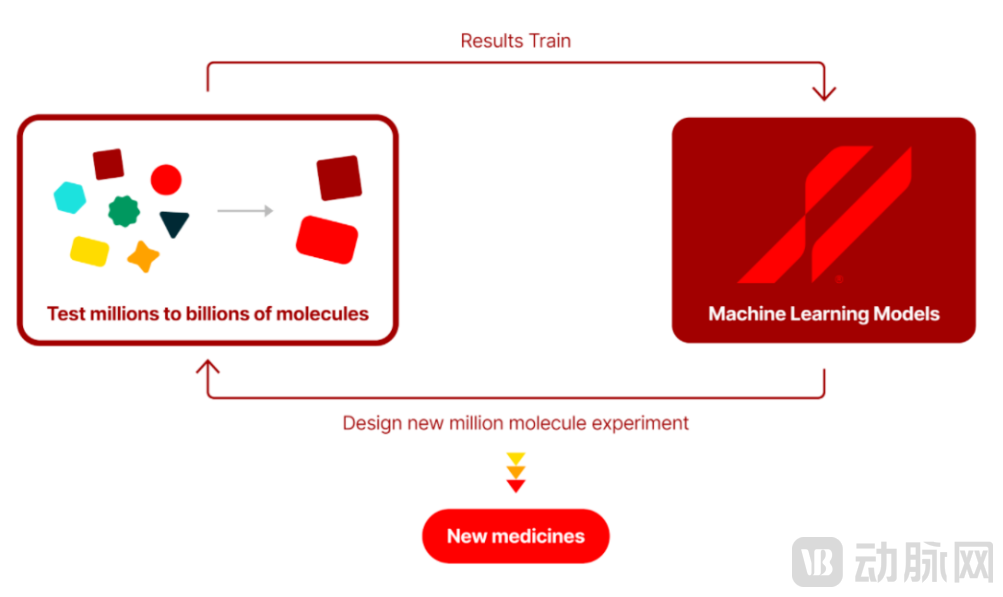
First, the company leverages DNA-encoded library (DEL) and affinity selection-mass spectrometry (ASMS) technologies to conduct parallel experimental testing on billions of compounds, thereby identifying key protein “targets” that may play a regulatory role in certain diseases. For any selected target, the company performs dozens of experiments at the scale of billions of compounds, generating rich, high-quality datasets.
Next, these measurements are fed into proprietary machine learning (ML) algorithms to guide the design of new experiments involving tens of billions of compounds. Meanwhile, the algorithm considers not only experimental results but also hundreds of billions of additional data points from internal databases. In other words, the ML model can leverage iterative data cycles to design next-generation compounds that “evolve” through repeated training.
Finally, the designed compounds will be synthesized and tested by Anagenex. These three steps form a virtuous cycle in which real-world data is used to refine ML models; each iteration generates higher-quality data, continuously improving AI predictions, accelerating and enhancing the efficiency of drug discovery, enabling the faster identification of more small-molecule drugs, and providing patients with a broader range of therapeutic options.
It is understood that Anagenex has established a customized parallel biochemistry laboratory, miniaturizing and automating every step of the aforementioned process. This enables Anagenex to rapidly generate high-quality data, and by leveraging machine learning (ML) algorithms, the company has gained an unprecedentedly clear view of chemical space. Reportedly, Anagenex is currently developing multiple high-value targets across various therapeutic areas, including oncology, inflammatory diseases, musculoskeletal disorders, and cardiovascular medicine.
By integrating machine learning with large-scale biochemical tools, Anagenex has achieved a more effective and high-throughput approach to compound analysis. Anagenex’s technology holds promise for establishing an efficient drug discovery pipeline, delivering beneficial impact across numerous disease areas.
As new chemical methods and computational tools become increasingly integrated, the combination of dry-lab and wet-lab approaches is set to become the norm in drug development, with Anagenex leading the transformation in next-generation small-molecule drug discovery.