

Alzheimer's Early Diagnosis and Screening Emerges as the New Hotspot in Biotech
When it comes to the hottest topics in biomedicine today, GLP-1 weight-loss drugs rank first, with Alzheimer’s disease likely coming in a close second.
In late August, Tonghua Jinma, a domestic manufacturer of proprietary Chinese medicines, announced the completion of the blinded data review for the Phase III clinical trial of Amber Octahydroacridine Tablets for the treatment of Alzheimer’s disease. This marks the fastest-progressing new drug for Alzheimer’s disease in China since Green Valley Pharmaceutical’s Sodium Oligomannate Capsules. Following the announcement, the secondary market reacted with enthusiasm, and Tonghua Jinma’s stock price hit the daily upper limit eight times in subsequent trading sessions.
Meanwhile, early diagnosis and screening for Alzheimer’s disease have emerged as a new strategic focus for clinical diagnostics companies. Over the past few months, domestic and international enterprises such as Danaher and Hotgen Biotech have flocked into the Alzheimer’s disease testing arena, bringing substantial capital and innovative teams along with them. This influx has made early diagnosis and screening for Alzheimer’s disease the most dynamic highlight in the biotechnology sector in 2023.
The Landscape of Diagnosis and Treatment for Alzheimer’s Disease Is Undergoing a Quiet Transformation.
Treating Alzheimer’s disease has long been a fortress that multinational pharmaceutical companies worldwide have strived to conquer, as it represents a lucrative market.
According to a 2021 study by the Alzheimer’s Association, there are 3.5 million new cases of Alzheimer’s disease worldwide each year. In China, data from the Seventh National Population Census showed that as of November 1, 2020, the population aged 60 and above reached 264.02 million. Another statistical dataset indicated that in 2020, approximately 9.83 million individuals aged 60 and older in China were living with Alzheimer’s disease, meaning roughly one in every 27 elderly people aged 60 or above was affected by the condition.
For three decades, no new Alzheimer’s disease drug was approved for market launch worldwide. Data show that between 2000 and 2017, more than 300 clinical-stage Alzheimer’s drug candidates failed globally, with a failure rate as high as 99.6%. Major pharmaceutical companies such as Biogen, Novartis, and Eli Lilly have spent tens of billions of dollars, repeatedly suffering setbacks in this field. In March 2023, Eli Lilly abandoned Solanezumab, which had been under development for over two decades, due to insufficient clinical evidence demonstrating its ability to clear or prevent the accumulation of amyloid-beta (Aβ) plaques and slow cognitive decline in patients with early-stage Alzheimer’s disease. A year earlier, on November 14, Roche also announced the failure of Phase III clinical trials for its investigational Alzheimer’s drug, Gantenerumab.
The turning point emerged around 2020. In 2019, the domestically produced sodium oligomannate capsules received approval for market launch, marking the commencement of commercialization for a specific therapeutic agent for Alzheimer’s disease. To date, three new drugs capable of effectively slowing disease progression in patients with Alzheimer’s disease have been introduced globally. However, existing clinical data indicate that the efficacy and safety profiles of these novel Alzheimer’s therapeutics are primarily established for patients in the early stages of the disease.
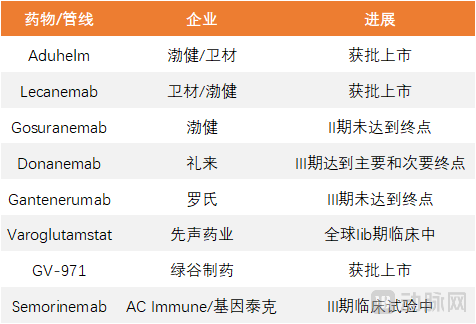
Progress in the Development of Specific Drugs for Alzheimer’s Disease Data Source: Artery Orange Database
In June 2021, Aduhelm, a beta-amyloid antibody developed by Biogen, was approved for marketing to treat patients with early-stage Alzheimer’s disease. This marks the first new drug approved by the FDA for the treatment of Alzheimer’s disease since 2003.
Since its market launch, the efficacy and safety of Aduhelm have remained controversial. Upon initial approval, the FDA required Biogen to conduct Phase 4 studies to confirm the drug’s clinical benefits. Aduhelm’s commercial performance has been underwhelming. According to Biogen’s 2022 financial report, Aduhelm generated $4.8 million in revenue, representing a 60% year-over-year increase, yet it remains a lackluster component of Biogen’s product pipeline.
Aduhelm’s lackluster commercial performance has not dampened multinational pharmaceutical companies’ interest in the commercialization of new Alzheimer’s disease drugs. By 2023, the market for new Alzheimer’s therapeutics had gradually become more vibrant.
On July 6, Leqembi, an Alzheimer’s disease treatment developed by Eisai and Biogen, received FDA approval for market launch. This time, the FDA did not require Eisai and Biogen to conduct further clinical studies prior to launch, indicating a high level of confidence in Leqembi’s safety and efficacy. However, Leqembi remains indicated only for patients with early-stage Alzheimer’s disease.
Just over 10 days later, Eli Lilly also announced that it had submitted a marketing application to the FDA for its new Alzheimer’s drug, donanemab, with the FDA expected to make a decision by the end of 2023. Similarly, donanemab is also targeted at patients in the early stages of Alzheimer’s disease.
In May 2023, Eli Lilly released data showing that Donanemab slowed the rate of cognitive and functional decline by 35% over 18 months in certain patients with early-stage Alzheimer’s disease. In contrast, Phase 3 pivotal clinical trial data for Leqembi demonstrated a 27% reduction in the rate of cognitive and functional decline over the same period. Leqembi is administered once every two weeks, while Donanemab is given once every four weeks. Many observers have speculated that if Donanemab receives regulatory approval, it will disrupt the Alzheimer’s market recently captured by Eisai and Biogen.
In the pre-approval studies of Leqembi, early-stage Alzheimer’s disease was clearly defined as mild cognitive impairment or mild dementia with confirmed amyloid plaques in the brain. Patients with late-stage Alzheimer’s disease may not benefit from Leqembi and could even face greater safety risks.
Against this backdrop, identifying patients with early-stage Alzheimer’s disease has emerged as a new challenge, sparking heightened activity in the market for early diagnosis and screening of Alzheimer’s disease.
Traditionally, early diagnosis and screening for Alzheimer’s disease were not practiced. During the era when no effective treatments were available for Alzheimer’s disease, early diagnosis and screening held no clinical value. Objectively, conventional diagnostic tools were also incapable of identifying patients in the early stages of Alzheimer’s disease.
Therefore, the currently booming market for early screening of Alzheimer’s disease is, in fact, proceeding by trial and error.
On one hand, the field of early diagnosis and screening for Alzheimer’s disease has received significant support from a global industry leader. In July 2023, Beckman Coulter, a subsidiary of the global IVD giant Danaher, announced a collaboration with Fujirebio, a long-established Japanese leader in medical diagnostics, to jointly develop new biomarkers for Alzheimer’s disease and other neurodegenerative disorders. Prior to this, key strategic moves by multinational corporations in the realm of Alzheimer’s disease were predominantly focused on treatment. This initiative marks the first major step taken by global giants into the early diagnosis and screening segment for Alzheimer’s disease.
Danaher’s collaboration with Fujirebio primarily aims to replace cerebrospinal fluid (CSF) with blood-based testing for Alzheimer’s disease screening. This development holds significant importance for the early diagnosis and screening of Alzheimer’s disease. In clinical practice, apart from brief cognitive assessments, neuroimaging and cerebrospinal fluid (CSF) analysis are commonly used to diagnose Alzheimer’s disease.
Specifically, neuroimaging examinations, primarily head CT and MRI scans, are used to detect cerebral cortical atrophy but have limited sensitivity for early-stage Alzheimer’s disease. Cerebrospinal fluid (CSF) analysis can directly reflect pathological changes in brain tissue and enable the detection of Alzheimer’s disease prior to abnormalities visible on medical imaging. However, the invasive nature of the CSF sampling procedure makes it unacceptable to many individuals.
Fujirebio has been at the forefront of biomarker development for neurodegenerative diseases, establishing a comprehensive biomarker portfolio. In 2022, Fujirebio’s cerebrospinal fluid (CSF)-based Aβ42/Aβ40 ratio assay received a new classification from the U.S. Food and Drug Administration (FDA). Prior to this, the Aβ42/Aβ40 ratio had already been widely used by clinicians in Europe and the United States to screen patients suspected of having Alzheimer’s disease. The development of blood-based Aβ42/Aβ40 ratio assays will undoubtedly further accelerate market penetration of this screening approach.
On the other hand, global innovations in early diagnosis and screening for Alzheimer’s disease are reaching a crescendo.
In September alone, China’s field of early diagnosis and screening for Alzheimer’s disease achieved multiple breakthroughs from zero to one.
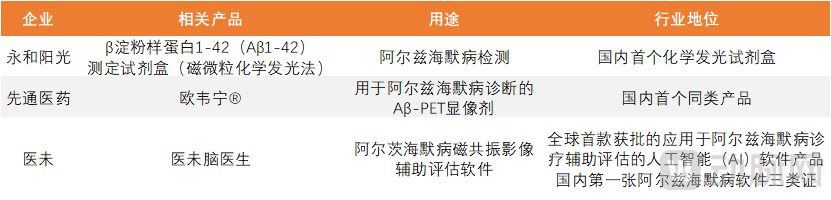
New Breakthroughs in the Early Diagnosis and Screening of Alzheimer’s Disease in China | Data Source: Arterial Orange Database
In early September, Yonghe Sunshine’s Alzheimer’s disease detection product, the β-Amyloid 1-42 (Aβ1-42) Assay Kit (Magnetic Particle Chemiluminescence Method), also obtained a medical device registration certificate. This is the first chemiluminescence assay kit for Alzheimer’s disease detection in China.
On September 15, Xiantong Medicine’s product Ouweining® (Florbetaben [18F] Injection) received marketing approval from the National Medical Products Administration (NMPA). This is the first Aβ-PET imaging agent approved in China for the diagnosis of Alzheimer’s disease, enabling early, precise, and non-invasive AD diagnosis. Ouweining® is used for brain positron emission tomography (PET) imaging to diagnose Alzheimer’s disease (AD), facilitate differential diagnosis, and assess treatment efficacy by measuring the level of beta-amyloid plaque deposition in the brain.
By late September, “Yiwei Brain Doctor,” the world’s first MRI-based auxiliary assessment software specifically designed for Alzheimer’s disease (AD) and developed by Yiwei (Yiwei) Medical, officially received a Class III medical device registration certificate from the National Medical Products Administration (NMPA). This marks the first globally approved artificial intelligence (AI) software product for auxiliary assessment in AD diagnosis and treatment, as well as China’s first Class III certification for an AD-related software. In prior clinical validations, Yiwei Brain Doctor demonstrated both sensitivity and specificity exceeding 90% in independent diagnoses, showing a substantial advantage over the diagnostic performance of general physicians.
Furthermore, Haosi Biotech has independently developed an exclusive early-detection product for Alzheimer’s disease (AD), capable of identifying AD and accurately staging the disease prior to the onset of clinical symptoms. This enables the timely formulation of individualized treatment plans based on disease stage, with precise adjustments made through real-time monitoring. Lanyu Biotechnology’s three-panel dementia test (Aβ1-42/p-Tau-181/AD7c-NTP), as a non-invasive diagnostic tool, provides a critical window of opportunity for early diagnosis and early intervention in AD. The involvement of various innovative forces will undoubtedly accelerate the rapid maturation of the ecosystem for early diagnosis and screening of Alzheimer’s disease.
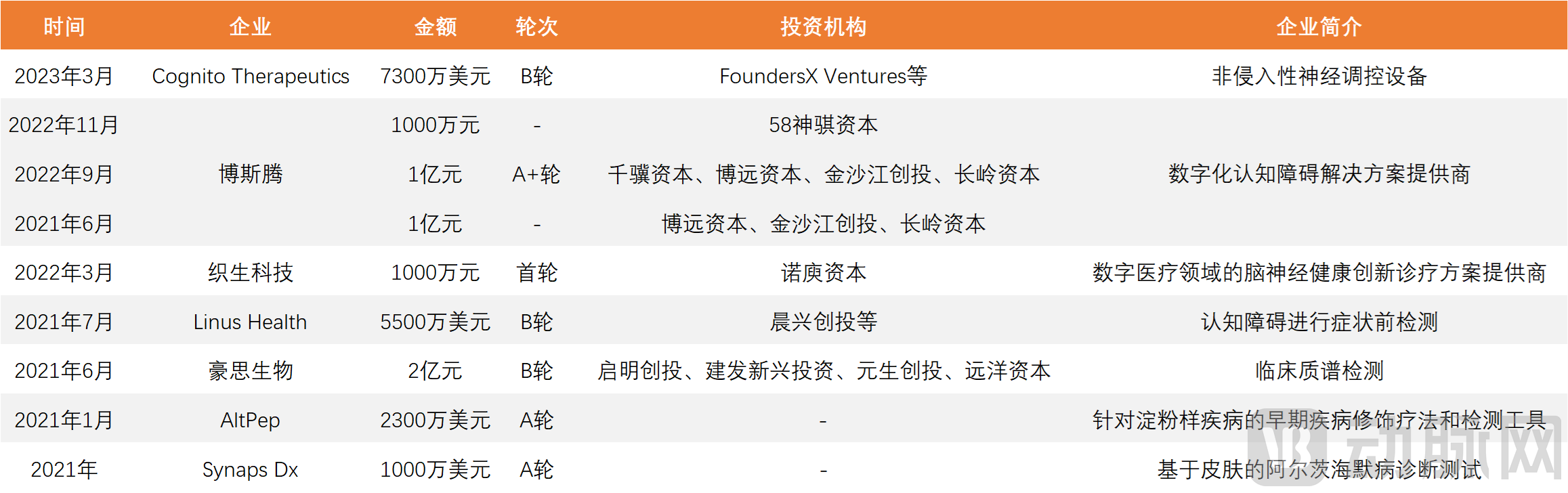 Selected Financing Events in the Global Field of Early Diagnosis and Screening for Alzheimer’s Disease Since 2021 Data Source: Artery Orange Database
Meanwhile, since 2021, innovative enterprises specializing in early diagnosis and screening of Alzheimer’s disease have frequently attracted capital attention. According to incomplete statistics from VCBeat, nearly 10 such companies have completed financing rounds in the past two years, with some securing multiple consecutive rounds. Professional investment firms including Qiming Venture Partners, CAS Star, and GSR Ventures have actively entered the space.
Undeniably, at least on the commercialization front, Alzheimer’s disease is becoming the next battleground for developers of precision diagnostics and therapeutics.
Similar to all diseases that benefit from early screening, Alzheimer’s disease, as a neurodegenerative disorder, progresses slowly. It often takes more than 10 years from the emergence of abnormal biomarkers in the brain to the onset of significant cognitive impairment in patients. For Alzheimer’s disease, the commonly referred early stage typically denotes the period when patients begin to exhibit mild cognitive impairment or even earlier phases.
At this stage of Alzheimer’s disease, diagnosis is challenging based on clinical symptoms or medical imaging alone, as abnormalities in biological markers are subtle and difficult to detect. In a sense, early diagnosis and screening for Alzheimer’s disease are still in their infancy, with countless milestones yet to be achieved.
First, the accumulation of data for early diagnosis and screening of Alzheimer’s disease remains relatively limited, necessitating ongoing clinical validation. Under current conditions, there is no clinical evidence to suggest that any single screening modality is sufficient for assessing Alzheimer’s disease. Although biomarker testing holds significant importance in the early diagnosis of AD, our understanding of the mechanisms underlying the onset and progression of Alzheimer’s disease is still immature. Consequently, research into which biomarkers can be used independently to diagnose early-stage Alzheimer’s disease is still underway.
There is currently a broad consensus that blood-based amyloid-beta (Aβ) and phosphorylated tau (p-tau) proteins, as blood biomarkers associated with Alzheimer’s disease, hold significant potential for clinical application. Among these, Aβ1-42 and p-tau181 are the two most widely recognized and extensively studied indicators. Blood levels of Aβ1-42 or the Aβ1-42/1-40 ratio, along with p-tau, can be used to predict cerebral Aβ pathology and the rate of conversion to Alzheimer’s disease. At the 2023 Alzheimer’s Association International Conference (AAIC), the National Institute on Aging and the Alzheimer’s Association (NIA-AA) released the latest diagnostic guidelines for Alzheimer’s disease, explicitly incorporating plasma biomarkers of human amyloid-beta 1-42 and human phosphorylated tau181 into the updated criteria for biomarker classification, disease diagnosis, and staging.
However, this diagnostic guideline clarifies that biomarkers should be interpreted within the clinical context rather than in isolation, and that, given currently available technologies and evidence, it is not possible to determine the extent to which individual cognitive deficits are attributable to Alzheimer’s disease versus other neuropathologies. Furthermore, relevant guidelines indicate that biomarkers not specific to Alzheimer’s disease—such as those reflecting neurofibrillary injury, dysfunction, and inflammation—also play a significant role in the onset and progression of the disease.
Secondly, even when utilizing biomarkers explicitly recommended in clinical guidelines, the early diagnosis and screening of Alzheimer’s disease still require further optimization at both the technical and product levels. For instance, multiple studies have begun to combine peripheral blood proteins, lipids, and metabolites, including Aβ42 dimer levels, plasma gelsolin (GSN)—which can inhibit Aβ fibrillization and depolymerize Aβ fibrils—and MMP3, the primary degrading enzyme of GSN. However, given the low abundance of these biomarkers in peripheral blood, it remains to be further investigated whether existing detection methods can accurately reach sufficiently low thresholds within a controllable cost range, and whether the test results truly reflect organic changes in the central nervous system.
Therefore, although product development and innovative investments in early diagnosis and screening for Alzheimer’s disease are flourishing, the primary diagnostic approach in clinical practice remains a combined diagnostic strategy. For patients with suspected Alzheimer’s disease, cognitive function assessments are generally conducted first, accompanied by imaging examinations such as CT and MRI to further confirm the diagnosis. If this battery of tests fails to yield a definitive result, PET imaging or cerebrospinal fluid/blood biomarker testing is required to obtain additional information for auxiliary judgment, making the process quite cumbersome.
Finally, and most challengingly, market education and the supporting infrastructure for early diagnosis and screening of Alzheimer’s disease remain in their infancy. The general public has a severe lack of knowledge about Alzheimer’s disease. In their perception, early-stage Alzheimer’s is often dismissed as a normal part of aging-related cognitive decline and thus ignored, causing patients to miss opportunities for early diagnosis, screening, and disease mitigation. Even among those with a certain level of disease awareness, acceptance of early diagnosis and screening for Alzheimer’s disease remains low.
Clearly, early screening for Alzheimer’s disease, despite being in the spotlight, still has a long way to go.