

Standardizing Technology Evaluation: Leveraging TRL for Life Sciences and Deep Tech
If you are deeply involved in early-stage life sciences or hard-tech projects, whether as an entrepreneur or an investor, you have surely often heard this phrase:
"This project has good technology."
This phrase is used so frequently that its casualness and ambiguity seem to have been overlooked. For a long time, due to the lack of quantifiable evaluation criteria for technology under a unified consensus, non-experts have always viewed frontier technologies in specialized fields as if through an impenetrable veil.
A bowl of Lanzhou beef noodles is categorized into varying degrees of thinness—such as "maoxi" (hair-thin), "sanxi" (three-level thin), and "erxi" (two-level thin)—and varying widths, including "dakuan" (extra-wide), "jiuye" (leek-leaf width), and "sanlengzi" (triangular prism shape). If a technical skill were judged merely as “good” or “bad,” such an assessment would be overly simplistic.
So, how can teams accurately determine the development progress of a new technology? How can they establish a shared understanding to ensure clarity and alignment in subsequent steps? What unique considerations arise when discussing technologies in the life sciences sector?
1Building Consensus: Technology Readiness Levels
To enable observers to establish a shared, universal understanding of a phenomenon, quantification is the most effective approach.
One is one, and two is two.
Here, we introduce the concept of Technology Readiness Levels (TRL).
TRL is a nomenclature, standard, and methodological framework used to assess and communicate technology readiness. It classifies readiness into nine levels, with Level 1 representing the earliest stage of maturity and Level 9 indicating the most mature technological state.
TRL provides engineers, investors, and other stakeholders with a consistent reference and methodology to assess the current maturity level of technologies, regardless of their specific backgrounds.
In layman’s terms, the significance of Technology Readiness Level (TRL) lies in providing a unified standard to indicate how far a technology or product is from commercial launch, or to estimate the time and resources required to develop it into a viable product or technology. Furthermore, TRL guides risk assessment and management, financial or resource investment decisions, as well as scheduling and resource planning by offering relevant information.
Of course, the itinerary of this framework has also been tested by time.
The TRL framework was originally developed by NASA in 1974. At that time, the framework consisted of seven Technology Readiness Levels. However, as the NASA team continued to use the framework, it evolved within NASA into a nine-level framework:
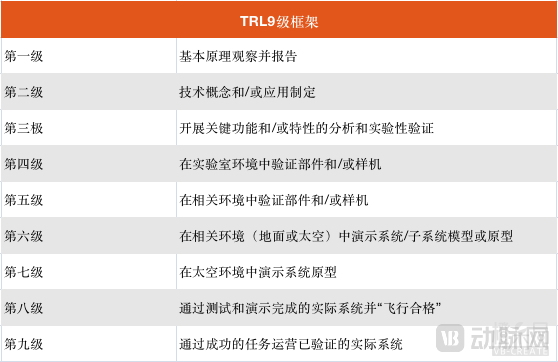
These nine levels can be categorized into three major stages: 1–3 for research, 4–6 for development, and 7–9 for deployment.
Taking MIT’s patent licensing office as an example, inventions and achievements by faculty and staff during their employment are prioritized for entry into the patent application process only after reaching Level 4.
Subsequently, the Technology Readiness Level (TRL) has evolved over time, gaining adoption and adaptation across an increasing number of fields, sectors, and institutions. Initially developed as a highly specific tool focused on aerospace, it has since demonstrated applicability and value across multiple industries and technology types.
2Applications of TRL in the Life Sciences Sector
For the application of the Technology Readiness Level (TRL) assessment framework in the design, development, and manufacturing of life science technologies, reference can be made to the practices of the U.S. Department of Health and Human Services.
The U.S. Department of Health and Human Services (HHS) and the National Institutes of Health (NIH) have both adopted Technology Readiness Levels (TRLs) to deconstruct and evaluate life science technologies and various hard-tech innovations.
Taking the NIH’s use of TRL to evaluate drug development, therapeutic approaches, and diagnostic tests as an example, the assessment framework specifically incorporates the following targeted criteria:
Compound Screening
In Vitro Validation
Regulatory and Clinical Research Milestones
Notably, an increasing number of grant-making and funding agencies, including the National Institutes of Health (NIH) and the Biomedical Advanced Research and Development Authority (BARDA), also encourage the use of Technology Readiness Level (TRL) assessments for life science technologies as a reference in funding decisions.
Building upon the original 9-level framework, TRL has its own unique definition in the life sciences sector:
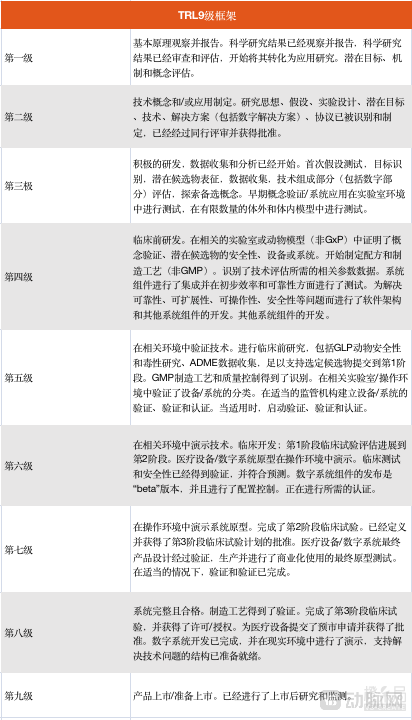
Based on the aforementioned framework, we have outlined several specific examples illustrating the value delivered by the TRL framework in the life sciences sector:
TRL enables stakeholders across various life science technologies—such as genomics, proteomics, molecular biology, and microbiology—to reach a consensus on technology readiness levels.
Increasingly complex laboratory supplies, including microfluidics, customized consumables, and sample preparation, benefit from TRL analysis at both the overall and subsystem levels;
In an increasingly competitive environment for time-to-market, TRL is highly useful for forecasting the funding and resource requirements needed to launch new life science instruments.
3The Value of Standards
The fact that TRL, as a unified framework, has been adopted and adapted by numerous technologies and industries worldwide attests to the value it provides. As we delve into the application of TRL within the context of life sciences technology development, it is worthwhile to carefully examine what these values specifically entail.
One of the most fundamental benefits of using TRL is that the framework provides a set of common nomenclature and standards, akin to establishing unified weights and measures. This in itself is valuable, as it enables teams to leverage an existing technology assessment framework to evaluate their technologies, rather than creating a non-standard, non-unified framework concurrently with the technology assessment process.
This enhances efficiency, significantly reduces ambiguity, and helps mitigate the emotions and biases that many individuals bring to technology readiness assessments.
Furthermore, this unified framework provides a general, shared understanding of technology maturity that is applicable to a broad range of stakeholders, regardless of their roles within a project or company. In other words, TRL assessments can help foster a consistent understanding of technology maturity across various roles with diverse backgrounds, educational levels, and experience.
In light of the above, it is entirely logical to employ Technology Readiness Levels (TRLs) as a planning tool for project management and systems engineering teams.
Specifically, TRL assessments help determine issues related to project timelines, resource requirements, and subsystem prioritization. Understanding the current TRL status not only helps assess the effort required to advance a technology to full commercialization (TRL 9) but also guides the estimation of the relative certainty of schedules and costs. Data indicate that timelines for projects at earlier TRLs are more prone to variability than those for projects at mature TRLs.
TRLs are also useful for life sciences project management teams, as they help define the milestone criteria required to advance a project, product, or technology to the next Technology Readiness Level.
Similarly, conducting regular TRL assessments within a project can help determine when to transition to the next phase of development, whether handing off to internal teams or external partners.
For example, some companies and institutions focus on early-stage technology development or late-stage commercialization. In practice, NASA typically transfers projects to external commercial partners once they reach Technology Readiness Level (TRL) 6. In this way, TRL assessments can inform decision-making while the project remains in-house, while also indicating when to engage or hand over the project to external partners.
TRL assessments also play a critical role in funding and resource allocation decisions. These decisions may pertain to internal investments and resource distribution, or to determinations by funding agencies regarding which projects and companies to support. For example, the NIH website states that the NCAI/REACH program anticipates most technical support will be directed toward technologies between TRL 3 and TRL 5.
For investors, understanding the current Technology Readiness Level (TRL) status, combined with the capital invested to date, helps them evaluate the business case for potential investments, as well as the trajectory and potential of startups. Similarly, some investors use TRL to help identify the status of key milestones associated with return on investment or decisions to pursue additional funding rounds.
For companies, regularly assessing the Technology Readiness Level (TRL) during project execution helps determine the development status of key components and the overall project, thereby enabling an assessment of alignment with the project plan. If project progress lags, companies can identify issues early and address them through adjustments in resource allocation. Alternatively, they can use this information to redirect resources to more promising projects.
4Summary
As the complexity of life science products continues to increase and evolve rapidly, Technology Readiness Levels (TRLs) play a critical role in forecasting resource requirements, managing risks, and facilitating rational decision-making. Furthermore, TRLs serve as a valuable reference for securing funding and investment for life science projects. The most profound impact of TRLs lies in ensuring a shared understanding of technological maturity.