

AI-Driven Drug Discovery Firms Rush to Build Wet-Dry Integrated Labs Amid Surge in Funding

InSilico Medicine
Intelligent Drug Development Platform and New Drug Research and Development Provider
The traditional pharmaceutical industry has developed over many years. Although there is a wide variety of drugs, the range of actual drug targets remains quite limited. Undruggable targets account for more than 75% of the human proteome. Currently validated and effective targets, such as PD-1 and GLP-1, face intense competition. Many oncological, neurological, and genetic diseases remain untreatable to this day, or existing therapies offer insufficient efficacy.
The development of AI technology has, to a certain extent, reshaped the landscape of the biopharmaceutical industry. With rapid advancements in AI, it has permeated multiple stages of new drug R&D, ranging from novel target protein discovery, computational structure prediction, experimental structure determination, and development of specialized simulation algorithms to drug design.
However, drug discovery remains an iterative process of trial and error, requiring multiple rounds of analysis based on experimental data to identify the optimal drug molecules. Currently, AI-driven drug development is predominantly focused on the early stages of drug discovery, with limited momentum in subsequent clinical trials and commercialization phases.
More importantly, AI-driven pharmaceutical companies continue to grapple with data challenges, as large volumes of high-quality data are critical to AI-enabled drug discovery. To address deficiencies in both the volume and quality of data, many AI pharmaceutical firms have begun establishing their own laboratories, seeking to create a closed-loop integration of dry (computational) and wet (experimental) labs to accumulate high-quality, standardized data.
21 Financing Rounds in Half a Year: Wet and Dry Labs Become the Next Frontier for AI Drug Discovery Bets
As biological systems grow increasingly complex, scales become more diverse, signals grow more ambiguous, and data volumes expand exponentially, biological research will rely ever more heavily on computational methods, making computational biology increasingly important.
In traditional new drug development, the lengthy cycle meant that identifying a single candidate with development potential from a vast pool of drug-like molecules was already a protracted process. In 2023, as ChatGPT reignited the artificial intelligence boom, researchers realized that the computational power for AI-driven drug screening had not yet reached its true limit, and enthusiasm for AI-enabled drug discovery in the capital markets seemed to be rekindled.
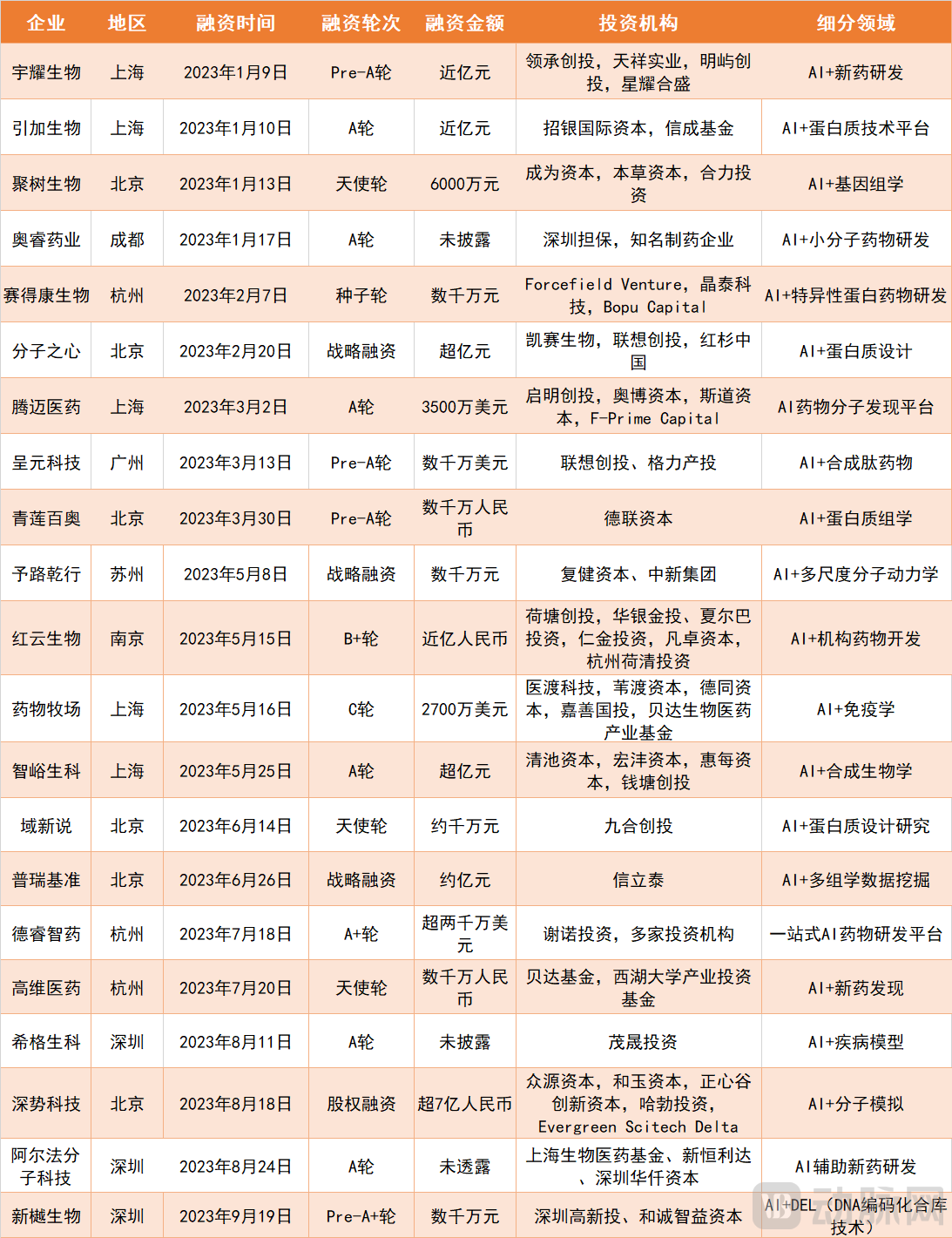
According to incomplete statistics, in the first half of 2023, more than 20 AI drug discovery companies in China secured new rounds of financing, with the total amount exceeding RMB 2 billion. Most of these AI-driven drug R&D companies are in relatively early stages of development; only a few financings occurred at Series B+ and Series C stages, while the majority were at Series A or earlier stages.
AI-Driven Drug Discovery: A Grand Blueprint for Humanity’s Attempt to Tame Disease. But as of now, will AI truly bring about disruptive change to the industry?
According to previous interviews by VCBeat, many industry experts believe that AI merely accelerates the process of new drug screening. While it improves efficiency in this stage, new drug development involves a long journey beyond early screening, including subsequent clinical trials, regulatory approval for market launch, and commercialization.
Meanwhile, AI-driven pharmaceutical companies also face numerous obstacles and inevitable losses. The primary business models for these companies fall into two categories: Contract Research Organizations (CROs) and biotechnology firms. Given the high barriers to entry in the CRO industry, it is challenging to secure sufficient interest and collaboration from pharmaceutical companies. The most favorable scenario is for a biotechnology company to possess its own AI capabilities, leveraging its proprietary technology platform to continuously discover new drugs, build a robust pipeline of drug assets, and evaluate and select the most promising candidates for development.
It is precisely for this reason that, when discussing AI-driven drug discovery, the industry is now placing greater emphasis on pioneering laboratory research, in addition to algorithms and data. The primary limitation of AI models lies in their divergence from reality due to insufficient calibration and validation with experimental data; thus, they cannot replace verification using real-world data. Without closed-loop validation and data augmentation through multiple rounds of high-throughput wet-lab experiments, it is difficult for AI models to deliver critical value. Only by organically integrating AI models with wet-lab experiments can this challenge be truly addressed.
Building a closed-loop platform that integrates dry and wet lab workflows by connecting all laboratory instruments to a unified operating system, leveraging AI models for experimental planning and selective execution to establish a closed-loop validation cycle between computational and experimental data. The future realization of fully automated laboratories controlled by an AI "brain" represents the prevailing trend for the industry's development.
Behind the Rise of Dry and Wet Labs: Data Scarcity in AI-Driven Drug Discovery
As AI and biotechnologies in China continue to achieve breakthroughs, AI-driven drug discovery has reached new heights, delivering innovations across all stages of new drug development. However, after a period of rapid expansion, the sector is now showing signs of fatigue.
First, the role of AI technology in new drug development is primarily confined to the preclinical stage; although there have been breakthroughs in target discovery, AI remains ineffective against many undruggable targets. Second, during the clinical trial phase, the extent to which AI can improve R&D success rates and reduce costs has yet to gain industry trust. Most importantly, data issues constitute the biggest barrier restricting the current development of the AI-driven pharmaceutical industry, with data facing dual challenges in both quality and quantity.
Data quality, data structure, and data generation speed are critical for AI applications. To obtain more first-hand information on drug development, particularly by integrating drug molecule data with pharmacokinetic, pharmacodynamic, and clinical data, wet and dry laboratories represent a significant approach beyond collaborations with pharmaceutical companies.
Therefore, establishing in-house integrated dry-wet laboratories is not only a critical solution for AI-driven pharmaceutical companies to address data challenges at present, but also an inevitable trend for the future development of the AI drug discovery industry.
Numerous AI-driven pharmaceutical companies have established wet and dry laboratories to create an integrated “wet-dry” closed loop, thereby acquiring high-quality data to accelerate drug discovery.
"Wet lab" refers to research conducted in a laboratory using molecular, cellular, and physiological experimental methods, which is characteristic of traditional drug discovery laboratories. "Dry lab" involves research performed through computer simulations and bioinformatics methods, which is the domain of AI platforms.
VCBeat has compiled an incomplete overview of the development paths taken by domestic companies that are conducting integrated dry-and-wet lab experiments and gradually achieving closed-loop iteration. Going forward, VCBeat will continue to report on the progress of Chinese AI drug discovery companies in establishing their dry-and-wet laboratory infrastructure. If you have the latest updates on your dry-and-wet lab projects, we welcome you to contact us for coverage.
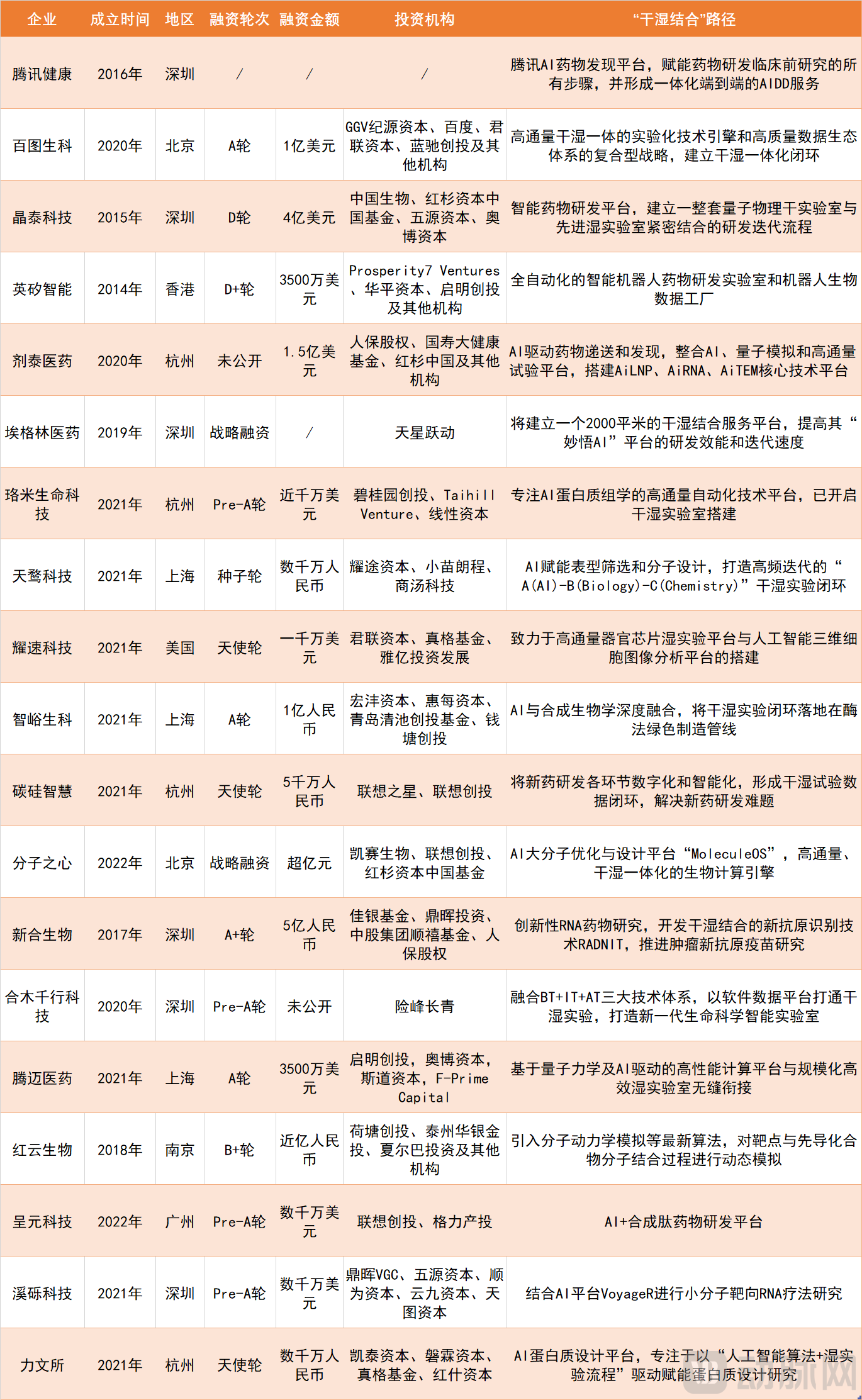
In fact, the concept of integrated dry and wet laboratories is not new; many industry leaders established wet laboratories in their early stages to generate data in-house. For instance, BioMap has focused on building an integrated dry-wet experimental platform since its inception, and XtalPi began constructing its own large-scale laboratory in 2018.
Typically, it takes approximately 12 months to complete target validation and identification, as well as assay development and screening. This is followed by an 18-month Design-Make-Test-Analyze (DMTA) cycle to optimize compounds into lead candidates, which then require another 12 months of continuous evolution to generate Preclinical Candidates (PCCs). This process involves the ongoing synthesis, purification, quantification, and characterization of required compounds, as well as subsequent assessments of potency, selectivity, and toxicity. Each DMTA cycle demands 3–6 weeks of scientists’ time.
The integration of wet and dry laboratories combines their respective platforms: the wet lab platform generates extensive experimental data from real-world environments, while the dry lab platform leverages molecular simulations and artificial intelligence models to predict the physicochemical and kinetic properties of drugs. Finally, machine learning bridges microscopic interactions and macroscopic physical phenomena, enabling continuous algorithmic iteration based on data generated from both wet and dry laboratories.
On the one hand, it saves time on multiple rounds of experiments; on the other hand, it enables mutual validation between dry-lab and wet-lab results. Therefore, the “dry-wet integration” approach is currently widely recognized within the industry as the optimal application of AI technology, and the combined use of automation and AI represents the future trend of the industry.
The Underlying Logic of the Dry-Wet Experiment Closed Loop: Returning to the Essence of Drug Development
Typically, AI’s role in drug R&D is described as providing deep empowerment across every stage of drug development. In reality, however, the most common applications of AI in pharmaceuticals are target discovery and compound screening—highly labor-intensive yet critically important steps in new drug development.
AI technology can be leveraged to streamline drug screening and synthesis, thereby reducing costs. Compounds identified through screening typically require evaluation across multiple dimensions, including solubility, activity/selectivity, toxicity, metabolism, pharmacokinetics/pharmacodynamics (PK/PD), and synthesizability. These highly repetitive tasks significantly elevate the costs of the preclinical research phase due to the need for extensive, iterative computations—areas where AI excels.
AI technology can also be employed for molecular generation. By learning from vast datasets of compounds or drug molecules, it identifies patterns in molecular structures and drug-likeness. Based on these patterns, it can generate numerous novel compounds that do not exist in nature as candidate drug molecules, thereby effectively constructing a large-scale, high-quality molecular library.
Furthermore, AI technologies are employed for chemical reaction design and compound screening. Currently, one of the areas in chemistry where AI is making significant progress is the modeling and prediction of chemical reactions and synthetic routes. Leveraging AI technology, molecular structures are mapped into formats processable by machine learning algorithms. Based on the structures of known compounds, multiple synthetic routes are generated, and the optimal route is recommended. Conversely, given specific reactants, deep learning and transfer learning can predict the outcomes of chemical reactions. AI technologies are even being used to explore novel chemical reactions. In compound screening, AI is utilized to model the relationship between the chemical structure of compounds and their biological activity, thereby predicting their mechanisms of action.
It can be said that AI-driven drug discovery has achieved significant breakthroughs at various standalone stages of drug development. However, in essence, AI-driven drug discovery prioritizes efficiency, seeking to validate its value by compressing development timelines, whereas the fundamental logic of pharmaceutical development lies in iterative validation. AI-driven drug discovery may need to halt its efforts focused on isolated breakthroughs and instead integrate into the closed-loop framework of new drug R&D, returning to the core principles of drug development.
Currently, mainstream pharmaceutical companies are equipped with personnel in bioinformatics, statistics, and data analysis. However, wet-lab teams and AI teams often operate independently. In fact, only through unified planning and collaborative work between AI models and experimental platforms can the integration of dry and wet labs be effectively advanced. In this process, biologists can better assess the capabilities of existing algorithms through collaboration with algorithm specialists. Meanwhile, algorithm specialists can learn from biologists how to adapt or create new models tailored to specific biological problems, thereby achieving more effective solutions.
Integrated Dry-Wet Closed-Loop Validation: Propelling AI Drug Discovery Beyond the Data Impasse
The data scale for new drug development is enormous, with highly complex types and structures. Building an integrated wet and dry laboratory platform can more efficiently complete the closed loop of design and validation.
On one hand, traditional drug development is predominantly based on experimental science, with data recording, governance, and storage all centered around experiments, making data merely a byproduct of the experimental process. However, the critical importance of data for AI is undeniable, which necessitates that pharmaceutical companies strictly standardize data formats, standards, quality, and quantity in drug development.
On the other hand, AI-driven pharmaceutical companies must also optimize their algorithmic models in a targeted manner. The deep integration of AI with the core business of the pharmaceutical industry requires a profound understanding of drug R&D, the ability to fully extract and refine real-time experimental data, and the capacity to optimize models and iterate algorithms based on data feedback.
In 2022, six major pharmaceutical companies, including AstraZeneca and Merck KGaA (Germany), jointly launched an innovation lab called AION Labs in partnership with Amazon and the Israel Biotech Fund (IBF). The lab aims to create and adopt breakthrough AI technologies to transform the process of drug discovery and development. It comprises a wet lab for biomedical research and a cloud-based dry lab focused on developing new algorithms and computational methods to accelerate the discovery and development of potential new therapies.
AION Labs’ cloud/AI + wet-lab approach unlocks the source of innovation through AI and precise predictive algorithms, followed by rapid validation via targeted experiments, and then sustains innovation through capital-driven support. This model can further accelerate the implementation of AI-driven drug discovery technologies, while also identifying truly capable innovative teams and providing them with superior development resources and opportunities. As the AI-driven drug discovery industry remains in its early stages of development, AION Labs’ business model may serve as a “shot in the arm” for the sector’s growth.
In China, AI-driven pharmaceutical companies such as XtalPi, InSilico Medicine, and BioMap have established “fully automated intelligent robot laboratories” capable of generating data around the clock to support the earliest stages of new drug development.
In the second half of 2022, InSilico Medicine integrated ChatGPT into its Biology42 platform, enabling real-time, professional Q&A on molecular biology and novel target discovery through fine-tuning. In June 2023, leveraging the multimodal Transformer algorithms underlying GPT-4, the company launched Precious1GPT, a multimodal aging clock poised to empower dual-effect target discovery for anti-aging and disease treatment.
According to InSilico Medicine’s prospectus, the company will advance the construction of fully automated intelligent robotic drug discovery laboratories and robotic biological data factories to continuously augment its vast data resources. The prospectus states that while it typically takes 4.5 years to take a drug from project initiation to clinical trial preparation, this timeline can be reduced to just 12 months by leveraging InSilico Medicine’s Pharma.AI R&D platform. The Pharma.AI platform offers capabilities such as novel target discovery, generative design of candidate drugs, and prediction of the likelihood of clinical success for these candidates.
XtalPi has established a comprehensive R&D iteration process that tightly integrates quantum physics-based dry labs with advanced wet labs, challenging the efficiency bottlenecks of traditional R&D and empowering new drug development to achieve breakthroughs in both innovation speed and scale. XtalPi’s intelligent drug discovery platform integrates cloud-based supercomputing digital R&D tools with advanced experimental capabilities, forming an R&D system in which high-precision predictions and targeted experiments mutually validate and guide each other.
Tencent’s AI Drug Discovery Platform has developed an out-of-distribution research framework, DrugOOD. Within this framework, existing databases have been systematically categorized into numerous real-world scenarios. An AI scoring system is employed to evaluate the reliability of AI-generated results across different targets, enabling early identification of model-target mismatches in subsequent studies and optimizing R&D efficiency. Currently, Tencent’s AI Drug Discovery Platform has established collaborations with multiple pharmaceutical companies. The predictive accuracy of its models has been validated through wet-lab experiments in various practical R&D scenarios. Leveraging the high-performance computing power of its cloud-based drug screening service, the platform has achieved order-of-magnitude improvements in both screening speed and the chemical structural space explored.
Leveraging Baidu’s years of accumulated AI expertise, BioMap has built a composite strategy centered on its biological computing engine, integrating a high-throughput dry-and-wet lab experimental technology engine with a high-quality data ecosystem. Through large-scale protein pre-training, BioMap enhances AI’s predictive capabilities for macromolecular drug design. By generating substantial experimental data via its high-throughput wet-lab platform to address specific pipeline R&D challenges, the company establishes a closed-loop feedback system between computational modeling and experimental validation. This iterative optimization ultimately improves the efficiency of antibody engineering.
The threshold for establishing integrated dry and wet laboratories is relatively high. First, it requires a cross-disciplinary team comprising talent proficient in experimental work with an understanding of bioinformatics, pharmaceuticals, and cutting-edge biotechnologies, as well as experienced systems engineering professionals and AI algorithm experts. Second, robust hardware support is essential, including both laboratory equipment and computational resources, along with the capability to integrate these two types of resources. Most importantly, it is crucial to return to the essence of drug discovery by using wet-lab data as supplementary support for iterative, multi-round validation via AI, ultimately achieving an integrated closed-loop system combining dry and wet laboratories.
The rapid advancement of generative AI has brought new surprises to drug discovery, but it will still take some time before it is fully implemented in practice. As new chemical methodologies become increasingly integrated with advanced computational tools, the establishment of a closed-loop system combining wet-lab and dry-lab experiments is poised to become the standard in drug development, ushering in a new paradigm for AI-driven pharmaceuticals.
References:
When AI Develops Drugs for Human Consumption — CBNData Health