

Laiqiu Medical Files IPO Prospectus: Pioneering Head-Worn, Standalone Mixed Reality Surgical Navigation Backed by Microsoft
Neurosurgical procedures, due to their intricacy and complexity, are often described as “walking a tightrope over a deep abyss.” Achieving precise lesion localization to endow surgeries with the characteristics of precision, flexibility, speed, and minimal invasiveness—thereby minimizing neurological trauma and maximizing surgical outcomes—has become a key focus and challenge in contemporary neurosurgery.
Traditional surgical procedures rely on preoperative imaging, such as magnetic resonance imaging (MRI) and computed tomography (CT), to identify the location of lesions. Physicians then perform freehand puncture or utilize neuronavigation to guide the needle insertion. This approach undoubtedly presents a series of limitations. First, preoperative images cannot provide real-time reference or operational warnings during surgery, which increases the difficulty and uncertainty of the procedure to some extent. Second, this method heavily depends on the surgeon’s subjective experience and tactile feedback. Physicians must integrate imaging data with the patient’s anatomical structures and mentally reconstruct a three-dimensional model, making it impossible to establish a standardized operational protocol.
Surgical navigation has become the breakthrough for addressing this issue.
After years of development, surgical navigation has been adopted by many hospitals. However, the neuronavigation systems currently used in most hospitals require lengthy preoperative preparation, and navigation results are typically displayed on external monitors. During surgery, to accurately localize lesions, surgeons must repeatedly look up at the screen to acquire imaging data and rely on experience to mentally map the observed images onto the patient’s head. This process not only increases the likelihood of errors but also prolongs surgical duration.
With the rapid development of visualization technologies, mixed reality provides a clearer, more convenient, and intuitive presentation method for surgical navigation.
Established in 2019, Laiqiu Medical leverages cutting-edge technologies such as artificial intelligence, digital twins, and extended reality (XR) to integrate with the medical field. The company has independently developed the “Intelligent XR Navigation System for Neurosurgical Intracerebral Hemorrhage,” which uses mixed reality technology to fuse patient imaging data with the physical patient. This innovation grants surgeons “X-ray vision,” enabling them to visualize three-dimensional, realistic images directly during surgery, thereby eliminating the need for mental spatial reconstruction.
Furthermore, the system offers the advantages of portability and ease of operation, with a price significantly lower than that of intraoperative navigation devices currently on the market. This substantially reduces the financial burden and operational complexity for primary healthcare institutions, achieving an effective balance among multi-scenario applicability, multifunctionality, and cost-effectiveness.
Laiqiu Medical: Empowering Healthcare Professionals to Build a Future of Comprehensive Care Rooted in Deep Empathy
“We chose neurosurgery precisely because we considered it the most challenging of all surgical specialties. If we could conquer this most difficult hurdle, expanding into other surgical fields in the future would be relatively easier.”
Yuan Zhiyi, founder of Laiqiu Medical, told VCBeat that, based on this rationale, the company has decided to focus on stroke care. By integrating an intelligent image management workstation with a mixed reality navigation system, Laiqiu Medical aims to empower primary-care CT scanners procured through centralized bidding, providing them with holographic 3D visualization for post-processing and mixed reality holographic navigation capabilities.
Laiqiu Medical’s XR devices are equipped with a mixed reality spatial registration system that integrates its proprietary pure vision and HoloNeuro intelligent sensing technologies. This system enables markerless registration within an extremely short time, assisting surgeons in rapidly identifying optimal surgical trajectories while intelligently avoiding high-risk structures such as major blood vessels and nerve bundles. This significantly enhances procedural safety and reduces the risk of patient disability. The system is suitable for puncture procedures in neurosurgery, orthopedics, pulmonology, and urology.
The application process for XR-assisted neurosurgery is straightforward, requiring only a mixed reality device and a computer. It eliminates the need for additional hardware such as optical tracking systems or external displays, offering portability and ease of use.
After acquiring the DICOM raw data from the patient’s head CT and MRI scans, the physician imports them into a 3D reconstruction software system. Using multiple templates, the system performs visualization-based segmentation, extraction, and computation to generate a 3D virtual model, with tumors, blood vessels, nerves, and brain tissue marked in different colors. The reconstructed and rendered 3D virtual model is then loaded into a mixed reality device. By wearing the mixed reality device, the physician aligns and registers the reconstructed virtual model with the patient’s scalp, ultimately enabling preoperative planning, preoperative communication, and intraoperative navigation based on mixed reality technology.
By leveraging this technology, holographic images viewed by surgeons on the operating table can be virtually overlaid onto the patient’s actual anatomy, enabling visualization of lesions and transforming virtual navigation into real-time guidance. This provides surgeons with stereoscopic, visualized representations of pathological structures and clear delineation of adjacent critical anatomical structures in real time, thereby enhancing surgical safety and efficacy while reducing the incidence of postoperative complications.
Precision is the critical factor for surgical navigation systems. The system achieves millisecond-level latency in gesture recognition, with a success rate exceeding 98%. Furthermore, Laiqiu Medical’s imaging is generated from original 2D images and features intelligent correction, ensuring that both holographic and 2D image accuracy exceed 98%.
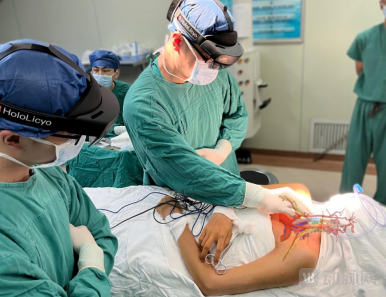
Laiqiu Medical Empowers Physicians with the Ability to Directly “See Through” Patient Lesions
“For acute surgeries such as those for cerebral hemorrhage, we can complete the entire treatment process—from the patient’s arrival at the hospital to the completion of surgery—within 30 minutes. By delivering care during the golden window after onset, we minimize brain damage to the greatest extent possible,” introduced Yuan Zhiyi.
Currently, the product has obtained multiple utility model and invention patents in China, as well as a Class II registration certificate from the NMPA.
On March 28, 2023, the Department of Neurosurgery at Qiubei County People’s Hospital in Yunnan Province successfully performed a ventricular puncture and drainage surgery assisted by mixed reality technology, under the guidance of Dr. Ma Zengyi from the Huashan Hospital Affiliated to Fudan University’s medical aid team to Yunnan. Postoperatively, Dr. Ma commented, “The intracerebral hemorrhage medical solution, independently developed through the integration of medicine and engineering by Huashan Hospital and its partner, Shanghai Laiqiu Medical Technology Co., Ltd., can convert medical imaging data into 3D images, thereby effectively reducing the error rate associated with ‘blind puncture’ based on anatomical landmarks.”[1]
After years of dedicated practice, Shanghai Laiqiu Medical Technology Co., Ltd. has established collaborations with dozens of medical institutions, including Shanghai Sixth People’s Hospital, Shanghai Changhai Hospital, Huashan Hospital, Xinhua Hospital, Renji Hospital, Shanghai Eighth People’s Hospital, Peking University Third Hospital, Xingguo County People’s Hospital in Jiangxi Province, and Qiubei County People’s Hospital in Yunnan Province. These partnerships have supported nearly 500 clinical procedures, such as surgeries for basilar invagination with atlantoaxial dislocation, ventricular puncture and drainage, minimally invasive keyhole skull base surgery, resection of superficial intracranial tumors, and removal of tumors in deep functional brain areas. According to founder Yuan Zhiyi, 80% of these cases are concentrated in neurosurgery, while the remaining 20% span urology, orthopedics, thoracic surgery, and cardiovascular surgery.
Recently, the company also joined forces with Huashan Hospital, China Unicom, and the Shanghai Municipal Government to establish a Medical Big Data Laboratory and a demonstration project for a Metaverse Application Platform for Surgery.[2], empowering healthcare, and jointly building specialized large models for artificial intelligence in medical data and implementing their application scenarios.
Notably, in 2022, Shanghai Laiqiu Medical Technology Co., Ltd. was formally invited by Microsoft to become an official Mixed Reality Partner (MRPP). The Mixed Reality Partners Program (MRPP) is a comprehensive initiative designed by Microsoft for outstanding global digital marketing agencies, system integrators, and solution providers, focusing on HoloLens and mixed reality technologies. This invitation underscores that the technologies and solutions provided by Shanghai Laiqiu Medical Technology Co., Ltd. in the field of mixed reality healthcare have received official recognition from Microsoft.

Image from Laiqiu Medical
Regarding the future of Laiqiu Medical, Yuan Zhiyi has long mapped out a clear development path in her mind.
First, in terms of algorithmic pathway design, the company will customize distinct AI algorithms for different neurosurgical procedures, continuously refine its core technologies, and achieve faster, more precise localization along with real-time intraoperative dynamic tracking.
From a commercialization perspective, Laiqiu Medical’s devices are not only easier to use but also significantly reduce product costs, as they do not require additional hardware aids such as optical positioning systems or display screens. The company offers its solutions through both outright sales and leasing models, making them affordable for small and medium-sized hospitals. Moving forward, the company plans to refine its promotion and distribution channels, aiming to achieve a 25% market coverage rate by the end of next year.
Meanwhile, Shanghai Laiqiu Medical Technology Co., Ltd. also looks forward to collaborating with upstream and downstream partners to jointly build intelligent operating rooms. This includes hardware integration with intraoperative imaging equipment such as mobile CT scanners, creating a more comprehensive solution covering preoperative, intraoperative, and postoperative stages, as well as integrating with surgical robots to develop holographic navigation systems.
Finally, let us introduce the team at Laiqiu Medical. The founder of Laiqiu Medical, Yuan Zhiyi, holds a Master’s degree in Computer Vision from Waseda University in Japan and a Ph.D. in Biomedical Engineering from Shanghai Jiao Tong University, with long-term focus on the application of mixed reality technology in the medical field. The core R&D team members all come from institutions such as Shanghai Jiao Tong University, Huawei, Stryker, Smith & Nephew, Philips, and the Institute of Computing Technology, having deeply cultivated their respective fields for many years.
When asked why the company was named “Laiqiu,” Yuan Zhiyi explained, “‘Lai’ is derived from an ancient river that never runs dry. We hope our company will continue to flow endlessly on the path of innovative R&D, and that during its growth, it will usher in a harvest akin to autumn, enabling more doctors and patients to truly enjoy the sweet fruits of technology.”
References:
[1] A First in Yunnan Province! Huashan Hospital Introduces Life-Saving “Black Tech”
[2] Huashan Neurosurgery Metaverse HealthcareSolutionSolution: Envisioning the Future of Healthy China in the Cloud