

Cerevance Files IPO Prospectus: Pioneering First-in-Class CNS Therapies Backed by Takeda, Bill Gates, and Google
Cerevance
Developer of Brain Disease Therapeutics
The development of central nervous system (CNS) drugs is highly unique. As CNS disorders account for an increasingly large proportion of modern disease incidence, countless multinational corporations (MNCs) and biotech companies have flocked to this field over the past decade, only to suffer repeated failures. This year, the approval of CNS drugs represented by lecanemab and donanemab has injected new hope into the CNS sector, long referred to as a “R&D black hole.”
This expectation seemed to have been foreshadowed. Early this year, Cerevance, a U.S.-based startup specializing in CNS drugs, announced an expansion of its Series B financing, securing an additional $51 million and bringing the total amount raised in this round to $116 million. The investors participating in this round includedincluding not only Gates Frontier, founded by Microsoft co-founder Bill Gates, but also Google Ventures (GV) and Takeda Ventures, Dementia Discovery Fund, Foresite Capital, Lightstone Ventures, UPMC Enterprises, and Dolby Family Ventures.
To date, Cerevance, founded in 2016, has completed multiple rounds of financing, securing a total of $142.5 million.
NETSseq: Collaborated with over 25 brain banks to evaluate more than 14,000 post-mortem human brain tissue samples
Since 2020, multiple multinational corporations (MNCs) have made high-profile returns to the central nervous system (CNS) therapeutic area, with several blockbuster deals specifically targeting Alzheimer’s disease (AD) drug development. For instance, GSK partnered with Alector to develop two antibodies, AL001 and AL101, for CNS diseases; AbbVie acquired Syndesi Therapeutics for $1 billion, primarily to secure its AD drug candidate SDI-118; and Bristol Myers Squibb (BMS) entered into a R&D collaboration with biotechnology company Prothena, obtaining U.S. development rights to Prothena’s investigational tau protein antibody therapy, PRX005.
In 2022, following Cerevance’s announcement of positive Phase 2 results for its Parkinson’s disease pipeline, Merck & Co. announced a strategic collaboration with Cerevance valued at up to $1.1 billion. At the core of this strategic partnership isUtilizeCerevanceProprietary nuclear-enriched transcriptome sequencing (NETSseq) platform identifies new therapeutic targets for AD.
For many years, the development of Alzheimer’s disease (AD) therapeutics has primarily focused on two targets: amyloid-beta (Aβ) protein and tau protein. Drug development targeting these pathways within the central nervous system (CNS) has been fraught with extreme challenges and high failure rates. It is well established that the CNS is heavily protected by physiological barriers, particularly the blood-brain barrier (BBB) and the blood-cerebrospinal fluid barrier, which prevent most CNS drugs from crossing into the brain and achieving effective therapeutic concentrations. Therefore, given the known difficulties in drug development, it is crucial to extensively explore and investigate novel therapeutic targets for CNS disorders.
New targets and new technologies are always closely intertwined. Shortly after its establishment in 2017, Cerevance entered into a collaboration agreement with Rockefeller University, gaining access to a novel technology developed by the Howard Hughes Medical Institute under the leadership of Dr. Nathaniel Heintz—a technique designed to analyze specific cell populations within human brain tissue. This technology was later further developed by Cerevance researchers into the NETSseq platform, which is used to identify novel target proteins with highly selective expression and to discover new therapies for neurological and psychiatric disorders.
To explore within a sufficiently rich sample,CerevanceIn collaboration with more than 25 brain banks, an expanding collection of over 14,000 post-mortem human brain tissue samples has been evaluated. Using antibodies against nuclear proteins (such as transcription factors), endoplasmic reticulum proteins, and membrane proteins, as well as RNA probes targeting transcripts specific to any cell type, specific cell types in the brain were selectively isolated. Gene expression analysis was performed on nuclei from more than 60 cell types, generating a database comprising over 45 trillion base pairs and exceeding 100 TB of sequencing data.
The NETSseq technology platform can also perform deep profiling of neuronal and glial cell populations beyond the reach of other methods, uncovering innovative target proteins that are overexpressed or underexpressed in diseased brain tissue. By leveraging human data, machine learning, and proprietary datasets, NETSseq can precisely identify novel targets expressed in specific cell types or altered in disease.
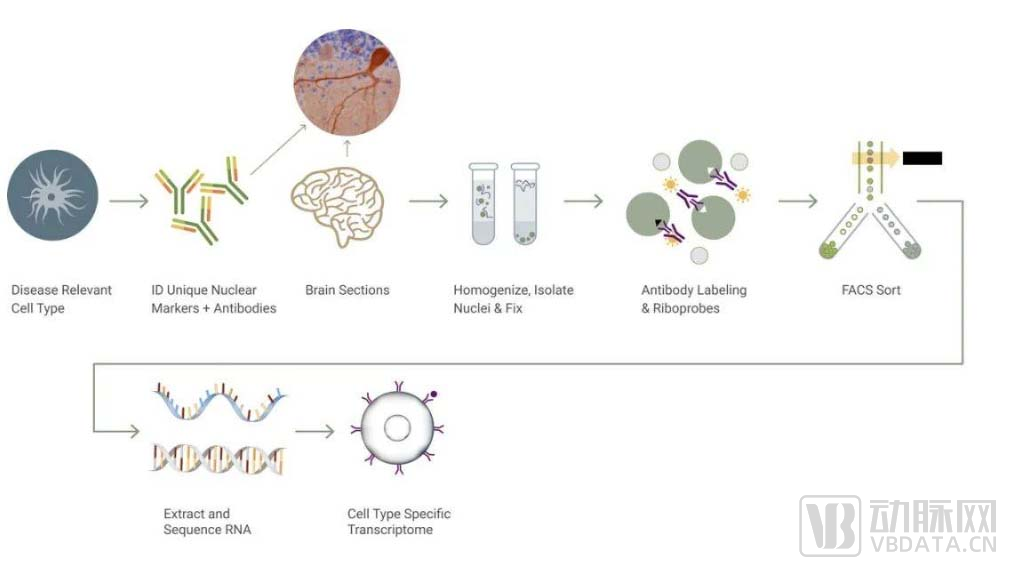 NETSseq Technology Image Source: Cerevance
Meanwhile, Cerevance integrates multiple detection technologies, including ATAC-seq, eQTL, and SNP analysis, to enhance the understanding of brain diseases and identify promising new targets.
Through the NETSseq technology platform, Cerevance has made several new discoveries. For instance, it was found that inhibition of KCNK12 reduces neuronal K+ efflux and inflammasome formation in microglia, thereby alleviating abnormal neuroinflammation and chronic neuropathy; furthermore, pseudotime trajectory reconstruction has revealed the molecular characteristics of Alzheimer’s disease progression.
More importantly, Cerevance is advancing multiple first-in-class drug pipelines for neurological diseases through its NETSseq technology platform, including those for Parkinson’s disease (PD), Alzheimer’s disease (AD), and amyotrophic lateral sclerosis (ALS).
Multiple first-in-class CNS disease pipelines, with the most advanced reaching Phase II clinical trials
Currently, Cerevance’s early-stage pipeline comprises multiple preclinical first-in-class programs, all of which leverage its proprietary NETSseq technology platform to identify novel target proteins with highly selective expression. These target proteins are either specific to certain neural circuits or exhibit aberrant overexpression or underexpression in the diseased brain.
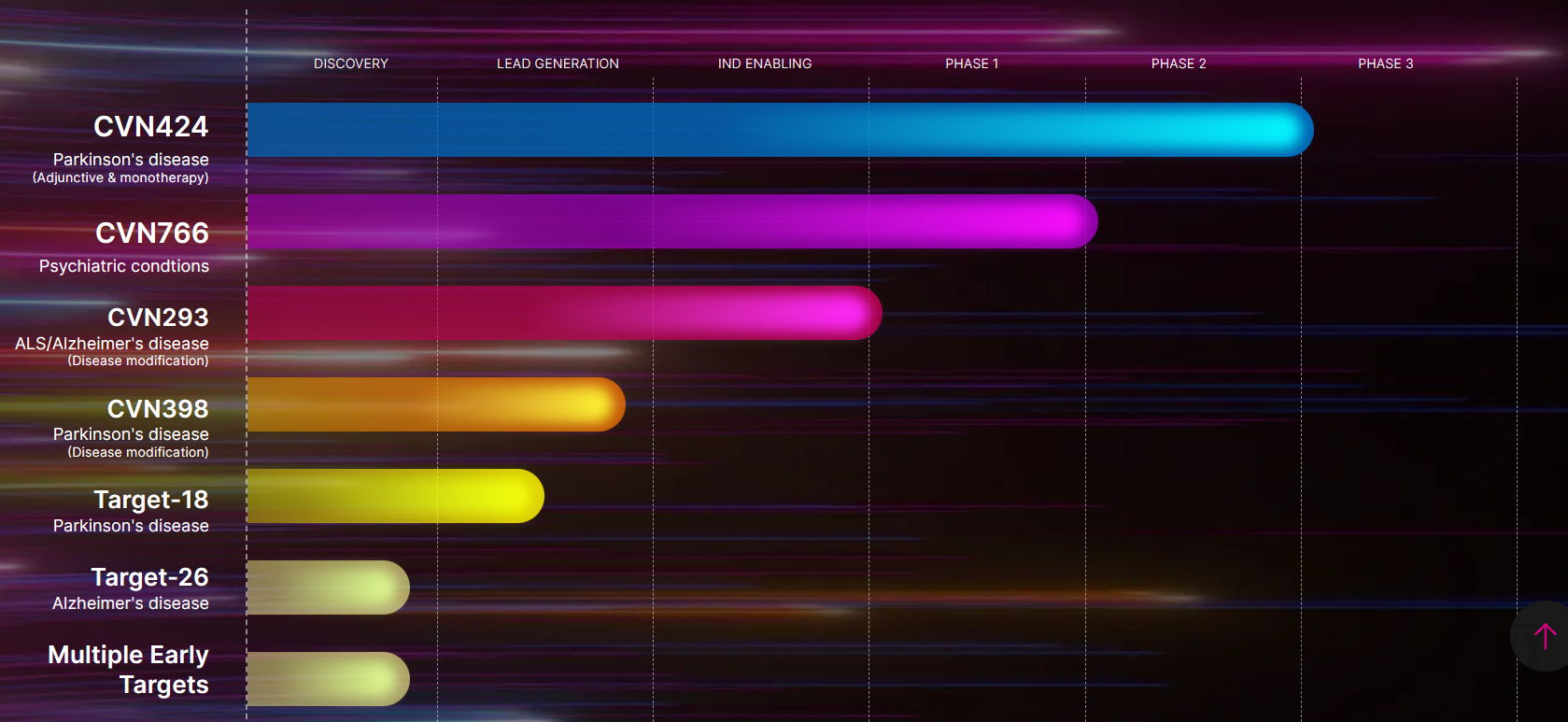 Cerevance Drug Pipeline Source: Cerevance Official Website
The following section introduces three drug pipelines with rapid progress.
CVN424 is a brain-penetrant, non-dopaminergic, oral GPCR6 inverse agonist indicated for Parkinson’s disease. As a member of the G protein-coupled receptor family, GPCR6 is highly and selectively expressed exclusively in striatal medium spiny neurons of the indirect pathway within the basal ganglia circuitry.Unlike dopamine replacement therapy (L-DOPA), which is commonly used in clinical practice for Parkinson’s disease, CVN424 selectively targets the dopamine D2 receptor-dependent indirect signaling pathway associated with Parkinson’s disease. It delivers positive outcomes comparable to those of levodopa or deep brain stimulation while avoiding adverse effects, thereby helping patients reduce their “OFF” time (periods during which Parkinson’s disease symptoms persist despite treatment).
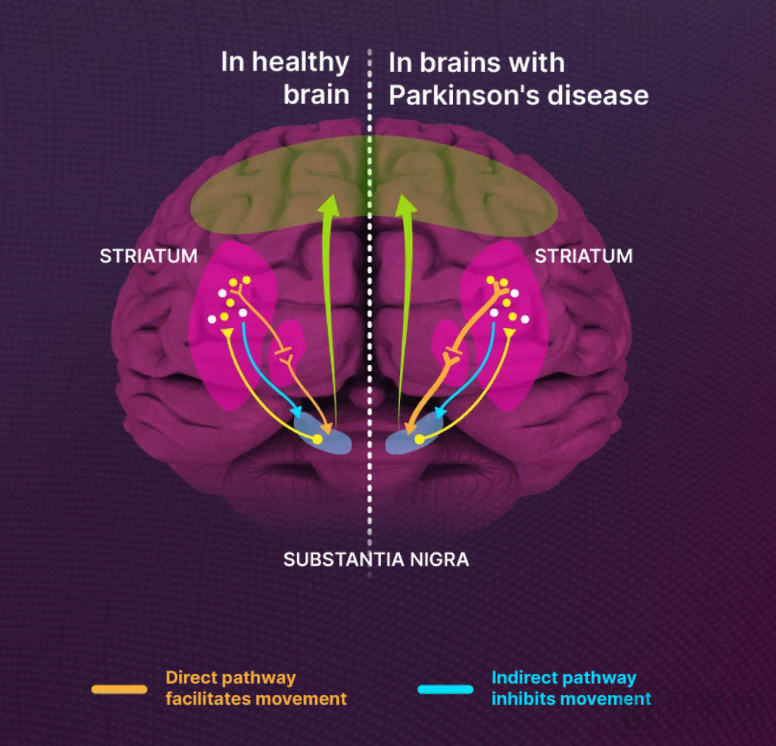
In clinical practice, levodopa is commonly used to improve or treat Parkinson’s disease, as this neurotransmitter precursor can alleviate symptoms such as bradykinesia and muscle rigidity. However, due to its broad, non-selective action—often described as “flooding the brain”—its effects may lack precision and can lead to side effects.
In a Phase 2 study, CVN424 demonstrated safety and efficacy as an adjunctive therapy to levodopa in reducing “OFF” time in patients with Parkinson’s disease. In this randomized, double-blind, placebo-controlled Phase 2 clinical trial, approximately 135 patients with Parkinson’s disease received treatment with two different doses of CVN424.
Trial results showed that after 4 weeks of treatment, high-dose CVN424 improved “OFF” time by 1.3 hours compared with placebo (p=0.042). Meanwhile, dyskinesia-free “ON” time increased. Unlike other adjunctive therapies used concurrently with levodopa, CVN424 reduced daytime sleepiness scores compared with placebo.
In addition to adjunctive therapy, Cerevance is developing its monotherapy. Currently, Cerevance plans to initiate a Phase 2 proof-of-concept study to evaluate CVN424 as a monotherapy in newly diagnosed Parkinson’s disease patients who have not previously received levodopa treatment.
CVN766 is a potent orexin 1 receptor (Ox1R) antagonist intended for the treatment of various psychiatric disorders, such as the negative and cognitive symptoms of schizophrenia, anxiety-related disorders, and substance abuse.
CVN766 exhibits over 1,000-fold selectivity for Ox1R compared to Ox2R. Ox1R is genetically linked to psychiatric disorders and is expressed in key brain regions involved in regulating mood, fear, anxiety, and motivation. The expression of Ox1R in cell types associated with human schizophrenia has been confirmed using the NETSseq technology platform.
In the Phase 1 trial, CVN766 demonstrated positive data—good tolerability and an excellent safety profile. Unlike most orexin receptor antagonists, CVN766 showed no evidence of increasing somnolence or fatigue in subjects. In this randomized, double-blind, placebo-controlled trial, the safety, tolerability, and pharmacokinetics (PK) of single and multiple ascending doses of CVN766 were evaluated in 64 healthy subjects.
Cerevance plans to initiate a Phase 2 study in the fourth quarter of 2023 to evaluate its potential as a therapy for negative and cognitive symptoms of schizophrenia.
CVN293 targets KCNK13, which is selectively expressed in brain microglia. By inhibiting KCNK13, CVN293 reduces neuronal K+ efflux and inflammasome formation in microglia, thereby suppressing central nervous system inflammation associated with various neurodegenerative diseases, particularly Alzheimer’s disease (AD) and amyotrophic lateral sclerosis (ALS).
Cerevance will initiate the Phase 1 trial of CVN293 in the third quarter of 2023.
Originating from Takeda Pharmaceutical’s Cambridge team, with over 25 years of deep expertise in the neuroscience field
It took Cerevance only seven years to build one of the world’s largest brain tissue databases and simultaneously advance multiple first-in-class drug pipelines for neurological disorders. In fact, prior to its $1.1 billion strategic collaboration with Merck & Co., Cerevance had partnered with Japanese pharmaceutical giant Takeda Pharmaceutical Company (Takeda) to address gastrointestinal diseases rooted in the central nervous system.
Its ties with Takeda Pharmaceutical date back to its inception. In 2016, Takeda Pharmaceutical and Lightstone Ventures jointly announced the establishment of Cerevance. In addition to providing a combined $21.5 million in Series A financing, they furnished Cerevance with fully equipped laboratories and licenses for a portfolio of preclinical and clinical trial drugs owned by Takeda. Furthermore, Takeda transferred a 25-member neuroscience research team from its Takeda Cambridge Ltd. research site to Cerevance, including Dr. Mark Carlton, Co-founder and Chief Scientific Officer of Cerevance.
Mark Carlton holds a Ph.D. in Genetics from the University of Cambridge, where he served as a researcher or lecturer for 17 years. In 1998, Mark founded Paradigm Therapeutics, a biopharmaceutical company focused on rare diseases, whose leading drug pipeline has completed Phase III clinical trials. Since 2007, Mark’s career has been closely intertwined with Takeda Pharmaceutical Company. He initially joined Takeda’s Singapore branch as Chief Scientific Officer and Strategy Director, while simultaneously serving as a Director and Chief Scientific Officer at Takeda Cambridge. In 2016, when Takeda announced the closure of Takeda Cambridge and the establishment of Cerevance, Mark naturally transitioned to join Cerevance.
Cerevance’s other co-founder, Brad Margus, also boasts an impressive résumé. After graduating from Harvard Business School, Brad embarked on a path of serial entrepreneurship. In 2000, he co-founded the genomics company Perlegen Sciences and served as its CEO for seven years; to date, the company has raised a total of $154 million in financing. In 2009, Brad ventured into the field of neurological diseases, co-founding Envoy Therapeutics with Nobel laureate Paul Greengard to focus on the development of novel CNS therapeutics. The company was acquired by Takeda Pharmaceutical in 2012 for $140 million.
Subsequently, Brad developed an interest in databases and, in 2013, co-founded Genome Bridge, a non-profit subsidiary of the Broad Institute of Harvard and MIT, with the aim of establishing a computational platform for sharing genomic data. As a serial entrepreneur, Brad co-founded Cerevance in 2016 and began serving as its CEO.
In 2022, the same year Cerevance entered into a collaboration with Merck & Co., Brad stepped down as CEO to become Chairman of the Board. The role of CEO was assumed by Craig Thompson, who has over 20 years of experience in multinational pharmaceutical companies. Previously, Craig spent 11 years at Merck & Co. and seven years at Pfizer, later serving as CEO or board member at several publicly listed pharmaceutical companies.
The R&D of new CNS drugs is a testing ground rife with ambiguity, fragmentation, and uncertainty. Despite unclear pathogenesis, frequent setbacks, and difficulties in reaching clinical trial endpoints, scientists’ enthusiasm for this field remains undiminished. In 2023, as the CNS drug development sector enters its “spring,” we continue to hold high expectations for new CNS therapies.