

Bristol Myers Squibb to Acquire Mirati Therapeutics for Up to $5.8 Billion to Strengthen KRAS-Targeted Oncology Portfolio

Mirati Therapeutics
Developer of Novel Cancer Therapies
On October 8 local time, Bristol Myers Squibb (BMS) and Mirati Therapeutics jointly announced that they had reached a definitive merger agreement. BMS will acquire Mirati for $58.00 per share in cash, implying an equity value of $4.8 billion.
Mirati shareholders will also receive a non-tradable contingent value right (CVR), which entitles holders to a one-time potential cash payment of $12.00 per share, with an aggregate value of approximately $1 billion.
The transaction is expected to close in the first half of 2024, will be accounted for as a business combination, and is projected to dilute BMS’s Non-GAAP earnings per share by approximately $0.35 during the first 12 months following the closing.
BMS stated that the acquisition of Mirati will strengthen its oncology portfolio and expand its late-stage KRAS pipeline. Last November, JPMorgan analysts estimated that the cost of acquiring Mirati could reach as high as $12 billion. In just the past six months, the acquisition price has been cut in half.
As a star company in the KRAS field, Mirati, founded in 2013, has been the subject of repeated rumors about being acquired at a high price.
In October, Bloomberg reported, citing sources familiar with the matter, that Sanofi was exploring the possibility of acquiring Mirati Therapeutics, while not ruling out interest from other major pharmaceutical companies. Although both parties declined to comment, rumors drove Mirati’s stock price up by 45%.
According to the Financial Times, Merck had expressed interest in acquiring Mirati as early as October 2021. Bloomberg reported that in November 2022, Mirati attracted “new acquisition interest” from large pharmaceutical companies. At that time, Mirati was still working to bring its KRAS inhibitor adagrasib into clinical use.
In a forecast released by JPMorgan Chase last November, the estimated cost of the Mirati transaction was projected to range from $185 to $200 per share, with a total value between $10.5 billion and $12 billion. Analysts speculated that potential competitors could include Pfizer, AstraZeneca, Merck & Co., and Bristol Myers Squibb, as these companies all lack late-stage KRAS programs.
Rumors of price fluctuations did not enable Mirati to smoothly secure the $12 billion deal, primarily due to its volatile performance in 2023.
In May, Mirati’s investigational kinase inhibitor sitravatinib failed in the Phase III SAPPHIRE trial. When combined with Bristol Myers Squibb’s nivolumab (Opdivo), sitravatinib did not significantly improve overall survival in patients with non-squamous non-small cell lung cancer. This result directly led Mirati to terminate all development of sitravatinib outside the Asia-Pacific region. [BeiGene holds the rights to sitravatinib in Asia (excluding Japan), Australia, and New Zealand.]
In July, the CHMP recommended rejecting the approval of Krazati for marketing in the European Union. In August, David Meek, Chief Executive Officer and board member of Mirati, resigned from his leadership position and board seat but continued to serve as a company advisor until October 15. That same month, Chief Financial Officer Laurie Stelzer departed and served as a company advisor through October.
More importantly, as Mirati’s only approved product, adagrasib (Krazati) still lags behind Amgen’s first KRASG12CInhibitor Lumakras (sotorasib). Based on second-quarter 2023 revenue, Krazati generated net revenues of $13.4 million, while Lumakras generated net revenues of $77 million.
Internal Turmoil and Drug Progress Impact Mirati, While External Pressures Continue to Mount.
On the same day that Mirati’s stock price surged 45% amid acquisition rumors, Amgen’s Lumakras failed to secure full approval (transitioning from accelerated approval to regular approval) at the FDA’s Oncologic Drugs Advisory Committee (ODAC) meeting. The committee voted 2 in favor and 10 against, concluding that the progression-free survival (PFS) results from the Phase III CodeBreaK 200 trial could not be reliably interpreted.
Although the outcomes of the ODAC meeting hold certain reference value and directional significance for the FDA’s review, the FDA’s final decision will not be officially announced until December of this year. Within the same KRAS gene therapeutic landscape, Lumakras’s failure to secure full approval has cast a shadow over Mirati.
In 1982, the rat sarcoma viral oncogene homolog (RAS) was discovered. This was the first human oncogene to be identified. Studies have shown that cancers driven by such mutations account for approximately 30% of all human cancers.
KRAS mutations are the most prevalent among the RAS gene family, accounting for approximately 85%, and are thus referred to as the “king of cancer targets.” This “king of targets” remained undruggable for decades because the KRAS protein surface lacks “protein pockets” (protein cavities), preventing small-molecule drugs from binding to it and disrupting its function.
KRAS gene mutations primarily occur at amino acid residues 12 or 13, including G12C, G12D, and G13D. The G12C mutation is the most common among these, predominantly found in lung cancer, colorectal cancer, and pancreatic cancer. In non-small cell lung cancer (NSCLC), approximately 14% of patients harbor KRASG12CMutations are a type of biomarker mutation associated with poor prognosis.
To date, there are two KRAS G12CThe approved inhibitors are Amgen’s Lumakras and Mirati’s Adagrasib.
In September 2021, the FDA approved Lumakras via the “accelerated approval” pathway for the treatment of KRAS G12CAdult patients with locally advanced or metastatic non-small cell lung cancer (NSCLC) harboring KRAS mutations, shattering the “undruggable” curse of the KRAS gene.
In December 2022, Mirati’s Adagrasib received FDA “Accelerated Approval” and “Breakthrough Therapy” designation for the treatment of patients with KRAS-mutantG12CAdult patients with locally advanced or metastatic non-small cell lung cancer (NSCLC) harboring mutations. This patient subgroup has previously received at least one prior systemic therapy.
Mirati official data shows that Adagrasib has advantages over other KRAS G12CProperties of the inhibitor, including:
· Long half-life
· Demonstrated in Phase I and II clinical trials to be combinable with PD-1 inhibitors for first-line treatment of NSCLC
· Demonstrated central nervous system penetration and intracranial activity in patients with active, untreated brain metastases
Currently, adagrasib in combination with cetuximab has demonstrated robust efficacy data as second- and third-line therapy for colorectal cancer, as well as monotherapy for pancreatic ductal adenocarcinoma where hope rests on treatment. Analysis of the development pipeline reveals that Mirati’s ambitions for the future of adagrasib extend beyond non-small cell lung cancer (NSCLC) to encompass KRAS. G12CExpansion of indications for mutations, combination therapy with monoclonal antibodies, etc.
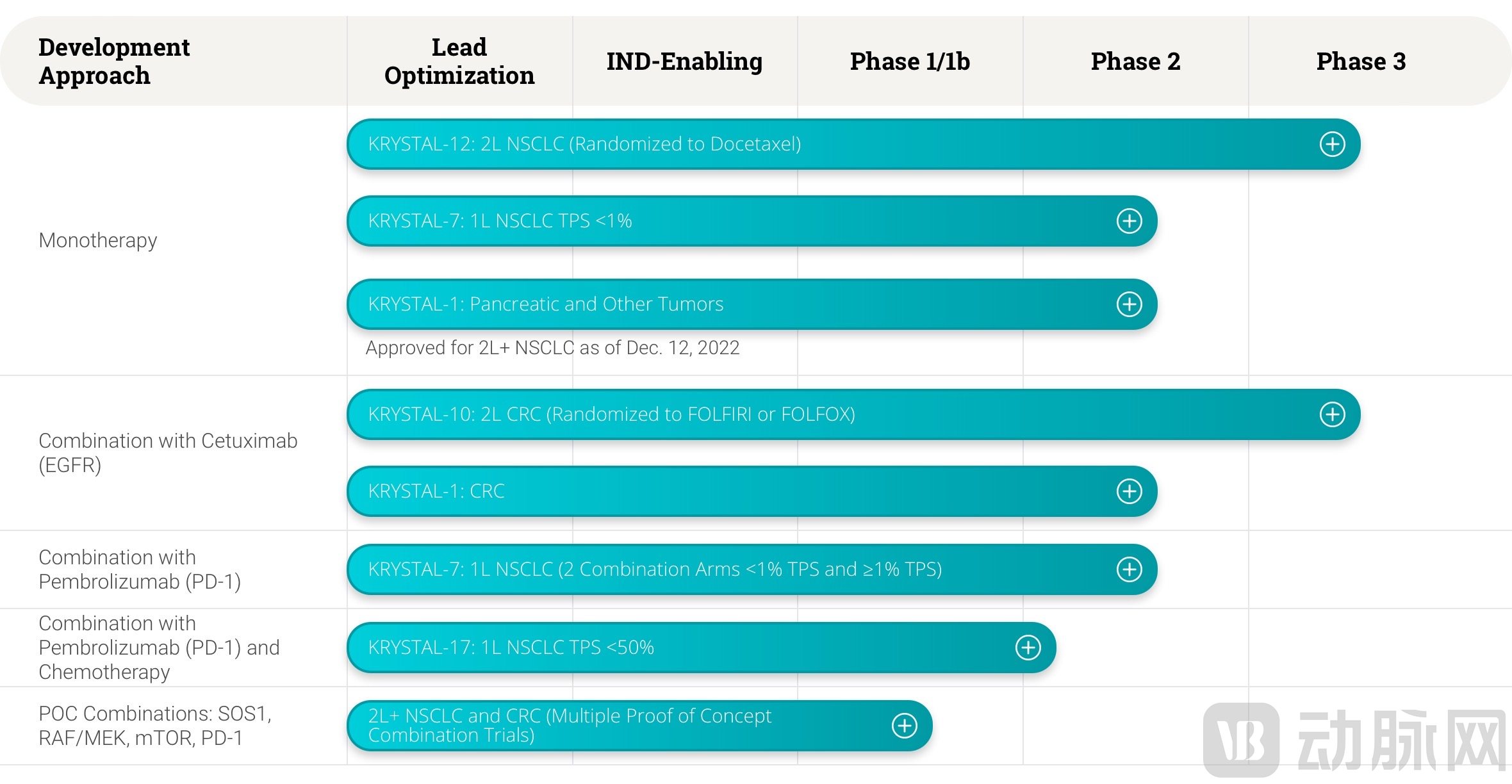
Adagrasib Development Pathway
From a macro perspective, Mirati’s targeted oncology asset portfolio aligns with Bristol Myers Squibb’s (BMS) strategic emphasis on oncology drugs, thereby supporting both monotherapy development and combination therapy strategies. BMS not only directly incorporates Adagrasib, a promising lung cancer drug, into its commercial product portfolio, but also acquires several early-stage clinical assets to bolster its oncology innovation pipeline.
Mirati’s early-stage clinical assets include KRAS G12DThe small-molecule inhibitor MRTX1133, the selective SOS1 inhibitor MRTX0902 that interacts with KRAS, and the first-in-class MTA-cooperative PRMT5 inhibitor MRTX1719 are all in Phase I clinical trials.
MRTX1133-Targeted KRAS G12DMutations are associated with more than 30% of pancreatic cancer patients and are also linked to key tumor types such as non-small cell lung cancer (NSCLC) and colorectal cancer. SOS1 inhibitors may be used in combination with other drugs targeting the MAPK/RAS pathway, including Adagrasib.
MRTX1719 is the first PRMT5-MTA complex inhibitor. PRMT5 is an emerging synthetic lethality target, and its dysregulation is associated with MTAP-deficient cancers. Currently, no inhibitors have been approved for marketing, but major pharmaceutical companies such as GSK, Amgen, AstraZeneca, CSPC Pharmaceutical Group, and Simcere Pharmaceutical have already established their presence in this field.
Compared with the supplementation of BMS's diversified oncology pipeline, what is more striking about this acquisition is its strategic layout in the KRAS track, which undoubtedly serves as a major boost.Just four days after pessimism engulfed the KRAS therapeutic landscape due to the failed approval of Amgen’s Lumakras, the sector has once again been thrust into the spotlight, underscoring the intense attention commanded by drugs targeting the “king of oncology targets.”
Yet greater challenges lie ahead.
Similar to Amgen’s Lumakras, Adagrasib is also following the path from accelerated approval to full approval, facing the same rigorous “conversion” test—Global regulatory oversight of accelerated approval pathways for drugs continues to intensify, with criteria tightening.
Secondly, whether it is Krazati’s net revenue of $13.4 million in three months or Lumakras’s $77 million, the commercial performance of KRAS G12C inhibitors after market launch has fallen short of expectations.Globally, KRAS G12CInhibitors have ushered in a research and development boom, and intense competition within the sector has already begun.
In China, Zai Lab holds exclusive rights to Adagrasib in the Greater China region, while Amgen’s Lumakras has entered into a R&D collaboration with BeiGene; both have currently advanced to Phase III clinical trials. Among domestic R&D efforts, the most advanced candidates include D-1553 (in Phase I/II), co-developed by Chia Tai Tianqing and Yifang Biopharmaceuticals; IBI351, jointly developed by Innovent Biologics and Genfleet Therapeutics; and glecirasib, developed by Jacobio Pharmaceuticals.