

Bringing MRI to the Patient: Marvel Stone's Strategy in Mid-to-High-End, Specialized, Miniaturized MRI Systems

Marvel Stone Healthcare
Developer of Medical Testing Instruments
If you ask clinicians how MRI performs, a common answer is—“Everything is good, except it’s slow, bulky, and expensive.”
The undisputed “gold standard” status of magnetic resonance imaging (MRI) is unquestionable. For years, the industry has been dedicated to improving proton polarization by using higher magnetic field strengths, thereby increasing the available signal to create better images. However, traditional MRI platform technologies have gradually matured, making further breakthrough progress unlikely in the short term. Meanwhile, factors such as operational costs, installation complexity, and accessibility have hindered the widespread adoption of this powerful imaging tool.
At that time, Dr. Wu Ziyue, who was pursuing advanced studies at the University of Oxford in the UK and the University of Southern California in the US, studied under Professor Krishna Nayak, a leading authority in the field of international magnetic resonance. His research focused on fast magnetic resonance imaging for “slow” processes, and his achievements earned him the highest honor for young magnetic resonance scientists worldwide—the “ISMRM Young Investigator Award.”
“However, before embarking on my entrepreneurial journey, I chose to gain experience at China’s first company independently developing superconducting MRI systems. Looking back, I remain deeply grateful for that experience. It provided me with the opportunity to personally tackle technical challenges, collaborate with the team to develop a completely new system from start to finish, and witness firsthand decision-making processes at the corporate level, particularly those beyond pure technology. This gave me a deeper and more comprehensive understanding of the industry. Many outstanding predecessors have raised the bar significantly over the years, making it difficult to achieve qualitative breakthroughs in addressing the issues of size and cost on traditional platforms in the short term. Yet, overcoming these hurdles is essential for improving accessibility. Therefore, we decided to move beyond the conventional mindset of large-scale imaging solutions and seek breakthroughs in niche market segments,” Dr. Wu Ziyue, founder of Wuxi Marvel Stone Healthcare Co., Ltd., shared with VCBeat.
Marvel Stone was founded based on the first “hand-drawn sketch” that emerged from his in-depth discussions with Professor Nayak. In 2019, Wuxi Marvel Stone Healthcare Co., Ltd. successfully secured angel investment and was established in Wuxi, committing to promoting innovative applications of magnetic resonance technology in the medical field. The company’s name is derived from “MARVEL STONE,” reflecting its aspiration to create miracles with small magnets. Its product positioning focuses on “miniaturization and specialization.” Headquartered in Wuxi, Jiangsu Province, the company has R&D and production centers in Chengdu and Hefei, and has established collaborations with numerous major hospitals and universities in China and the United States. Its product portfolio includes detection of fatty liver disease, specialized neurosurgical imaging, early cancer screening, and several extensions beyond medical scenarios. Among these, the bedside fatty liver detector Lively Sensors and the mid-field high-performance Neuro MRI for neurosurgery have made rapid progress and completed type testing.
“We are not replacing traditional radiology MRI, but rather creating miniaturized, customized solutions tailored to the specific characteristics of specialized disciplines and diseases. By integrating these into comprehensive specialty-specific diagnostic and treatment protocols, we enable MRI technology to extend beyond radiology departments into clinical specialties and a broader range of application scenarios.”This is the original aspiration behind the establishment of Wuxi Marvel Stone Healthcare Co., Ltd., and it serves as the guiding beacon for the team’s forward journey.
“Thanks to advances in MR system technologies such as magnets, radiofrequency, sequence programming, and image processing, advanced MR imaging is no longer constrained by the need for high-field-strength magnets,” Dr. Wu Ziyue told VCBeat. “High field strength ≠ high performance.”
For magnetic resonance imaging (MRI) equipment, generally, the stronger the magnetic field, the higher the clarity of the generated images. This is why MRI manufacturers have been pursuing higher-field-strength devices for many years. However, at the same time, MRI scans under higher field strengths correspond to larger equipment and more expensive prices.
First, how is a “good image” defined? Signal-to-noise ratio (SNR) and resolution are important metrics for evaluating image quality, but image quality encompasses more than just these two parameters. Artifacts generated during the imaging process serve as a typical example; susceptibility artifacts become more severe at higher magnetic field strengths, whereas lower field strengths offer better homogeneity and can reduce such artifacts. Furthermore, due to the lower energy requirements, more pulses can be excited per unit time, thereby improving scanning efficiency.
Additionally, due to the inherent properties of soft tissues, signal decay is slower at low magnetic field strengths. This is particularly beneficial for moving organs and those containing air cavities, such as the lungs. While these areas are typically challenging or contraindicated for imaging on traditional high-field MRI systems, reducing the field strength slows signal decay, thereby enabling superior image quality. Furthermore, low-field MRI systems generate less acoustic noise, enhancing the experience for both patients and technologists. The equipment is also more compact and lightweight, imposing fewer requirements on installation sites.
“Based on the physical properties of low-field systems, high-quality images can also be achieved at low field strengths. Simply transplanting imaging methods from high-field to low-field systems will indeed yield suboptimal results. This, in fact, places greater demands on our product’s original innovation capability,” summarized Dr. Wu Ziyue.
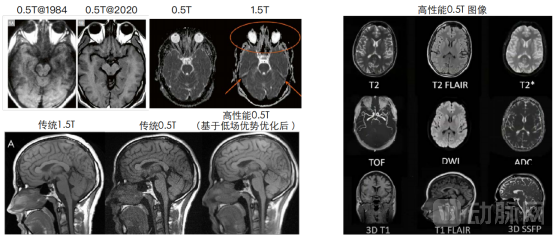
High-field strength is not the only prerequisite for high-quality imaging; 0.5T systems can far exceed conventional expectations. Image provided by Wuxi Marvel Stone Healthcare Co., Ltd. (partially adapted from [3]).
“Similarly, the miniaturization of MRI products cannot be achieved through proportional scaling; instead, entirely new form factors must be designed based on specialty-specific needs,” Dr. Wu Ziyue explained to VCBeat. Although major medical imaging manufacturers possess the technological and talent foundations, large-scale imaging systems and miniaturized devices represent two fundamentally different product philosophies. Not only does this require a complete redesign from scratch, but the R&D process must also navigate around the patent barriers established by first-movers, in addition to demanding substantial investments of time, cost, and manpower.
Although specialty-specific customization cannot account for generalizability, it does not diminish the diagnostic value for target indications. Only by ensuring that clinical departments find such solutions affordable, easy to integrate, and reliable in use can broader adoption beyond radiology departments be achieved.
After years of development and accumulation, Wuxi Marvel Stone Healthcare Co., Ltd. now possessesMiniaturized Multi-Parameter Quantitative PlatformandLightweight Mid-Field System Featuring High-Efficiency Imagingtwo major technology platforms, from which are derivedLively Sensors bedside fatty liver detector, Neuro MRI mid-field high-performance dedicated neurosurgical magnetic resonance imaging, tumor screening magnetic resonance imagingandOn-Site Testing of Industrial Crude OilFour Products.
In terms of product pipeline strategy, Wuxi Marvel Stone Healthcare Co., Ltd. leverages the characteristics of low-field nuclear magnetic resonance (LF-NMR) technology to develop specialized applications tailored to specific medical specialties and diseases, providing customized comprehensive diagnostic and therapeutic solutions for each specialty. Given the long development cycles and substantial investments required for medical device R&D, the company also deploys non-medical application equipment to generate revenue and ensure sustainable growth.
Among these, the Lively Sensors bedside fatty liver detector is one of the company’s medical product lines with relatively rapid progress; it has completed type testing and is currently under application for innovative medical device designation.
From the developmental trajectory of fatty liver disease, a healthy liver remains in a reversible stage as it progresses to non-alcoholic fatty liver disease (NAFLD) and further to non-alcoholic steatohepatitis (NASH). Beyond this point, the condition evolves into a partially reversible or irreversible stage. Therefore, early detection, diagnosis, and treatment play a crucial positive role in preventing progression to moderate and advanced stages of the disease.
Currently, liver biopsy pathology remains the “gold standard” for diagnosing non-alcoholic fatty liver disease (NAFLD), particularly non-alcoholic steatohepatitis (NASH). However, liver biopsy is invasive and is not suitable for patients with poor coagulation function, massive ascites, extrahepatic obstructive jaundice, hepatic hemangioma, hepatic echinococcosis, coma, or other conditions that prevent cooperation; it is also unsuitable for frequent use during early-stage follow-up. Although ultrasound, which is widely used, is cost-effective and rapid, it is more appropriate for patients with hepatic fat content exceeding 30% and only allows for qualitative assessment. There is currently no diagnostic tool available on the market capable of providing timely and adequate warning before permanent liver tissue damage occurs.
Meanwhile, the lack of ideal monitoring methods has also made the clinical validation of NAFLD therapeutic drugs time-consuming and labor-intensive for the pharmaceutical industry. As major pharmaceutical companies advance their related drug pipelines, there will be an explosive growth in demand, both for equipment in the early stages of drug development and for diagnostic tests to complement pharmacological treatment.
Although traditional quantitative magnetic resonance imaging (MRI) protocols have been widely accepted as the optimal non-invasive independent biomarkers, particularly for the quantitative assessment of hepatic steatosis and fibrosis, experts in both China and the United States agree that they can replace liver biopsy as the endpoint for drug evaluation in clinical trials. However, due to limited resource availability and high costs, these protocols cannot be widely adopted or recommended as first-line diagnostic or screening tools.
Lively Sensors, a bedside fatty liver detector independently developed by Marvel Stone, effectively addresses the aforementioned challenges. Requiring no shielded room, it enables one-click scanning to quantitatively assess three key indicators—fat content, fibrosis, and inflammation—within five minutes. Featuring non-invasive measurement, absence of ionizing radiation, low cost, accurate quantification, ease of operation, and no special configuration requirements, it is well-suited for outpatient clinics and primary care hospitals. In the future, the device can be further miniaturized for portability and extended to health checkup centers, gyms, and even individual users.
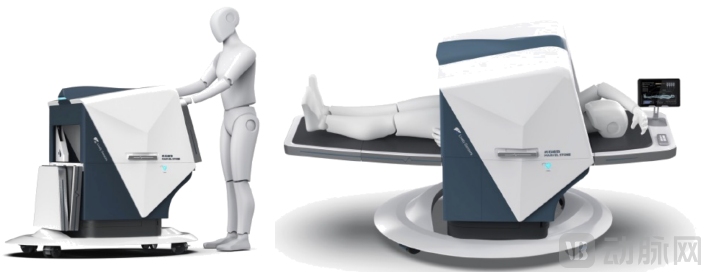
Lively Sensors Point-of-Care Fatty Liver Detector
As a specialized device, Marvel Stone’s system is designed based on the clinical departments’ need for quantitative values rather than images, unlike the radiology department’s focus. It employs natural gradients from unilateral magnets for spatial selection of specific regions, instead of traditional homogeneous field designs. This approach eliminates the gradient system typically required in MRI, thereby enhancing scanning efficiency while achieving precise quantification. Its innovative design features a compact magnet paired with customized RF coils, significantly improving suppression of subcutaneous fat signals. By accepting signals only from specific liver regions and avoiding interference from subcutaneous fat layers, it ensures that variations in patient body shape do not affect test results.
The concise, automated one-click rapid measurement operation avoids subjective errors caused by technician technique, fundamentally eliminating the labor-intensive barriers to the large-scale adoption of hepatic steatosis monitoring. By independently mastering core technologies and leveraging a mature, comprehensive supply chain, this product achieves “MRI-level precision at the cost and form factor of ultrasound.”
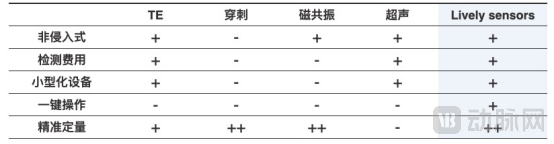
Marvel Stone's Bedside Fatty Liver Detector Lively Sensors vs. Other Technologies
Currently, there are several companies both in China and abroad focusing on the development of miniaturized MRI systems. So, what are the competitive advantages of Wuxi Marvel Stone Healthcare Co., Ltd.?
“Beyond our robust original innovation capabilities, our greatest advantage lies in our ability to identify growth focal points that are both technically and commercially viable,” summarized Dr. Wu Ziyue.First, there is the first-mover advantage.Miniaturization of MRI products is not a proportional scaling-down, but rather requires the design of entirely new form factors based on specialty-specific needs. Leveraging its first-mover advantage, the company has accumulated extensive experience, technological reserves, and patent portfolios.Next is a highly cohesive and synergistic team.The company’s core team has known each other for many years and boasts a “proven record” widely recognized both domestically and internationally in terms of original technological innovation, full-lifecycle experience in industrial system-level product development, and team cohesion.Furthermore, it enjoys globally leading academic and supply chain resources.Wuxi Marvel Stone Healthcare Co., Ltd. is the first enterprise in China to conduct research on miniaturized specialized MRI equipment, possessing world-class academic and external expert resources. Meanwhile, its independent R&D capabilities for core technologies and control over customized supply chain requirements enable it to sustainably maintain a preemptive advantage in technological leadership.Finally, a broad international perspective.The company’s DNA and competitiveness dictate that overseas markets will undoubtedly become a powerful driver of future performance growth.
Wuxi Marvel Stone Healthcare Co., Ltd. “does not sell traditional large-scale equipment, nor does it engage in traditional large-scale imaging.” Instead, it targets specialized hospital departments, precisely meeting their clinical needs. In product development, the company maintains a structured approach and sustained momentum by “launching one generation, developing the next, and reserving the following generation.”
Large-scale MRI systems are immobile, whereas portable MRI devices, leveraging their lightweight and mobile design, shift the paradigm from “moving the patient to the scanner” to “bringing the scanner to the patient.” This significantly enhances the accessibility and convenience of imaging, holding particular significance in scenarios such as early disease screening and follow-up (capitalizing on the unique advantages of soft-tissue imaging), emergency care (where every second counts in delivering timely treatment during the golden hour), intensive care units (reducing risks associated with patient transport), and primary healthcare settings (offering moderate pricing and greater accessibility).
During the interview, Dr. Wu repeatedly emphasized to VCBeat that “Wuxi Marvel Stone is not aiming to replace traditional radiology MRI systems; rather, it seeks to create compact, customized solutions tailored to the characteristics of specific specialties and diseases, thereby maximizing the potential of MRI technology by pioneering novel applications.” We also look forward to Wuxi Marvel Stone rising to prominence and leading the technological revolution in MRI accessibility.
References:
1. VCBeat “Marvel Stone: The Future of Portable Quantitative Fatty Liver Detection | ChinaBang Innovative Enterprises”
2. [Profile] Wu Ziyue of Marvel Stone: Pioneering the Miniaturization of MRI
3、MAGNETOM Free.Max special issue RSNA Edition 2020