

Behind Over 200 Pharma M&A Deals in A-Share Market in the Past Three Months: Drugmakers Navigate the Winter with Diverse Strategies

CSPC Megalith Biopharmaceutical
Biopharmaceutical R&D and Manufacturing Company
Kelun-Biotech
Innovative Drug Developer
Junshi Biosciences
Innovative Drug Developer
Amid the Capital Winter in Healthcare, M&A Activity Continues to Rebound.
According to data from Hithink RoyalFlush, in the first half of this year (as of July 5), a total of 268 M&A transactions were disclosed in the A-share pharmaceutical sector. This figure represents a twofold increase compared to the same period last year.
In the second half of the year, as IPOs were tightened in phases, the M&A boom in the A-share market intensified further.
According to VCBeat’s statistics based on Choice data (counting by initial announcements and excluding suspended deals), as of September 27, the number of M&A transactions in the A-share pharmaceutical sector (including distribution) had exceeded 220 in the third quarter. Biopharmaceuticals emerged as the most active segment for M&A activity in the A-share market.
Amid the “harsh winter,” leading pharmaceutical companies still have “financial reserves” and are in urgent need of “new growth narratives,” while Biotech firms face surging growth pressures, strengthening mutual M&A intentions. Meanwhile, after two years of development, valuations of promising domestic Biotech targets have declined, highlighting their consolidation value. Coupled with policy tailwinds and increased pressure for financial exits following tighter IPO regulations, these three converging factors have ushered in this year’s wave of mergers and acquisitions.
The underlying logic is that the rapid consolidation of China’s pharmaceutical industry is unfolding at just the right time.
Currently, an increasing number of pharmaceutical companies are standing at a crossroads of “rise” or “decline.” Advance means “leaping up the ranks,” while retreat means “being eliminated.” According to the interim financial reports of 488 pharmaceutical companies listed on China’s A-share market, 414 companies were profitable in the first half of the year, while 74 incurred losses. Among them, 30 companies reported losses exceeding RMB 100 million, with the innovative drug sector being the hardest hit. A domestic “ranking competition” among pharmaceutical companies has already begun.
“Cold Current” Hits: Pharma Companies Seek Change
Established pharmaceutical companies are in urgent need of a “new narrative.”
In the first half of 2023, the overall operating revenue of pharmaceutical and biotechnology companies listed on China’s A-share market increased by 4.21% year-on-year, while net profit attributable to shareholders of the parent company decreased by 20.89% year-on-year. Amid slowing growth and rising revenue without corresponding profit gains, major pharmaceutical companies are likewise experiencing significant anxiety this year.
In the M&A market, unlike multinational corporations (MNCs) that frequently pursue external acquisitions worth billions of dollars, the “new narrative” for major Chinese pharmaceutical companies this year begins from within.
Based on Choice data, VCBeat has compiled 220 M&A transactions since July 1. Approximately 60% of these deals involved buyers with affiliated relationships to the disclosing parties (including the companies themselves, wholly-owned subsidiaries, listed subsidiaries, and minority shareholders).Data indicates that the primary driver behind the current wave of mergers and acquisitions is “internal optimization,” which has become the top priority for large pharmaceutical companies.
In terms of sector focus, the main theme for large pharmaceutical companies in the Q3 M&A market was a dual emphasis on R&D and commercialization. Of the 220 healthcare M&A deals, approximately 60% were aimed at strengthening R&D and production capabilities, while nearly 20% were focused on expanding into emerging markets and pharmaceutical distribution.
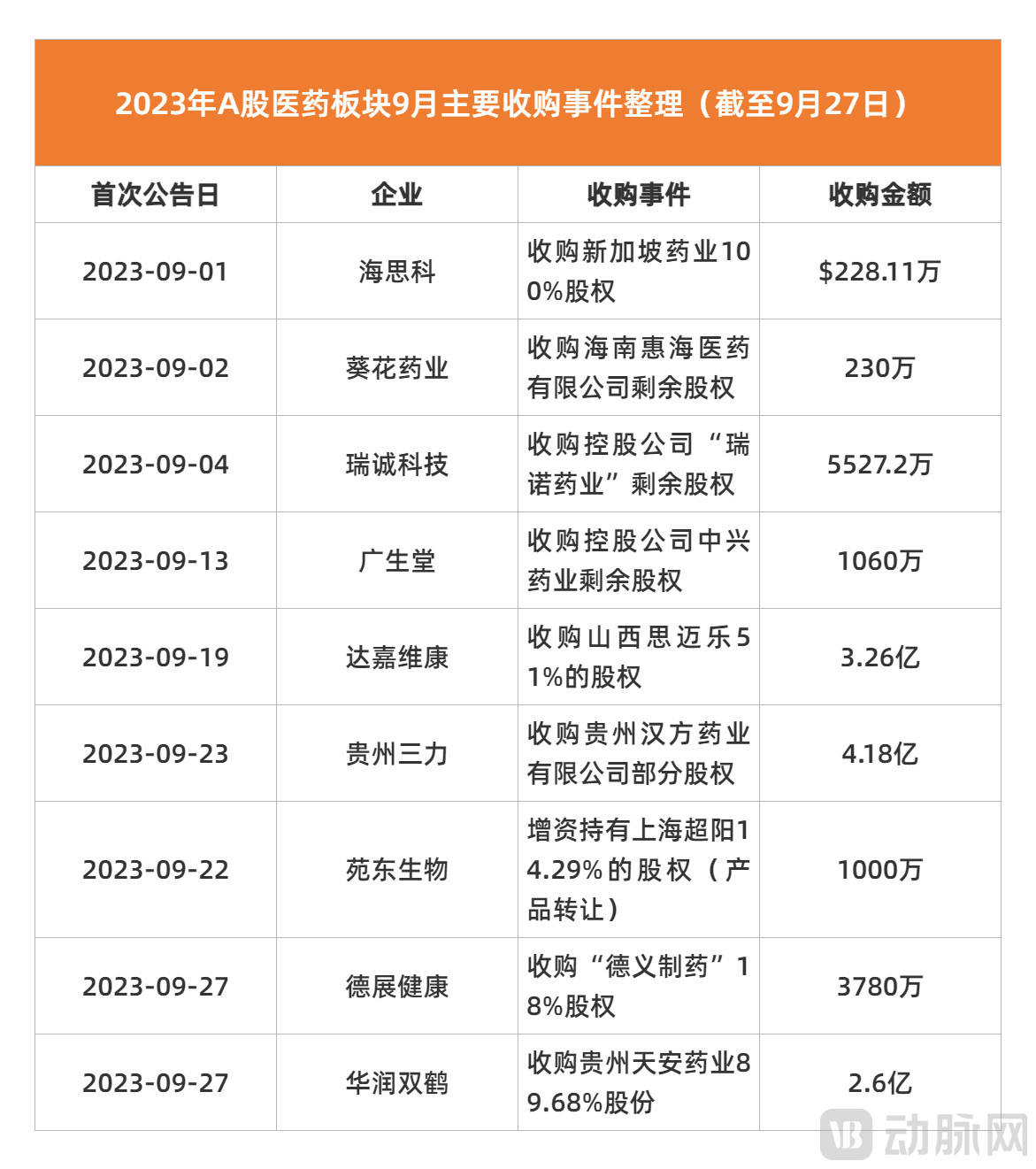
VCBeat has detailed the major acquisition events in September, with large-scale deals concentrated in product acquisitions and pharmaceutical distribution.
A closer look at the pathways through which pharmaceutical companies acquire products—aside from China Resources Double-Crane and Guizhou Sanli, which continue to see substantial capital inflows for direct external acquisitions, a growing number of pharmaceutical firms are acquiring the remaining equity stakes in their original holding companies. This strategy aims to strengthen corporate control and enhance efficiency in R&D or commercialization.
Furthermore, pharmaceutical companies are placing greater emphasis on marketing and sales. For instance, Haisco Pharmaceutical acquired Singapore Pharmaceuticals to intensify its overseas expansion, while Kuihua Pharmaceutical acquired “Huihai Medicine” to accelerate its layout in the distribution channel.
Compiled by VCBeat based on Choice data
Under the overarching theme of “prioritizing internal optimization,” the total value of mergers and acquisitions (M&A) remained modest in the first three quarters, despite a doubling in the number of M&A deals. According to incomplete statistics from Zero2IPO Research, approximately 280 M&A transactions occurred in the biopharmaceutical industry by mid-October 2022, with a total transaction value exceeding RMB 70 billion. In contrast, there were 308 M&A deals throughout the entire year of 2021, with a total transaction value of RMB 251.625 billion.
Amid the downturn in pharmaceutical funding, returning to core businesses, expanding market networks, and focusing on high-potential pipelines have become the main themes for pharmaceutical companies seeking change this year.
Clearly, at the current stage, these major pharmaceutical companies believe that absolute scale is more important than relative scale. They are no longer keen on “horizontal acquisitions” but are more focused on the commercialization of products related to their core therapeutic areas of expertise. They achieve sustainable growth through “internal M&A and restructuring” and cautious “product in-licensing.”
At this time, state-owned assets are the main players in the "large-scale" acquisitions.
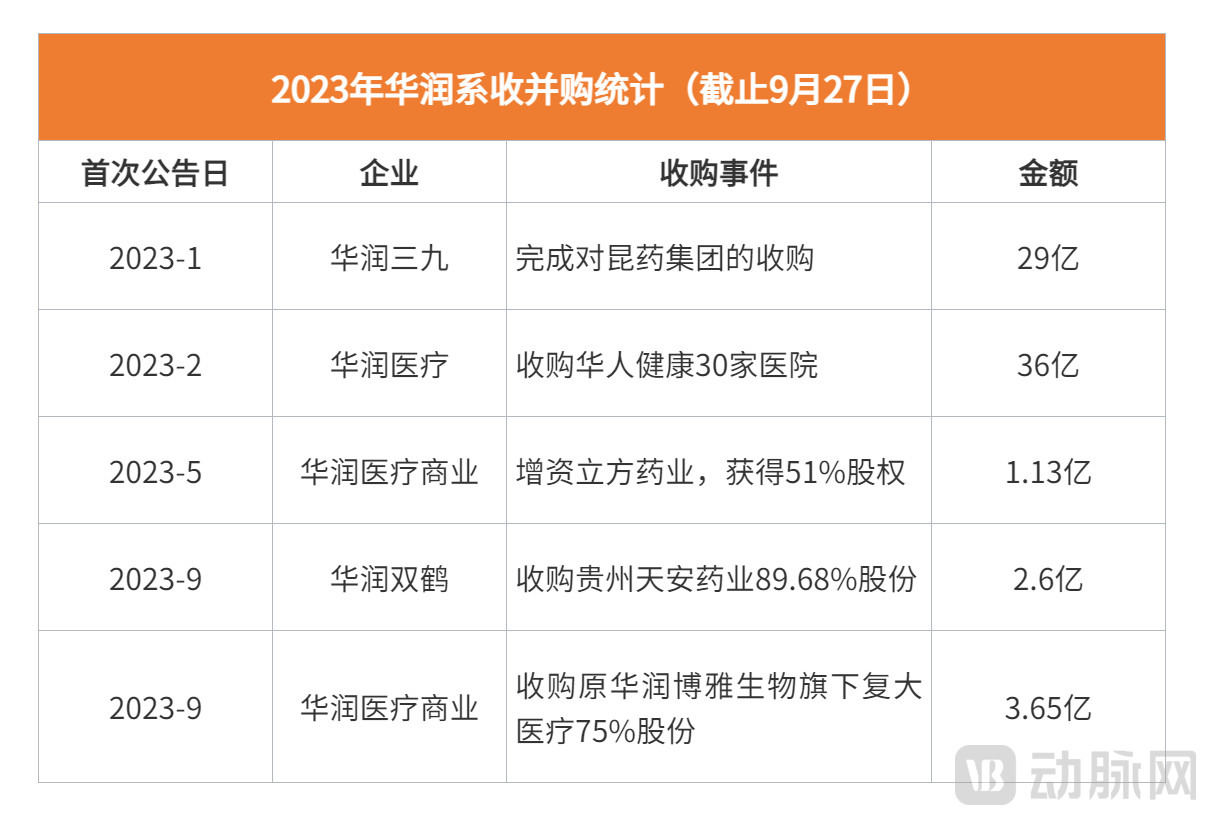
For example, China Resources Pharmaceutical, backed by a central state-owned enterprise, has been on a buying spree from the beginning of the year to the present, showing no signs of stopping.
Amid this wave of intensive acquisitions, China Resources Pharmaceutical, as a distribution giant, has made significant inroads into the pharmaceutical manufacturing sector, further underscoring the determination of major domestic pharmaceutical companies to transition from generic drugs to innovative therapies.
Compiled by VCBeat based on Choice data
In the first three quarters, China Resources Pharmaceutical’s largest M&A deal remained within the pharmaceutical segment.
At the beginning of the year, after CR Sanjiu integrated Kunyao Pharmaceutical for RMB 2.9 billion, its revenue in the first half of 2023 surpassed RMB 10 billion. Through continuous acquisitions, CR Sanjiu has not only expanded its business segments but also rapidly increased its asset scale. Over the past five years, its total assets have more than doubled, rising from RMB 18 billion to RMB 38.866 billion by the end of June.
Within the same system, China Resources Double-Crane Pharmaceutical, in addition to acquiring Guizhou Tianan Pharmaceutical for RMB 260 million in September to bolster its competitiveness in the diabetes sector, also spent approximately RMB 800 million last year to complete the acquisitions of two active pharmaceutical ingredient (API) manufacturers: Tiandong Pharmaceutical and Shenzhou Biologics.
A review of China Resources Pharmaceutical’s acquisitions reveals both horizontal deals aimed at expanding scale and vertical integrations designed to consolidate the supply chain. As a “super buyer” in China’s pharmaceutical industry, the China Resources Pharmaceutical Group has acquired four listed companies over the past five years—namely Jiangzhong Pharmaceutical, Boya Bio-pharmaceutical, Dirui Medical, and Kunming Pharmaceutical Group—with total expenditures exceeding RMB 13.6 billion, primarily in the pharmaceutical manufacturing sector.
According to Tianyancha, China Resources Pharmaceutical currently has more than 730 member enterprises under its umbrella. It controls eight listed companies within its system, with a combined market capitalization exceeding RMB 200 billion.
Following a period of rapid expansion, China Resources Pharmaceutical has demonstrated a clear trend toward “innovative transformation” over the past two years. According to its financial report, the group’s total R&D expenditure in the first half of the year reached HK$1.174 billion, representing an increase of approximately 26% when converted into RMB. Senior management disclosed that the company will continue to strengthen R&D efforts in the two key areas of innovative biologics and innovative chemical drugs.
This trend toward transformation is also reflected in the M&A landscape. For instance, last July, China Resources Pharmaceutical invested RMB 800 million in Yongtai Biologics, a cell therapy company. According to insiders, the company’s target selection strategy “focuses primarily on high-quality assets in the fields of self-care, biologics, innovative drugs, and specialized generics.”
CR Pharma’s M&A Activities to ContinueOn September 27, CR Pharmaceutical Group released its interim report, stating that it will continue to prioritize resource integration as a core strategy. The company emphasized its focus on seizing M&A and integration opportunities involving leading enterprises and key product lines within niche segments.
“Bold moves and aggressive entry”—this M&A strategy adopted by China Resources Pharmaceutical is also a major characteristic of the “high-profile, high-impact” approach taken by state-owned enterprises in this year’s A-share M&A market.
In June 2023, the State-owned Assets Supervision and Administration Commission (SASAC) clarified requirements such as “central state-owned enterprises shall leverage listed companies as platforms to carry out mergers and acquisitions and restructuring, thereby helping to enhance core competitiveness and strengthen core functions.” As a national strategic industry, the biopharmaceutical sector has seen vigorous entry by state-owned capital through M&A, reflecting a national-level vision to support the rapid growth of leading pharmaceutical enterprises.
The development of the pharmaceutical industry, particularly the advancement of pharmaceutical innovation, has always required a strong alliance between “technology and capital.” Meanwhile, mixed-ownership reform of state-owned enterprises (SOEs) has become a major theme in the current capital market, with local state-owned assets accelerating their consolidation of the pharmaceutical industry since 2020.
This year has seen even greater momentum. In September, Gansu State-owned Capital Investment Group planned a tender offer to acquire Foci Pharmaceutical, which had a market capitalization of RMB 5.464 billion. In July, the Shanxi Provincial State-owned Assets Supervision and Administration Commission (SASAC) and the Baoji Municipal SASAC jointly reacquired Ziguang Chenji Pharmaceutical, a “century-old pharmaceutical enterprise” previously acquired by Japanese investors.
And driven by Hefei Industrial Investment Group and Feidong County of Hefei City, Haisheng Biopharmaceutical has embarked on a “non-mainstream” development path. In the first half of this year, the company successively completed the acquisition of Rocephin® in mainland China and obtained exclusive licenses for the commercialization rights of Stilamin® in the Greater China region and Switzerland.
Subsequently, on September 12, it introduced LIB Therapeutics’ third-generation long-acting PCSK9 inhibitor. With this addition, the biotech company, established less than three years ago, not only holds a portfolio of seven mature products but also broke into the top 10 global biomedical financings in the first half of the year. Rewinding to December 2020, Haishen Biopharma, merely three months after its inception, boldly announced the acquisition of divested assets from Takeda Pharmaceutical, a top-10 global pharmaceutical company. The confidence behind this move stemmed precisely from “state-owned capital strength.”
After state-owned capital platforms enter the pharmaceutical industry, their advantages are self-evident: strong resource acquisition capabilities, relatively lower costs, long exit horizons, no pressure to exit, and the ability to provide long-term holding and support.
This year, local governments across China have incorporated the development of the biopharmaceutical industry into their key performance indicators (KPIs).
By July, more than 20 policy measures had been introduced across various regions in China to encourage the development of the biopharmaceutical industry. In addition to the Yangtze River Delta, Beijing-Tianjin-Hebei, and Pearl River Delta regions, many second- and third-tier cities have also rolled out supportive policies covering industrial park planning, output value targets, and special fund support.
Amid the downturn in investment and financing, state-owned capital has become a stabilizing force. However, whether the influx of more “state-owned newcomers” into the pharmaceutical industry will face adaptation challenges and what their ultimate performance will be remain to be seen.
Bidding Farewell to the Era of Rapid Growth, the Iteration Speed of Emerging Technologies and Therapies Has Become the Greatest Variable in the Pharmaceutical Industry.
Over the past two years, major pharmaceutical companies have been aggressively increasing their R&D investments.
In terms of scale, the total R&D investment of listed pharmaceutical companies exceeded RMB 100 billion in 2022, a year-on-year increase of approximately 15%; in the first half of 2023, R&D spending continued its “significant leap,” growing by about 18%.
In terms of specific pipeline development, major pharmaceutical companies are engaged in fierce competition. For instance, in the field of new antibody-drug conjugate (ADC) drugs, approximately 100 ADC new drugs had been filed for approval in China by the end of June 2023. Among these, Hengrui Medicine and Bio-Thera Solutions each filed seven ADC new drugs; CSPC Pharmaceutical Group, DuoXi Biologics, and Lepu Biopharma each filed five ADC new drugs; RemeGen, Kelun-Biotech, Duality Biologics, Baili Pharmaceutical, and Fudan-Zhangjiang each filed four ADC new drugs; while Bilexikon and Minghui Pharmaceutical each filed two ADC new drugs.
From the perspective of technological competition, acquiring from external sources is naturally the optimal solution.But the current reality is that everyone is “tightening their belts.” Thus, making every effort to revitalize existing capital pools has become a pragmatic choice for pharmaceutical companies to weather the winter.
On August 30, CSPC Innovation Pharmaceutical Co., Ltd., the A-share listed platform spun off from CSPC Pharmaceutical Group, announced that it is planning a cash capital increase in CSPC Megalith Biopharmaceutical Co., Ltd. By investing RMB 1.87 billion to acquire a 51% equity stake, the company aims to achieve controlling interest in CSPC Megalith Biopharmaceutical.
Bringing innovative drugs from H-shares back to A-shares is not only a choice forced by circumstances for CSPC Pharmaceutical Group, but also a crucial step in its full-throttle push into innovative medicines. Perhaps this move embodies even greater ambition: they hope to recreate another “CSPC” on the A-share market.
According to the financial report, CSPC Pharmaceutical Group’s primary revenue source is currently the sales of finished pharmaceutical products. However, the growth rate of the finished pharmaceuticals segment has declined for three consecutive years, dropping to 5.2% in the first half of 2023. Viewed against the broader performance, overall revenue growth nearly stagnated in the first half, with revenue reaching RMB 16.08 billion, representing a year-on-year increase of only 3%.
Revenue growth has hit a ceiling, and its core product, NBP (Butylphthalide Sodium Chloride Injection), is facing a patent cliff, with a surge in competitors for its key products.
Reflected in its stock price, the trend has been one of “relentless decline.” After reaching an all-time high of HK$12.29 per share in June 2021, CSPC Pharmaceutical Group’s stock price plunged continuously. As of October 10, it had fallen to HK$5.83 per share, with its market capitalization dropping to HK$65.8 billion—more than halved from its peak.
CSPC is in urgent need of a new growth breakthrough. At this juncture, its innovative drug division—Megalith Biopharmaceutical—must go into “sprint mode.”
Megalith Biopharma’s pipeline is primarily structured as a tiered portfolio of “biosimilars/monoclonal antibodies + antibody-drug conjugates (ADCs) + mRNA.” According to available data, one mRNA vaccine, SYS6006, has been launched, marking it as the first and currently the only approved COVID-19 mRNA vaccine in China. The company has more than 20 projects in development, with eight products either in clinical trials or under regulatory review for market approval: two are in the pre-marketing application stage, three are in Phase II/III clinical trials, and three are in Phase I clinical trials. Notably, its most advanced candidates, the CLDN18.2 ADC and Nectin-4 ADC, were out-licensed to Elevation Oncology and Corbus Pharmaceuticals, respectively, in the past two years, enabling their international expansion.
Currently, the company is still operating at a loss but has reached a critical stage of crossing the revenue break-even point.
CSPC Innovation Pharmaceutical is one of the few A-share listed platforms under CSPC Group, boasting excellent financial health. As the world’s largest producer of chemically synthesized caffeine, CSPC Innovation Pharmaceutical reported a net profit of RMB 726 million in 2022, representing an 84% year-on-year increase. The subsidiary’s ample cash flow and strong liquidity have provided the impetus for CSPC Group’s recent internal restructuring.
It is widely believed within the industry that following Megalith Biopharmaceutical’s injection into the A-share market from the H-share market, the valuation of the innovative drug sector may be further amplified, and the industrial translation of technological achievements is also expected to accelerate.
CSPC Pharmaceutical Group’s continued 51% controlling stake in Sinobioway further demonstrates its strategic acumen. This structure allows the group, in full compliance with regulatory requirements, to retain within its Hong Kong-listed parent company a portion of the equity interests in highly promising innovative drugs, thereby minimizing any adverse impact on the parent company’s market capitalization.
Currently, leveraging their resource and capital advantages to execute sophisticated strategies in the secondary market is a core competency that established pharmaceutical companies have cultivated through years of immersion in the capital markets.
Globally, the cyclical pattern of consolidation followed by divestiture—and vice versa—is a recurring theme in the business operations of major pharmaceutical companies. This year, the separation of innovative drugs from generic drugs appears to be a growing trend. Recently, Novartis spun off its generics subsidiary, Sandoz, for listing on the SIX Swiss Exchange. Senior executives at Novartis stated that this move aims to streamline operations, sharpen focus, and double down on innovation.
The same holds true in China. This July, Kelun Pharmaceutical spun off its innovative drug segment, Kelun-Biotech, for a listing on the Hong Kong Stock Exchange.
Kelun-Biotech has long been regarded as a star player in China’s ADC sector. Currently, it is advancing 33 differentiated and clinically valuable pipeline assets (including five in pivotal trials or at the NDA registration stage, nine in Phase I or II trials, and four in IND preparation). Its two core ADC drugs (SKB264 and A166), along with an upcoming PD-L1 inhibitor (A167), are viewed most favorably.
Leveraging its technological advantages, Kelun-Biotech has forged deep partnerships with pharmaceutical giants.Through license-out deals, Kelun-Biotech partnered with Merck & Co. twice within two months. From May 2022 to July 2022, Kelun-Biotech consecutively granted Merck & Co. licenses to develop, use, and commercialize two products, SKB264 and SKB315, outside the Greater China region.
Subsequently, the partnership was upgraded. In December 2022, Kelun-Biotech and Merck & Co. entered into an exclusive license and collaboration agreement to develop up to seven preclinical ADC assets for the treatment of cancer.
Earlier this year, Kelun-Biotech further strengthened its ties with Merck & Co. In January 2023, Kelun Pharmaceutical officially announced the spin-off and listing of Kelun-Biotech. Prior to the listing, Kelun-Biotech initiated its Series B financing round, in which Merck & Co. invested $100 million, becoming its second-largest shareholder.
Relying on overseas product licensing, Kelun-Biotech saw a significant financial recovery in the first half of the year. Notably, revenue of RMB 1.037 billion was recognized from licensed projects with Merck & Co., resulting in a net loss of RMB 31 million, representing an 88.51% year-on-year reduction in losses. The company is now poised to begin generating its own internal cash flow.
Indeed, Kelun-Biotech listed on the Hong Kong Stock Exchange in July, launching the largest IPO under Chapter 18A of the Hong Kong listing rules in two years. Currently, Kelun-Biotech’s market capitalization has exceeded HK$17 billion. Thanks to a significant reduction in losses within its innovative drug segment, Kelun Pharmaceutical joined the “RMB 10 Billion Revenue Club” for the first time in the first half of 2023. From a value perspective, Kelun-Biotech has completed its transition from being a recipient of financial support to becoming a contributor that feeds back into the parent company.
Observing the path of Kelun’s innovative drugs to “break through,” on one hand, it is evident that domestic innovative drugs in specific fields are basically no longer lagging behind the global pace;On the other hand, it also provides a reference for the development path of emerging domestic biotech companies—biotech firms partner with large pharmaceutical companies, with biotechs responsible for bold innovation and big pharma responsible for validation and driving commercialization.
With insufficient “ammunition,” Biotech will inevitably face greater challenges in continuing the race.
On September 10, Junshi Biosciences issued an announcement regarding external investment and related-party transactions.
The announcement stated that, to accelerate the research and development of Junshi Biosciences’ pipeline projects and optimize resource allocation, the Company, its wholly-owned subsidiary Junshi Engineering, and Suzhou Junmeng intend to enter into a Joint Venture Agreement with Shanghai Anlingke Biopharmaceutical Co., Ltd. (hereinafter referred to as “Anlingke Bio”) and Feng Hui, a Non-Executive Director of the Company. The Company plans to contribute assets related to two preclinical oncology pipeline projects and certain patent rights, valued at RMB 30.5978 million, in exchange for a subscription of RMB 140,000 in the newly increased registered capital of Anlingke Bio.
Annual Fundraising, Annual Losses: Junshi Biosciences, One of China’s “PD-1 Four Little Dragons,” Begins Selling Technology. Pessimists Lament the Difficult Times, While Optimists See a “Desperate Struggle for Survival” Behind This Deal. According to the announcement, Feng Hui is a former executive director and core technical personnel at Junshi Biosciences. Junshi Biosciences has invested its preclinical pipeline into a new joint venture, with the precise aim of safeguarding its technology.
Following these maneuvers, the company has not only secured Feng Hui’s continued involvement in the subsequent development and commercialization of the clinical project but also opened up channels for future financing rounds. Meanwhile, this approach enables a reduction in R&D expenditure and an enhancement of valuation, thereby helping the company navigate the prolonged period of losses prior to achieving profitability.
To weather the “harsh winter,” Junshi Biosciences has also begun adopting a more pragmatic and restrained R&D model. This indicates that the previous growth strategy employed by biotech companies—relying on heavy R&D spending and expanding multiple pipelines to boost corporate valuations and secure greater cash flows—is losing its effectiveness. In the past, continuous equity financing had consistently provided Junshi Biosciences with financial support.
Going forward, as the financing environment remains sluggish, biotech companies will introduce capital through more flexible and diversified means. “Collaborative R&D, joint fundraising, and shared R&D risks” will become the prevailing trend. The window of opportunity in which biotechs could achieve a “class leap” by going it alone is gradually disappearing.
Meanwhile, business development (BD) collaborations among biotech firms represent another form of “huddling together for warmth.”
According to statistics from EYao Manager, domestic business development (BD) transactions between Chinese pharmaceutical companies in the new drug R&D sector during the first three quarters of this year have been growing at an average rate of one deal per month. The “internal circulation” of BD activities among pharmaceutical companies is gradually being activated.
Environmental changes have never been able to alter the direction of industrial megatrends. What changes are only the structure, methodology, speed, and the key players holding sway.
In the first half of the year, the scale of China’s pharmaceutical industry continued to expand. Major pharmaceutical companies have grown stronger, while those challenging the dominant players are also established industry leaders.
According to financial reports, a total of 27 pharmaceutical companies reported revenues exceeding RMB 10 billion, an increase of six year-on-year. The threshold for the top 10 by revenue rose to RMB 20 billion for the first time. Among the top 10 by net profit, WuXi AppTec surpassed RMB 5 billion for the first time, while Kelun Pharmaceutical, Yunnan Baiyao, and China Resources Sanjiu, among others, hit record highs...
Among the sub-sectors, innovative drugs recorded the highest year-on-year revenue growth rate, surging by 59.03%. Perhaps it is precisely because they are in the midst of a “winter” that domestic innovative drugs are accelerating their “awakening.”