

RootPath Slashes Gene Synthesis Costs by 70% and Demonstrates Early Efficacy of Synthetic TIL Therapy in Solid Tumors

RootPath
Developer of New Anti-Cancer Drugs
During my university years, I could not foresee the connections between the events that unfolded. Looking back now, I realize that everything has become clear. No one can predict the future; it is only in retrospect that we can discern the cause and effect. You must believe that intuition, destiny, and causality—these fragments will eventually connect to pave the way forward, giving you the confidence to follow your heart. Even if you are not favored at the time, we should not stop moving forward. Only in this way can we achieve something remarkable.
—Excerpt from Steve Jobs’ 2005 commencement address at Stanford University
“Looking back now, every step I took in the past seems interconnected, although at the time, I certainly could not have predicted how things would unfold years later. Back then, I simply believed that through parameter measurement and algorithm development, I could accurately predict the thermodynamics and kinetics of reactions between DNA molecules. However, I did not know specifically what problems these efforts would solve. I only felt that if I first tackled these scientific challenges, following the logical progression would inevitably lead me to their applications.”Dr. Chen Xi, Co-founder and CEO of RootPath (Chengyuan Bio), told VCBeat.
“Driven by the conviction of translating scientific achievements into industrial applications, Dr. Chen Xi has journeyed from Ultivue (a biotechnology company spun out of research findings from Professor Yin Peng’s laboratory at Harvard University) to Chao Sheng Capital, and then to Chengyuan Biopharma. ‘In fact, these experiences represent different phases of a single entrepreneurial journey. Throughout this process, I first needed to critically assess my unique talents in diverse contexts, then identify the “battlefield” where these talents could be best deployed, and finally “recruit and build a team” on this dedicated battlefield to win the war and maximize my self-worth.’”
Today, Dr. Chen Xi has led Chengyuan Biotechnology to a rather intriguing stage in this endeavor, and these achievements may well reshape the future of the gene synthesis and cell therapy industries. Let’s take a closer look.
The founder possesses a background in IT, BT, and venture capital.
The company has a presence in Hangzhou, Guangzhou, and Boston.
During his undergraduate years, Dr. Chen Xi leveraged his interdisciplinary background to join Academician He Lin’s laboratory research group, and within one year, he published a paper in the field of DNA computing as the first author in Angewandte Chemie International Edition.
After graduation, Dr. Chen Xi went to the University of Texas at Austin to study under the renowned synthetic biologist and aptamer inventor Andrew D. Ellington, continuing his advanced studies in biochemistry,“At that time, I published many papers. Initially, I was quite pleased, but as the number of publications grew, I came to see them as ‘high-brow’ works left gathering dust on the shelf. These findings neither deepened people’s understanding of science nor addressed practical application issues.”
Driven by the vision of applying “high-brow” academic research to industry, Dr. Chen Xi moved to Boston after earning his Ph.D. and joined the Wyss Institute at Harvard University, where he conducted postdoctoral research under the mentorship of Peng Yin, a renowned expert in molecular engineering, biology, and information science.After completing his postdoctoral research, Dr. Chen Xi joined Ultivue and Nest Bioventures as a founding member, accumulating extensive experience in biotechnology venture capital investment, R&D, and management, which laid the foundation for establishing Chengyuan Biologics.
This is also thanks to the work experience at RootPath Capital,Unlike most scientists who pursue commercialization based on their research achievements, the founding of Chengyuan Bio was driven by the opposite rationale.“During my tenure in the venture capital industry, I first focused on identifying pain points and unmet needs within the pharmaceutical sector. I discovered an urgent demand for low-cost, high-throughput gene synthesis in the rapidly evolving field of immune cell therapy. ‘The foundational technologies of gene synthesis aligned perfectly with my expertise in DNA molecular thermodynamics, kinetics, and biophysics, so the establishment of Chengyuan Bio followed naturally.’”
Release the Chengyuan Custom Gene Library,
Successfully reduced gene synthesis costs by 70%
Not only is Dr. Chen Xi, co-founder of RootPath, an alumnus of Nest Capital, but the company itself was also incubated and established by Nest Capital in 2017. In its early stages, RootPath benefited from the resources and financial support facilitated by Nest Capital. However, in the subsequent years, the company continued to attract interest from various investors, relying on its own strengths and a promising market outlook.
Between 2018 and 2021, Chengyuan Biotech completed three rounds of market-oriented financing, raising a cumulative total of approximately USD 60 million. The company received backing from several renowned industrial investment institutions, including Sequoia Capital, Volcanic Stone Investment, Baidu Venture Capital, Matrix Partners China, Yuanhe Origin, CDH Investments, Yunjiu Capital, and Hony Capital.
With the dual support of funding and team,Chengyuan Biology completed PathFinder in just a few yearsTMFollowing the establishment of its core technology platform, the company successfully launched the Chengyuan Custom Gene Library (hereinafter referred to as the “Custom Gene Library”) to the market on October 9, 2023. This initiative has reduced the current price of de novo gene synthesis from RMB 0.6–1 per base pair (bp) to a range of RMB 0.2–0.38 per bp, representing a price reduction of up to 70% and marking the lowest known price globally.
Before introducing this groundbreaking innovative product in the field of gene synthesis, we must first clarify the concept and scope of gene synthesis as discussed in this article.
Gene synthesis is a broad concept that encompasses everything from the synthesis of individual primers and oligonucleotide pools (oligo pools) to the synthesis of genes and gene clusters ranging from several kilobases (kb) to tens or even hundreds of kb. However, the area currently receiving the most attention within the industry typically refers to gene synthesis in the 0.5–3 kb range. This is also the definition of gene synthesis adopted in this article, with costs primarily arising from three key stages:
① "From Zero to One" Phase:The client will send the company an email containing the synthetic gene sequence for this project. The company must first synthesize the target short fragments de novo on a solid-phase support based on this fully digital information. During this process, nucleotides are added one by one; “errors can occur at every step. Therefore“De novo synthesis methods can ultimately assemble only 100–200 bases, falling far short of the gene length range of 0.5–3 kb (500–3,000 bp).”
② “Assembly Error Correction” Phase:In this step, the company assembles the short fragments obtained in the previous step into long fragments of 0.5–3 kb.Because the error rate in the de novo synthesis process can be as high as 1%, appropriate error correction is required during the assembly process to reduce the error rate from the order of 1% to below 1‰.
③ “Amplification Screening” Phase:After assembly is complete, the company needs to clone these synthetic genes into Escherichia coli for amplification, then screen for colonies with completely correct gene sequences, and finally deliver the target genes amplified from these colonies to the customer.
“In the gene synthesis workflow, most attention has been focused on the first step. In reality, the cost proportions of these three steps are roughly equivalent; even if the cost of the first step were reduced to zero, two-thirds of the total price would remain unchanged. With the advent of microarray-based oligonucleotide pools (oligo pools), the technology for the first step has become sufficiently mature, and its commercial price is now quite affordable. We should shift our focus to the subsequent two steps,” Dr. Chen Xi told VCBeat.
In the latter two stages, manipulating these DNA fragments using the “visible hand” (including robotic arms) requires substantial amounts of enzymes and consumables, resulting in significant costs. Therefore, Chengyuan Bio has opted to leverage the “invisible hand”—namely, the DNA sequences themselves. The company’s core technology enables DNA molecules to self-assemble into long genes based on their own sequences within a solution containing thousands of distinct sequences. The key challenge lies in ensuring that hundreds of correct reactions proceed efficiently within the same test tube while preventing all erroneous reactions.
The key to solving the problem lies in the design of DNA sequences, such as codon usage and breakpoint selection. This processA highly quantitative and accurate simulation algorithm is required for the computational modeling of DNA hybridization and ligation reactions.“Design based on simulation algorithms is standard practice in other industrial disciplines, but it is rarely used in biology, primarily because people have long doubted whether computers can accurately simulate biological processes,” analyzed Dr. Chen Xi.
Dr. Chen Xi spent a decade in academia striving to change perceptions of biological computing. Through years of research, he successfully demonstrated that processes such as DNA folding, hybridization, and enzymatic ligation can be predicted with sufficient precision and accuracy using simulation algorithms. Empowered by these simulation algorithms, Chengyuan Biology has proven its ability to achieve high-throughput, low-cost gene synthesis. In short,Chengyuan Biology leverages its independently developed PathFinder DNA Assembly technology to achieve parallel assembly of thousands of genes with effective error correction in a single reactor, significantly reducing assembly costs.
In the intricate market of gene synthesis and gene library synthesis, Chengyuan Bio’s custom gene libraries boast three standout features:
① Unlike some commercially available model organisms or human cDNA libraries with predefined sequences, Chengyuan Bio can customize genes according to customer requirements while ensuring affordable pricing.
②Unlike gene libraries based on random sequences, GenScript accurately synthesizes target genes according to the sequences provided by customers. These sequences may be derived from public databases, single-cell immune cell sequencing, or AI-driven design.
③ Due to the high cost of traditional gene synthesis, customers often use it as a supplementary tool, occasionally synthesizing small quantities of genes only when de novo synthesis is unavoidable. In contrast, the low cost of Chengyuan’s gene library enables customers to adopt it as their primary tool, facilitating research that requires the synthesis of hundreds or even thousands of custom genes.
Taking the current market price for other de novo gene synthesis services, which ranges from RMB 0.6 to 1 per base pair (bp), as an example, synthesizing a gene library containing 1,000 genes with an average length of 1.5 kb would cost between RMB 900,000 and 1.5 million. This far exceeds the budget of most research and development projects. By using customized gene libraries, the price per bp can be reduced to RMB 0.2–0.38, depending on delivery timelines and synthesis throughput. Consequently, the cost of synthesizing the same gene library can be lowered to RMB 300,000, significantly reducing customers’ R&D expenses.
Although Chengyuan Biotechnology’s technology is bold and novel, its final deliverable is identical to that of traditional gene synthesis—namely, sequence-verified plasmids obtained after E. coli colony picking—thereby ensuring product quality.In addition, Chengyuan Bio offers a variety of plasmid vector options, including standard vectors such as pUC19, pET, and pcDNA, and also supports customer-supplied vectors. The length of inserted genes ranges from 450 bp to 2.5 kb, meeting the requirements of the vast majority of scientific research projects. Furthermore, if the genes in the library are antibody genes, Chengyuan Bio can provide antibody protein expression, purification, and characterization services at highly competitive prices.
A Broader Future:
Its cell therapy has reduced the diameter of patients' tumors by 46.5%.
Chengyuan Biotech’s focus on gene synthesis technology stems from the current challenges faced by cell therapies in treating solid tumors.CAR-T cells can only recognize cell surface antigens, whereas TCR-T cells, although capable of recognizing intracellular antigens, face challenges in HLA matching, and tumors can easily escape immune surveillance by losing HLA alleles. Moreover, both approaches carry safety concerns.
In contrast, TIL therapy, which is entirely autologous and polyclonal in nature, possesses inherent advantages. Its leading product (lifileucel from Iovance Biotherapeutics in the United States) is nearing FDA approval. However, the manufacturing process for traditional TIL products is a “black box” operation. It is not possible to control which T-cell clones are expanded during production, nor is it possible to reverse the exhausted state of the T cells.
The founding team of Chengyuan Bio recognized that if tumor-recognizing TCRs from TILs could be predicted or even experimentally identified and then transferred into peripheral blood T cells, the highly uncertain “blind operation” could be transformed into a fully controllable process, while ensuring optimal T cell status. However, this workflow demanded extremely high costs for TCR gene synthesis, and no existing technology at the time could address this challenge. Chengyuan Bio took on this challenge, aiming to fundamentally resolve the cost issue associated with gene synthesis.
Currently, Chengyuan Biotech has completed the technical development and feasibility validation of synthetic TILs and established several therapeutic pipelines targeting solid tumors. Its core pipeline has treated multiple patients with solid tumors in investigator-initiated trials (IITs). Data on safety, pharmacokinetics, and other parameters have demonstrated the advantages of synthetic TILs, and researchers have observed tumor shrinkage in multiple patients.In one patient, CT results showed a 46.5% reduction in the sum of tumor diameters, meeting the criteria for confirmed partial response (cPR).Next, Chengyuan Bio will actively submit an Investigational New Drug (IND) application to demonstrate the safety and efficacy of this therapy in registration-enabling clinical trials.
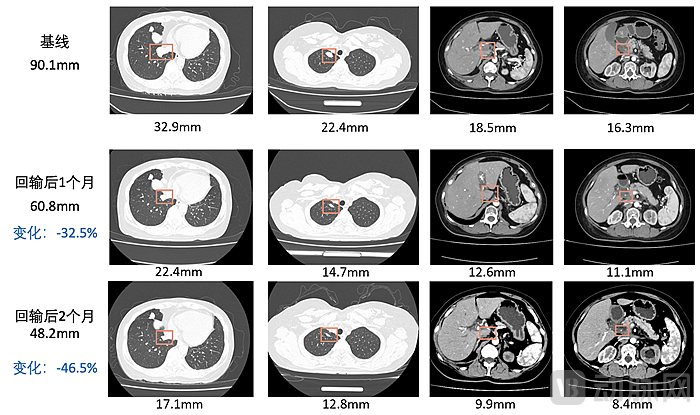
Following reinfusion, the patient’s tumor diameter decreased by 46.5%. Image source: Chengyuan Biotechnology
Regarding future development, Dr. Chen Xi stated, “Moving forward, Chengyuan Biotech will pursue a parallel strategy for its customized gene library products and cell therapies. In the realm of cell therapies, we will adopt multiple commercialization pathways—including independent R&D, collaborative development, and product licensing—to deliver safe and effective products to patients as rapidly as possible.” We look forward to Chengyuan Biotech continuing to achieve breakthroughs in high-throughput, low-cost gene synthesis, thereby making therapies more accessible across the industry.