

University of Science and Technology of China Drives Over 30 IPOs, Reinforcing Hefei as an Innovation Hub
In Hefei, there is a university that, despite being established only 65 years ago, stands on par with Tsinghua University and Peking University—University of Science and Technology of China(hereinafter referred to as: USTC).
Since its founding, the University of Science and Technology of China (USTC) has gathered the most prestigious cutting-edge scientists in China, becoming known as the “cradle of Chinese scientists.” Many epoch-making scientific achievements, such as the synthetic crystalline bovine insulin, the “107 Computer,” and the Tianwen-1 mission, originated at USTC.
However, scientific research achievements alone cannot fully define the University of Science and Technology of China (USTC). Since the Chinese Academy of Sciences implemented"One Hospital, Two Systems"Since the policy’s inception, she has actively promoted the commercialization of scientific and technological achievements, fostering the emergence of a large number of well-known enterprises.
In the AI sector, the “USTC cohort” commands a significant share of the market, having spawned world-class unicorns such as Cambricon, CloudWalk Technology, SenseTime, and Unisound; in the healthcare industry, companies like Mindray Medical and Boshida Medical have established strong reputations... According to statistics, as of October 2023, the University of Science and Technology of China has already produced33 Listed Companies, ranking among the forefront of technology transfer at universities and colleges across China.
What Magic Lies Within This “National Team” That Pursues Both Scientific Research and Translation?
I. The Chinese Academy of Sciences’ “Favorite Son”
To speak of the University of Science and Technology of China, one must mentionChinese Academy of Sciences。
As is well known, the Chinese Academy of Sciences (CAS) represents China’s highest academic institution in the natural sciences, bringing together top-tier scientific researchers across the country. However, with the passage of time, CAS has faced an urgent need to replenish its reserve of outstanding talent, particularly leading-edge technological experts in emerging technical disciplines. In 1958, leveraging its own strengths, CAS established the first university in China dedicated to cultivating cutting-edge scientific and technological personnel in emerging, frontier, and interdisciplinary fields—what we now know as the University of Science and Technology of China (USTC).
In terms of institutional development, the University of Science and Technology of China has pioneered many “firsts.” It is China’s firstAbandon the Soviet Model of Separating Science and Engineering in Higher Educationuniversities that adopt a model integrating engineering with science, and technology with scientific research. They have cultivated a large number of interdisciplinary talents for China's scientific research community, filling gaps in emerging scientific fields.
In addition, USTC has also pioneeredScientists' Lecturea new trend. The 13 departments of the University of Science and Technology of China (USTC) are each paired with different institutes of the Chinese Academy of Sciences (CAS). Scientists from CAS also serve as part-time instructors for USTC’s foundational courses, as well as holding leadership positions at the university, departmental, and teaching-research section levels. Renowned scientists such as Yan Jici, Hua Luogeng, Qian Xuesen, Wu Youxun, Liu Dagang, Zhao Jiuzhang, and Zhao Zhongyao have all lectured at USTC, ensuring that students have access to the most cutting-edge scientific research knowledge.
In addition to its distinguished faculty, the University of Science and Technology of China (USTC) has instituted academic regulations—such as requiring graduating students to complete their capstone projects and theses at the Chinese Academy of Sciences (CAS), and mandating internships at CAS for upperclassmen—to ensure a seamless transition from learning to research.
To strengthen the cultivation of cutting-edge talent, USTC has also established in BeijingChina's First Graduate School, with Yan Jici, the father of modern Chinese physics, serving as its first president; this graduate school was the predecessor of the current University of the Chinese Academy of Sciences.
Furthermore, to enable high-caliber students to engage with the scientific research system at an earlier stage, the University of Science and Technology of China established in 1979China's First Junior ClassThe School of the Gifted Young at the University of Science and Technology of China (USTC) is not part of the traditional high school exam-oriented education system. It exclusively recruits children aged 16 and under who demonstrate exceptional talent and academic excellence for intensive cultivation. The program features specialized tracks such as the “Hua Luogeng Class,” the “Yan Jici Class,” and the “Physical Sciences Class,” designed to maximize students’ strengths. As of 2021, the USTC School of the Gifted Young has achieved“Three academicians and eight hundred master’s and doctoral graduates from Qiansheng”in terms of talent cultivation achievements; Academicians Luo Liqun and Zhuang Xiaowei, among others, are all graduates of the Special Class for the Gifted Young at the University of Science and Technology of China.
A large number of talents have emerged from the University of Science and Technology of China (USTC) and eventually given back to the university, enabling it to gradually develop distinctive strengths characterized by a solid research foundation and a broad distribution of disciplines. However, breakthroughs in the field of applied sciences have not confined USTC’s development trajectory; instead, they have inspired the USTC community to step out of the laboratories and venture into the market.
II. The Conversion System That Enabled 33 IPOs to “Break Through”
The technology transfer efforts at the University of Science and Technology of China (USTC) also stemmed from a policy change at the Chinese Academy of Sciences.
In the 1980s, the Chinese Academy of Sciences (CAS) already comprised 11 branch academies and more than 100 research institutes. Operating such a vast system required substantial financial and material resources, at a time when New China was also undergoing major reforms. The era in which the state centrally assigned research tasks and provided funding had come to an end, prompting the Chinese Academy of Sciences to implement a new institutional framework.
In 1984, a household-name ICT technology company emerged from a dusty security guard room at the Chinese Academy of Sciences.Lenovo—This marked the first time the Chinese Academy of Sciences brought applied scientific research to the market, and in a sense, it became a “Promethean act” for the transformation of scientific and technological achievements in China’s research institutions and universities.
In early 1988, the Chinese Academy of Sciences began to implement the policy of “one academy, two systems,” requiring that 80% of its applied research scientists engage directly in activities serving the main arena of the national economy, while reducing annual operational funding allocations to its subordinate institutes by 20% each year.
As a practitioner of the integrated teaching and research model under the Chinese Academy of Sciences, the University of Science and Technology of China (USTC) has been greatly encouraged by the trend of commercializing scientific achievements. By 2023, USTC had spawned 33 IPO-listed companies, a feat that has placed it at the forefront of Chinese universities in technology transfer rankings.
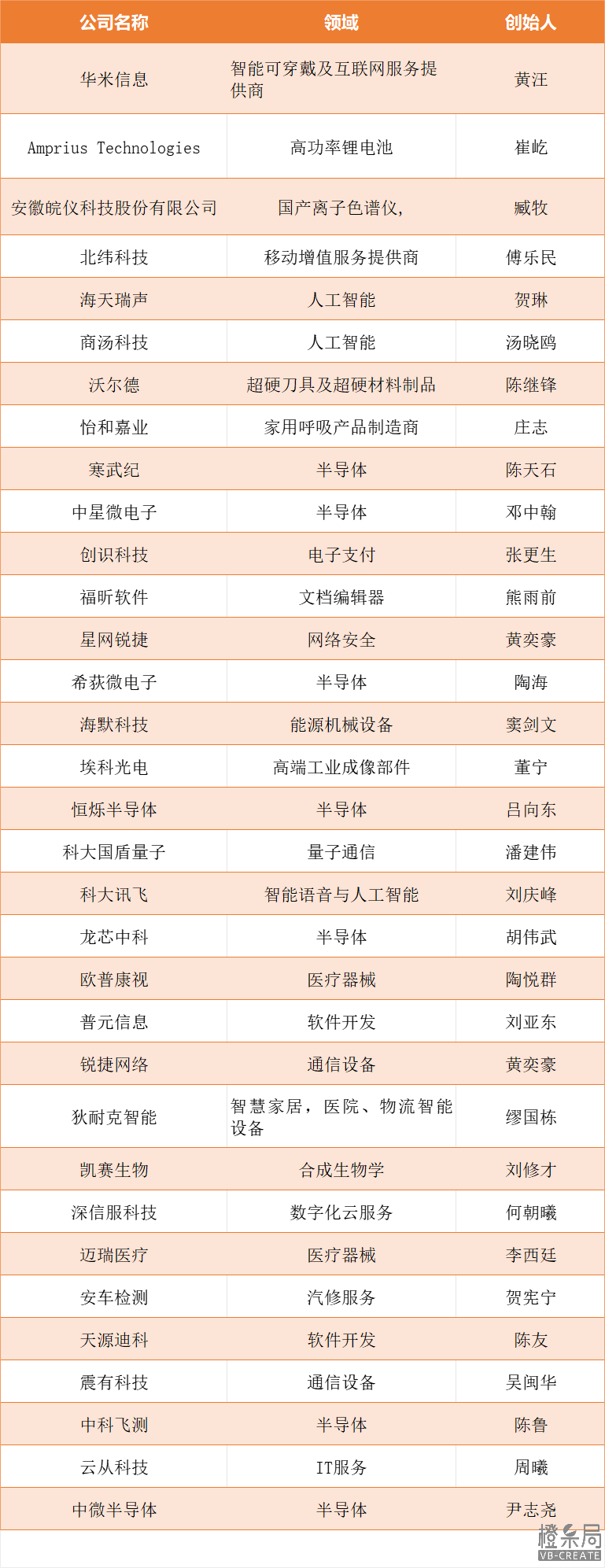 “IPO Companies from the USTC Network” (Data compiled by VCBeat Orange Bureau)
The Institute of Intellectual Property at the University of Science and Technology of China, in its article “A Clear Ledger Is Needed for the Conversion of Scientific Research Achievements,” emphasizedTalent, Intermediaries, and the Markettheir importance in the commercialization of academic achievements at universities. These three factors may also be the secret to the successful technology transfer at the University of Science and Technology of China (USTC).
1Transforming Talent Strength into Innovation and Entrepreneurship Capabilities
As the successor to the Chinese Academy of Sciences, the University of Science and Technology of China (USTC) boasts undeniable strength in scientific research talent. How to fully translate this talent advantage into innovation and entrepreneurship capabilities has long been a persistent focus for USTC. Therefore, within its talent development framework, USTC is committed to instilling innovative and entrepreneurial thinking into the consciousness of every member of its community.
At the level of student education, the University of Science and Technology of China (USTC) is renowned for its "liberal" curriculum framework, which implements a "personalized course schedule." This means that students are not confined to selecting courses within their broad disciplinary category; instead, they can earn credits and even obtain degrees in other majors by taking courses offered by those disciplines.This approach reduces the cost of cultivating interdisciplinary talent while efficiently developing professionals with multi-level expertise.
For the research staff currently employed at the University of Science and Technology of China,USTC has improved its evaluation mechanism, abandoning the traditional "research point-based" assessment system to fully respect researchers' innovative ideas and project pacing.
In terms of timing, the University of Science and Technology of China (USTC) has adopted milestone-based progress as the benchmark, shortening the research assessment cycle from its original annual basis. This approach enables real-time monitoring of project advancements and timely provision of appropriate support and assistance to research teams, while also allowing researchers to regularly review their own progress, thereby serving as a motivational mechanism.
In terms of reporting methods, the University of Science and Technology of China (USTC) has replaced rigid “performance reviews” with “peer exchanges.” This approach transforms each stage of researchers’ reports into academic exchange salons, which not only summarize the scientific achievements of the previous phase but also foster brainstorming through dialogue, thereby providing inspiration for the next phase of research.
However, neither the growing number of high-caliber talents nor the increasing volume of “highly cited” papers represents the ultimate goal of the University of Science and Technology of China (USTC). The true objective of USTC’s scientific research development is to facilitate the commercialization of applied technology projects and their integration into everyday life. Therefore, in supporting innovative ideas from students and researchers, USTC has gone beyond mere theoretical exploration (“paper and pen”) and committed substantial financial resources.
Each year, the University of Science and Technology of China invests millions of yuan to establishFledgling Eagle Program, Soaring Eagle Program, and Kunpeng Program.
These three initiatives primarily serve startup projects at different stages. For instance, the "Fledgling Eagle Program" provides R&D funding of RMB 100,000–150,000 to students who independently undertake scientific research projects. The "Soaring Eagle Program" offers financial support of RMB 300,000–500,000 to research teams that have established startups; if a project demonstrates potential for technological commercialization, it may also secure initial financing. Under the "Kunpeng Program," the university collaborates with various cities in Anhui Province to provide funding of RMB 2–5 million on a 1:1 matching basis. According to statistics,Each year, the University of Science and Technology of China’s “Entrepreneurship Fund” will support more than 60 innovation and entrepreneurship projects., helping more students turn their entrepreneurial dreams into reality.
However, outstanding alumni of the University of Science and Technology of China (USTC) are distributed across the globe. In addition to support from the university administration, these alumni have become a crucial “backbone” for USTC entrepreneurs in their ventures. Previously, alumnus Li Dong, representing the Green Science Co-creation Alliance, donated RMB 100 million; subsequently, Li Xiting, Chairman of Mindray Medical, personally donated RMB 106.8 million to support the cultivation of high-end talent and mid-to-high-end technological projects at USTC. Furthermore, alumni have establishedXinchuang Public Welfare Foundation, regularly hosting events such as the “Alumni Longmenzhen” and “Industry Elite Gathering,” which not only provide young CEOs with opportunities to connect with industry leaders but also strengthen ties among the “CAS-affiliated” companies in the market.
On the entrepreneurial journey, the importance of funding is self-evident. Financial support from the University of Science and Technology of China (USTC) has provided “USTC alumni” with the opportunity to pursue their entrepreneurial dreams. For instance, in 1999, had USTC not allocated RMB 6.68 million in equity rewards for technological achievements, Liu Qingfeng, then a second-year doctoral student at USTC, would have found it extremely difficult to establish iFlytek. Consequently, the development of China’s intelligent voice market would have remained stagnant.
2“Stable” Transformation Mechanisms and a “Fluid” Advisory Team
In the process of translating scientific research achievements into practical applications, “intermediaries” assume various roles. They may be university technology transfer offices, technology brokers in the market, or project incubators. Regardless of their specific role, “professionalism” is an indispensable requirement.
Here, “professional” means that they must not only possess a thorough understanding of the market and the mindset and experience to navigate capital markets, but also have technical expertise to bridge the “language gap” between researchers and the market. Therefore, the Technology Transfer Office of the University of Science and Technology of China (USTC) adopts a “high-standard, high-requirement” approach in its recruitment, selecting technology transfer professionals who have both market experience and a technical background.
However, prolonged immersion in an academic environment may inevitably lead to a narrow perspective. To ensure that technology transfer organizations and research project directions remain closely aligned with market trends, in addition to establishing a Technology Transfer Office, the University of Science and Technology of China has specifically set up"Maker Center", and has engaged experts in fields such as finance, investment, legal affairs, and management to serve as members of its advisory board, providing market recommendations and resource support for USTC’s technology transfer projects. The composition of the advisory board is not fixed,The “Maker Center” undergoes an annual membership rotation, aiming to ensure that HKUST entrepreneurs can hear more authentic voices from the market.
In addition to collaborating with the market, USTC has also partnered with the Hefei Municipal Government and more than 20 research institutes and universities to establishChina's First Special Task Force for the Commercialization of Scientific and Technological Achievements, achieving “overtaking on the bend” in scientific and technological innovation through policy guidance. As of April 2023, the Hefei Special Task Force for the Transformation of Scientific and Technological Achievements had identified and facilitated over 1,000 transformable scientific and technological achievements from universities and research institutes. The number of granted invention patents surpassed 10,000 for the first time, and the total value of technology contract transactions exceeded RMB 100 billion, including transformation projects from the University of Science and Technology of China.
3Cultivating the “Soil” for Practical Translation
From a micro perspective, “people” are a critical factor in the success or failure of technology transfer; however, from a macro perspective, the quality of the translation environment is equally crucial.
To facilitate the commercialization of research achievements, the University of Science and Technology of China (USTC) has created a “liberated” environment for technology transfer. For on-campus researchers, concerns about the potential loss of state-owned assets during the commercialization process are a frequent source of anxiety. Taking the common “commercialize first, reward later” model as an example, this approach not only involves lengthy approval procedures but also subjects equity distribution to numerous constraining factors. Consequently, some researchers have adopted a wait-and-see attitude toward the commercialization of their findings.
Meanwhile, the University of Science and Technology of China innovatively proposed"Empowerment + Transfer + Agreed Returns"A new model, under which partial ownership of job-related scientific and technological achievements is granted to researchers prior to project commercialization, making them co-owners with the university. Subsequently, when these achievements are capitalized as equity for commercialization, researchers may apply to the university to have their share invested in the commercialization entity, with revenue sharing agreed upon between the university and the researchers.The university does not hold equity in the technology transfer company; it only enjoys future benefits from the company’s development through an “agreed-upon return” arrangement.
Furthermore, the University of Science and Technology of China has relaxed restrictions on researchers: deficiencies or shortcomings arising from lack of experience or pioneering efforts will not result in negative evaluations or accountability for individuals or entities, provided that they align with the direction of national reforms, follow legally compliant decision-making procedures, and involve no pursuit of personal gain.
This approach not only ensures the preservation and appreciation of state-owned assets but also frees researchers from the constraints associated with “state-owned assets” during the commercialization process. Furthermore, the “what you see is what you get” nature of revenue distribution from achievement commercialization further boosts researchers’ enthusiasm for technology transfer.
In addition to the on-campus technology transfer ecosystem, the University of Science and Technology of China (USTC) has actively leveraged the influence of its affiliated enterprises and alumni network (“USTC-affiliated” entities), helping transform Hefei into an “Eastern Silicon Valley” conducive to the commercialization of scientific and technological achievements.
Back in 1972, as the University of Science and Technology of China (USTC) relocated to Hefei, a large number of USTC-affiliated research institutes also settled in the city, laying a foundational “scientific research character” for Hefei. With the continuous advancement of the commercialization of USTC’s scientific achievements, enterprises spun off from USTC projects, such as CIQTEK and QuantumCTek, have established their operations in Hefei due to its proximity.
The establishment of high-tech enterprises has enabled Hefei to chart a new path for urban development. The city has also leveraged policy support and other measures to broaden and extend this innovative trajectory. For instance, Hefei introduced a series of incentive policies to attract talent, aiming to retain skilled professionals in the city. In 2022, 43.5% of master’s graduates and 44% of doctoral graduates from the University of Science and Technology of China (USTC) chose to remain in Hefei. Furthermore, Hefei has significantly increased funding for technology commercialization. In 2022 alone, the city’s science and technology expenditure rose to RMB 24.57 billion, a year-on-year increase of 41.1%, with over RMB 9 billion allocated as industrial policy funds for the science and technology sector.
Just as Silicon Valley relies on Stanford, Hefei is gradually becoming an “Eastern Silicon Valley” that gathers innovative forces, leveraging the alumni resources and brand effect of the University of Science and Technology of China.
III. Only by Running Can You Stay in Place
In January 1970, when the University of Science and Technology of China (USTC) relocated to Hefei after a series of moves, it was situated in a remote corner of the city. Today, Hefei’s central urban area has developed around USTC. Starting from USTC, one can find clusters of innovative industries in all directions—east, west, south, and north. This is the result of USTC’s persistent efforts in translating scientific research achievements into practical applications, as well as Hefei’s support for the development of scientific research.
When we think of the University of Science and Technology of China (USTC), we often envision renowned scientists traversing history, approaching us through the mists of time. Yet USTC is also a young university. Its scientific achievements consistently stand at the forefront of their fields, while enterprises founded by its alumni occupy leading positions in the market. USTC’s technology transfer model, originating from talent, policy, and market dynamics, has evolved into a distinctive “USTC-affiliated” commercialization paradigm.
Lewis Carroll, the renowned British author, once wrote in "Alice's Adventures in Wonderland": In this country,"You must keep running just to stay in place."This statement remains applicable on the path to translating scientific and technological achievements into practical applications. The technology transfer model of the University of Science and Technology of China (USTC) is by no means static; in response to evolving demands of the times, it continues to “forge ahead,” strengthening this fortress built in the name of “innovation.”