

Founder Resigns as Chairman of PKU Healthcare; Ping An Expected to Appoint New Director Amid Strategic Realignment
On the evening of October 16, PKU HealthCare Corp., Ltd. (stock code: 000788), a Chongqing-listed company under Ping An Group, announced that its Board of Directors had recently received a written resignation report from Mr. Song Jinsong, the Company’s Chairman. Mr. Song has applied to resign from his positions as Director and Chairman of the Board due to personal reasons and will no longer hold any position within the Company.
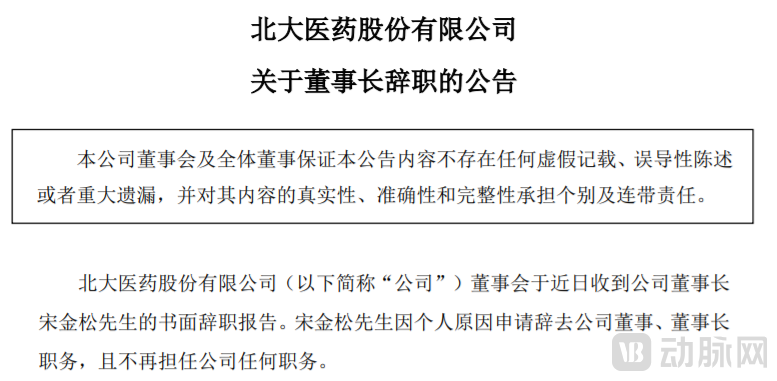
As of the date of this announcement, Song Jinsong does not hold any shares in the Company, either directly or indirectly. In accordance with the relevant provisions of the Company Law of the People’s Republic of China, the Rules Governing the Listing of Stocks on the Shenzhen Stock Exchange, and the Articles of Association of the Company, Mr. Song’s resignation will not cause the number of members of the Board of Directors to fall below the statutory minimum. His resignation shall become effective upon delivery of his resignation report to the Board of Directors.
PKU HealthCare Corp.,Ltd. stated that Mr. Song Jinsong had performed his duties with diligence and devotion during his tenure, playing a significant role in promoting the company’s high-quality development. The Company and its Board of Directors hereby extend their sincere gratitude to Mr. Song Jinsong for his contributions during his period of service.
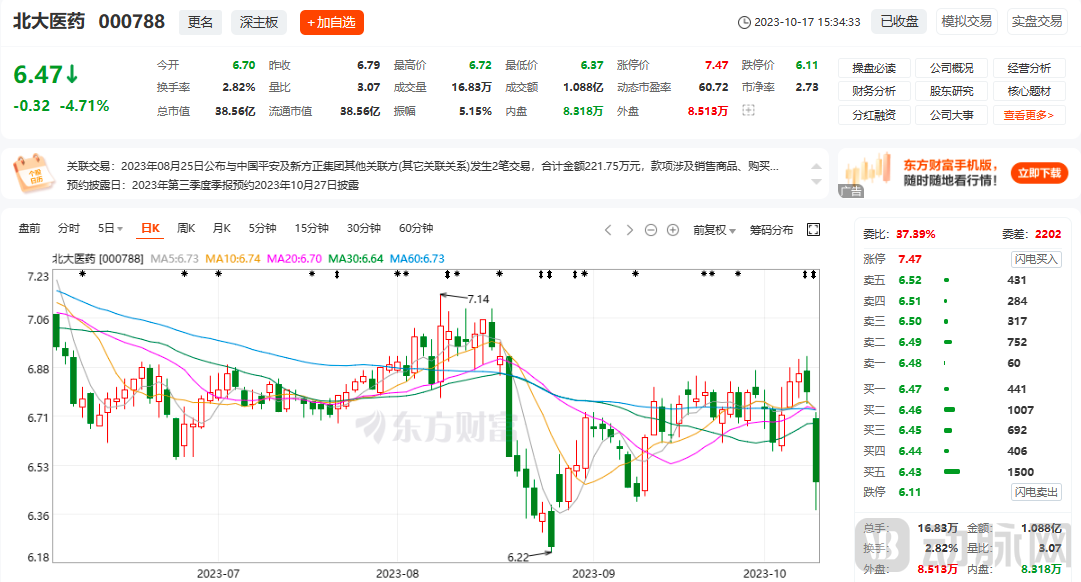
Affected by this personnel change, PKU HealthCare Corp.,Ltd.'s stock price fell to 6.47 yuan per share at the close on the 17th, representing a total decline of 4.71% from the previous day.
Song Jinsong, male, born in February 1967. He received his Bachelor of Medicine degree from China Medical University in July 1991 and his Ph.D. in Diagnostic Imaging from Peking Union Medical College in July 1999. From September 2002 to May 2003, he completed postdoctoral research at Ludwig Maximilian University of Munich in Germany.
From June 1999 to August 2002, Song Jinsong served as CT Product Manager at GE Healthcare (China) Co., Ltd.; From June 2003 to July 2015, he successively served as MRI Regional Manager for the South Region, General Manager of MRI for Greater China, Vice President of Greater China and General Manager of the Central Region, Vice President of Greater China and General Manager of the North Region, and Vice President of Greater China and General Manager of HCS China at GE Healthcare (China) Co., Ltd.Former No. 2 Executive at GE Healthcare。
Song Jinsong joined Fosun Pharma in July 2015 as Senior Vice President, with his more specific role being President of Fosun Hospital Investment Group.Fosun Pharma described its medical services business for the year in its 2016 annual report as follows:
“The launch of projects such as the Phase II expansion of Qilu Hospital of Shandong University in Qingdao, Zhongwu Hospital, and Guangji Hospital; the opening of Wenzhou Geriatric Hospital; and the establishment of Yulin Guanghai Investment (responsible for the operational management of Yulin Cardiovascular Specialist Hospital and Yulin Brain Hospital), have laid the foundation for a new model of social capital participation in healthcare.”
Participated in the restructuring of medical institutions originally affiliated with Xuzhou Mining Group to establish Huaihai Medical Group, marking a new breakthrough for the Group in participating in the restructuring of state-owned enterprises’ healthcare sectors and exploring collaborative operational management with large local medical institutions and major insurance companies; this holds significant importance for the reform of mixed-ownership hospitals and the integration of the healthcare industry chain.
"Explore a new model for building third-party medical laboratories in collaboration with public hospitals by investing in Jinan Qilu Medical Laboratory."
During the year, the medical services business generated total revenue of RMB 1,677.56 million, representing a 21.67% increase compared to 2015. Excluding the impact of newly established entities such as Wenzhou Geriatric Hospital, revenue increased by 13.57% on a comparable basis relative to 2015. The segment achieved a segment result of RMB 231.08 million, up 13.96% from 2015, and realized a segment profit of RMB 148.89 million, marking a 96.06% increase over 2015.
Evidently, Song Jinsong’s capabilities have gained the recognition of PKU Healthcare. In April 2017, Song Jinsong succeeded Lv Hedong as the CEO of PKU Healthcare. Five months later, Song Jinsong unveiled a new strategic plan at the 2017 China Private Healthcare and Hospital Management Summit, preparing to “make a major strategic move.”
Song Jinsong has endowed PKU Healthcare with a renewed strategic positioning: to possess the capabilities for exporting modern hospital management and incubating new technological innovations within China’s private healthcare sector; to establish a comprehensive internet healthcare and health insurance system; and to demonstrate innovative R&D capabilities in the pharmaceutical sector, thereby becoming an internationally leading enterprise in the broader health industry.
With his dual background in healthcare and investment, Song Jinsong has gained a profound understanding that the industrialization of the broader health sector is already sweeping across China. To align with policy directives and market demands, Peking University Healthcare (PKU Healthcare) needs to undergo three transformations: transitioning its traditional medical services division into a comprehensive big-health sector; transforming its medical real estate segment, primarily represented by the PKU Healthcare Industrial Park, into an innovation and venture capital division; and establishing an entirely new pharmaceuticals segment. At the time, Song Jinsong predicted that the future healthcare market would be dominated by “innovative medical services + physician groups + hospital management.” Therefore, along the industry chain, PKU Healthcare planned to integrate new models such as “healthcare + insurance,” “healthcare + insurance,” and “healthcare + pharmaceuticals” to create a novel ecosystem.
Based on the company's financial data, after Song Jinsong took over PKU HealthCare Corp., Ltd., the company's total revenue increased significantly from 2017 to 2019, with an average growth rate of 7.9% in 2018 and 8.3% in 2019. After 2019, affected by the COVID-19 pandemic, PKU HealthCare's revenue in 2020 dropped sharply to approximately RMB 1.977 billion. It rebounded significantly in 2021, but fell again in 2022 to approximately RMB 2.077 billion.
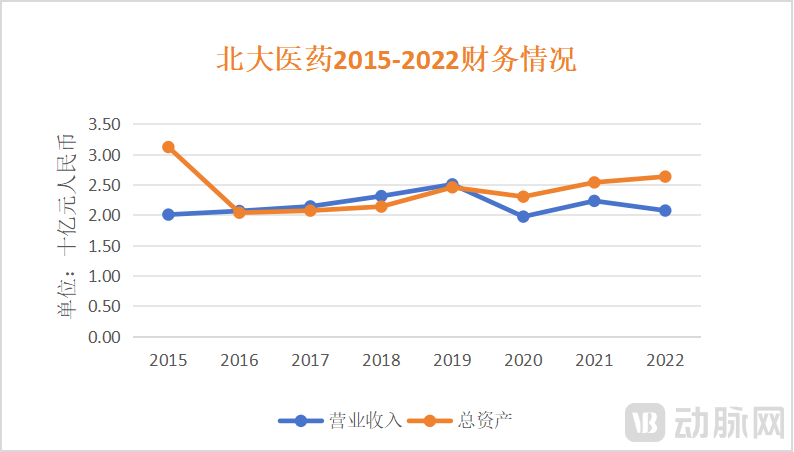
Data Source: PKU HealthCare Corp., Ltd. Annual Reports from 2016 to 2022
According to PKU HealthCare Corp., Ltd.’s 2023 semi-annual report, the company achieved dual growth in revenue and net profit during the first half of the year. It recorded operating revenue of RMB 1.084 billion, representing a year-on-year increase of 8.28%, while operating profit reached RMB 46.6582 million, up by 22.59% compared to the same period last year. Three of its anti-infective products, including Ornidazole Injection, were selected in the eighth round of National Centralized Drug Procurement. In the first half of the year, the company’s core therapeutic areas—psychiatry, anti-infectives, and analgesics—achieved several product milestones. Its key product portfolio has now entered nearly 400 hospitals across more than 30 provinces nationwide.
It appears that Song Jinsong only “let go” after everything at PKU HealthCare Corp., Ltd. had returned to normal.
In 2022, Ping An entered PKU HealthCare Corp., Ltd. through judicial reorganization.Currently, the indirect controlling shareholder of PKU HealthCare is New Founder Group, with Ping An Life and China Ping An exercising indirect control over PKU HealthCare through New Founder Group.
As a pharmaceutical manufacturing and distribution subsidiary of PKU Healthcare Group, PKU HealthCare Corp., Ltd. is gradually aligning itself with Ping An. He Qing from Lingyun Capital speculates that the new owner, Ping An, may appoint a new chairman.
At the 2020 Annual General Meeting of Shareholders, Ma Mingzhe, Founder and Chairman of Ping An Insurance (Group) Company of China, Ltd., stated: “Finance represents Ping An’s present, while healthcare represents its future.”Thus, it is evident that within Ping An’s newly established “Finance + Ecosystem” paradigm, the healthcare ecosystem will constitute a critical component of its five major smart ecosystems and represent a significant development opportunity for PKU HealthCare Corp., Ltd.
In light of PKU HealthCare Corp., Ltd.’s actual circumstances, strategic planning can be approached from three aspects. First, high-quality products are always the primary driver of productivity; supplementing the product portfolio has consistently been the core strategy for the company’s operation and development. By leveraging the capabilities of Ping An Technology and utilizing big data accumulated within the healthcare ecosystem, PKU HealthCare can identify target products with large market potential, high value, and strong strategic fit more quickly and accurately. Such products may include over-the-counter (OTC) medicines, health supplements, and special medical purpose foods for infants and young children, among others.
Second, it secures priority cooperation opportunities with Ping An partners, acting as an agent to sell their high-quality products. This two-pronged approach enriches its own product pipeline and continuously enhances its core competitiveness. In terms of sales, it can engage in deep collaboration with established platforms, such as the Ping An Health online mall, to intensify product promotion, broaden sales channels, and fully leverage the synergistic benefits of internal platform resources, thereby achieving mutual win-win outcomes.
Third, by securing technical or financial support for product R&D, the company aims to build itself into a pharmaceutical and general health product manufacturing platform that integrates generic production with innovative development. It seeks to become a key product supplier and profit center within the healthcare ecosystem, continuously empowering and adding value to the ecosystem. Furthermore, it is conceivable that in the future, the company could develop unique medical-insurance integrated products through innovative product design, thereby enriching insurance offerings and enhancing Ping An Insurance’s differentiated service capabilities, which in turn would feed back into and strengthen its financial services business.