

Nearly One Billion Patients, Less Than 50% Seeking Care? Urologists Turn to Digital Therapeutics for a Breakthrough
Urinary incontinence disorders are a hidden source of embarrassment. Although the symptoms may seem minor, they often leave patients in a vulnerable position—causing anxiety, depression, and even disrupting daily life and work. As a result, these conditions are sometimes referred to as “social cancer.” People are often too ashamed to discuss them openly, even with their closest family members, making it a difficult secret to share.
However, the issue of “urine” remainsAffects the lives of approximately 2 billion people worldwide. Some patients believe that they can simply endure the symptoms until they pass, but this only creates greater hidden risks. If urinary control disorders are not treated in a timely and effective manner,This may ultimately lead to renal failure and death in patients.。
Huang HaiThe professor is a chief physician specializing in lower urinary tract diseases within the Department of Urology at Sun Yat-sen Memorial Hospital, Sun Yat-sen University. He has dedicated nearly two decades to the diagnosis and treatment of lower urinary tract disorders. Recently, he has been working to integrate digital therapeutics into clinical urological practice, aiming to decentralize medical resources and enable broader access to the benefits of medical advancements. He shared his perspectives with VCBeat.Application of Digital Therapeutics in Urology。
I. 50% Risk of Disease
Urinary Continence: As the name suggests, it refers to the ability to control urination. In the medical field, urinary continence disorders mainly refer toLower Urinary Tract Symptoms(Lower Urinary Tract Symptoms, hereinafter referred to as LUTS) are a series of symptoms caused by bladder or urethral dysfunction. Common symptoms include urinary frequency, urgency, incomplete emptying, incontinence, and nocturia.
From childhood, urinary control seems to be an innate ability, but with age and the influence of disease, some people gradually begin to "lose control." The ability of middle-aged and elderly individuals to control the urethral sphincter or pelvic muscles declines gradually with age, which may lead to lower urinary tract symptoms (LUTS). According to statistics,Patients aged over 40 with lower urinary tract symptoms (LUTS) account for 70% of outpatient visits in urology departments.
In addition to aging, the major late-stage complications of certain conditions—such as spinal cord injury, cerebral infarction, dementia, and paraplegia—are urological in nature, with an incidence rate as high as 82.4%. Professor Huang told VCBeat, “Throughout a person’s lifetime, there is at least a 50% probability of experiencing issues related to urinary dysfunction.”
II. Consultation Rate of Less Than 50%
The vast patient population has made the treatment of lower urinary tract symptoms (LUTS) a focal point of clinical attention. However, in reality, the healthcare-seeking rate among LUTS patients remains low. This issue encompasses both seemingly minor and distinctly practical challenges.
1Stigma: The Unspoken Struggles Even Among Loved Ones
Some older LUTS patients, or those with limited cognitive capacity, tend to hold conservative views, believing that “urinary incontinence” is not a condition requiring medical treatment. Most choose to endure the symptoms in silence, neither seeking professional medical consultation nor disclosing their condition to others. Some even prefer trying unproven folk remedies and refuse conventional, evidence-based treatment.
Stigma keeps “stubborn” patients away from hospitals, allowing the harms of lower urinary tract symptoms (LUTS) to spread further within the body. Faced with stigma, many patients choose to endure their symptoms repeatedly, only seeking medical attention when their quality of life is severely affected or more serious complications arise.
2Unequal Distribution of Medical Resources: Rural Patients Face Difficulties in Accessing Care
Another practical reason is related to the distribution of medical resources. Due to uneven resource allocation, some township and community healthcare facilities lack the capacity to treat lower urinary tract symptoms (LUTS), and even in certain urban areas with weaker medical infrastructure, corresponding specialized departments have not been established. However, townships are the “frontlines” of population aging, and these very regions are also high-incidence areas for LUTS.
Professor Huang told VCBeat, “As far as I know, many provinces, or even entire provinces, do not have a single specialized outpatient clinic.”
A large number of patients with mild to moderate symptoms are reluctant to seek medical attention, while even more individuals lack access to healthcare services, as primary care facilities have limited capacity for patient intake and management. Caught between stigma and resource constraints,The actual patient consultation rate is less than 50%.. Therefore, enhancing awareness among patients with lower urinary tract symptoms (LUTS) and strengthening the decentralization of medical resources constitute an imperative societal task.
III. Change: Making Digital Healthcare a Downward Force
To improve the consultation rate for patients with lower urinary tract symptoms (LUTS) in China, Professor Huang launched the “Urological Health Campaign Across a Thousand Counties.” The campaign mobilized over 100 urology specialists nationwide to deliver lectures, aiming to enhance the treatment capabilities of primary care physicians on one hand, and to shift public perception so that more patients properly address urological issues on the other. To date, the “Thousand Counties Campaign” has trained1,643 Physicians, the current situation in which no dedicated personnel are assigned to carry out urological functions in primary healthcare is gradually changing.
In addition to empowering primary care physicians through training and health education, Professor Huang also aims to leverage technology to enable high-quality medical resources to reach the grassroots level more rapidly, conveniently, and sustainably. The development of digital healthcare has revealed boundless possibilities to him.
1Frontend: A Digital Management Platform Connecting Patients, Doctors, and Primary Care Physicians
In recent years, Professor Huang has been actively developing and promoting a digital whole-course disease management platform. During consultations, urologists can upload patient data and treatment plans to this platform, which automatically generates medical records. This enables other physicians to clearly review the patient’s condition and prior treatments during follow-up visits, thereby facilitating more appropriate therapeutic decisions.
Meanwhile, this platform also provides treatment protocol references for junior and grassroots physicians with limited clinical experience, thereby facilitating the decentralization of medical resources.
Professor Huang introduced, “Within the regional assistance group, this platform enables one-click replication of standardized yet locally adapted diagnosis and treatment protocols, covering”From pre-consultation assessment and screening to in-consultation behavioral intervention, and then to long-term post-consultation managementsolutions tailored to different patients.”
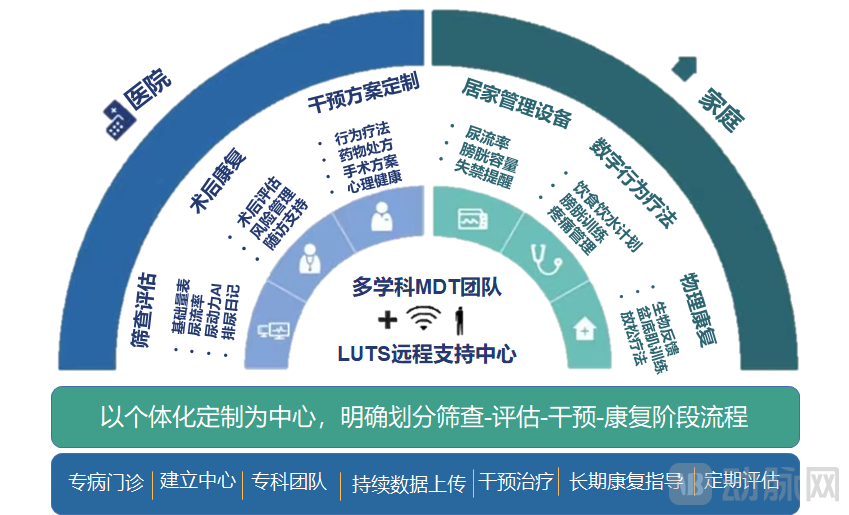 Digital Full-Course Disease Management Platform Operation Mode
2Backend: Long-Term Patient Management
Unlike other acute-onset conditions, lower urinary tract symptoms (LUTS) resemble a chronic disease; in addition to surgical and pharmacological interventions, daily management is essential to achieve optimal therapeutic outcomes. This necessitates behavioral training for patients, focusing on voiding patterns, lifestyle modifications, and related factors.
Professor Huang stated:"This is a pain point and also a challenge in the treatment of LUTS."
He cited the example of weight loss in patients with severe obesity: such patients require not only surgery but also long-term glycemic control, combined with exercise and dietary adjustments, to achieve optimal sustained therapeutic outcomes.
However, achieving effective postoperative lifestyle management for patients with lower urinary tract symptoms (LUTS) is no easy task. After discharge, it is difficult for physicians to monitor and guide patients’ behaviors. Furthermore, long-term recording of data such as voided volume, voiding time, and maximum urinary flow rate is required to evaluate whether the current management plan aligns with the individual patient’s condition. Yet, patients often struggle to accurately record these data in their daily lives. In addition, when away from home, traditional recording tools—such as measuring cups and urine collectors—are not only inconvenient to use but also cause unnecessary embarrassment for patients.
Professor Huang and his team designed aof Patients with LUTSDigital Therapeutics ToolsPatients need only wear a sensor to conveniently, quickly, and accurately record voiding data. These recorded data are uploaded directly to the backend, where AI-driven big data analysis is used to match patients with personalized cognitive behavioral therapy programs, aiming for better therapeutic outcomes.
Meanwhile, LUTS digital therapeutics can be integrated with a comprehensive digital disease management platform to consolidate relevant data. This integration facilitates the design of subsequent treatment plans for patients and enriches China’s LUTS patient database, thereby laying the foundation for clinical and research innovation. Emerging therapies in the LUTS field, such as novel physical therapies and gut microbiota-based interventions, can be further optimized using platform data, thereby expanding treatment options for a broader population of LUTS patients.
According to Professor Huang, digital whole-course disease management and digital therapeutics for urinary dysfunction have been developed in collaboration with technology companies and will soon enter the market. As part of the National Key R&D Programs supported by the Ministry of Science and Technology during China’s 13th and 14th Five-Year Plan periods, these two products have already received favorable feedback in practical applications and are being adopted by multiple medical centers.The user base has surpassed 50,000.。
IV. Epilogue
Throughout the entire course of lower urinary tract symptoms (LUTS), from clinical consultation and treatment to behavioral management, each step still presents challenges that require optimization. Digital therapeutics may hold significant potential in this regard. In the field of LUTS, which necessitates long-term behavioral guidance for patients,The Advantages of Digital Therapeutics Are Amplified: Enables remote consultations and patient monitoring, provides personalized treatment plans, and is not constrained by time or space...
Currently, many fields are exploring digital therapeutics in search of more effective and convenient treatment options, and urology is no exception. At the end of the interview, Professor Huang made a bold prediction: the future of LUTS management will undoubtedly move toward greater personalization,Digitalization, IntelligenceWill play an important role in medical innovation.
Future treatment modalities should not only restore patients’ physical health but also help them regain a high quality of life.