

Who Has the Edge to Overtake in the Artificial Heart Race?

Baheal Medical
Health Brand Commercialization Platform
For a long time, the domestic artificial heart market in China remained vacant. It was not until 2019 that China’s artificial heart field achieved a major breakthrough, ushering in a new phase.
Since Yongrenxin Medical’s EVAHEART received NMPA approval for market launch in August 2019, three additional ventricular assist devices (VADs)—Tongxin Medical’s Cifu® VAD, Aerospace TaiXin’s HeartCon, and Core Medical’s Corheart 6—have also been approved successively, gradually filling the long-standing gap in the domestic artificial heart market.
However, after decades of continuous iteration in the development of artificial heart technology, regulatory approval is merely the first step to avoid obsolescence and maintain core competitiveness throughout the development process. More critically, the device must ensure its safety and efficacy across its entire product lifecycle.
For example, Medtronic’s HVAD artificial heart product was discontinued in June 2021 due to the high incidence of stroke and risk of death among patients. In addition, Abbott previously failed in its development of the percutaneous heart pump HeartMate PHP. More recently, Abiomed, a subsidiary of Johnson & Johnson, has received two recall notices from the U.S. Food and Drug Administration (FDA) concerning its Impella percutaneous artificial heart, which may be associated with blood leakage issues.
The high technological barriers characteristic of artificial heart products determine the immense potential of this sector. As new technologies and emerging players continue to arise globally, the prospects of the artificial heart market are being continuously reshaped.
LVAD: A New Frontier in Heart Failure Treatment
Over the past decade, heart failure has become the only cardiovascular disease showing an increasing trend globally.
According to data published in the “Chinese Expert Consensus on the Clinical Application of Biomarkers for Heart Failure,” the global number of patients with heart failure is currently estimated at 64.3 million. Based on the latest epidemiological survey results on heart failure in China, the prevalence among residents aged 35 years and older is 1.3%, with an estimated total of more than 10 million patients currently living with heart failure.
Although heart transplantation is an effective treatment for end-stage heart failure, it still faces significant challenges. First, there is a severe shortage of donor hearts, which prevents the vast majority of patients with end-stage heart failure from receiving this treatment. Second, even patients who have undergone heart transplantation face the risk of treatment failure due to complications such as rejection, toxic effects of immunosuppressants, and cardiac allograft vasculopathy.
As an artificial mechanical assistive technology capable of replacing the heart’s pumping function, Mechanical Circulatory Support (MCS) offers a ray of hope for patients with end-stage heart failure. Among these technologies, Left Ventricular Assist Devices (LVADs) have seen the most prominent development as a key therapeutic approach for end-stage heart failure. By implanting a cardiac pump connected to an external battery into the patient’s left ventricle, LVADs enhance the left ventricle’s pumping capacity. LVAD-related technologies have advanced rapidly in developed countries and have become a widely recognized and effective treatment for advanced refractory heart failure. Currently, approximately 90% of patients using artificial heart devices are implanted with LVADs.
Left ventricular assist devices (LVADs) integrate a wide array of cutting-edge technologies from fields such as mechanics, electronics, software control, fluid dynamics, and biomedical engineering. They also require internationally advanced expertise in medical device development management and manufacturing, making them high-tech medical devices with extremely high R&D difficulty. Over decades of industry development, only a handful of companies worldwide—including Abbott, Medtronic, and Jarvik—have successfully advanced new products to clinical trials or commercial market launch.
LVAD technology has also undergone years of iteration: the older generation utilized pulsatile blood pumps, which were associated with severe complications such as pump thrombosis and stroke, as well as a bulky form factor; this technology has now been phased out. The newer generation employs rotary blood pumps, which are categorized into three types based on their bearing technologies: contact/sliding bearings, hydrodynamic magnetic levitation, and full magnetic levitation. Contact/sliding bearing pumps are characterized by physical contact between the pump housing and the impeller, with blood propulsion achieved through impeller rotation. Although smaller than the first-generation devices, their high rotational speeds cause friction-induced heating at the contact points, leading to hemolysis (crushing and damage of blood cells) and resulting in severe pump thrombosis and stroke. Hydrodynamic magnetic levitation combines magnetic and hydrodynamic suspension; the latter involves a specially designed sliding bearing where blood acts as a lubricant during impeller rotation. While this eliminates physical contact between the impeller and the pump housing, the lubrication process generates shear stresses far exceeding physiological limits, causing blood damage and predisposing patients to thrombosis. In contrast, full magnetic levitation technology ensures stable control of the gap between the impeller and the pump housing, allowing for smooth blood flow. This significantly reduces blood-related complications, including pump thrombosis, stroke, and bleeding events, thereby improving patients' quality of life. Consequently, since 2019, full magnetic levitation technology has gradually become the mainstream technology in the international artificial heart market.
Currently, the global annual clinical implantation volume of LVADs has reached approximately 7,000 cases. According to Grand View Research, the global VAD market size was $1.8 billion in 2020, with LVADs accounting for the majority of the market. Global Market Monitor reports that the compound annual growth rate (CAGR) of LVADs from 2019 to 2025 is 10.29%, indicating substantial market development potential.
Since Medtronic announced the discontinuation of HVAD sales in June 2021, the global VAD market has been largely monopolized by Abbott’s HeartMate 3. In the United States, for example, the proportion of LVADs reached 92.7% in 2021. According to the latest data released by Abbott in 2023, more than 30,000 patients worldwide have received HeartMate 3 implants since its launch.
On October 18, Abbott “teased” its cardiovascular medical device products slated to debut at the 2023 China International Import Expo (CIIE) in Shanghai, including the HeartMate 3.
The undisputed leader in the artificial heart sector, which has long held a monopoly in overseas markets, appears poised to make its move into the Chinese market.
Why Is the HeartMate 3 So Attractive to Clinicians and Patients?
At the 2022 European Society of Cardiology Congress, Abbott announced clinical study data from over 1,000 patients showing that patients with advanced heart failure using HeartMate 3 had significantly prolonged survival—those treated with HeartMate 3 survived for more than five years, whereas the median survival for patients who did not receive left ventricular assist devices or heart transplantation was less than one year. The clinical application of fully magnetically levitated hearts is becoming increasingly compelling.
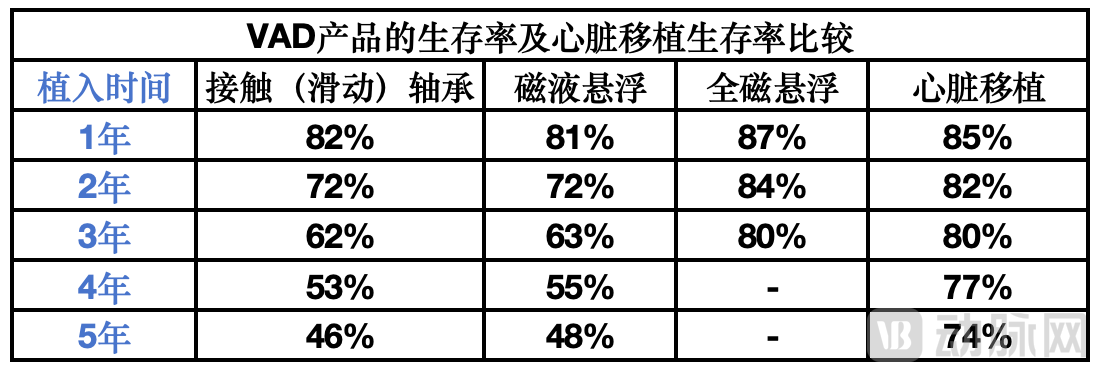
Survival Rates of VAD Products and Heart Transplantation
Data Source: US INTERMACS Database
However, some analyses point out that given the high costs and stringent processes for registration and clinical trials in China, HeartMate 3 will still need to undergo a lengthy process to enter the market. Domestically produced artificial hearts will continue to have a significant window of market opportunity in China for a considerable period.
Compared with the relatively mature artificial heart markets in Europe and the United States, China’s artificial heart market is still in its early stages of development. However, from a technological perspective, there are domestically produced left ventricular assist devices (LVADs) that can rival top-tier international products. Among the “Four Little Dragons” of marketed domestic artificial hearts, Tongxin Medical’s Cifu® VAD adopts the fully magnetically levitated technology route. In its product approval documents, the National Medical Products Administration (NMPA) stated that the Cifu® VAD utilizes “fully magnetically levitated blood pump technology,” and that “compared with similar international products, its key performance indicators have reached equivalent levels, with a smaller blood pump size and less invasive implantation.”
Data indicates that the fully magnetically levitated technology of the Cifu® VAD was independently developed by the company and possesses independent intellectual property rights. This fully magnetically levitated technology enables the impeller, a core component of the Cifu® VAD blood pump, to achieve stable levitation. With no mechanical contact between the impeller and its surroundings, it can maintain high-speed rotation within sub-millimeter clearances without wall contact, thereby minimizing blood damage during flow and reducing blood-related complications. Furthermore, compared with international products of the same technological category, the Cifu® VAD features improved implantation invasiveness and a thinner percutaneous cable, which helps enhance anti-infection performance. These advancements have enabled the product to reach an internationally leading level in various key performance metrics for ventricular assist devices.
It can be said that the Cifu® VAD marks China’s transition from a phase of following and learning to directly joining the ranks of international leaders in the research, development, manufacturing, and application of artificial hearts.
Meanwhile, the author also notes that implantation invasiveness (reflected by the miniaturization of the blood pump), as a key metric for artificial hearts, has become one of the focal areas for R&D breakthroughs in China’s artificial heart industry in recent years.
How Do the Size and Weight of Artificial Hearts Impact Clinical Outcomes? Experts Point Out That While the Volume of Implantable Artificial Hearts Is a Critical Metric, Smaller Is Not Necessarily Better. An Excessively Small Volume May, First, Limit Rotational Speed, Thereby Compromising Blood Flow Output. Second, an Undersized Device Is Prone to Causing Hemolysis and Thrombus Formation Due to Red Blood Cell Shearing at High Rotational Speeds. Therefore, Achieving a Balance in Performance Is of Greater Importance.
Cifu® VAD achieves a balance between size and performance through multidisciplinary optimization technology. Among patients who have received treatment, no cases of blood compatibility-related adverse events, such as pump thrombosis, stroke, or gastrointestinal bleeding associated with the device, have been reported.
Returning to the Chinese Market.
According to data from the Huayi Research Institute, the terminal price of implantable artificial hearts in the United States is approximately RMB 1 million (USD 140,000). In the Chinese market, even assuming a unit price of only RMB 500,000, a market penetration rate of just 1% would yield a market size exceeding RMB 10 billion.
In 2021, among the 742 heart transplant cases registered with the China Heart Transplant Registry, the utilization rate of left ventricular assist devices (LVADs) was 1.1%, which remains relatively low but represents a significant increase from 0.3% in 2020.
With a vast patient base of nearly ten million, the heart failure sector has become the “next blue ocean.” It is foreseeable that, once fully developed, this market will become an important component of the global heart failure market.
Domestic Artificial Hearts Are Gaining Momentum: Capital Floods the Sector with Massive Investments to Capture Market ShareSince 2022, seven artificial heart-related brands have secured financing. Among them, Tongxin Medical, Core Medical, and HeartQuest Medical each received investments amounting to hundreds of millions of RMB. Prominent institutions such as Sequoia China, CICC Capital, and CDH Investments are vying to enter the market and seize market share.
A blue ocean awaits domestically produced “artificial hearts,” while foreign products also seem eager to enter the fray. Among the products already on the market, who will take the lead?
As of March 2023, a total of 363 implantable ventricular assist device (VAD) procedures had been completed across 70 hospitals in China. Based on the current market deployment progress of commercially available artificial hearts, Tongxin Medical’s Cifu® VAD remains the only fully magnetically levitated blood pump in the domestic market and was approved relatively early. Since its launch in December 2021, it has been adopted by more than 40 hospitals, with over 160 cumulative patient implants. The first recipient has survived for more than six years and continues to maintain a high quality of life.
Furthermore, it is worth noting that Tongxin Medical has already completed its core patent layout in China, the United States, Europe, Japan, and other countries and regions. Achieving a global commercial footprint for its products is one of the company’s core strategies. Currently, the company is collaborating with the medical community both domestically and internationally to introduce advanced international concepts in heart failure treatment, establishing a full-cycle clinical service system for the commercialization of Ventricular Assist Devices (VADs) in accordance with international standards. It is taking the lead in promoting the clinical adoption of artificial heart therapy in China and continues to drive innovation and development in the VAD field by leveraging global resources in the artificial heart sector.
Weighing 186 grams and about the size of a ping-pong ball, an artificial heart was secured to the apex of Liao Cui’s left ventricle through meticulous surgical procedures.
That day also marked the beginning of Liao Cui’s new life. At Wuhan Union Hospital, doctors successfully implanted a fully magnetically levitated artificial heart (Cifu® VAD) into her body. This internal “artificial heart” has been operating continuously ever since, providing a steady supply of energy to her body.
Liao Cui placed it in her small pink bag and embarked on her new “heart” life. No longer plagued by severe heart disease, she can walk, run, dance, travel, and do anything she desires. “I feel as if I have been reborn,” she said. “I am deeply grateful to Wuhan Union Hospital and Tongxin Medical for giving me this opportunity to continue living.”
Today, the clinical application conditions for “artificial hearts,” which replace natural organs with artificial ones, are gradually maturing. China’s artificial heart market has not only emerged from its initial blank slate; companies like Tongxin Medical are leveraging cutting-edge technologies to bring new hope to patients with end-stage heart failure, reigniting the flame of life through innovation.
Public information indicates that Baheal Medical has undertaken the commercialization of Tongxin Medical’s fully magnetically levitated artificial heart, operating this domestically pioneering medical device product characterized by core technological barriers. As an A-share listed third-party commercialization platform, Baheal Medical has incubated several leading brands with significant market share across various disease areas, such as Caltrate and Biet, and maintains commercial collaborations with multinational corporations and innovative pharmaceutical companies. Tongxin Medical is an innovative enterprise in which Baheal Medical Group, its parent company, has invested cumulatively over three rounds. Throughout Tongxin Medical’s development, Baheal Medical Group, acting as an industrial investor, has provided comprehensive resource support. With Baheal Medical’s commercialization expertise, this artificial heart is poised to rapidly realize its value in the future, bringing new hope to more patients.